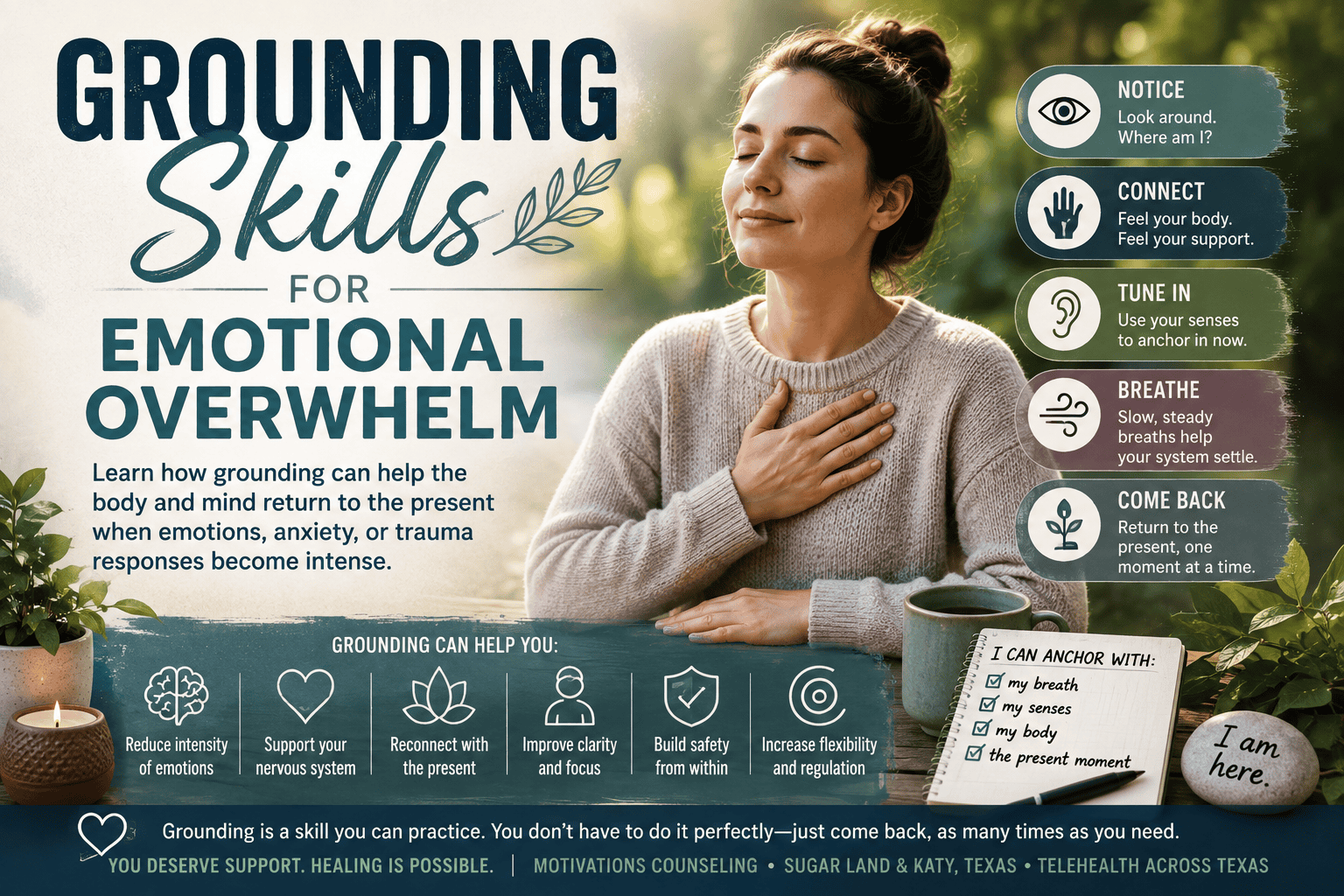
Grounding Skills for Emotional Overwhelm
Emotional Regulation & Nervous System Resources
Grounding Skills for Emotional Overwhelm
Grounding can help the body and mind reconnect with the present when emotions, anxiety, panic, trauma responses, sensory overload, or conflict become intense. The goal is not to force yourself to feel calm. It is to reduce urgency enough to notice where you are, what is happening now, and what choice may be available next.
Start Here
Grounding Helps You Reconnect With What Is Happening Right Now
During emotional overwhelm, the nervous system may become organized around danger, urgency, rejection, helplessness, conflict, physical sensations, or memories of earlier experiences. Attention can narrow. Thoughts may race or disappear. The body may move toward fight, flight, freeze, shutdown, or appeasing before there is time to think through the situation.
Grounding introduces clear information about the present. You may notice the floor beneath your feet, identify objects in the room, name the date and location, feel the support of a chair, or focus on a tolerable sound or texture. These actions can help create a little distance between the activation and the next response.
What Is Grounding?
Grounding refers to practical strategies that increase awareness of the present environment, body, and current facts. Grounding may use the senses, movement, physical support, breathing, language, or connection with another person. It is not a formal diagnosis or a single treatment method, and it does not require becoming completely calm before you can move forward.
Why Grounding May Help
Grounding Can Increase Orientation, Stability, and Choice
Grounding does not erase the emotion or prove that everything is safe. It can help the nervous system receive more accurate information about the present and reduce the sense that an immediate reaction is the only available option.
Present-Moment Orientation
Looking around and naming what is actually present can shift attention away from imagined outcomes, memories, or internal alarm signals.
Sensory Information
Tolerable sights, sounds, textures, temperatures, and movement can provide concrete information that competes with mental spiraling.
Physical Support
Feeling a chair, wall, floor, blanket, or stable object may help the body register support instead of remaining entirely braced.
Reduced Urgency
Even a small decrease in intensity can make it easier to delay a message, pause an argument, or decide what the situation requires.
More Flexible Choices
Grounding may help you move from automatic protection toward a response that better fits your values, goals, safety, and current needs.
Co-Regulation
A steady, respectful person can help through calm pacing, clear information, practical support, and permission to take time.
A grounding skill is useful when it creates more orientation or choice. It does not have to make the emotion disappear. Moving from a ten out of ten to an eight, or from complete shutdown to one clear next step, can still be meaningful.
Orienting to the Environment
Let Your Eyes and Attention Notice Where You Are
Emotional activation often pulls attention inward toward thoughts, memories, sensations, or feared outcomes. Orienting gently directs attention outward so the brain can gather current information rather than relying only on alarm.
Try this slowly:
- Keep your eyes open if closing them increases discomfort.
- Turn your head and look around rather than staring at one point.
- Name three colors, three shapes, or three stable objects.
- Notice where the doors, windows, and exits are without repeatedly checking them.
- Identify one sign that the present moment is different from the feared situation or earlier experience.
Current Facts
Add Simple Information About Time and Place
When anxiety, trauma reminders, or dissociation are strong, factual language can help connect the experience with the present.
- “My name is ___, and I am in ___.”
- “Today is ___, and the approximate time is ___.”
- “I am sitting in a chair with both feet on the floor.”
- “I am having a strong reaction, and I can pause before acting.”
- “This feeling is intense, but feelings can change.”
- “I can decide whether I need space, support, information, or safety.”
Orienting is not the same as telling yourself that nothing is wrong. The goal is accuracy. You can acknowledge that a situation is painful or stressful while also noticing what is true in the present and what choices remain available.
Physical Grounding
Use Support, Pressure, Texture, and Temperature Carefully
Physical grounding can be helpful when the body feels unsteady, tense, numb, restless, or disconnected. Choose sensations that are clear but tolerable rather than overwhelming.
Press Into the Floor
Place both feet down and gently press through the heels. Notice the effort in the legs and the support returning from the floor.
Lean Against Support
Feel the back of a chair, a wall, or another stable surface. Let the object hold some of your weight rather than bracing alone.
Use a Clear Texture
Hold fabric, a smooth stone, a textured object, or the edge of a notebook and describe the sensation without judging it.
Notice Temperature
Hold a cool or warm object that is safe for your skin. Avoid extreme temperatures, pain, or anything that could cause injury.
Containment and Comfort
Wrap in a blanket, cross your arms comfortably, hold a pillow, or place a hand where contact feels supportive and welcome.
Meet Basic Needs
Hunger, dehydration, pain, overheating, illness, or exhaustion can intensify distress. Grounding may begin with food, water, medication, rest, or medical care.
Five-Senses Grounding
The 5-4-3-2-1 Exercise Is a Framework, Not a Test
A common grounding exercise involves naming five things you can see, four you can feel, three you can hear, two you can smell, and one you can taste. The structure can redirect attention toward the environment, but there is no need to complete every step or use the numbers perfectly.
A flexible version may look like:
- See: Notice several colors, edges, objects, or sources of light.
- Feel: Notice clothing, the chair, the floor, air on the skin, or an object in your hand.
- Hear: Identify nearby and distant sounds without needing to locate every source.
- Smell: Notice a neutral or pleasant scent only if smell is comfortable for you.
- Taste: Notice water, gum, a mint, or the natural taste in your mouth without forcing the step.
Sensory grounding can be difficult for people with migraines, sensory sensitivity, trauma connected to specific sensations, or certain medical conditions. Skip any sense that feels activating and focus on one or two neutral sources of information instead.
Breathing as Grounding
Gentle Breathing Is Often More Helpful Than Forcing a Deep Breath
When people are told to “take a deep breath,” they may inhale too quickly or too fully, which can increase lightheadedness, chest discomfort, tingling, or panic. Grounding through breath can be smaller and less demanding.
- Notice one natural breath before trying to change it.
- Let the exhale become slightly longer or softer than the inhale.
- Breathe out as though cooling a warm drink.
- Hum quietly or speak a short phrase on the exhale.
- Keep your eyes open and feet supported if that feels steadier.
When Breath Focus Is Uncomfortable
You Do Not Have to Use Breathing Exercises
Breath-focused exercises can increase distress for some people, particularly when panic, respiratory concerns, trauma, dizziness, or intense body monitoring are present.
- Stop if the exercise increases panic, dizziness, numbness, or breathlessness.
- Shift attention to the room, floor, sound, movement, or a conversation.
- Do not use breath-holding competitions or extreme breathing patterns.
- Seek medical care for new, severe, or unexplained breathing symptoms.
Movement and Muscle Grounding
Movement Can Give Protective Energy a Safer Direction
Some nervous systems settle more effectively through movement than stillness. Restlessness, trembling, muscle tension, and an urge to escape may respond to slow, intentional actions that provide clear feedback from the body.
Walk With Attention
Walk slowly enough to notice each foot contacting the ground. Name landmarks or count a small number of steps without turning it into a performance.
Push and Release
Press the palms together, push gently against a wall, or squeeze a soft object, then notice what changes when the muscles release.
Stretch Within Comfort
Roll the shoulders, turn the head slowly, stretch the hands, or stand and reach without pushing through pain or dizziness.
Use Repetition
Rock gently, tap the feet, fold a towel, sort objects, or repeat another simple action that feels organized and predictable.
Add Rhythm or Sound
Walk to a steady beat, hum, count aloud, or listen to familiar music at a comfortable volume when sound feels regulating.
Protect Physical Safety
Avoid driving, intense exercise, or rapid movement when you feel faint, dissociated, medically unwell, or unable to judge your surroundings safely.
Grounding Through Words
Use Language That Is Accurate, Present-Focused, and Nonjudgmental
Harsh self-talk often adds shame and urgency to an already activated state. Grounding language works best when it describes what is happening without exaggerating, minimizing, or demanding instant control.
Helpful statements may include:
- “My nervous system is activated, and I do not have to solve everything this minute.”
- “I can feel angry and still delay what I say or send.”
- “This may be a trauma reminder, but I need more information before deciding what it means.”
- “I am overwhelmed. The next step is to reduce input and identify one need.”
- “I can ask for a pause and return to the conversation at a specific time.”
- “I do not have to prove that the feeling is reasonable before I support myself.”
Avoid statements that deny reality, such as “nothing is wrong,” when something is genuinely painful or unsafe. A more grounded statement might be: “This is difficult, and I am going to focus on what I can do next.”
Grounding During Dissociation
External Orientation May Be More Helpful Than Turning Inward
Dissociation may involve feeling unreal, detached, numb, far away, confused about time, or as though you are watching yourself from a distance. Some inward-focused practices can increase this experience, especially early in recovery.
- Keep the eyes open and look toward clear, stable objects.
- Say your name, location, date, and what you are doing.
- Stand or sit where your body is physically supported.
- Use a familiar voice, object, photograph, or written orientation card.
- Choose a clear but nonpainful temperature or texture.
- Ask a trusted person to speak slowly and use short sentences.
Do Not Force Intensity
Stronger Sensation Is Not Always Better Grounding
Pain, extreme cold, snapping bands against the skin, or other harsh techniques may cause injury, increase shame, reinforce self-punishment, or intensify trauma responses.
- Use tolerable sensation rather than pain.
- Stop when the technique increases disorientation or distress.
- Seek professional support for frequent, severe, or worsening dissociation.
- Avoid driving or hazardous tasks when awareness is significantly impaired.
Grounding During Conflict
Regulation Often Needs to Come Before Problem-Solving
During conflict, the urge to explain, defend, pursue, leave, shut down, or force resolution can become intense. Continuing the conversation while flooded may reduce listening, increase misinterpretation, and lead to words or actions that do not reflect the person’s longer-term intentions.
A structured pause can include:
- Name the activation without blaming: “I am too overwhelmed to think clearly.”
- Request a pause rather than disappearing without explanation when it is safe to communicate.
- Set a realistic time to return, such as later that evening or the next day.
- Use grounding during the break instead of rehearsing the argument continuously.
- Write down the main concern and the outcome you hope for.
- Return when both people have enough capacity to listen and respond.
A pause should not be used to punish, control, frighten, or avoid every difficult conversation. In relationships involving coercion, threats, stalking, or violence, prioritize safety planning and professional support rather than relying on communication techniques alone.
Build a Personal Grounding Plan
Practice Skills Before the Most Overwhelming Moments
Grounding is easier to access when the steps are familiar. A personal plan reduces the need to invent a strategy while the brain is already overloaded.
Identify Early Signals
Notice the first signs of activation, such as jaw tension, heat, racing thoughts, numbness, urgency, shallow breathing, or difficulty speaking.
Create a Short Menu
Choose three to five skills that fit different states—for example, orienting, walking, texture, factual language, and contacting support.
Match the Skill to the State
Restlessness may need movement, shutdown may need gentle activation, panic may need external focus, and overload may need reduced input.
Practice When Calm Enough
Rehearse briefly during ordinary moments so the steps feel familiar without turning grounding into another demanding routine.
Plan Supportive Language
Tell trusted people what helps, what makes things worse, and how they can support a pause without pressuring you to explain immediately.
Review What Worked
Afterward, note which skill reduced urgency, increased orientation, or helped you act more safely—even if the emotion remained present.
When a Skill Does Not Help
Grounding Is Individual and Context-Dependent
A technique may work one day and feel ineffective the next. The difference can reflect the intensity of the trigger, sleep, pain, illness, current safety, sensory needs, the setting, or how practiced the skill is.
- Try a different sensory channel or use movement instead of stillness.
- Reduce the number of steps and focus on one clear action.
- Use another person’s support rather than working alone.
- Address hunger, pain, exhaustion, medication needs, or environmental overload.
- Stop treating the skill as a test you must pass.
Limits of Grounding
Coping Skills Cannot Regulate Away Actual Danger or Unsustainable Conditions
Grounding may support decision-making, but it cannot make abuse, coercion, unsafe housing, discrimination, severe financial instability, medical illness, or excessive demands harmless.
- Prioritize safety planning when danger is present.
- Seek medical evaluation for concerning physical or neurological symptoms.
- Reduce ongoing stressors when possible rather than relying only on coping.
- Use therapy to address recurring patterns, trauma, or severe impairment.
Mental Health Support
Therapy Can Help You Understand Why Overwhelm Happens
A therapist can help identify triggers, early warning signs, protective responses, relationship patterns, trauma reminders, and current stressors. Treatment can include individualized grounding, emotional regulation, communication, boundaries, cognitive and behavioral strategies, and trauma-focused work when clinically appropriate.
Grounding is often one part of a broader treatment plan. The long-term goal is not to depend on a technique every time discomfort appears. It is to increase capacity, safety, flexibility, recovery, and confidence in responding to difficult experiences.
Medical and Immediate Support
Similar Symptoms Can Have Medical or Psychiatric Causes
New or severe dizziness, chest pain, fainting, breathing difficulty, neurological changes, confusion, medication reactions, substance-related symptoms, or significant changes in functioning require appropriate evaluation.
- Call 911 or seek emergency care for a possible medical emergency.
- Call or text 988 in the United States for suicidal crisis support.
- Discuss persistent physical symptoms with a qualified medical provider.
- Seek urgent help when a person cannot remain safe.
Counseling at Motivations Counseling
Counseling Can Support Grounding, Regulation, and Recovery
Motivations Counseling provides therapy for adults and teens experiencing emotional overwhelm, anxiety, panic, trauma-related symptoms, hypervigilance, shutdown, irritability, dissociation, burnout, relationship conflict, and difficulty returning to the present after activation.
Our counseling team serves clients in Sugar Land, Katy, Richmond, Fort Bend County, West Houston, and through telehealth across Texas when clinically appropriate.
Counseling Support
Trauma-Informed Counseling in Sugar Land, Katy, and Online Across Texas
Therapy can help you identify the grounding strategies that fit your nervous system, understand what drives recurring overwhelm, improve communication and boundaries, and address anxiety, trauma, grief, burnout, or relationship stress when those concerns are part of the pattern.
- Individual counseling for anxiety, emotional overwhelm, stress, and burnout
- Trauma-informed therapy focused on safety, stabilization, and flexibility
- EMDR therapy when clinically appropriate
- Support for panic, shutdown, dissociation, hypervigilance, and emotional flooding
- In-person counseling in Sugar Land and Katy when available
- Telehealth counseling across Texas when clinically appropriate
Therapy Learning Center
Continue Learning About Emotional Overwhelm and Nervous System Responses
These related resources explore emotional flooding, chronic activation, hypervigilance, stress load, trauma reminders, and why it can become difficult to think clearly or feel present.
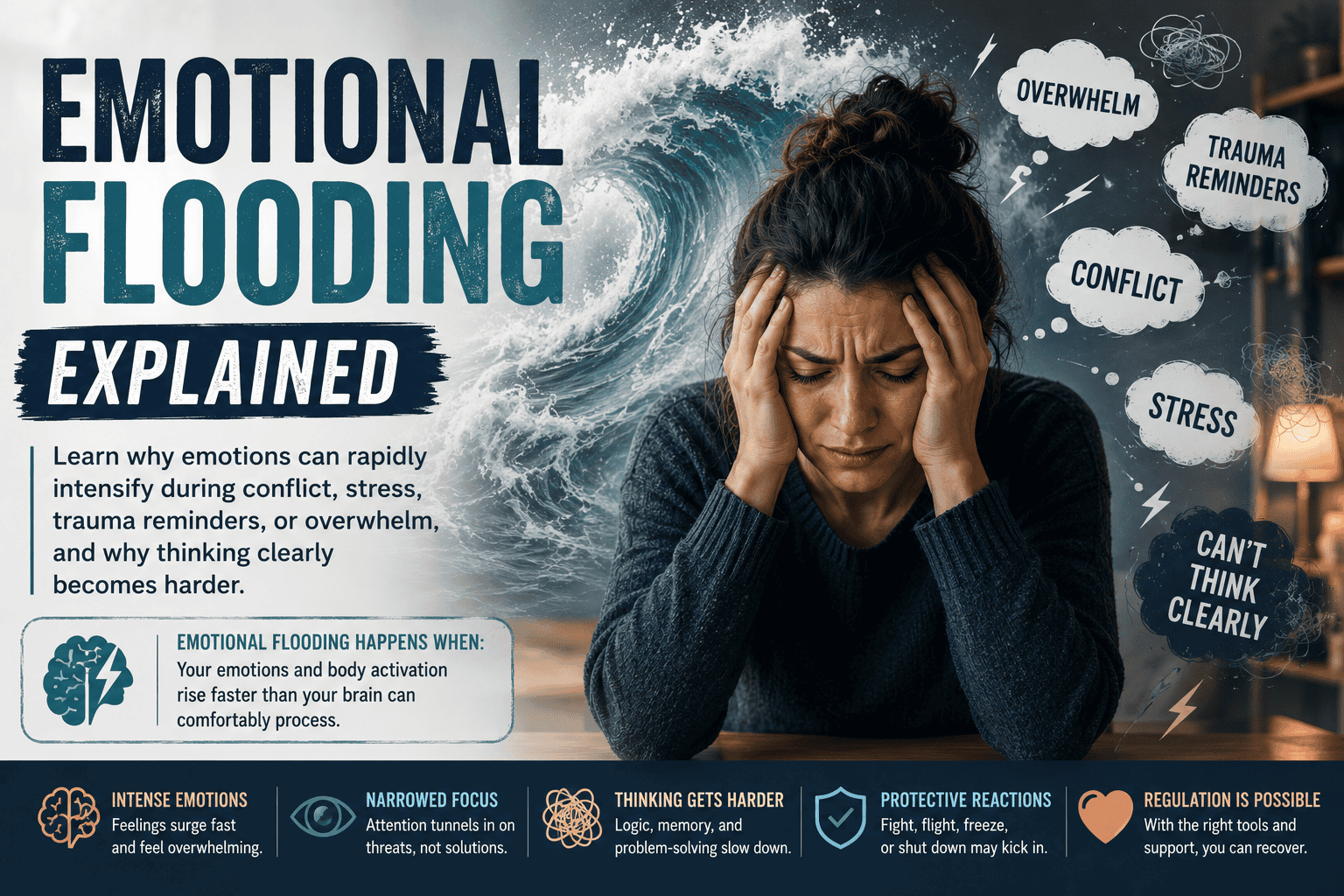
Emotional Flooding Explained
Learn why feelings and body activation can rise rapidly during conflict, stress, trauma reminders, or overwhelm.
Read article →Why Do I Get Emotionally Overwhelmed So Easily?
Explore why small stressors may feel intense when your nervous system is overloaded, depleted, or carrying unresolved stress.
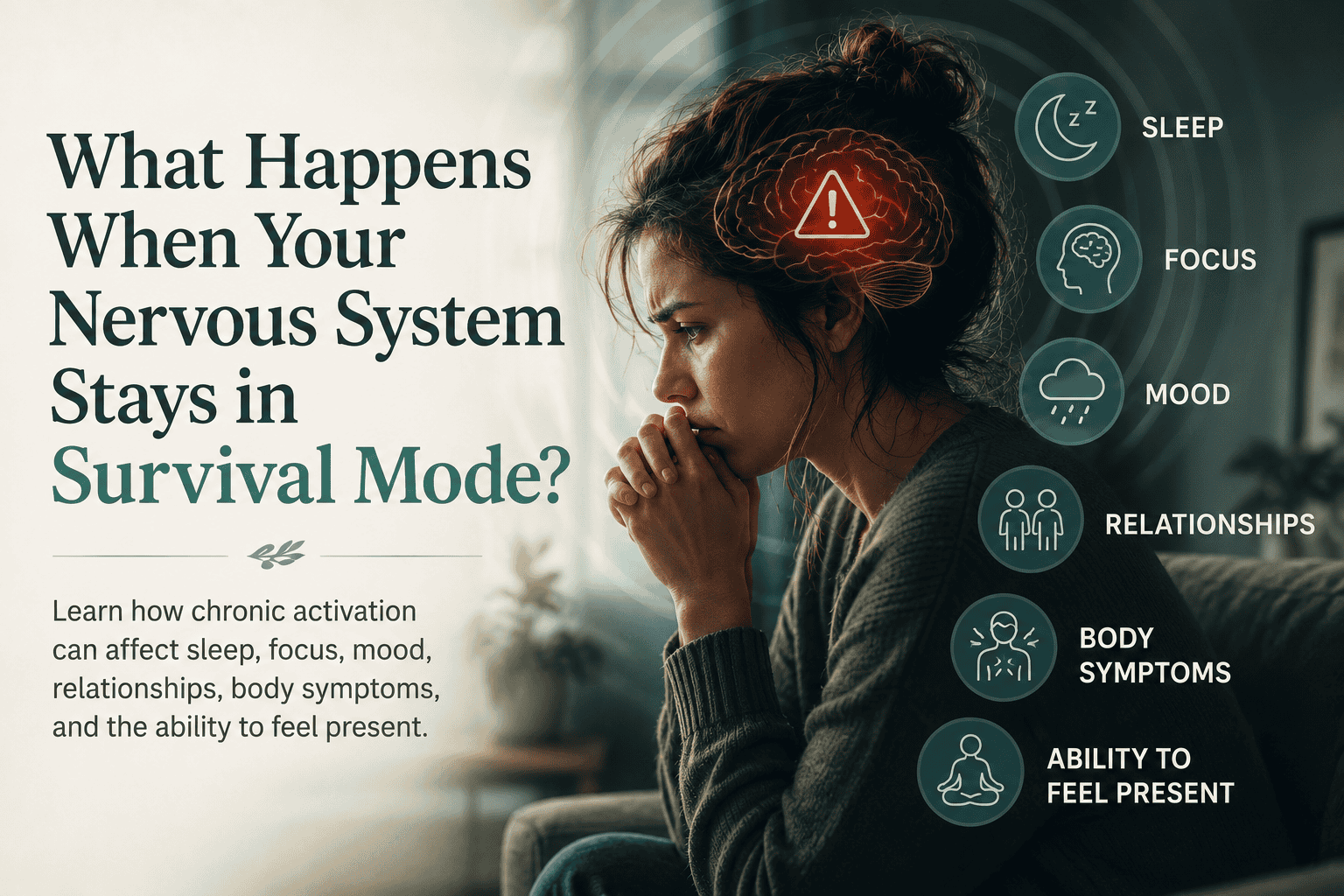
Read article →What Happens in Survival Mode?
Understand how chronic activation may affect sleep, focus, mood, relationships, body symptoms, and presence.
Read article →Hypervigilance: When Your Brain Will Not Turn Off
Explore why the brain may keep scanning, planning, rehearsing, and watching for danger even when you want to rest.
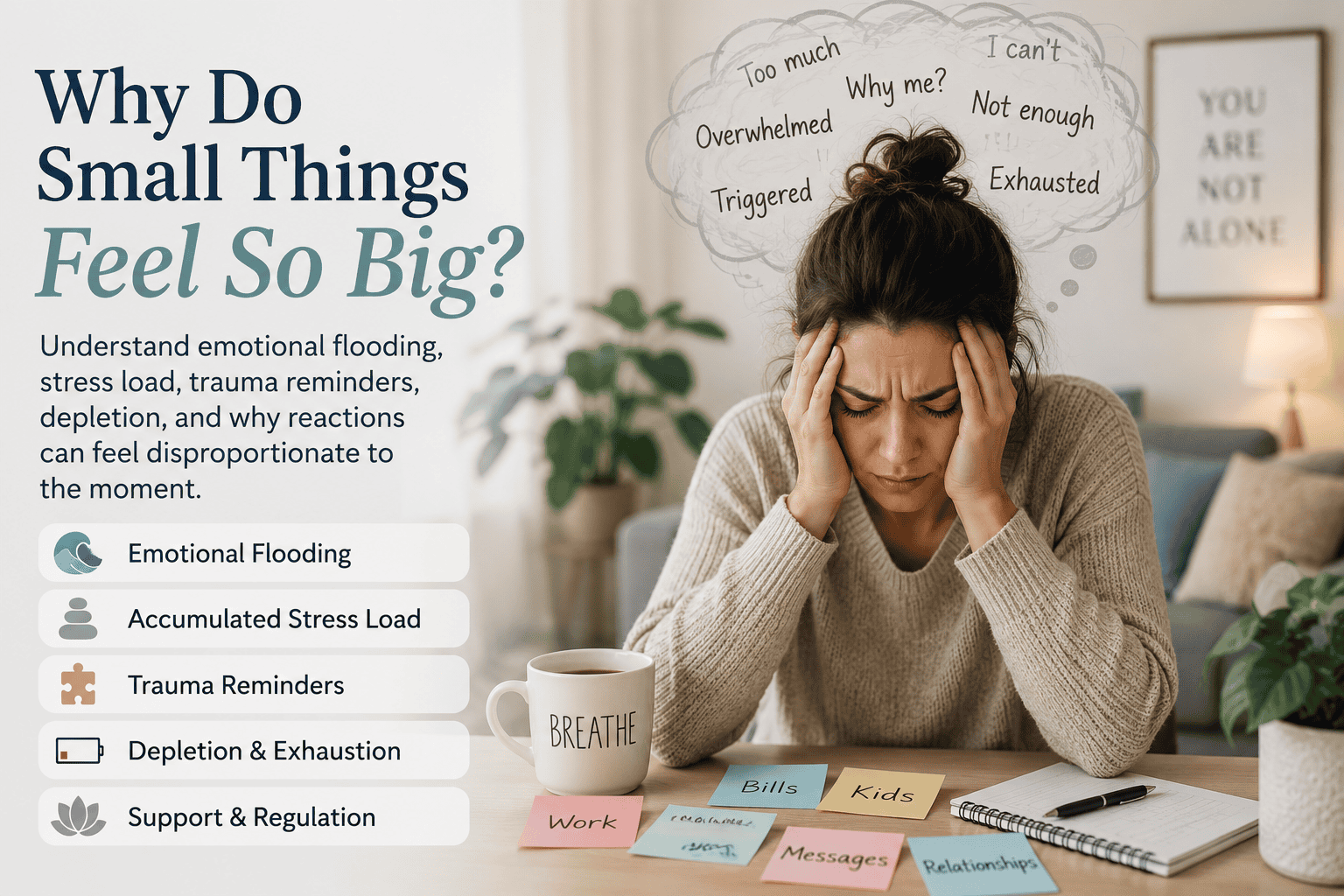
Read article →Why Do Small Things Feel So Big?
Understand stress load, trauma reminders, depletion, and why reactions can feel larger than the immediate moment.
Read article →Counseling Resource Center
Explore educational resources on anxiety, trauma, depression, relationships, EMDR therapy, and emotional health.
Explore resources →Full Resource Center
Explore the Full Counseling Resource Center
Our Counseling Resource Center includes educational articles on emotional flooding, anxiety, trauma, depression, relationships, hypervigilance, grounding skills, emotional overwhelm, nervous system responses, EMDR therapy, teen counseling, and practical ways to understand mental health symptoms.
Frequently Asked Questions
Common Questions About Grounding Skills
What is a grounding skill?
A grounding skill is a practical strategy that helps direct attention toward the present environment, body, senses, or current facts. Grounding may involve looking around, feeling physical support, using movement, naming what is happening, or connecting with another person.
How quickly should grounding work?
There is no required time frame. A grounding skill may create a small shift within moments, or the nervous system may need more time, reduced stimulation, practical support, sleep, food, medication, safety, or professional care. The goal is increased orientation and choice rather than immediate calm.
Does the 5-4-3-2-1 grounding exercise work?
It can help some people by directing attention toward present sensory information. It does not work equally well for everyone, and the numbers do not need to be completed perfectly. People with sensory sensitivity or trauma connected to certain sensations may prefer a modified approach.
What if deep breathing makes my anxiety worse?
You do not have to use deep breathing. Forced or rapid breathing can increase lightheadedness, tingling, chest discomfort, or panic. Try orienting to the room, pressing your feet into the floor, walking slowly, using a texture, or allowing only a slightly longer exhale. Seek medical evaluation for concerning breathing symptoms.
Can grounding help during a panic attack?
Grounding may help some people reconnect with the environment and reduce the sense of immediate danger. Panic symptoms can resemble medical emergencies, however, so new, severe, or unusual symptoms should be evaluated appropriately rather than automatically attributed to anxiety.
Can grounding help with dissociation?
External grounding may help some people experiencing detachment, numbness, unreality, or disorientation. Keeping the eyes open, naming the location and date, feeling stable support, and using a familiar voice or object may be useful. Frequent or severe dissociation should be assessed by a qualified professional.
Can I use grounding during relationship conflict?
Yes. Grounding may help reduce urgency before responding, improve awareness of body signals, and support a structured pause. It should not be used to avoid every difficult conversation or as a substitute for safety planning in relationships involving threats, coercion, or violence.
Why do grounding skills work sometimes but not others?
Effectiveness can change with the intensity of the trigger, current safety, sleep, pain, illness, sensory needs, environment, medication, substance use, and how familiar the skill is. A technique may also be mismatched to the state—for example, stillness may not help when the body needs movement.
Is grounding the same as mindfulness?
They overlap, but they are not identical. Mindfulness generally involves intentionally noticing present experience with openness. Grounding is often more concrete and may be used specifically to increase orientation, stability, or connection to the current environment during intense activation.
When does emotional overwhelm require immediate help?
Seek immediate help when there may be a life-threatening medical emergency, a person cannot remain safe, or there are thoughts of suicide or serious self-harm. In the United States, call 911 for an emergency, call or text 988 for the Suicide & Crisis Lifeline, or go to the nearest emergency room.

Take the Next Step
Counseling for Emotional Overwhelm in Sugar Land, Katy, and Online Across Texas
If intense emotions, anxiety, panic, trauma responses, dissociation, or conflict make it difficult to stay present and think clearly, counseling can help you build grounding skills and understand the patterns driving the overwhelm.