
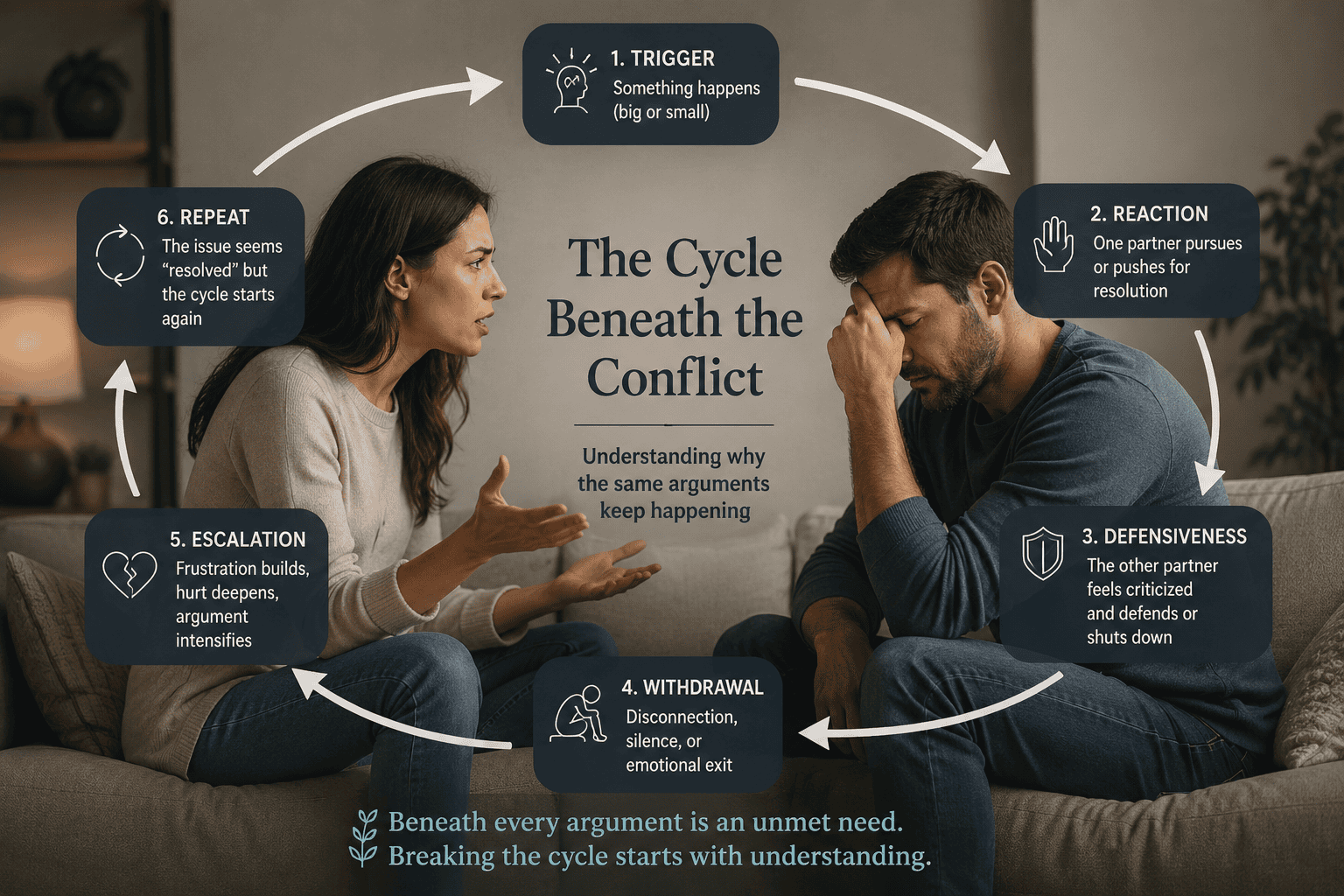
Why Couples Get Stuck in the Same Arguments: Understanding the Cycle Beneath the Conflict
Couples Counseling Resource Center
Why Couples Get Stuck in the Same Arguments
Many couples do not keep arguing because they lack love, intelligence, or good intentions. They often get stuck because the visible argument is only part of a deeper emotional cycle. Repeated conflict may reflect unmet needs, defensiveness, fear, withdrawal, emotional flooding, old wounds, or a pattern where both partners are trying to protect themselves but end up hurting each other.
Start Here
The Same Argument Usually Means the Same Emotional Pattern Is Repeating
Couples often describe recurring arguments as if they are about chores, parenting, money, intimacy, tone of voice, family boundaries, phones, schedules, or who said what. Those issues may matter. But when the same disagreement keeps returning, the surface topic is often connected to a deeper emotional pattern.
One partner may feel dismissed, alone, controlled, criticized, unimportant, or emotionally unsafe. The other may feel blamed, attacked, pressured, inadequate, misunderstood, or unable to get it right. As each person reacts to their own pain, the couple can become trapped in a cycle where both partners are trying to be heard but neither feels understood.
The Deeper Issue
The Argument Is Often Not Really About the Thing You Are Arguing About
Repeated conflict often becomes confusing because the topic seems too small to explain the intensity of the reaction. A conversation about dishes may turn into a fight about respect. A disagreement about spending may become a fight about trust. A scheduling conflict may become a fight about whether one partner matters.
This does not mean the practical issue is unimportant. Couples still need to solve real-life problems. But when the emotional intensity is much larger than the topic, it can be helpful to ask what the argument represents underneath the surface.
In couples counseling, the goal is often not to decide who is right about the surface issue first. The goal is to understand the cycle that keeps turning a solvable problem into a painful argument.
Surface arguments may represent deeper questions such as:
- “Do I matter to you?”
- “Can I trust you to consider me?”
- “Are you really listening?”
- “Am I safe being vulnerable with you?”
- “Will you show up for me when I need you?”
- “Do you see how much I am carrying?”
- “Can we disagree without one of us shutting down or exploding?”
The Conflict Cycle
Couples Often Get Stuck in a Predictable Loop
When partners are emotionally activated, they may respond in ways that feel protective in the moment but painful to the relationship. Over time, the couple may begin repeating the same sequence almost automatically.
A Trigger Appears
A comment, facial expression, delay, mistake, tone, or unmet expectation activates a familiar feeling or old relationship fear.
Protection Takes Over
One partner may criticize, push, explain, withdraw, defend, shut down, correct, or try to prove their point.
The Pattern Repeats
Each person’s response activates the other. The argument escalates, the original issue gets lost, and both partners feel more alone.
Disconnection Builds
After repeated conflict, partners may begin avoiding certain topics or bracing for the next argument before it even begins.
Old Meanings Attach
The current issue may connect with past hurts, attachment fears, trauma history, family patterns, or previous relationship injuries.
Repair Becomes Harder
When the cycle repeats often enough, even small misunderstandings may feel loaded, unsafe, or impossible to discuss calmly.
Pursuer-Withdrawer Pattern
One Common Cycle Is When One Partner Pushes and the Other Pulls Away
A common relationship pattern happens when one partner responds to disconnection by pursuing more conversation, reassurance, answers, or resolution, while the other responds to emotional intensity by withdrawing, shutting down, avoiding, or becoming quiet. Both reactions can make sense from the inside, but together they can create a painful loop.
The pursuing partner may feel abandoned, ignored, or emotionally alone. The withdrawing partner may feel criticized, overwhelmed, or unable to say anything right. The more one pushes for connection, the more the other may pull away. The more one pulls away, the more the other may push harder.
This cycle can sound like:
- “You never want to talk about anything.”
- “I can’t talk to you when you come at me like this.”
- “You always shut down.”
- “You always criticize me.”
- “I just want you to care.”
- “Nothing I say is ever good enough.”
In many couples, the pursuer is not simply “needy” and the withdrawer is not simply “uncaring.” Both partners may be reacting to fear, overwhelm, shame, loneliness, or the belief that they cannot get their needs met safely.
Emotional Flooding
When the Nervous System Is Flooded, Good Communication Gets Harder
Emotional flooding happens when a person becomes so activated that their nervous system shifts into protection mode. At that point, the goal may no longer be understanding. The goal becomes defending, escaping, proving, shutting down, or trying to regain control.
Couples may think they are having a communication problem when they are actually having a regulation problem. If one or both partners are flooded, the conversation may need calming and repair before problem-solving can happen.
Signs of emotional flooding may include:
- Racing heart, tight chest, shaking, or feeling hot
- Going blank or not being able to find words
- Wanting to leave, shut down, or end the conversation immediately
- Repeating the same point more forcefully
- Interrupting, criticizing, or becoming defensive
- Feeling trapped, attacked, rejected, or unsafe
- Remembering the conversation differently afterward
Learning to recognize flooding can help couples pause before the conflict becomes more damaging. A pause is not the same as avoidance when both partners agree to return to the conversation with more calm and intention.
Unmet Needs
Repeated Arguments Often Point to Unspoken Emotional Needs
Many couples argue about behavior, but underneath the behavior is often a need. One partner may need reassurance, appreciation, follow-through, affection, honesty, partnership, rest, respect, sexual connection, emotional safety, or help carrying responsibilities. The problem is that needs often come out as criticism when a partner already feels hurt.
For example, “You never help me” may mean “I feel alone and overwhelmed.” “You are always on your phone” may mean “I miss feeling close to you.” “You only care about yourself” may mean “I do not feel considered.” When the need is hidden underneath blame, the other partner is more likely to defend than respond with care.
Common needs underneath recurring conflict include:
- Feeling emotionally important to your partner
- Feeling respected during disagreement
- Feeling supported with responsibilities
- Feeling safe enough to be honest
- Feeling wanted, chosen, or prioritized
- Feeling trusted rather than controlled
- Feeling understood before being corrected
Why Logic Alone Rarely Solves It
Repeating the Facts Usually Does Not Heal the Emotional Injury
Many couples try to solve repeated arguments by explaining more clearly, proving what really happened, listing evidence, or showing why the other person is being unfair. Sometimes facts matter. But when the deeper issue is emotional safety, attachment fear, shame, loneliness, or resentment, logic alone may not repair the injury.
A partner who feels dismissed may not be helped by a more detailed explanation. A partner who feels attacked may not become more open because the criticism becomes more accurate. A partner who feels alone may not feel comforted by being told they are “too sensitive.” The couple may need a different kind of conversation.
How Counseling Helps
Couples Counseling Helps Partners Understand and Interrupt the Cycle
Couples counseling can help partners slow down the argument and identify what happens before, during, and after the conflict. Instead of focusing only on who started it or who is right, therapy can help the couple understand how both partners participate in the cycle and what each person is needing underneath their reaction.
Counseling may help couples develop healthier ways to communicate, pause during escalation, name needs more clearly, repair emotional injuries, and create a stronger sense of partnership. The goal is not to eliminate every disagreement. Healthy couples still disagree. The goal is to disagree in ways that do not repeatedly damage trust, connection, and emotional safety.
Couples counseling may focus on:
- Identifying the couple’s repeated conflict cycle
- Recognizing emotional triggers and protective reactions
- Improving communication during difficult conversations
- Reducing blame, criticism, defensiveness, and withdrawal
- Helping each partner express needs more clearly
- Building emotional safety and trust
- Strengthening repair after conflict
- Creating practical agreements for recurring issues
Couples counseling is not about assigning one partner as the problem. It is about helping both partners see the pattern clearly enough to respond differently.
When to Seek Help
Signs the Argument Cycle May Need Professional Support
Many couples wait until they are exhausted before starting counseling. Support may be helpful earlier, especially when the same arguments keep returning without meaningful repair.
The Same Fight Keeps Repeating
You may change the topic, but the emotional pattern feels the same: hurt, defense, escalation, withdrawal, and distance.
Conversations Escalate Quickly
Small disagreements may become intense before either partner understands what happened or how to calm things down.
One or Both Partners Shut Down
Important topics may be avoided because they feel too overwhelming, hopeless, or likely to become another fight.
Resentment Is Building
Unrepaired hurts may make partners more guarded, less affectionate, less patient, or less willing to assume good intent.
Trust Feels Fragile
Even when there has not been a major betrayal, repeated disconnection can make the relationship feel emotionally unsafe.
You Want to Repair but Feel Stuck
Both partners may care about the relationship but not know how to stop repeating the same painful pattern.
Learning Center
Continue Learning About Relationships, Communication, and Emotional Patterns
These related resources can support clients who are trying to understand relationship conflict, emotional triggers, anxiety, trauma responses, and counseling options.
Emotional Safety in Relationships
Understand why emotional safety matters and how couples can begin rebuilding trust, steadiness, and connection.
Read article →Emotional Disconnection in Relationships
Learn why couples can feel emotionally distant, lonely, or disconnected even when they still care about each other, and how counseling may help rebuild emotional safety, communication, and repair.
Read article →Couples Counseling
Learn how couples counseling can help partners improve communication, repair conflict, and rebuild emotional connection.
View service page →Attachment Styles in Relationships
Learn how attachment patterns may affect trust, closeness, conflict, reassurance, and emotional safety in adult relationships.
Read article →Individual Counseling
Individual therapy can help clients understand emotional triggers, anxiety, trauma responses, boundaries, and relationship patterns.
View service page →Anxiety Counseling
Anxiety can affect communication, conflict, reassurance seeking, avoidance, and emotional regulation in relationships.
View service page →Trauma-Informed Therapy
Past experiences can shape how people respond to closeness, conflict, trust, rejection, and emotional safety.
View service page →EMDR Therapy
EMDR may help clients process distressing memories, triggers, and negative beliefs that affect present-day relationships.
View service page →Depression Counseling
Depression can affect motivation, intimacy, irritability, emotional availability, and the ability to repair after conflict.
View service page →How to Talk Without Escalating
A future relationship resource on slowing down hard conversations before they become emotionally overwhelming.
Coming soon →Repair After Conflict
A future guide on apologies, accountability, emotional repair, and rebuilding connection after an argument.
Coming soon →Emotional Needs in Relationships
A future article explaining how unspoken needs can turn into criticism, withdrawal, defensiveness, or distance.
Coming soon →Start Counseling
Ready to Understand the Pattern Beneath the Argument?
If you and your partner keep returning to the same painful conversations, couples counseling may help you slow down the cycle, communicate more clearly, and rebuild emotional safety. Our counseling team can help you explore whether couples therapy is a good fit for your relationship.

