Category: Immigration Evaluations

Understanding Extreme Hardship in Immigration Psychological Evaluations

Attorney Resource Guide

Understanding Extreme Hardship in Immigration Psychological Evaluations

In hardship-related immigration matters, attorneys often need more than a general statement that a family would suffer. A clinically strong psychological evaluation documents how separation, relocation, medical vulnerability, caregiving responsibilities, psychological symptoms, and family disruption may affect a qualifying relative’s emotional functioning and daily life.

Why This Matters for Attorneys

Hardship Evaluations Are Stronger When They Explain Clinical Impact, Not Just Emotional Pain

Extreme hardship cases often involve deeply personal family circumstances: separation from a spouse or parent, children with emotional or educational needs, medical vulnerability, financial instability, fear of relocation, caregiving burdens, trauma history, depression, anxiety, and uncertainty about the future.

A weak hardship report may simply state that a qualifying relative would be sad, anxious, or overwhelmed. A stronger report explains how the stressor affects psychological functioning: sleep, concentration, parenting, caregiving, medical follow-through, work stability, emotional regulation, relationships, and ability to cope.

Attorneys remain responsible for legal strategy and hardship arguments. The evaluator’s role is to provide clinically grounded documentation of symptoms, impairment, family dynamics, psychological risk factors, and treatment needs.

Clinical Scope

Extreme Hardship Is a Legal Concept; Psychological Impact Is Clinical

A psychological evaluator should not decide whether the legal standard has been met. The evaluator documents mental health findings that attorneys may consider within the larger case.

Issue Attorney Role Evaluator Role
Legal standard Analyzes statutory requirements, legal arguments, and case strategy. Does not determine eligibility or state that the legal hardship standard has been met.
Hardship theory Identifies how facts should be presented within the legal framework. Documents emotional, psychological, relational, medical, and functional impact within clinical scope.
Evidence organization Determines how declarations, records, and reports support the legal case. Reviews relevant information when available and integrates clinically meaningful context.
Recommendations Uses clinical findings as appropriate in the legal submission. Provides mental health treatment recommendations, supports, and risk considerations when clinically appropriate.

Core Hardship Factors

What a Clinically Strong Hardship Evaluation May Address

Strong evaluations look at how multiple hardship factors interact rather than treating each concern as isolated.

Emotional Hardship

The report may document sadness, grief, fear, guilt, emotional overwhelm, irritability, panic, hopelessness, or difficulty coping with possible separation or relocation.

Psychological Symptoms

Evaluations may address anxiety, depression, trauma symptoms, sleep disruption, panic attacks, intrusive worry, concentration problems, emotional dysregulation, or worsening mental health history.

Medical Vulnerability

Medical issues may intensify psychological hardship when the qualifying relative depends on emotional support, transportation, medication management, treatment access, or caregiving stability.

Caregiving Responsibilities

Hardship may involve children, elderly parents, disabled relatives, medically vulnerable family members, or others who rely on the client’s practical, financial, or emotional support.

Children and School Functioning

When children are involved, evaluations may document attachment disruption, academic stress, behavioral changes, special education needs, emotional symptoms, or developmental vulnerability.

Relocation Stress

Possible relocation may involve safety concerns, language barriers, loss of medical care, education disruption, reduced support systems, financial instability, or cultural adjustment stress.

Two Common Scenarios

Separation Hardship vs. Relocation Hardship

Attorneys often need documentation that distinguishes the psychological impact of remaining in the United States without the applicant from the impact of relocating abroad with the applicant.

Scenario Clinical Issues Often Explored Functional Impact to Document
Separation Anxiety, depression, grief, panic, sleep disturbance, attachment disruption, parenting strain, caregiving burden, fear about family stability, and worsening prior mental health symptoms. Reduced work functioning, impaired parenting, difficulty managing children’s needs, reduced medical follow-through, emotional instability, social withdrawal, and impaired concentration.
Relocation Fear about safety, language barriers, loss of treatment access, financial instability, education disruption, medical concerns, isolation, trauma triggers, and loss of established support systems. Disruption in treatment, reduced stability, difficulty accessing care, increased anxiety, loss of employment, educational setbacks, isolation, and impaired ability to cope.

Functional Impairment

Hardship Documentation Should Explain How Daily Life Is Affected

A strong hardship evaluation does not stop at feelings. It explains how symptoms change the person’s ability to function in concrete areas of life.

Clinical Depth

Functional Impact Is Often the Difference Between a Generic Report and a Useful One

Attorneys may already have declarations describing love, fear, and family hardship. The clinical report adds value when it explains how those stressors affect mental health, behavior, caregiving capacity, medical stability, and daily functioning.

This is where a psychological evaluation becomes more than a sympathy statement.

Parenting and caregiving How symptoms may affect patience, consistency, supervision, emotional availability, or ability to manage children’s needs.
Work and concentration How anxiety, depression, poor sleep, or intrusive worry may affect focus, productivity, attendance, or decision-making.
Medical follow-through How emotional instability may affect treatment compliance, transportation, appointments, medication routines, or health management.
Daily emotional regulation How hardship stress may affect irritability, tearfulness, panic, withdrawal, sleep, appetite, motivation, or ability to cope.

Report Documentation

What a Strong Hardship Evaluation Report May Include

The strongest reports are structured, specific, clinically grounded, and careful about the boundary between psychological findings and legal conclusions.

Clear referral context

The report should identify the type of immigration matter, the referral question, the qualifying relative relationship when relevant, and the clinical purpose of the evaluation.

Psychosocial and family history

The evaluation should describe family roles, dependency patterns, caregiving responsibilities, emotional bonds, child-related concerns, medical issues, and support systems.

Clinical symptoms and diagnostic impressions

A strong report documents symptoms such as anxiety, depression, panic, trauma-related distress, sleep disturbance, grief, irritability, and functional impairment, with diagnoses when clinically supported.

Assessment results when appropriate

Screening tools may support findings related to depression, anxiety, trauma symptoms, emotional distress, or functional impairment, but should be interpreted alongside interview findings and clinical observations.

Treatment recommendations

Recommendations may include individual therapy, trauma-informed treatment, EMDR when clinically appropriate, psychiatric consultation, family support, medical follow-up, or stress-management planning.

Attorney Value

What Makes a Hardship Evaluation More Useful to Attorneys?

A strong report gives attorneys clinically specific material rather than general statements of distress.

Specific Examples

The report should include examples of how hardship affects daily functioning, not simply state that the qualifying relative is worried or sad.

Connection Between Facts and Symptoms

Strong reports connect hardship stressors to symptoms, impairment, risk factors, family dynamics, and treatment needs in a clinically coherent way.

Clinical Restraint

The evaluator should avoid stating legal conclusions, predicting legal outcomes, or using advocacy language that exceeds the mental health role.

Important Boundary

A Psychological Evaluation Does Not Replace Attorney Strategy

The evaluator documents clinical findings. The attorney determines legal relevance, prepares the case strategy, and decides how the psychological evaluation fits with declarations, medical records, country conditions, financial records, school records, affidavits, and other evidence.

This boundary strengthens the report. A clinically strong evaluation is persuasive because it is specific, organized, careful, and grounded in psychological assessment — not because it tries to argue the legal case.

Attorney Referrals

Need a Hardship Waiver Psychological Evaluation?

Motivations Counseling provides trauma-informed, forensic-style immigration psychological evaluations for hardship waiver matters, qualifying-relative hardship, family separation concerns, relocation stress, and related immigration cases throughout Texas.

The Importance of Forensic Immigration Evaluations | USCIS-Focused Psychological Assessments

Immigration Psychological Evaluations

The Importance of Forensic Immigration Evaluations

A strong immigration psychological evaluation is more than a summary of symptoms. It is a carefully prepared forensic clinical report that helps USCIS officers, immigration attorneys, and immigration judges better understand a person’s psychological functioning, trauma history, hardship, risk factors, and emotional impact in a clear and clinically grounded way.

At Motivations Counseling, our immigration evaluations are designed with strong forensic analysis, careful documentation, and USCIS- and immigration-court-informed reporting in mind.

What Makes an Immigration Evaluation “Forensic”?

A forensic immigration evaluation is different from a therapy intake, counseling summary, or general mental health letter. In therapy, the clinician’s role is primarily treatment and support. In a forensic evaluation, the clinician’s role is to conduct a structured, objective, and clinically defensible assessment for a specific immigration-related purpose.

A forensic evaluation is not simply about diagnosing a client. It is about explaining the clinical meaning of the person’s symptoms, history, functioning, trauma responses, and psychological risk factors in a way that is relevant to the immigration matter.

A strong forensic report uses clinical interviewing, psychological testing when appropriate, record review, behavioral observations, collateral information when available, and careful clinical reasoning. The goal is to provide useful psychological information while staying within the evaluator’s professional role.

Why Forensic Quality Matters in Immigration Cases

Immigration decisions often involve deeply personal facts: family separation, trauma, abuse, fear of return, medical vulnerability, emotional hardship, or rehabilitation. A well-prepared forensic immigration evaluation can help organize these concerns into a clear clinical picture.

Clear Clinical Evidence

A forensic report can document symptoms, diagnoses, functional impairment, trauma responses, and emotional hardship in a structured and professional format.

Stronger Case Organization

A detailed evaluation can help connect personal history, psychological symptoms, and immigration-related hardship into one coherent clinical narrative.

Professional Credibility

Reports that are balanced, objective, and clinically grounded are generally more persuasive than reports that sound generic, overly emotional, or advocacy-driven.

Core Elements of a Strong Forensic Immigration Evaluation

At Motivations Counseling, we focus on the elements that make an immigration evaluation more complete, useful, and defensible.

Clinical and Forensic Preparation

  • Clarifying the immigration referral question
  • Reviewing relevant records when available
  • Understanding the type of immigration relief involved
  • Identifying the psychological issues most relevant to the case
  • Preparing trauma-informed interview questions

Detailed Clinical Assessment

  • Psychosocial and developmental history
  • Trauma and abuse history when relevant
  • Immigration and migration stressors
  • Current symptoms and emotional functioning
  • Functional impairment in daily life, work, parenting, and relationships

Forensic Analysis

  • Behavioral observations during the interview
  • Symptom consistency and clinical plausibility
  • Connections between trauma, hardship, and current functioning
  • Careful diagnostic reasoning
  • Clear discussion of limitations

Readable Reporting

  • Organized sections and clear headings
  • Plain-language explanations for non-clinical readers
  • Clinical conclusions tied to the referral question
  • Avoidance of unsupported legal conclusions
  • Professional recommendations when appropriate

How a Forensic Evaluation Can Benefit an Immigration Case

A forensic immigration evaluation may help an attorney, USCIS officer, or immigration judge better understand the human and psychological dimensions of the case. It can provide clinical context that may not be fully captured in legal forms, personal declarations, or medical records alone.

The value of a forensic evaluation is clarity. It helps explain what the client has experienced, how those experiences affected mental health, and how symptoms or hardship show up in real life.

Depending on the case type, a forensic evaluation may address trauma-related symptoms, anxiety, depression, panic attacks, sleep disturbance, family hardship, fear of return, domestic violence impact, crime-related trauma, emotional dependency, parenting concerns, or psychiatric stability.

Forensic Evaluations for USCIS and Immigration Court

Motivations Counseling prepares immigration psychological evaluations for matters involving USCIS and immigration court, including cases that may be reviewed by immigration judges. Our reports are written to be clinically detailed while remaining organized, professional, and understandable.

We do not write reports that simply repeat a client’s story. We focus on clinical meaning: what the symptoms suggest, how the person is functioning, what patterns are clinically significant, and how the psychological findings relate to the immigration referral question.

Trauma-Informed

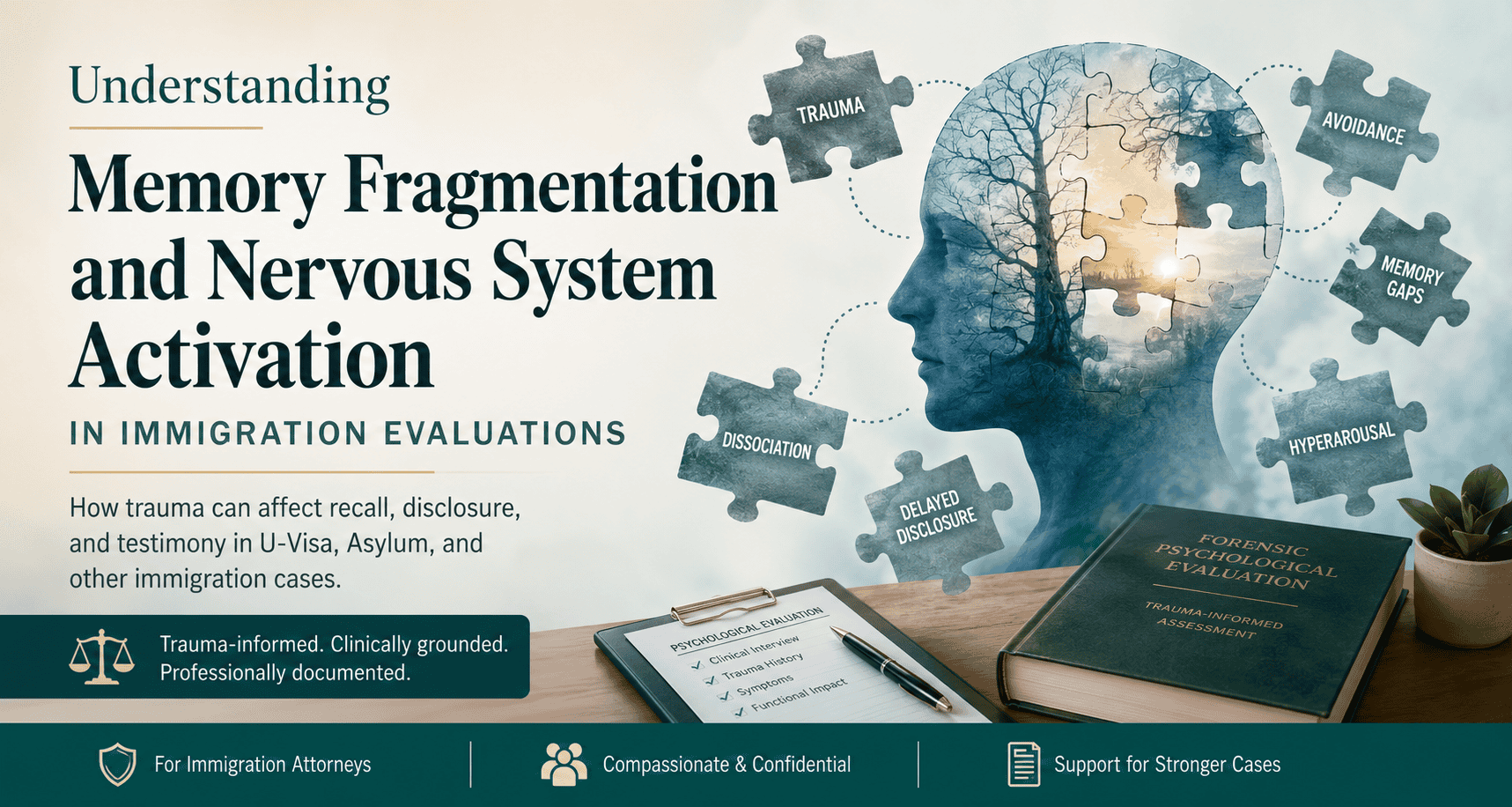
We recognize how trauma can affect memory, emotional expression, avoidance, disclosure, and nervous system responses.

Clinically Grounded

We use mental health assessment skills, diagnostic reasoning, and functional analysis to support our conclusions.

Forensically Focused

We write with the immigration purpose in mind while avoiding unsupported legal opinions or exaggerated claims.

Examples of Immigration Matters That May Benefit from a Forensic Evaluation

  • Hardship waivers
  • I-601 and I-601A waiver cases
  • VAWA petitions
  • U-Visa and T-Visa matters
  • Asylum-related evaluations
  • Cancellation of removal
  • Immigration court evaluations
  • Trauma-related immigration matters
  • Family separation hardship cases
  • INA § 212 mental health-related concerns

What Makes a Report Stronger?

The strongest immigration evaluations are careful, balanced, and specific. They do not rely on dramatic language or generic conclusions. Instead, they explain the clinical findings in a way that is detailed, credible, and connected to the specific immigration issue.

A strong forensic evaluation should answer the question: “What does this person’s psychological history and current functioning mean in the context of this immigration case?”

At Motivations Counseling, we emphasize functional examples, trauma-informed interpretation, symptom consistency, clinical reasoning, and clear conclusions. This allows the report to support the legal team while remaining professionally independent and clinically appropriate.

Schedule a Forensic Immigration Evaluation

Motivations Counseling provides forensic immigration psychological evaluations for clients and attorneys throughout Texas. Our reports are designed to be trauma-informed, clinically grounded, and carefully structured for USCIS and immigration court use.

What Makes a Strong Immigration Psychological Evaluation? A Clinical Guide for Attorneys and Applicants

Immigration Psychological Evaluations

What Makes a Strong Immigration Psychological Evaluation?

Immigration psychological evaluations can provide clinically grounded documentation of mental health symptoms, functional impairment, and the emotional impact of immigration-related stressors. A strong evaluation is structured, evidence-based, trauma-informed, and clearly written so that attorneys and adjudicators can understand the clinical findings without confusion or overstatement.

The Role of an Immigration Psychological Evaluation

An immigration psychological evaluation is a clinical assessment that documents psychological symptoms, diagnoses when appropriate, and the ways emotional symptoms affect daily functioning. The evaluation may also describe the anticipated emotional and practical consequences of immigration outcomes such as family separation, relocation, or prolonged legal uncertainty.

These evaluations are not approval letters and do not guarantee legal outcomes. Their purpose is to provide a clinically grounded picture of emotional functioning using professional standards, objective documentation, and trauma-informed assessment.

Who Conducts Immigration Psychological Evaluations?

Immigration psychological evaluations are typically conducted by licensed mental health professionals such as psychologists or licensed professional counselors with experience assessing trauma, anxiety, depression, PTSD symptoms, and stress-related conditions.

Strong evaluations commonly reflect:

  • Appropriate licensure in the state where services are provided
  • Training in evidence-based assessment and trauma-informed care
  • Experience with immigration-related clinical documentation
  • Clear professional boundaries between clinical opinions and legal conclusions
  • Structured and organized report writing

It is also helpful when the evaluator understands how to communicate findings in a format attorneys can use effectively, including concise summaries, organized sections, and plain-language descriptions of symptoms and functioning.

Core Components of a Strong Immigration Psychological Evaluation

1. Thorough Clinical Interview

A strong evaluation begins with a detailed clinical interview exploring presenting concerns, emotional symptoms, trauma exposure, mental health history, treatment history, medical background as relevant, and current stressors.

The goal is to understand what symptoms are present, how long they have occurred, and how they affect functioning across important areas of life.

2. Psychosocial and Family History

Immigration-related matters often involve complex family systems, caregiving responsibilities, trauma exposure, loss, instability, and chronic stress. A strong evaluation documents relevant background information while remaining clinically focused and avoiding unnecessary speculation.

3. Standardized Screening Measures

Many strong evaluations incorporate validated clinical screening tools when appropriate. These measures do not replace clinical judgment, but they can strengthen clarity and provide additional support for clinical impressions.

Screening tools may assess:

  • Depression symptoms
  • Anxiety symptoms
  • Post-traumatic stress symptoms
  • Functional impairment
  • Sleep disruption and stress-related reactions

4. Mental Status Examination

The mental status examination documents observable findings during the interview, including mood, affect, orientation, thought processes, cognition, insight, judgment, and behavioral presentation.

A strong mental status examination is concise, factual, and consistent with the symptoms described throughout the evaluation.

5. Diagnostic Impressions

When clinically appropriate, evaluations may include diagnostic impressions related to anxiety disorders, depressive disorders, trauma-related disorders, or other mental health conditions.

Strong evaluations avoid overstatement and connect diagnoses to documented symptoms and clinical reasoning.

6. Functional Impact

One of the most important components of an immigration psychological evaluation is documenting how symptoms affect daily life and functioning.

This may include effects on:

  • Work performance and stability
  • Parenting and caregiving responsibilities
  • Relationships and communication
  • Sleep, appetite, energy, and concentration
  • Self-care and medical adherence
  • Community support and social functioning

Strong evaluations connect symptoms to real-world functioning and explain why immigration-related stressors may be clinically significant.

7. Objective Clinical Summary

A strong evaluation concludes with a focused and objective clinical summary highlighting major symptoms, clinical impressions, and functional consequences using clear, understandable language.

How Evaluations Differ by Immigration Case Type

While the clinical foundation remains consistent, immigration psychological evaluations may focus on different emotional themes depending on the immigration matter.

I-601 / I-601A Hardship Waiver Evaluations

These evaluations often focus on the emotional and functional impact of potential family separation or relocation, including hardship-related stress, emotional destabilization, caregiving concerns, and mental health symptoms affecting qualifying relatives.

Cancellation of Removal Evaluations

These evaluations commonly address prolonged uncertainty, emotional hardship, family disruption, caregiving stress, and the psychological impact of separation.

I-246 Stay of Removal Evaluations

These evaluations frequently document acute stress responses, fear, sleep disruption, panic symptoms, and emotional destabilization associated with imminent removal concerns.

VAWA Psychological Evaluations

VAWA evaluations often include trauma-informed assessment of abuse-related stress, coercive control, trauma symptoms, emotional safety concerns, and long-term psychological impact.

U-Visa Psychological Evaluations

U-Visa evaluations commonly explore trauma symptoms following victimization, including hypervigilance, intrusive memories, emotional numbing, anxiety, avoidance, and changes in daily functioning.

T-Visa Psychological Evaluations

T-Visa evaluations often focus on complex trauma responses, chronic stress, fear, emotional dysregulation, and the effects of exploitation on safety, trust, and daily functioning.

I-130 Psychological Evaluations

These evaluations may address emotional hardship, family stability, separation-related stress, anxiety, depression, and the psychological impact of prolonged uncertainty.

Common Misconceptions About Immigration Evaluations

“A Psychological Evaluation Guarantees Approval”

No evaluation can guarantee a legal outcome. The role of the evaluation is to provide clinically grounded documentation of symptoms, functioning, emotional impact, and clinical impressions.

“An Immigration Evaluation Is Just a Therapy Letter”

Immigration evaluations are structured assessment services that differ from therapy documentation. They typically involve formal interviews, assessment components, clinical analysis, and organized report writing.

“The Evaluator Should Make Legal Conclusions”

Strong evaluations avoid legal conclusions. Instead, they provide clinical findings that attorneys may integrate into the broader legal strategy.

Ethical and Professional Standards

High-quality immigration psychological evaluations reflect ethical practice, professional boundaries, and trauma-informed interviewing principles.

  • Informed consent and explanation of the evaluation purpose
  • Objective and clinically independent reporting
  • Trauma-informed interviewing practices
  • Confidentiality and professional documentation standards
  • Accurate reporting based on clinical findings

Choosing an Immigration Evaluation Provider in Texas

When selecting an immigration evaluation provider, it may be helpful to consider:

  • Texas licensure and authorization to practice
  • Experience with the relevant immigration case type
  • Trauma-informed assessment experience
  • Structured evaluation and reporting process
  • Communication expectations and attorney coordination
  • Telehealth availability throughout Texas

A strong provider communicates clearly, maintains professional objectivity, and avoids unrealistic promises about legal outcomes.

Key Takeaways

  • Strong immigration psychological evaluations are structured, objective, and trauma-informed.
  • High-quality evaluations clearly connect emotional symptoms to daily functioning and hardship-related impact.
  • Different immigration case types may involve different clinical themes and symptom patterns.
  • Trauma-informed assessment, ethical practice, and professional documentation standards are important components of a strong evaluation.
  • Immigration psychological evaluations provide clinical documentation but do not guarantee legal outcomes.

Immigration Psychological Evaluations in Texas

Motivations Counseling provides trauma-informed immigration psychological evaluations for clients throughout Texas via telehealth, with in-person availability in Sugar Land and Katy.

Evaluations are available for hardship waivers, VAWA, U-Visa, T-Visa, cancellation of removal, Stay of Removal matters, Petition for Alien Relative cases, and other immigration-related concerns.

Explore Immigration Evaluation Services

Need to schedule a consultation?

Fill out a brief form and a member of our staff will contact you right away.

Schedule Consultation

How to reach us...

   (281) 858-3001
     admin@motivationscounseling.com
     Contact Us

When Do I Need an Evaluation for VAWA?

When Do I Need an Evaluation for VAWA?


If you’re applying for immigration protection under the Violence Against Women Act (VAWA), you may have heard that a psychological evaluation can strengthen your petition. But what exactly is this evaluation? Who needs one? And when should you get it?

This post explains when and why a VAWA psychological evaluation may be needed, what it involves, and how it can support your immigration journey.


What Is VAWA?

The Violence Against Women Act (VAWA) allows certain immigrants—regardless of gender—to apply for lawful status in the U.S. if they have experienced abuse by a:

  • U.S. citizen or lawful permanent resident spouse
  • Parent
  • Or adult child

VAWA allows you to self-petition for lawful status and includes work authorization, protection from deportation, and eventually, permanent residency.


What Is a VAWA Psychological Evaluation?

A VAWA psychological evaluation is a clinical report prepared by a licensed mental health professional. It documents:

  • The abuse you experienced
  • How it has affected your mental health
  • The emotional, psychological, and functional impact of the relationship

When Should You Get a VAWA Evaluation?

1. When Your Immigration Attorney Recommends It

Many VAWA cases benefit from expert documentation of abuse—especially when there is:

  • Little or no police documentation
  • Emotional or psychological abuse (vs. physical only)
  • Difficulty proving the relationship was abusive

2. When You Have No Restraining Order or Police Report

If you didn’t report the abuse or obtain a protective order, your psychological evaluation can:

  • Explain why you didn’t report (e.g., fear, dependency)
  • Describe the trauma and control patterns
  • Show the emotional toll

3. When the Abuse Was Emotional, Verbal, or Psychological

VAWA covers more than just physical abuse. Psychological evaluations highlight the severity of:

  • Verbal threats
  • Emotional manipulation
  • Isolation or intimidation

4. Before Submitting Your I-360 Petition

Having your evaluation ready when you file allows attorneys to incorporate it into your legal brief and can prevent delays.

5. When You Are Struggling Emotionally

Even if not legally required, get an evaluation if you’re experiencing:

  • Depression, anxiety, or trauma
  • Sleep or concentration problems
  • Panic attacks or nightmares

What Does the Evaluation Involve?

Typically includes:

  • 1–2 clinical interviews
  • Assessment questionnaires
  • Discussion of abuse and symptoms
  • 10–20 page written report with diagnosis and professional opinion

How Long Does It Take?

  • Standard: 5–7 business days
  • Expedited: 48–72 hours (additional fee)

What Does It Cost?

  • $650 per evaluation
  • $150 for interpreter services (if needed). No cost if you bring your own.
  • $300 for expedited report

Do Immigration Officers Use These Reports?

Yes. Officers are trained to review psychological evaluations as supportive evidence. A strong evaluation can fill in gaps and increase approval odds.


Final Thoughts

A VAWA psychological evaluation helps tell your story with clarity and clinical credibility. It supports both your legal case and emotional healing.


Need Help with a VAWA Evaluation?

Motivations Counseling offers:

  • Fast, trauma-informed VAWA evaluations
  • Licensed bilingual clinicians
  • 48-hour expedited options
  • In-person or telehealth across Texas

Call today to schedule an appointment with one of our therapists offering Sugar Land or Katy counseling services or ask for a free 10-minute consultation.


How to reach us...

   (281) 858-3001
     admin@motivationscounseling.com
     Contact Us

Hardship Waiver Psychological Evaluation

Immigration Psychological Evaluations

Hardship Waiver Psychological Evaluation

Compassionate, trauma-informed psychological evaluations for I-601 and I-601A hardship waiver cases, designed to document the emotional, psychological, medical, family, and practical impact of separation or relocation.

Call (281) 858-3001

What Is a Hardship Waiver Psychological Evaluation?

A psychological evaluation for a hardship waiver, including an I-601 or I-601A waiver, is a formal mental health assessment used to support immigration petitions where a U.S. citizen or lawful permanent resident may suffer extreme hardship if their relative is denied entry, required to leave the United States, or unable to remain with the family.

These evaluations are conducted by licensed mental health professionals and are often submitted with immigration applications to strengthen the evidence of emotional, psychological, financial, medical, and family hardship.

Purpose of the evaluation: to provide professional clinical documentation of how separation from, or relocation with, a loved one may affect the qualifying relative’s mental health, functioning, stability, family responsibilities, and overall well-being.

Why Does USCIS Need This Kind of Evaluation?

USCIS reviews hardship waiver cases to determine whether the qualifying relative would experience hardship beyond the ordinary emotional distress that often occurs when families are separated.

A licensed therapist or psychologist can provide clinical insight into the depth and severity of the hardship, including how the stressor affects the qualifying relative’s emotional functioning, mental health symptoms, medical stability, parenting responsibilities, financial strain, and ability to function day-to-day.

Who Is Usually Evaluated?

The psychological evaluation is typically conducted with the qualifying relative, meaning the U.S. citizen or lawful permanent resident who would experience hardship if the waiver is denied.

Spouse The husband or wife of the applicant may be evaluated when they are the qualifying relative.
Parent A U.S. citizen or lawful permanent resident parent may be evaluated when the case involves hardship to the parent.
Child In some cases, a child may be relevant to the hardship analysis, especially when age, dependency, or clinical concerns are significant.
Family System The evaluation may also consider the broader family impact, including caregiving, finances, medical needs, and emotional stability.

What Does the Evaluation Include?

Our hardship waiver evaluations are designed to provide a clear, clinically grounded report that attorneys and families can use as part of a larger immigration packet.

  • Clinical interview with the qualifying relative
  • Assessment of emotional, psychological, and physical health concerns
  • Discussion of separation-related hardship
  • Discussion of relocation-related hardship
  • Review of medical, academic, legal, or collateral records when available
  • Clinical impressions and diagnosis, when warranted
  • Professional opinion regarding the likely severity and functional impact of the hardship
Reports are generally completed within 4–5 days. Expedited report delivery may be available within 48 hours for an added fee.

Our Evaluation Process

Schedule the appointment Contact our office to request an evaluation appointment or consultation.
Complete intake paperwork We gather background information, symptoms, family history, hardship concerns, and relevant documentation.
Attend the clinical interview The qualifying relative meets with a licensed clinician through secure telehealth or another appropriate format.
Report preparation The clinician prepares a detailed, trauma-informed, USCIS-focused psychological evaluation report.
Delivery of final report The completed report is provided for use with the immigration attorney or petition packet.

How Much Does a Hardship Waiver Evaluation Cost?

$650

Evaluation conducted in English or with a Spanish-speaking therapist.

If a language other than English or Spanish is needed, or if a Spanish-speaking therapist is unavailable, interpreter support may be provided for an additional fee. There is no additional cost if you bring your own interpreter.

Standard report delivery is typically within 4–5 days. Expedited report delivery may be available for an added fee of $300.

Can the Evaluation Be Completed Online?

Yes. We offer secure telehealth evaluations across Texas and other eligible states. Telehealth sessions are private, HIPAA-compliant, and effective for immigration psychological evaluations.

Online evaluations can be especially helpful for clients who live outside the Houston area, have limited transportation, or need to coordinate appointments around work, childcare, or family responsibilities.

Other Immigration Evaluation Services

Motivations Counseling provides compassionate, trauma-informed psychological evaluations for a wide range of immigration cases. Our licensed therapists specialize in detailed, professionally written reports for attorneys and families navigating the immigration process.

  • VAWA evaluations
  • U-Visa and T-Visa evaluations
  • I-601 and I-601A hardship waiver evaluations
  • Cancellation of Removal evaluations
  • Adjustment of Status and other humanitarian immigration evaluations

Frequently Asked Questions

Do I need an attorney before scheduling?

You do not have to have an attorney before contacting us. However, many clients are referred by immigration attorneys, and we are happy to coordinate with your attorney when appropriate and authorized.

Is the evaluation only about mental health?

Mental health is central to the evaluation, but the report may also discuss family responsibilities, medical needs, financial strain, safety concerns, relocation concerns, cultural factors, and functional impairment when clinically relevant.

Can you complete the report quickly?

Standard reports are usually ready within 4–5 days. Expedited report delivery may be available within 48 hours for an added fee.

Schedule a Hardship Waiver Psychological Evaluation

Whether you are working with an attorney or seeking help on your own, Motivations Counseling is here to help you move forward with strength, clarity, and professional documentation.

×