Category: Mental Health Education

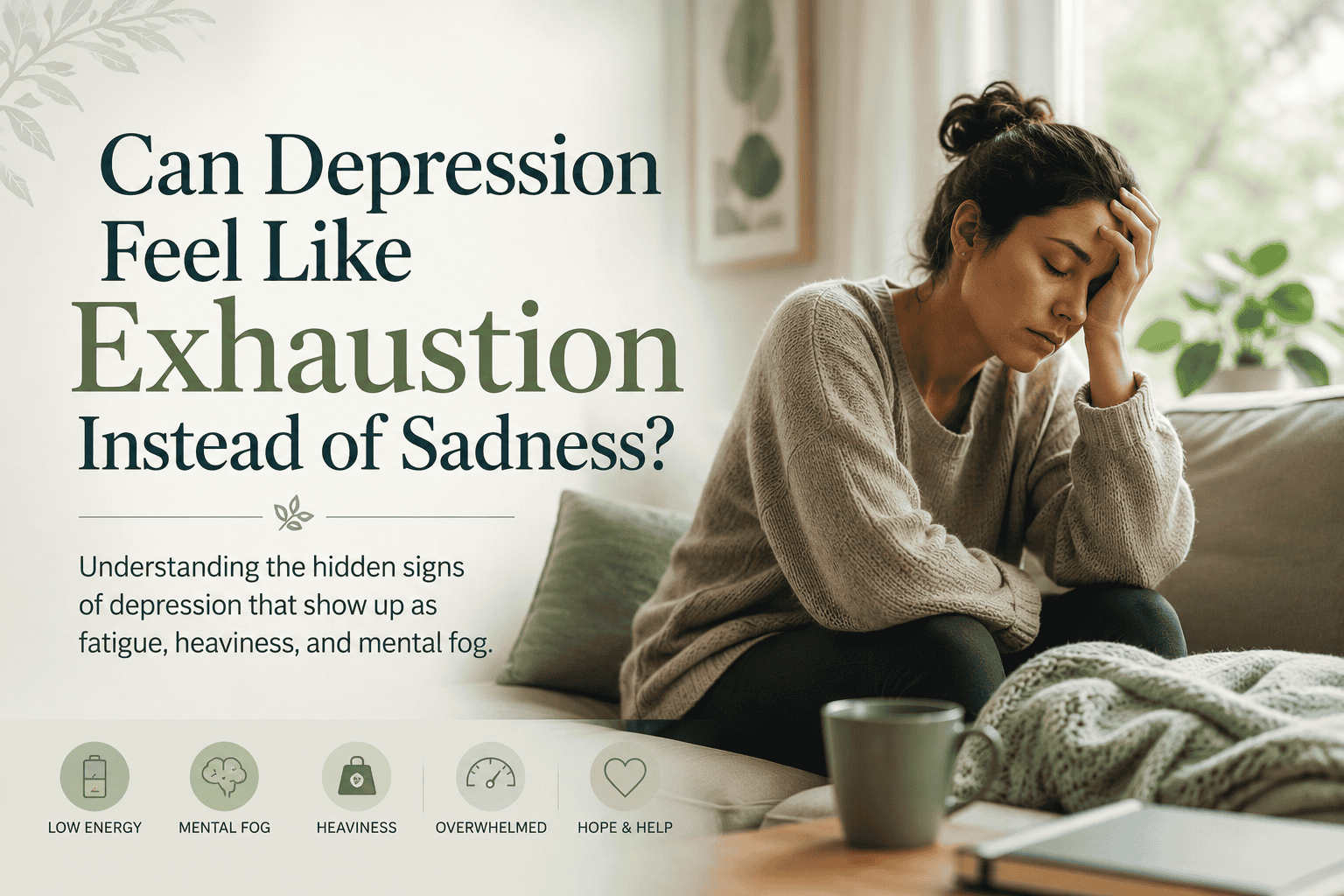
Can Depression Feel Like Exhaustion Instead of Sadness?

Depression & Mental Health Resources

Can Depression Feel Like Exhaustion Instead of Sadness?

Depression does not always feel like obvious sadness. For many adults, it can feel more like heaviness, low energy, mental fog, emotional shutdown, and difficulty keeping up with life. This guide explains how depression-related exhaustion can show up and when counseling may help.

Start Here

Depression Can Feel Like Exhaustion Instead of Sadness

Many people picture depression as crying, sadness, or obvious emotional pain. While those symptoms can happen, depression can also feel like being physically and emotionally drained. Some adults describe it as heaviness, numbness, mental fog, low motivation, or feeling like every task takes more effort than it should.

When depression feels like exhaustion, a person may still go to work, care for others, and appear functional on the outside. Internally, they may feel like they are pushing through each day with very little energy left.

Depression and Fatigue

Depression Exhaustion: What It Can Feel Like

Depression-related exhaustion can affect the body, thoughts, emotions, motivation, and relationships. It is often more than ordinary tiredness.

Low Energy

Feeling drained even after sleep, needing more effort to complete basic tasks, or feeling like your body is running on empty.

Emotional Heaviness

Feeling weighed down, slowed down, or emotionally heavy without always being able to explain why.

Mental Fog

Having trouble focusing, remembering details, making decisions, or staying mentally present.

Difficulty Keeping Up

Feeling behind on chores, work, parenting, messages, appointments, or responsibilities that used to feel manageable.

Less Interest

Losing interest in hobbies, relationships, intimacy, social plans, or routines that usually help you feel connected.

Sleep That Does Not Restore

Sleeping more but still feeling tired, waking during the night, or feeling unrested even after a full night of sleep.

Not Always Obvious Sadness

Depression Without Sadness Can Still Be Depression

Some adults do not identify with the word “sad.” They may feel numb, tired, disconnected, irritable, flat, or simply unable to keep going at their usual pace. Because sadness is not always the main symptom, depression can be missed or minimized.

Depression without obvious sadness may be especially confusing for people who are used to being responsible, productive, or emotionally composed. They may think they are just tired, lazy, burned out, or not trying hard enough.

Depression may feel more like:

  • Dragging yourself through the day
  • Feeling emotionally flat or disconnected
  • Having no energy for things you care about
  • Needing more time alone but not feeling better afterward
  • Feeling overwhelmed by normal responsibilities
  • Feeling like you are functioning, but barely

Depression can be present even when a person is still working, parenting, smiling, helping others, or appearing “fine” on the outside.

Daily Functioning

Why Depression Can Make Life Feel Hard to Keep Up With

Depression can make ordinary responsibilities feel unusually difficult. A person may still care about their work, family, home, or relationships, but feel unable to consistently follow through.

This can create guilt and self-criticism. The person may wonder why they cannot just “get it together,” when the real issue may be depression affecting energy, focus, motivation, and emotional capacity.

Common Pattern

Depression Can Look Like Falling Behind

When depression feels like exhaustion, the signs may show up in everyday routines before they are recognized as a mental health concern.

  • Texts, emails, and calls go unanswered.
  • Laundry, dishes, bills, or paperwork pile up.
  • Appointments or deadlines become harder to manage.
  • Work takes longer and feels more mentally draining.
  • Social plans feel exhausting instead of refreshing.

Mental Fog and Focus

Depression Fatigue Can Affect Concentration and Decision-Making

Depression-related exhaustion is not only physical. It can also affect the way a person thinks. Mental fog can make conversations harder to follow, tasks harder to finish, and decisions harder to make.

Even small choices may feel overwhelming. A person may avoid decisions, procrastinate, or shut down because their mind feels overloaded.

Mental fog may include:

  • Trouble concentrating or staying on task
  • Forgetfulness or difficulty tracking details
  • Feeling mentally slow or overwhelmed
  • Difficulty making decisions
  • Reading or working without retaining information
  • Feeling disconnected during conversations

Body Signals

Depression Can Show Up as Physical Heaviness and Low Energy

Some adults notice depression first in their body. They may feel heavy, tense, slowed down, restless, or physically depleted. Sleep may change, appetite may shift, and the body may feel like it is carrying more than usual.

These body-based symptoms can make depression harder to identify because the person may assume the problem is only stress, poor sleep, overwork, or not enough discipline.

Physical signs may include:

  • Feeling tired even after rest
  • Sleeping too much or struggling to sleep
  • Moving or speaking more slowly than usual
  • Feeling restless, tense, or unable to relax
  • Changes in appetite or weight
  • Headaches, stomach discomfort, or body aches that worsen with stress

If exhaustion is new, severe, or medically concerning, it is also important to speak with a medical provider to rule out physical health causes.

Burnout or Depression?

Burnout and Depression Can Overlap

Burnout is often connected to prolonged stress, overwork, caregiving demands, or emotional overload. Depression can include similar exhaustion, but may also involve deeper hopelessness, loss of interest, self-criticism, withdrawal, sleep or appetite changes, and difficulty feeling pleasure.

Sometimes burnout and depression occur together. A person may begin with chronic stress and eventually experience symptoms that look and feel more like depression.

Clinical Clues

When Exhaustion May Be More Than Burnout

Exhaustion may be more concerning when rest does not help, symptoms persist, or the person begins to lose interest, withdraw, feel hopeless, or struggle to function across multiple areas of life.

  • Rest does not restore energy.
  • Enjoyment and connection feel muted.
  • Basic responsibilities feel overwhelming.
  • Self-criticism or hopelessness increases.
  • Symptoms continue even when stress decreases.

When to Seek Help

When to Seek Therapy for Depression Exhaustion

It may be time to reach out when exhaustion, heaviness, low motivation, or mental fog lasts more than a couple of weeks, keeps returning, or begins interfering with work, parenting, relationships, sleep, self-care, or your ability to feel like yourself.

Therapy can help you slow down the self-blame cycle, understand what may be contributing to the exhaustion, identify realistic coping steps, and rebuild support in a way that feels manageable.

Consider counseling if you notice:

  • Persistent exhaustion that does not improve with rest
  • Loss of interest, numbness, or emotional disconnection
  • Difficulty keeping up with daily responsibilities
  • Mental fog, poor concentration, or decision fatigue
  • Increased isolation, irritability, or hopelessness
  • Thoughts of death, self-harm, or not wanting to be here

If depression includes thoughts of death, self-harm, or suicide, seek immediate support. In the United States, call or text 988 for the Suicide & Crisis Lifeline, call 911, or go to the nearest emergency room.

Depression Counseling at Motivations Counseling

Therapy Can Help When Depression Feels Like Exhaustion

Motivations Counseling provides therapy for adults experiencing depression, emotional exhaustion, anxiety, stress, trauma-related symptoms, relationship strain, and life transitions. Counseling may focus on understanding symptoms, reducing shame, improving coping skills, rebuilding routines, and taking realistic steps toward emotional and daily functioning.

Our counseling team serves clients in Sugar Land, Katy, Richmond, Fort Bend County, West Houston, and through telehealth across Texas when clinically appropriate.

Counseling Support

Depression Counseling in Sugar Land, Katy, and Online Across Texas

If depression feels like exhaustion, heaviness, mental fog, or difficulty keeping up, counseling can help you better understand what is happening and begin taking manageable next steps.

  • Individual counseling for adults
  • Support for depression, anxiety, trauma, stress, and emotional exhaustion
  • In-person options in Sugar Land and Katy when available
  • Telehealth counseling across Texas when clinically appropriate
  • Trauma-informed and relationship-informed care
Call or Text: (281) 858-3001

Frequently Asked Questions

Common Questions About Depression, Exhaustion, and Low Energy

Can depression feel like exhaustion instead of sadness?

Yes. Depression can feel like low energy, heaviness, mental fog, numbness, reduced motivation, and difficulty keeping up with life instead of obvious sadness.

Why does depression make me feel so tired?

Depression can affect sleep, motivation, concentration, body energy, emotional capacity, and the nervous system. Many people feel exhausted even when they are trying hard to function.

Can depression cause mental fog?

Yes. Depression may make it harder to concentrate, remember details, make decisions, follow conversations, or complete tasks.

How do I know if it is burnout or depression?

Burnout and depression can overlap. Depression may be more likely when exhaustion persists, rest does not help, enjoyment decreases, hopelessness increases, or symptoms affect multiple areas of life.

Can someone be depressed and still function?

Yes. Some adults continue working, parenting, and helping others while privately feeling depleted, disconnected, overwhelmed, or emotionally numb.

When should I seek therapy for depression exhaustion?

Consider therapy when exhaustion, low motivation, mental fog, or emotional heaviness lasts more than a couple of weeks, keeps returning, or interferes with work, relationships, sleep, self-care, or daily life.

What should I do if I am having thoughts of suicide?

If you are in immediate danger or may hurt yourself, call 911 or go to the nearest emergency room. In the United States, you can call or text 988 for the Suicide & Crisis Lifeline.

Susan Baker, M.Ed., NCC, LPC-S, Licensed Professional Counselor Supervisor in Texas

Article Author

Written by a Licensed Texas Mental Health Professional

This article was written for Motivations Counseling by Susan Baker, M.Ed., NCC, LPC-S, a Texas Licensed Professional Counselor Supervisor and clinical leader at Motivations Counseling.

Susan Baker, M.Ed., NCC, LPC-S
Texas Licensed Professional Counselor Supervisor
EMDR Therapist & EMDRIA Member
Texas LPC License #73957

Susan Baker is the Clinical Director of Motivations Counseling and provides trauma-informed counseling, EMDR therapy, depression counseling, anxiety treatment, immigration psychological evaluations, and mental health assessment services. Motivations Counseling serves clients from offices in Sugar Land and Katy, Texas, with telehealth services available statewide for Texas residents.

Take the Next Step

Depression Counseling in Sugar Land, Katy, and Online Across Texas

If depression feels like exhaustion, low energy, mental fog, or difficulty keeping up, counseling can help you understand what is happening and begin taking manageable steps toward support.

×

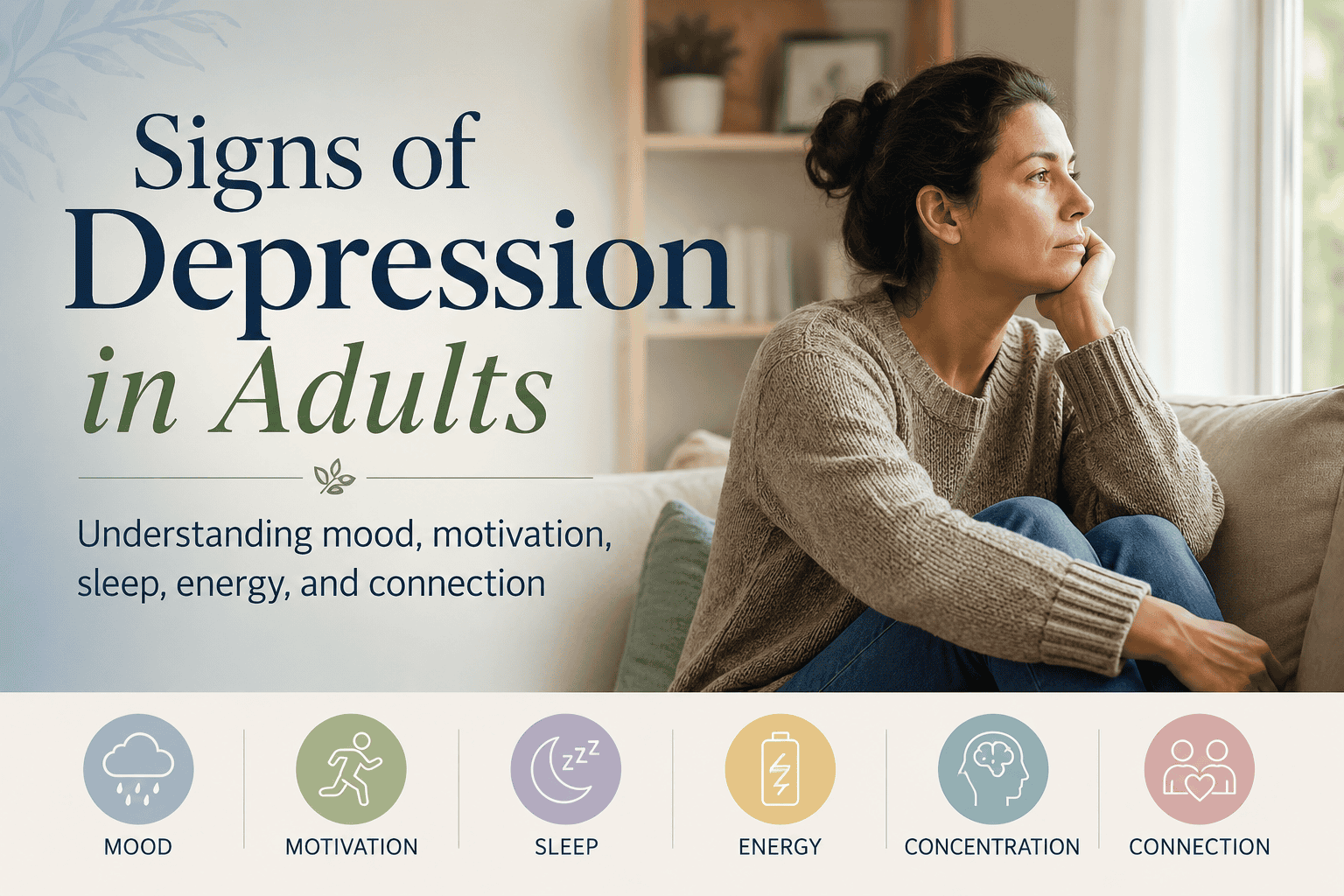
Signs of Depression in Adults

Depression & Mental Health Resources

Signs of Depression in Adults

Depression can affect more than mood. It may show up through changes in motivation, sleep, energy, appetite, concentration, self-worth, relationships, and daily functioning. This guide explains common signs of depression in adults and when it may be time to reach out for support.

Start Here

Depression Is More Than Feeling Sad

Everyone has difficult days, periods of stress, or times when they feel discouraged. Depression is different because symptoms may last longer, feel harder to move through, and begin interfering with work, school, relationships, parenting, health, or everyday responsibilities.

Some adults recognize depression as sadness or hopelessness. Others notice that they feel numb, disconnected, exhausted, irritable, unmotivated, or unable to enjoy things that used to matter. Depression can also show up physically through changes in sleep, appetite, energy, pain, or body tension.

View Depression Resources

Common Signs

Adult Depression Symptoms: What to Look For

Depression does not look exactly the same for every person. These are common areas where adults may begin to notice changes.

Persistent Low Mood

Feeling sad, empty, tearful, hopeless, emotionally heavy, or unable to feel joy for much of the day.

Loss of Energy

Feeling exhausted even after rest, having trouble starting tasks, or feeling like ordinary responsibilities take too much effort.

Loss of Interest

Pulling away from hobbies, relationships, activities, intimacy, or parts of life that previously felt meaningful.

Sleep Changes

Sleeping too much, waking during the night, waking too early, struggling to fall asleep, or feeling unrested.

Appetite Changes

Eating much more or much less than usual, losing interest in food, or noticing weight changes connected to mood.

Concentration Problems

Difficulty focusing, remembering details, making decisions, following through, or staying mentally present.

Symptoms of Depression in Adults Can Vary

Symptoms of depression in adults do not always appear the same. Some people experience sadness and hopelessness, while others notice irritability, fatigue, emotional numbness, sleep problems, difficulty concentrating, or withdrawal from relationships.

Mood and Emotional Signs

Signs of Clinical Depression in Adults

Many adults expect depression to feel like crying or sadness. That can happen, but depression may also feel like emotional numbness, irritability, discouragement, guilt, shame, or a sense that nothing will improve.

Some people become quieter and more withdrawn. Others become more easily frustrated, impatient, or reactive. For some adults, depression feels less like sadness and more like being disconnected from themselves, their relationships, or their usual sense of purpose.

Emotional signs may include:

  • Feeling sad, empty, hopeless, or emotionally flat
  • Feeling unusually irritable, angry, or easily overwhelmed
  • Feeling guilty, worthless, ashamed, or like a burden
  • Feeling disconnected from people who matter
  • Feeling unable to enjoy things that used to feel good
  • Feeling like life is harder than it should be

Depression is not a character flaw or a lack of willpower. It is a real mental health condition that can affect emotions, thoughts, the body, relationships, and daily functioning.

Motivation and Functioning

Depression Can Make Ordinary Tasks Feel Overwhelming

One of the most common signs of depression in adults is a noticeable drop in motivation. Tasks that once felt normal may begin to feel heavy, confusing, or impossible to start.

This can affect work, parenting, school, chores, bills, hygiene, communication, and decision-making. The person may care deeply, but still feel stuck or unable to follow through.

Often Misunderstood

Depression Can Look Like Laziness From the Outside

Adults with depression are sometimes misunderstood as lazy, careless, negative, or unmotivated. In reality, depression can interfere with energy, concentration, hope, self-confidence, and the ability to begin or complete tasks.

  • Unopened mail may pile up.
  • Texts and calls may go unanswered.
  • Basic routines may feel harder to maintain.
  • Work performance may decline.
  • Important decisions may feel paralyzing.

Sleep, Energy, Appetite, and the Body

Depression Often Shows Up Physically

Depression can affect the body as much as the mind. Some adults first notice that they are sleeping differently, feeling exhausted, eating differently, moving slower, or experiencing more physical discomfort.

Physical changes are sometimes easier to notice than emotional changes. A person may not say, “I am depressed,” but may say, “I am tired all the time,” “I cannot get out of bed,” “I do not feel hungry,” or “My body feels heavy.”

Physical signs may include:

  • Sleeping much more or much less than usual
  • Waking up tired even after a full night of sleep
  • Feeling physically slowed down or restless
  • Low energy, fatigue, or heaviness in the body
  • Changes in appetite or weight
  • Headaches, stomach problems, body aches, or tension that worsen with stress

Thinking and Concentration

Depression Can Affect Focus, Memory, and Decision-Making

Depression can make thinking feel slower or heavier. Adults may have difficulty concentrating at work, remembering appointments, reading, following conversations, finishing tasks, or making even small decisions.

This can create a painful cycle. The more someone falls behind, the more guilt or shame they may feel. That guilt can increase avoidance, which makes depression feel even more overwhelming.

Cognitive signs may include:

  • Trouble focusing or staying mentally present
  • Difficulty making decisions
  • Forgetfulness or mental fog
  • Negative self-talk or harsh self-criticism
  • Feeling hopeless about the future
  • Difficulty imagining that things can improve

If depression includes thoughts of death, self-harm, or suicide, seek immediate support. In the United States, call or text 988 for the Suicide & Crisis Lifeline, call 911, or go to the nearest emergency room.

Relationships and Connection

Depression Can Lead to Withdrawal

Adults with depression may stop answering messages, cancel plans, avoid family, lose interest in intimacy, or feel emotionally far away even when they are physically present.

Withdrawal is often not about not caring. It may be a sign that the person feels depleted, ashamed, overwhelmed, or unsure how to explain what is happening.

What Loved Ones May Notice

Depression May Be Visible to Others First

Family members, partners, friends, or coworkers may notice changes before the person identifies them as depression.

  • Less communication or emotional availability
  • More irritability or conflict
  • Less interest in activities or connection
  • More time alone or in bed
  • Difficulty keeping up with responsibilities

When to Seek Help

When to Seek Therapy for Depression

It may be time to seek professional support when symptoms last for more than a couple of weeks, keep returning, or begin interfering with your ability to function, connect, work, parent, sleep, care for yourself, or feel like yourself.

Therapy can help you understand what is happening, reduce shame, identify patterns, build coping strategies, and begin taking manageable steps toward feeling more stable and connected.

Consider reaching out if you notice:

  • Depressed mood, numbness, or hopelessness that does not lift
  • Loss of interest in relationships, activities, or responsibilities
  • Sleep, appetite, or energy changes that affect daily life
  • Difficulty concentrating, making decisions, or completing tasks
  • Increased irritability, isolation, or emotional shutdown
  • Thoughts of death, self-harm, or not wanting to be here

Depression Counseling at Motivations Counseling

Therapy Can Help You Understand Depression and Take the Next Step

Motivations Counseling provides therapy for adults experiencing depression, anxiety, stress, trauma-related symptoms, relationship distress, emotional exhaustion, and life transitions. Counseling may focus on understanding symptoms, improving coping skills, identifying stuck patterns, rebuilding connection, and taking realistic steps toward daily functioning.

Our counseling team serves clients in Sugar Land, Katy, Richmond, Fort Bend County, West Houston, and through telehealth across Texas when clinically appropriate.

Counseling Support

Depression Counseling in Sugar Land, Katy, and Online Across Texas

If you are noticing signs of depression, you do not have to wait until everything feels unmanageable before reaching out.

  • Individual counseling for adults
  • Support for depression, anxiety, trauma, stress, and relationship strain
  • In-person options in Sugar Land and Katy when available
  • Telehealth counseling across Texas when clinically appropriate
  • Trauma-informed and relationship-informed care
Call or Text: (281) 858-3001

Frequently Asked Questions

Common Questions About Signs of Depression in Adults

What are common signs of depression in adults?

Common signs include persistent sadness, numbness, irritability, loss of interest, low motivation, sleep changes, appetite changes, fatigue, concentration problems, guilt, hopelessness, and withdrawal from relationships or responsibilities.

Can depression show up as irritability instead of sadness?

Yes. Some adults experience depression as irritability, anger, impatience, emotional shutdown, or feeling easily overwhelmed rather than obvious sadness.

Can depression affect sleep and energy?

Yes. Depression may cause insomnia, early-morning waking, sleeping too much, low energy, fatigue, or feeling physically slowed down.

Can depression affect concentration?

Yes. Adults with depression may have difficulty focusing, remembering details, making decisions, completing tasks, or staying mentally present.

When should someone seek therapy for depression?

Consider therapy when symptoms last more than a couple of weeks, interfere with daily life, affect relationships or work, or include hopelessness, withdrawal, or thoughts of self-harm.

Is depression treatable?

Yes. Many people improve with appropriate support, which may include therapy, lifestyle changes, support systems, medical evaluation, medication when appropriate, or a combination of care.

What should I do if I am having thoughts of suicide?

If you are in immediate danger or may hurt yourself, call 911 or go to the nearest emergency room. In the United States, you can call or text 988 for the Suicide & Crisis Lifeline.

Susan Baker, M.Ed., NCC, LPC-S

Article Author

Written by a Licensed Texas Mental Health Professional

This article was written for Motivations Counseling by Susan Baker, M.Ed., NCC, LPC-S, a Texas Licensed Professional Counselor Supervisor and clinical leader at Motivations Counseling.

Susan Baker, M.Ed., NCC, LPC-S
Texas Licensed Professional Counselor Supervisor
EMDR Therapist & EMDRIA Member
Texas LPC License #73957

Susan Baker is the Clinical Director of Motivations Counseling and provides trauma-informed counseling, EMDR therapy, depression counseling, anxiety treatment, immigration psychological evaluations, and mental health assessment services. Motivations Counseling serves clients from offices in Sugar Land and Katy, Texas, with telehealth services available statewide for Texas residents.

Take the Next Step

Depression Counseling in Sugar Land, Katy, and Online Across Texas

If depression is affecting your mood, motivation, sleep, energy, concentration, or relationships, counseling can help you understand what is happening and begin taking manageable steps toward support.
×

Emotional Support Animal Letters in Texas: What You Need to Know

ESA Learning Center

Emotional Support Animal Letters in Texas: What You Need to Know

Emotional support animal letters can be confusing because there is so much misinformation online about ESA registration, instant letters, housing rights, and what a licensed mental health professional actually evaluates. This guide explains how ESA documentation works in Texas, what an ESA letter can and cannot do, and what to consider before seeking an evaluation.

Start Here

ESA Documentation Is a Clinical Recommendation, Not a Pet Registration

An emotional support animal letter is documentation from a licensed mental health professional stating that an emotional support animal may be clinically appropriate for a person with a mental health condition. It is not the same as registering a pet, buying a certificate, or obtaining a service dog credential.

A legitimate ESA letter should be based on a clinical evaluation. The evaluator considers symptoms, functioning, mental health needs, and whether the animal appears to provide therapeutic benefit related to the individual’s emotional or psychological condition.

View ESA Service Page

What Is an Emotional Support Animal?

An ESA Provides Emotional or Therapeutic Support Through Its Presence

An emotional support animal is an animal that may help reduce symptoms or provide emotional support for someone with a mental health condition. For some people, the presence of an animal may help with anxiety, depression, trauma-related symptoms, panic, emotional regulation, loneliness, or stress-related difficulties.

Emotional support animals are different from service animals. A service animal is trained to perform specific tasks for a person with a disability. An ESA does not need specialized task training in the same way. Instead, the therapeutic benefit usually comes from the animal’s presence, companionship, routine, grounding effect, or emotional support.

Emotional support animals may be clinically meaningful for some individuals, but ESA documentation should be based on an actual mental health evaluation rather than a quick online purchase or generic certificate.

An ESA may provide support by helping with:

  • Reducing feelings of loneliness or emotional isolation
  • Providing routine, comfort, and companionship
  • Helping with grounding during anxiety or trauma-related distress
  • Supporting emotional regulation during periods of stress
  • Encouraging daily structure, care, and responsibility

How ESA Letters Work

A Letter Should Come After a Clinical Evaluation

ESA documentation should reflect a licensed professional’s clinical judgment, not a guaranteed transaction.

Clinical Evaluation

A licensed professional reviews the individual’s mental health history, current symptoms, and treatment-related needs.

Mental Health Assessment

The evaluation considers emotional symptoms, functional limitations, and whether the animal may help alleviate symptoms.

Clinical Determination

Documentation is provided only when the clinician determines that an ESA recommendation is clinically appropriate.

Documentation

If clinically justified, the provider may issue ESA documentation that can be used as part of a housing accommodation request.

Ethical Standards

A legitimate ESA process avoids guarantees, fake registries, and documentation that is issued without clinical review.

Follow-Up Support

When authorized and appropriate, a provider’s office may clarify documentation while protecting client confidentiality.

Who May Qualify?

Qualification Depends on Clinical Factors, Not Just Wanting to Keep a Pet

A person may potentially qualify for ESA documentation when they have a mental health condition and the emotional support animal helps alleviate symptoms or supports functioning in a clinically meaningful way. The decision is not based only on loving an animal or wanting to avoid pet fees.

The clinical question is whether the animal provides emotional or therapeutic support connected to the person’s mental health needs. A clinician may consider diagnosis, symptoms, daily functioning, emotional distress, treatment history, and the role the animal plays in helping the person manage symptoms.

Clinical concerns that may be considered include:

  • Anxiety-related symptoms
  • Depression or mood-related symptoms
  • Trauma-related symptoms or PTSD
  • Panic symptoms
  • Emotional regulation difficulties
  • Other mental health concerns that substantially affect functioning

A diagnosis alone does not automatically mean ESA documentation is appropriate. The evaluator also considers functional limitations and whether the animal helps alleviate symptoms in a clinically relevant way.

Housing Accommodation Requests

ESA Letters Are Often Used for Housing Accommodation Requests

Many people seek ESA documentation because they live in housing with pet restrictions, pet rent, breed limitations, or other animal-related policies. ESA documentation may support a reasonable accommodation request when the individual has a qualifying mental health condition and the animal helps alleviate symptoms.

However, an ESA letter does not force automatic approval. Housing providers may review documentation, request clarification in appropriate situations, and make accommodation decisions based on applicable laws, policies, and facts.

Important Clarification

No Therapist Can Guarantee Housing Approval

ESA documentation is a clinical recommendation. It does not guarantee that a landlord, property manager, university housing office, or other housing provider will approve a request.

  • ESA documentation is not pet registration.
  • There is no official national ESA registry.
  • Housing providers may review documentation.
  • Accommodation decisions are made by the housing provider.
  • Documentation should be issued only when clinically appropriate.

Common Misconceptions

ESA Myths Can Lead People Toward Bad Information

Many websites sell certificates, ID cards, or instant letters that may look official but do not replace a clinical evaluation.

Myth: ESAs Must Be Registered

There is no official national emotional support animal registry. Registration websites do not determine whether an ESA is clinically appropriate.

Myth: ESA Letters Are Guaranteed

A legitimate provider should not guarantee documentation before completing a clinical evaluation.

Myth: ESAs Are Service Dogs

Emotional support animals and service animals are different. Service animals are trained to perform specific disability-related tasks.

Reality: Evaluation Matters

ESA documentation should be based on symptoms, functioning, treatment needs, and the clinical role of the animal.

Reality: Housing Rules Differ

Housing accommodations are different from airline policies, public access rules, and ordinary pet policies.

Reality: Ethics Matter

A careful ESA process protects the client, the clinician, and the credibility of legitimate mental health documentation.

Choosing an Evaluator

Choose a Licensed Professional Who Takes the Evaluation Seriously

Because ESA documentation can affect housing accommodation requests, it is important to work with a licensed mental health professional who understands the difference between ethical clinical documentation and quick online letter sales.

A qualified evaluator should complete an actual assessment, explain that documentation is not guaranteed, and avoid making promises about housing approval. The process should focus on mental health needs rather than simply producing a letter.

Licensed Professional

Look for a licensed mental health professional who is legally and clinically qualified to evaluate mental health concerns.

Real Evaluation Process

The provider should gather clinical information and assess whether an ESA recommendation is appropriate.

Avoid Instant-Letter Claims

Be cautious of websites that promise instant approval, registration, certification, or guaranteed acceptance.

ESA Evaluations at Motivations Counseling

Texas ESA Evaluations Through a Licensed Counseling Practice

Motivations Counseling provides emotional support animal evaluations for Texas residents. Evaluations may be completed through secure telehealth when clinically appropriate, with in-person services available through our Sugar Land and Katy-area counseling practice when scheduling allows.

Our process is designed to be clear, ethical, and clinically grounded. Documentation is provided only when the evaluator determines that an ESA recommendation is clinically appropriate based on the evaluation.

Clinical ESA Evaluation

Schedule an ESA Evaluation in Texas

The ESA evaluation fee is currently $99. If you qualify and ESA documentation is clinically appropriate, there is no additional charge for the letter.

  • Licensed Texas mental health professionals
  • Telehealth available statewide for Texas residents
  • Same-day options may be available when scheduling allows
  • Documentation provided only when clinically appropriate

ESA Learning Center

Continue Learning About ESA Letters, Housing, and Mental Health Support

These related resources can help you better understand emotional support animal documentation, housing accommodation requests, and when an ESA evaluation may be clinically appropriate.

Frequently Asked Questions

Common Questions About Emotional Support Animal Letters in Texas

Is an ESA the same as a service dog?

No. A service dog is trained to perform specific tasks for a person with a disability. An emotional support animal provides emotional or therapeutic support through its presence and relationship with the individual, but it is not the same as a service animal.

Do emotional support animals need to be registered?

No. There is no official national ESA registry. Websites that sell registrations, certificates, ID cards, or vests do not replace a clinical evaluation from a licensed mental health professional.

Can anxiety qualify for an emotional support animal?

Anxiety may be considered during an ESA evaluation when symptoms substantially affect functioning and the animal helps alleviate symptoms in a clinically meaningful way. Qualification depends on the individual evaluation.

Can a landlord deny an emotional support animal?

Housing providers may review accommodation requests and documentation. An ESA letter may support a request, but it does not guarantee approval. Housing decisions depend on applicable laws, documentation, and the specific circumstances.

Are ESA letters guaranteed?

No. ESA documentation should not be guaranteed before an evaluation. A licensed clinician may provide documentation only when it is clinically appropriate based on the assessment.

How much does an ESA evaluation cost at Motivations Counseling?

Motivations Counseling currently offers ESA clinical evaluations for $99. If the evaluator determines that ESA documentation is clinically appropriate, there is no additional charge for the letter.

Can the evaluation be completed online?

In many cases, ESA evaluations may be completed through secure telehealth for Texas residents when clinically appropriate. Some situations may require additional clinical follow-up before documentation can be issued.

Susan Baker, M.Ed., NCC, LPC-S

Article Author

Written by a Licensed Texas Mental Health Professional

This article was written for Motivations Counseling by Susan Baker, M.Ed., NCC, LPC-S, a Texas Licensed Professional Counselor Supervisor and clinical leader at Motivations Counseling.

Susan Baker, M.Ed., NCC, LPC-S
Texas Licensed Professional Counselor Supervisor
EMDR Therapist & EMDRIA Member
Texas LPC License #73957

Susan Baker is the Clinical Director of Motivations Counseling and provides trauma-informed counseling, EMDR therapy, depression counseling, anxiety treatment, emotional support animal evaluations, and mental health assessment services. Motivations Counseling serves clients from offices in Sugar Land and Katy, Texas, with telehealth services available statewide for Texas residents.

Start Your ESA Evaluation

Schedule an Emotional Support Animal Evaluation in Texas

If you are seeking ESA documentation, Motivations Counseling can help you complete a clinical evaluation and determine whether an emotional support animal recommendation may be appropriate. Evaluations are available for Texas residents through telehealth and through our Sugar Land and Katy-area counseling practice when scheduling allows.

×

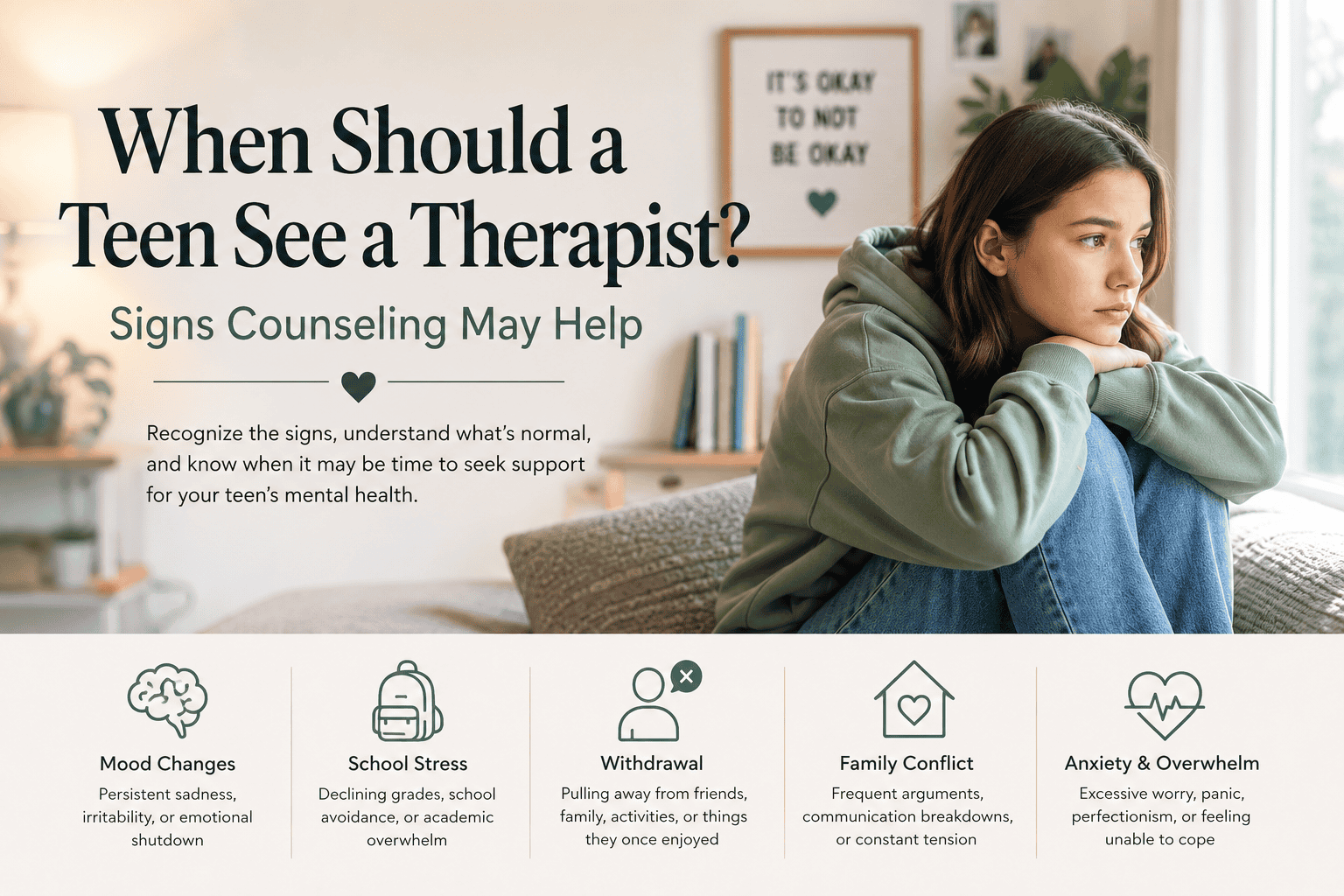
When Should a Teen See a Therapist? Signs Counseling May Help

Teen Counseling Resource Center

When Should a Teen See a Therapist?

Many teens experience stress, mood changes, frustration, and emotional ups and downs as part of normal development. However, when emotional struggles begin interfering with school, relationships, family life, self-esteem, or daily functioning, counseling may provide valuable support.

Start Here

Therapy Is Not Only for Crisis Situations

Parents sometimes wait to seek counseling because they are unsure whether their teen’s behavior is “serious enough.” Therapy can be helpful before a teen is in crisis. Counseling can support emotional wellness, coping skills, communication, confidence, school functioning, and family relationships.

A teen may benefit from therapy when mood, anxiety, stress, withdrawal, family conflict, school concerns, trauma responses, or emotional overwhelm are starting to affect everyday life. The goal is not to label the teen as broken. The goal is to give them a safe, supportive space to understand what they are feeling and build healthier ways to cope.

Teen Counseling Services

Normal Teen Behavior or Something More?

It Can Be Hard to Know When to Be Concerned

Teenagers are growing emotionally, socially, physically, and neurologically. They may want more independence, question rules, experience mood shifts, become more private, and feel stronger pressure from peers, school, and identity development. Some of this is expected during adolescence.

The concern increases when changes are persistent, intense, worsening, or interfering with daily functioning. A single bad day is different from weeks or months of withdrawal, anxiety, irritability, sadness, hopelessness, school avoidance, sleep disruption, or family conflict.

A helpful question for parents is: “Is this affecting my teen’s ability to function, connect, cope, or feel like themselves?”

Common Signs

Signs a Teen May Benefit From Therapy

Counseling may be helpful when emotional, behavioral, physical, or relational changes begin to interfere with a teen’s life or the family’s ability to support them.

Mood Changes

Persistent sadness, irritability, anger, hopelessness, emotional shutdown, or feeling unlike themselves may signal a need for support.

Anxiety or Panic

Excessive worry, panic symptoms, perfectionism, social fear, reassurance seeking, or avoidance can make daily life feel overwhelming.

Withdrawal

Pulling away from family, friends, hobbies, sports, church, activities, or things they used to enjoy may be a warning sign.

Low Motivation

A teen may stop trying, avoid responsibilities, fall behind, or feel unable to start tasks that once felt manageable.

Sleep or Appetite Changes

Sleeping too much, too little, staying up all night, fatigue, appetite changes, or stress-related physical symptoms may matter.

Emotional Shutdown

Some teens go quiet, numb, flat, disconnected, or unable to explain what is wrong even when they are clearly not okay.

School Concerns

School Stress Can Be a Major Sign That a Teen Needs Support

School functioning is often one of the first places parents notice a change. A teen may begin missing assignments, avoiding school, struggling to concentrate, dropping grades, becoming overwhelmed by tests, or losing motivation. Sometimes this reflects anxiety, depression, perfectionism, burnout, social stress, ADHD-related concerns, trauma responses, or emotional overwhelm.

Therapy can help teens identify what is making school feel unmanageable and build strategies for coping, planning, communicating, and managing stress.

School-related signs may include:

  • Declining grades or missing assignments
  • School avoidance or frequent requests to stay home
  • Test anxiety, panic, or freezing under pressure
  • Perfectionism and fear of mistakes
  • Difficulty concentrating or completing work
  • Loss of interest in future goals
  • Academic burnout or emotional exhaustion

Related resource: Teen Anxiety and School Stress.

Family and Relationships

Therapy May Help When Family Communication Feels Stuck

Parent-teen conflict can become exhausting when the same conversations repeatedly turn into arguments, shutdown, defensiveness, sarcasm, or silence. Teens may feel criticized or misunderstood, while parents may feel worried, ignored, or unsure how to help.

Counseling can help families understand the pattern underneath the conflict and build healthier communication, emotional safety, and repair.

Family-related signs may include:

  • Frequent arguments or escalating conflict
  • Communication shutting down quickly
  • Teen withdrawal from family connection
  • Difficulty discussing school, behavior, or emotions
  • Parent concern about major changes in mood or functioning
  • Blended family stress, divorce adjustment, grief, or major transitions

Related resource: Parent-Teen Communication Struggles.

Mood and Anxiety

Teen Anxiety and Depression Do Not Always Look Obvious

Teen anxiety may look like irritability, perfectionism, avoidance, overthinking, reassurance seeking, panic symptoms, stomachaches, headaches, or refusing to do things that feel overwhelming. Teen depression may look like withdrawal, low motivation, emotional numbness, anger, sleep changes, appetite changes, or loss of interest.

Parents sometimes assume a teen is being lazy, dramatic, defiant, or disrespectful when the teen is actually struggling with emotional overload. Therapy can help clarify what is happening and support the teen with coping skills, communication, and emotional regulation.

Anxiety Depression Withdrawal Low motivation School stress Family conflict Emotional overwhelm Trauma responses

Safety Concerns

Some Signs Require Immediate Support

Some concerns should be taken seriously right away. If a teen talks about wanting to die, not wanting to be here, feeling like a burden, self-harm, suicide, or feeling unsafe, parents should seek immediate crisis support or emergency care.

If a teen may be at risk of self-harm or suicide, call or text 988 for the Suicide & Crisis Lifeline, call 911, go to the nearest emergency room, or contact local crisis services. See our Crisis Resources Page for a list of additional emergency & crisis services.

Do not leave a teen alone if there is an immediate safety concern. Remove access to weapons, medications, or other means of self-harm when possible.

Urgent warning signs may include:

  • Talking or writing about death, suicide, or not wanting to live
  • Self-harm or threats of self-harm
  • Giving away belongings or saying goodbye
  • Sudden hopelessness or feeling like a burden
  • Risky behavior that seems out of character
  • Sudden calm after a period of severe distress

How Teen Counseling Helps

Therapy Gives Teens a Safe Place to Build Skills and Feel Understood

Teen counseling provides a supportive space where adolescents can talk about what they are experiencing, understand their emotions, identify stressors, and learn healthier coping strategies. Therapy can also help teens improve communication, strengthen self-esteem, process difficult experiences, and develop more effective ways to manage stress.

Counseling may include individual therapy, parent consultation, family support, trauma-informed therapy, EMDR-informed care when appropriate, coping skills, emotional regulation, and support for school or relationship stress.

Teen counseling may help with:

  • Anxiety, panic, and excessive worry
  • Depression, sadness, irritability, or withdrawal
  • School stress and academic pressure
  • Family conflict and communication struggles
  • Trauma responses and emotional triggers
  • Low self-esteem and identity concerns
  • Grief, loss, and life transitions
  • Coping skills and emotional regulation

For Parents

How to Talk to a Teen About Starting Therapy

How therapy is introduced matters. Teens may feel defensive if counseling is presented as punishment or proof that something is wrong with them. A calmer approach can help therapy feel like support rather than criticism.

Instead of saying:

  • “You need therapy.”
  • “Something is wrong with you.”
  • “You have to talk to someone because you are acting badly.”

Try saying:

  • “I’ve noticed you seem overwhelmed lately, and I want you to have support.”
  • “You do not have to handle this alone.”
  • “Therapy could give you a private space to talk with someone who is not here to judge you.”
  • “We can take it one step at a time and see if it feels helpful.”

Parents do not have to have the perfect words. Calm concern, curiosity, and patience often matter more than a perfect explanation.

Learning Center

Continue Learning About Teen Mental Health and Counseling Support

These related resources can help parents and teens better understand anxiety, depression, school stress, family communication, trauma responses, and therapy options.

Start Counseling

Support for Teens and Families

If your teen is struggling with mood changes, anxiety, school stress, withdrawal, family conflict, trauma responses, or emotional overwhelm, counseling can help you explore the right next step.

×

Attachment Styles in Relationships: How Attachment Patterns Affect Trust, Conflict, and Emotional Safety

Couples Counseling Resource Center

Attachment Styles in Relationships

Attachment patterns can shape how adults experience trust, closeness, conflict, reassurance, vulnerability, and emotional safety in romantic relationships. Understanding attachment styles can help partners move beyond blame and begin recognizing the deeper needs and fears underneath repeated relationship patterns.

Explore Couples Counseling

Start Here

Attachment Patterns Influence How We Reach for Connection

In adult relationships, attachment patterns often show up in the moments when people feel vulnerable, rejected, criticized, misunderstood, ignored, or afraid of losing connection. One person may reach for reassurance, while another may pull away to feel safe. One partner may want to talk immediately, while the other may need space before they can respond.

Attachment styles are not meant to label people as good or bad partners. They are a way of understanding how a person learned to protect themselves emotionally and how those protective patterns may affect present-day relationships.

Couples Counseling Services

Attachment Styles

What Are Attachment Styles?

Attachment styles describe common patterns in how people relate to closeness, emotional needs, trust, dependence, independence, conflict, and reassurance. These patterns often develop from early experiences, but they can also be shaped by later relationships, trauma, loss, betrayal, and repeated emotional experiences.

Secure Attachment

Secure attachment often involves comfort with closeness, healthy independence, repair after conflict, and the ability to ask for support.

Anxious Attachment

Anxious attachment may involve fear of rejection, strong needs for reassurance, sensitivity to distance, and worry about abandonment.

Avoidant Attachment

Avoidant attachment may involve discomfort with vulnerability, a strong need for independence, emotional withdrawal, or shutting down.

Fearful-Avoidant Patterns

Fearful-avoidant patterns may include wanting closeness while also fearing it, leading to push-pull dynamics in relationships.

Relationship Cycles

Attachment patterns often become most visible during conflict, disconnection, stress, or moments of emotional vulnerability.

Healing Is Possible

Attachment patterns can change through awareness, emotional safety, therapy, repair, and repeated experiences of secure connection.

Free Attachment Style Quiz

Want to Identify Your Relationship Attachment Style?

If you are curious about how attachment patterns may show up in your relationship, you can take our free Relationship Attachment Style Quiz. The quiz is designed to help individuals and couples reflect on patterns related to reassurance, closeness, independence, emotional safety, and conflict.

This quiz can be especially helpful for couples because each partner may have a different attachment pattern. Understanding those patterns can make it easier to see why one person may pursue reassurance while the other may withdraw, shut down, or need space during conflict.

No personal information is required. The quiz does not ask for your name, email address, phone number, or other identifying information. It is offered for informational and self-reflection purposes only and is not a diagnosis or formal psychological assessment.

After completing the quiz, you will receive a general attachment-style result, such as secure, anxious, avoidant, mixed/fearful-avoidant, or blended. The result is meant to support awareness and conversation, not label either partner as the problem.

Explore Couples Counseling

Secure Attachment

Secure Attachment Supports Trust, Repair, and Emotional Safety

Secure attachment does not mean a person never feels insecure, anxious, hurt, or frustrated. It means the person generally has an internal sense that relationships can be safe, needs can be expressed, conflict can be repaired, and closeness does not have to erase independence.

In secure relationship patterns, partners are usually better able to ask for support, listen during conflict, take responsibility, tolerate emotional vulnerability, and repair when something goes wrong. Secure attachment is not perfection; it is a pattern of responsiveness and repair.

Secure attachment may look like:

  • Being able to ask for comfort or reassurance directly
  • Feeling close without feeling trapped
  • Taking space without emotionally disappearing
  • Repairing after conflict
  • Trusting that disagreement does not mean abandonment
  • Balancing independence and connection

Anxious Attachment

Anxious Attachment Often Intensifies the Need for Reassurance

Anxious attachment patterns may show up when a person becomes highly sensitive to distance, changes in tone, delayed responses, emotional withdrawal, or signs that a partner may be upset. The person may deeply want connection but feel afraid that connection is fragile or could disappear.

This can lead to reassurance seeking, repeated questioning, intense worry, protest behaviors, or difficulty calming down until the relationship feels secure again.

Anxious attachment may sound like:

  • “Are you mad at me?”
  • “Do you still care?”
  • “Why are you being distant?”
  • “I feel like I matter less to you.”
  • “I need to talk about this right now.”
  • “If you loved me, you would understand why this hurts.”

The goal is not to shame the need for reassurance. The goal is to help the person express needs more clearly and build a stronger sense of internal and relational security.

Avoidant Attachment

Avoidant Attachment Often Protects Through Distance

Avoidant attachment patterns may show up when a person feels overwhelmed by emotional intensity, vulnerability, pressure, criticism, or dependence. The person may care deeply but struggle to stay emotionally present when conflict or closeness feels too much.

Avoidant patterns can look like withdrawal, shutting down, minimizing feelings, needing space, focusing on logic, or becoming uncomfortable when a partner asks for emotional reassurance. From the outside, this may look uncaring. From the inside, it may feel like trying to stay regulated or avoid making things worse.

Avoidant attachment may sound like:

  • “I do not want to talk about this right now.”
  • “You are making this too big.”
  • “I need space.”
  • “I do not know what you want me to say.”
  • “I feel like nothing I say is right.”
  • “Can we just move on?”

Avoidance is often a protective strategy. Therapy can help partners understand the fear or overwhelm underneath distance while also building healthier ways to stay connected during difficult moments.

Fearful-Avoidant Patterns

Some People Want Closeness and Fear It at the Same Time

Fearful-avoidant attachment patterns can involve a painful push-pull experience. A person may deeply want closeness but feel unsafe when closeness becomes real. They may reach for connection and then pull away, test the relationship, become suspicious of care, or feel overwhelmed by vulnerability.

These patterns may be connected to inconsistent, painful, frightening, or confusing relationship experiences. Healing often involves building emotional safety slowly, learning to recognize triggers, and developing more stable ways to communicate needs and boundaries.

Fearful-avoidant patterns may include:

  • Wanting reassurance but struggling to trust it
  • Feeling drawn to closeness and then needing distance
  • Expecting rejection even when a partner is trying to connect
  • Becoming overwhelmed by vulnerability
  • Testing whether a partner will stay
  • Feeling unsure whether relationships are safe

Conflict Patterns

Attachment Styles Often Become Most Visible During Conflict

Attachment patterns may not be obvious when a relationship feels calm. They often become more visible when one or both partners feel rejected, criticized, ignored, controlled, pressured, misunderstood, or emotionally unsafe. Under stress, partners may move into familiar protective strategies.

One partner may pursue connection by asking questions, pushing for a conversation, or seeking reassurance. Another partner may protect themselves by withdrawing, becoming quiet, focusing on logic, or trying to end the conversation. The interaction can become a cycle where both partners feel hurt and neither feels understood.

Need for reassurance Fear of rejection Withdrawal Defensiveness Emotional flooding Criticism Shutdown Repair

How Counseling Helps

Therapy Can Help Partners Build More Secure Relationship Patterns

Relationship counseling can help partners understand how attachment patterns show up in conflict, closeness, emotional needs, reassurance, and repair. Rather than blaming one partner for being “too needy” or the other for being “too distant,” therapy helps the couple understand the emotional cycle and the protective strategies each person uses.

Attachment-focused therapy, including Emotionally Focused Therapy for couples, can help partners communicate softer emotions, ask for needs more clearly, respond with greater emotional safety, and create new experiences of trust and connection.

Counseling may help couples:

  • Identify attachment patterns without blame
  • Understand the pursue-withdraw cycle
  • Recognize emotional triggers
  • Communicate needs more directly
  • Reduce defensiveness, criticism, and shutdown
  • Build emotional safety and trust
  • Repair after conflict more effectively
  • Create more secure patterns of connection

Learning Center

Continue Learning About Relationships, Attachment, and Emotional Safety

These related resources can help couples understand conflict cycles, emotional needs, attachment-based therapy, trauma responses, and relationship counseling options.

Emotional Disconnection in Relationships

Learn why couples can feel emotionally distant, lonely, or disconnected even when they still care about each other, and how counseling may help rebuild emotional safety, communication, and repair.

Read article →

Why Couples Get Stuck in the Same Arguments

Understand the conflict cycle beneath repeated arguments, defensiveness, withdrawal, and emotional flooding.

Read article →

Couples Counseling

Learn how couples counseling can help partners improve communication, reduce conflict, and rebuild connection.

View service page →

Emotionally Focused Therapy for Couples

Learn how EFT helps couples identify negative cycles and strengthen emotional safety and connection.

Read article →

Individual Counseling

Individual therapy can help clients understand emotional triggers, anxiety, trauma responses, and relationship patterns.

View service page →

Anxiety Counseling

Anxiety can affect reassurance seeking, fear of rejection, avoidance, communication, and emotional closeness.

View service page →

Trauma-Informed Therapy

Past experiences can shape how people respond to closeness, conflict, trust, rejection, and emotional safety.

View service page →

Emotional Safety in Relationships

A future resource on how couples can create safer conversations, deeper trust, and healthier repair.

Read article →

High-Functioning Anxiety?

Learn how anxiety can hide behind achievement, perfectionism, overthinking, people-pleasing, and constant productivity.

Read article →

How to Ask for Reassurance

A future guide on expressing needs without criticism, panic, pressure, or emotional shutdown.

Coming soon →

Repair After Conflict

A future article about apologies, accountability, emotional repair, and reconnecting after arguments.

Coming soon →

Start Counseling

Support for Attachment Patterns in Relationships

If attachment patterns are affecting trust, closeness, communication, reassurance, or emotional safety in your relationship, counseling can help you understand the cycle and begin building healthier patterns of connection.

Explore Couples Counseling
×
×

Emotionally Focused Therapy for Couples: How EFT Helps Partners Reconnect

Couples Counseling Resource Center

Emotionally Focused Therapy for Couples

Emotionally Focused Therapy, often called EFT, is an attachment-based approach to couples counseling that helps partners understand the emotional patterns beneath conflict, distance, defensiveness, and disconnection. Rather than focusing only on communication techniques, EFT helps couples identify the deeper needs, fears, and protective responses that keep them stuck.

Start Here

EFT Helps Couples Understand the Pattern Beneath the Problem

Many couples enter counseling because they keep having the same arguments, feel emotionally distant, struggle to repair after conflict, or do not know how to talk without one or both partners becoming defensive. The visible issue may be communication, parenting, intimacy, money, trust, household responsibilities, or time together. EFT looks underneath those surface issues to understand the emotional cycle that keeps pulling the couple into pain.

In EFT, the problem is not viewed as one partner being “the problem.” Instead, therapy helps both partners see the pattern they are caught in together. When couples can name the cycle, slow it down, and understand the softer emotions beneath blame or withdrawal, they often become more able to respond to each other with care, honesty, and emotional safety.

Couples Counseling Services

What Is EFT?

Emotionally Focused Therapy Is an Attachment-Based Couples Therapy

EFT focuses on the emotional bond between partners. It helps couples understand how they reach for connection, protect themselves from hurt, respond to fear, and react when they feel criticized, rejected, dismissed, alone, or emotionally unsafe.

Emotional Connection

EFT helps couples move beyond surface arguments and better understand the need for closeness, reassurance, trust, and emotional responsiveness.

Negative Cycles

Couples learn to identify the repeated pattern that turns stress, hurt, or misunderstanding into conflict, shutdown, or distance.

Protective Reactions

Defensiveness, criticism, withdrawal, and emotional shutdown are often protective responses to deeper feelings of fear, hurt, shame, or loneliness.

The Negative Cycle

EFT Helps Couples Stop Seeing Each Other as the Enemy

When couples are distressed, it can feel like the other person is the problem. One partner may seem too critical, too withdrawn, too emotional, too distant, too defensive, or too demanding. EFT helps couples shift the focus from blaming each other to understanding the cycle that keeps both partners feeling hurt and disconnected.

For example, one partner may pursue conversation because they feel alone and need reassurance. The other partner may withdraw because they feel overwhelmed and afraid of making things worse. The more one partner pursues, the more the other pulls away. The more one partner pulls away, the more desperate or frustrated the other becomes. Both partners may be trying to protect themselves, but the pattern leaves both feeling unseen.

Common negative cycles include:

  • Pursue and withdraw
  • Criticize and defend
  • Attack and retreat
  • Shut down and escalate
  • Overfunction and underfunction
  • Blame and counter-blame
  • Reach for closeness and brace for rejection

EFT helps couples see the cycle as the shared problem. This can reduce blame and create room for curiosity, compassion, and repair.

Attachment Needs

Many Relationship Conflicts Are About Emotional Safety

EFT is rooted in the understanding that adult partners often need to feel emotionally safe, valued, chosen, and connected. When those needs feel threatened, the nervous system may react quickly. A partner may become louder, quieter, more critical, more distant, more anxious, or more guarded.

The question underneath the conflict is often not simply, “Who is right?” It may be, “Are you there for me?” “Do I matter to you?” “Can I trust you?” “Will you respond when I need you?”

EFT explores questions like:

  • What happens inside each partner during conflict?
  • What does each partner fear will happen if they are vulnerable?
  • How does each partner try to protect themselves?
  • What does each partner need but struggle to ask for clearly?
  • How can the couple create safer moments of reaching and responding?

When partners can express softer emotions and attachment needs more clearly, the relationship can begin to feel less like a battlefield and more like a place where both people can be understood.

What Sessions Look Like

What Happens in EFT Couples Counseling?

EFT sessions often focus on slowing down the moments when a couple gets stuck. The therapist may help partners identify what triggered the conflict, what each person felt inside, what protective response came out, and how the other partner experienced that response.

The goal is not simply to teach a script. Communication tools can be helpful, but EFT goes deeper by helping couples experience each other differently. Partners practice recognizing the cycle, naming vulnerable feelings, listening with more openness, and responding in ways that create emotional safety.

EFT sessions may include:

  • Identifying the couple’s negative interaction cycle
  • Slowing down conflict moments
  • Understanding each partner’s emotional experience
  • Exploring attachment needs and fears
  • Helping partners express softer emotions
  • Reducing blame, defensiveness, and withdrawal
  • Creating new conversations that build connection
  • Strengthening repair after conflict

How EFT Helps

EFT Can Support Couples Facing Many Relationship Concerns

Couples may seek EFT because they feel stuck, disconnected, emotionally reactive, or unsure how to repair after hurt. EFT can be especially helpful when couples want to understand the emotional pattern beneath repeated conflict.

Recurring Conflict

EFT helps couples understand why the same arguments keep returning and how to interrupt the cycle before it escalates.

Emotional Distance

Partners may learn how distance developed, what each person is protecting, and how to create safer closeness.

Trust and Safety

EFT can help couples rebuild emotional safety by improving responsiveness, vulnerability, and repair.

Relationship Injuries

When there have been painful moments, EFT can help partners talk about hurt in ways that support repair rather than more harm.

Life Transitions

Parenting, work stress, grief, health concerns, family changes, or major transitions can strain connection and communication.

Emotional Reconnection

EFT helps partners create new experiences of being seen, heard, valued, and emotionally important to one another.

Communication and Emotional Safety

EFT Is Not Just About Communicating More Clearly

Many couples have already tried to communicate better. They may have read articles, listened to podcasts, agreed to stay calmer, or promised not to argue the same way again. Those efforts may help temporarily, but if the deeper emotional cycle is unchanged, the couple may still return to the same painful pattern.

EFT helps couples understand what happens emotionally when communication breaks down. It helps partners recognize when they are reacting from fear, shame, loneliness, or a sense of rejection. As emotional safety improves, communication often becomes more honest, less defensive, and more connected.

Less blame More emotional safety Less withdrawal More responsiveness Less defensiveness More repair Less escalation More connection

Therapist Spotlight

Work With Carolina Román for EFT-Focused Couples Counseling

At Motivations Counseling, Carolina Román works with couples using an attachment-focused approach that helps partners better understand one another, reduce negative interaction cycles, and strengthen emotional connection. Her experience and focus with EFT for couples can be especially helpful for partners who feel stuck in repeated arguments, emotional distance, defensiveness, or difficulty repairing after conflict.

Carolina’s work with couples emphasizes emotional safety, connection, and understanding what is happening beneath the surface of conflict. Rather than focusing only on who is right or wrong, EFT helps couples identify the relationship pattern, communicate underlying needs more clearly, and create new experiences of responsiveness and trust.

Learn More About Carolina Román

Learning Center

Continue Learning About Couples Counseling and Relationship Patterns

These related resources can help couples better understand conflict cycles, communication patterns, emotional safety, trauma responses, and relationship counseling options.

Emotional Disconnection In Relationships

Learn why couples can feel emotionally distant, lonely, or disconnected even when they still care about each other, and how counseling may help rebuild emotional safety, communication, and repair.

Read article →

Why Couples Get Stuck in the Same Arguments

Understand the conflict cycle beneath repeated arguments, defensiveness, withdrawal, and emotional flooding.

Read article →

Couples Counseling

Learn how couples counseling can help partners improve communication, repair conflict, and rebuild emotional connection.

View service page →

Emotional Safety in Relationships

A future resource on how couples can create safer conversations, deeper trust, and healthier repair.

Read article →

Attachment Styles and Relationships

A future article on how attachment patterns can influence closeness, conflict, reassurance, and withdrawal.

Read article →

Repair After Conflict

A future guide on apologies, accountability, emotional repair, and reconnecting after arguments.

Coming soon →

Trauma-Informed Therapy

Past experiences can shape how people respond to closeness, conflict, trust, rejection, and emotional safety.

View service page →

Individual Counseling

Individual therapy can help clients understand emotional triggers, anxiety, trauma responses, and relationship patterns.

View service page →

Anxiety Counseling

Anxiety can affect reassurance seeking, avoidance, conflict, communication, and emotional closeness.

View service page →

EMDR Therapy

EMDR may help clients process distressing memories, triggers, and negative beliefs that affect present-day relationships.

View service page →

Start Counseling

Interested in EFT Couples Counseling?

If you and your partner feel stuck in the same painful cycle, EFT couples counseling may help you better understand what is happening beneath the conflict and begin rebuilding emotional safety, trust, and connection.

×

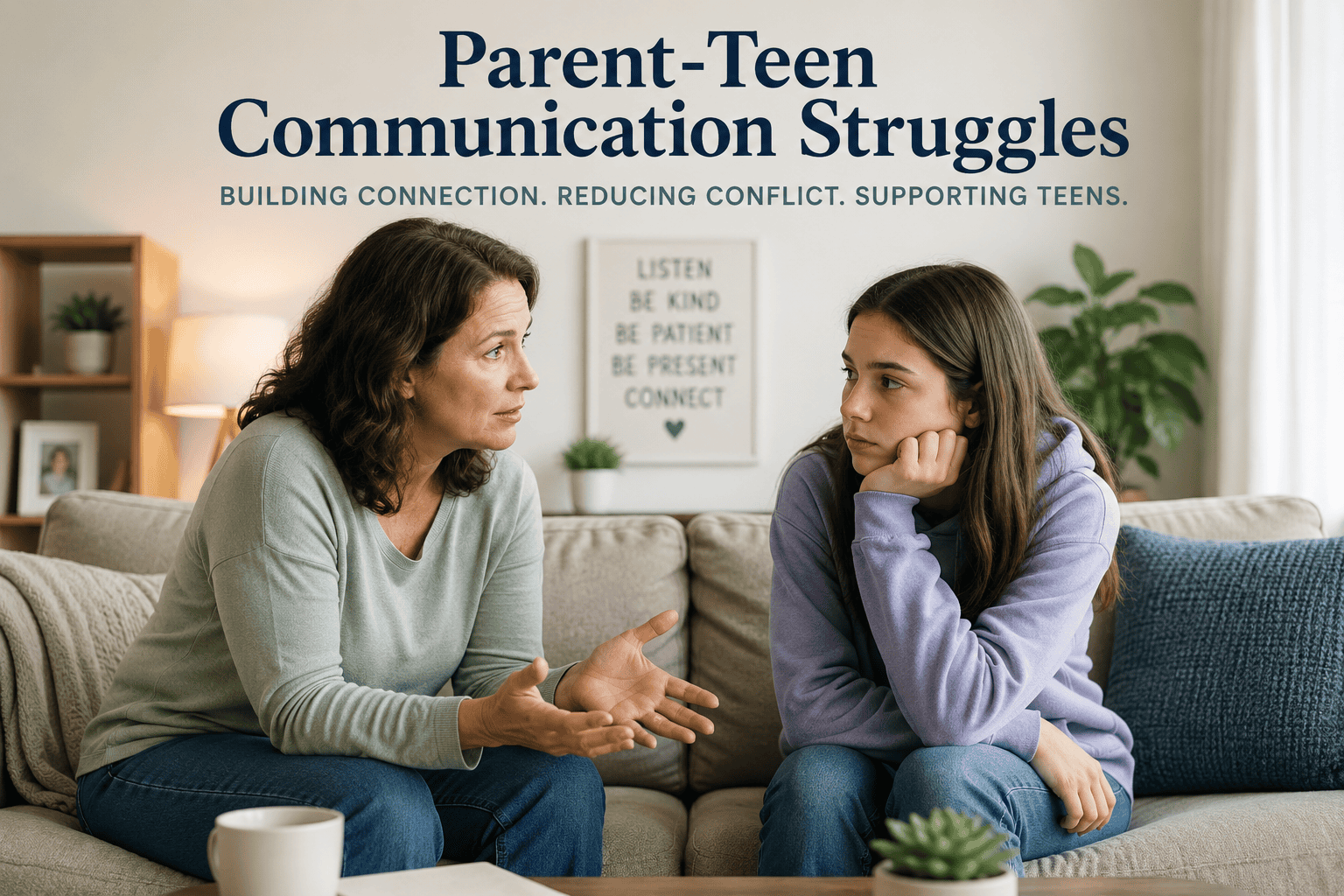
Parent-Teen Communication Struggles: How Therapy Can Help Families Reconnect

Teen Counseling Resource Center

Parent-Teen Communication Struggles

Communication between teens and caregivers can become strained when stress, independence, emotions, expectations, and conflict all collide. Therapy can help families reduce conflict, improve emotional safety, and build healthier communication patterns that support both connection and accountability.

Start Here

Communication Problems Are Often About More Than Words

Parent-teen communication struggles are rarely just about tone, attitude, or whether a teen will “open up.” Underneath the conflict, families may be dealing with stress, anxiety, depression, school pressure, changing independence, hurt feelings, mistrust, or emotional overwhelm.

A teen may shut down because they feel criticized, judged, misunderstood, or afraid of disappointing their parent. A parent may push harder because they feel worried, disrespected, ignored, or unsure how to help. Both sides may care deeply, but the conversation still turns into defensiveness, arguing, silence, or distance.

Teen Counseling Services

Why It Gets Hard

Why Communication Between Parents and Teens Can Become So Difficult

The teenage years involve major emotional, social, developmental, and family changes. Teens are trying to form identity and independence, while parents are still responsible for safety, guidance, structure, and accountability.

Growing Independence

Teens often want more privacy, freedom, and decision-making power, while parents may still feel responsible for protecting them.

Big Emotions

Stress, anxiety, depression, shame, or frustration can make calm conversations harder for both teens and parents.

School Pressure

Grades, homework, college planning, friendships, and activities can add pressure that spills into family communication.

Shutdown

Teens may stop talking when conversations feel unsafe, repetitive, judgmental, overwhelming, or unlikely to help.

Defensiveness

Parents and teens may both become defensive when they feel blamed, misunderstood, criticized, or unheard.

Repeating Cycles

Families can fall into predictable patterns where the same conversations lead to the same arguments or silence.

Common Patterns

Parent-Teen Conflict Often Follows a Predictable Cycle

Many families describe feeling stuck in the same communication loop. The parent asks a question, the teen gives a short answer, the parent pushes for more information, the teen becomes defensive or shuts down, and the parent becomes more frustrated or worried. The conversation then ends with both people feeling unheard.

These cycles are painful because each person is usually reacting to their own fear or frustration. The parent may be thinking, “I am trying to help, and they are shutting me out.” The teen may be thinking, “No matter what I say, I am going to be judged or lectured.”

Common communication patterns include:

  • Lecturing instead of listening
  • Defensiveness on both sides
  • Short answers, silence, or avoidance
  • Escalating tone or sarcasm
  • Repeating the same argument without repair
  • Parents feeling ignored or disrespected
  • Teens feeling criticized or misunderstood

The goal is not to make every conversation perfect. The goal is to help families recognize the pattern early enough to respond differently.

Emotional Safety

Teens Are More Likely to Talk When They Feel Emotionally Safe

Emotional safety does not mean teens get to avoid responsibility or that parents cannot set limits. It means the teen believes they can be honest without being mocked, shamed, dismissed, attacked, or immediately lectured.

When teens feel emotionally safe, they are more likely to share what is happening, ask for help, admit mistakes, and tolerate difficult conversations. When they do not feel safe, they may hide, deny, shut down, or become defensive.

Emotional safety may sound like:

  • “I want to understand before I respond.”
  • “You are not in trouble for having feelings.”
  • “I may still set a limit, but I want to hear you.”
  • “Help me understand what felt hard about that.”
  • “I am going to pause so this does not turn into a fight.”
  • “We can come back to this when we are calmer.”

Emotional safety helps create space for honesty, accountability, and repair. It is not permissiveness; it is a foundation for better communication.

Reducing Conflict

Families Often Need Fewer Lectures and More Repair

When parents feel worried, they may explain more, repeat themselves, or push harder for change. While this comes from concern, teens may experience it as criticism or pressure. When teens feel criticized, they may shut down, argue, or avoid. This can make parents feel even more worried, and the cycle continues.

Repair means returning to the relationship after a difficult interaction. It may involve apologizing for tone, clarifying intention, taking responsibility, validating feelings, or reopening the conversation with more calm.

Less lecturing More curiosity Less sarcasm More repair Less shutdown More listening Less escalation More clarity

For Parents

How Parents Can Support Healthier Communication

Parents do not have to be perfect communicators. Small changes in timing, tone, curiosity, and repair can make a meaningful difference. A teen who refuses to talk during conflict may be more open later when the conversation is calmer and less pressured.

Helpful parent strategies include:

  • Choose calmer times for important conversations.
  • Lead with curiosity before correction.
  • Reflect what you heard before offering advice.
  • Avoid turning every conversation into a lesson.
  • Set limits clearly without shaming.
  • Notice and repair your own tone when needed.
  • Ask what kind of support your teen wants before problem-solving.

Teens often need both connection and structure. Counseling can help families find a healthier balance between emotional support, boundaries, independence, and accountability.

How Counseling Helps

Therapy Can Help Families Change the Communication Pattern

Therapy can help parents and teens slow down the conflict cycle, understand what is happening underneath the arguments, and practice healthier ways to talk. Counseling is not about blaming the parent or blaming the teen. It is about helping the family identify the pattern clearly enough to respond differently.

Depending on the situation, therapy may involve teen counseling, parent consultation, family sessions, or a combination. The goal is to support the teen’s emotional health while also helping caregivers communicate with more confidence, calm, and clarity.

Counseling may focus on:

  • Reducing parent-teen conflict
  • Improving emotional safety
  • Helping teens express feelings more clearly
  • Helping parents listen without immediately lecturing
  • Supporting boundaries, accountability, and independence
  • Addressing anxiety, depression, school stress, or emotional shutdown
  • Improving repair after arguments
  • Creating healthier family communication patterns

When to Seek Help

Signs Family Communication May Need Support

Counseling may be helpful when conversations repeatedly lead to conflict, shutdown, avoidance, emotional distance, or escalating tension.

Your Teen Has Stopped Talking

They avoid conversations, give one-word answers, or shut down whenever important topics come up.

Conversations Escalate Quickly

Small issues turn into arguments, raised voices, sarcasm, defensiveness, or emotional distance.

The Same Conflict Repeats

The family keeps returning to the same arguments about school, respect, screens, responsibilities, or trust.

Trust Feels Strained

Parents and teens may feel guarded, misunderstood, resentful, or unsure how to reconnect.

Mental Health Is Affected

Anxiety, depression, school stress, irritability, withdrawal, or emotional shutdown are affecting the relationship.

You Want to Repair

The family wants things to improve but does not know how to stop repeating the same painful communication cycle.

Learning Center

Continue Learning About Teen Mental Health and Family Communication

These related resources can help families better understand teen emotions, anxiety, depression, school stress, counseling options, and healthier communication patterns.

Start Counseling

Support for Parent-Teen Communication Struggles

If communication with your teen has become tense, distant, or repeatedly stuck in conflict, counseling can help your family build healthier patterns of listening, boundaries, emotional safety, and repair.

×

Signs a Teen May Be Depressed: What Parents Should Notice

Teen Counseling Resource Center

Signs a Teen May Be Depressed

Depression in teens may not always look like sadness. It can show up as irritability, withdrawal, sleep changes, low motivation, emotional shutdown, loss of interest, changes in appetite, or a decline in school functioning. Parents may notice that their teen seems different, disconnected, easily frustrated, or unable to enjoy things that used to matter.

Start Here

Teen Depression Can Look Different Than Adult Depression

Many parents expect depression to look like constant sadness or crying. While some teens do appear sad, others may look angry, numb, distant, tired, restless, unmotivated, or emotionally shut down. A teen may say they are “fine” while their behavior, sleep, schoolwork, friendships, or mood suggest that something deeper is happening.

Depression can affect how a teen thinks, feels, behaves, relates to others, and functions at school. It may interfere with motivation, concentration, self-worth, decision-making, energy, and the ability to experience pleasure or connection.

Teen Counseling Services

Warning Signs

Common Signs a Teen May Be Depressed

Depression may develop gradually, and parents may initially wonder whether the changes are “normal teenage moodiness.” A pattern of changes that lasts, worsens, or interferes with daily functioning deserves attention.

Irritability or Anger

A depressed teen may seem easily annoyed, reactive, impatient, argumentative, or unusually sensitive to feedback.

Withdrawal

Teens may pull away from family, friends, activities, hobbies, sports, church, or social situations they once enjoyed.

Sleep Changes

Depression may involve sleeping much more, sleeping too little, staying up late, struggling to wake up, or feeling tired all day.

Low Motivation

A teen may stop trying, avoid responsibilities, fall behind, or seem unable to start tasks that used to feel manageable.

Emotional Shutdown

Some teens feel numb, disconnected, flat, or unable to explain what is wrong, even when they know they are not okay.

School Changes

Depression may affect grades, attendance, concentration, homework completion, classroom participation, or relationships at school.

Irritability

Teen Depression May Show Up as Anger, Not Sadness

Parents may expect a depressed teen to look visibly sad, but many teens express depression through irritability, frustration, or anger. They may snap over small things, react strongly to limits, become defensive, or seem like they are pushing everyone away.

This does not mean every angry teen is depressed. However, if irritability is persistent, intense, or paired with withdrawal, sleep changes, hopelessness, low motivation, or loss of interest, it may be a sign that something more serious is happening underneath the surface.

Sometimes anger is the emotion parents can see, while sadness, shame, loneliness, hopelessness, or emotional exhaustion are hidden underneath.

Withdrawal

Pulling Away Can Be a Sign of Emotional Overload

A depressed teen may spend more time alone, stop responding to friends, avoid family conversations, lose interest in hobbies, or seem emotionally unavailable. Parents may describe the teen as “not themselves” or “hard to reach.”

Withdrawal can be confusing because teens also naturally need privacy and independence. The concern increases when isolation is paired with mood changes, loss of interest, school decline, hopeless statements, or reduced daily functioning.

Withdrawal may look like:

  • Staying in the bedroom most of the time
  • Stopping activities or hobbies
  • Avoiding family meals or conversations
  • Pulling away from close friends
  • Not wanting to go places they used to enjoy
  • Appearing emotionally flat, numb, or disconnected

A teen who is withdrawing may not know how to ask for help. Gentle, steady connection can matter, even when a teen does not respond warmly at first.

School Functioning

Depression Can Affect Motivation, Concentration, and School Performance

Depression can make ordinary school tasks feel overwhelming. A teen may struggle to concentrate, remember assignments, complete homework, study for tests, attend class consistently, or care about grades. This may look like laziness from the outside, but depression can make effort feel emotionally and physically exhausting.

A teen may also avoid school because of shame. Once they fall behind, they may feel embarrassed, discouraged, or convinced they cannot catch up. This can create a painful cycle of avoidance, falling further behind, and feeling worse.

School-related signs may include:

  • Missing assignments or falling grades
  • Difficulty concentrating or remembering work
  • Skipping school or frequently asking to stay home
  • Loss of interest in future goals
  • Giving up quickly or saying, “What’s the point?”
  • Increased conflict about homework or responsibilities

Physical and Daily Changes

Depression Can Affect the Body and Daily Routines

Depression is not only emotional. Teens may experience changes in sleep, appetite, energy, hygiene, movement, headaches, stomachaches, or general physical complaints. Some teens feel heavy, slowed down, and exhausted. Others feel restless, tense, or unable to settle.

Parents may notice that routines become harder. A teen may stop taking care of themselves, struggle to get out of bed, avoid basic responsibilities, or seem drained by ordinary tasks.

Sleep changes Low energy Appetite changes Headaches Stomachaches Low motivation Isolation Emotional numbness

For Parents

How Parents Can Respond When They Are Concerned

It can be difficult to know how to respond when a teen seems depressed. Parents may feel scared, frustrated, helpless, or unsure whether to push harder or give more space. A helpful first step is to approach the teen with calm concern rather than criticism.

Instead of beginning with grades, chores, or attitude, parents can start by naming what they notice. For example: “I’ve noticed you seem more withdrawn lately, and I’m concerned about you.” This communicates care without turning the conversation into an argument.

Helpful parent responses include:

  • Use a calm tone and avoid shaming language.
  • Ask open-ended questions and allow silence.
  • Validate that things may feel hard, even if you do not fully understand.
  • Watch for changes in sleep, appetite, school, social life, and safety.
  • Offer counseling support rather than framing therapy as punishment.
  • Seek immediate help if there are safety concerns.

Parents do not have to solve everything in one conversation. Consistent, calm, nonjudgmental concern can help a teen feel less alone.

Safety Concerns

When Teen Depression Requires Immediate Support

Some signs require urgent attention. If a teen talks about wanting to die, not wanting to be here, feeling like a burden, self-harm, suicide, or having no reason to live, parents should take those statements seriously and seek immediate support.

If a teen may be at risk of self-harm or suicide, call or text 988 for the Suicide & Crisis Lifeline, call 911, go to the nearest emergency room, or contact local crisis services. See our Crisis Resources Page for a list of additional emergency & crisis services.

Do not leave a teen alone if there is an immediate safety concern. Remove access to weapons, medications, or other means of self-harm when possible.

Safety concerns may include:

  • Talking or writing about death, suicide, or not wanting to live
  • Self-harm or threats of self-harm
  • Giving away belongings or saying goodbye
  • Sudden hopelessness or feeling like a burden
  • Risky behavior that seems out of character
  • Sudden calm after a period of severe distress

How Counseling Helps

Teen Counseling Can Help Depression Feel Less Overwhelming

Teen counseling provides a supportive space for teens to talk about what they are experiencing, understand their emotions, develop coping skills, and identify patterns that may be contributing to depression. Therapy can also help teens communicate with parents, rebuild routines, improve emotional awareness, and develop a healthier sense of self-worth.

Counseling is not about blaming the teen or telling them to “just be positive.” It is about helping the teen feel seen, supported, and better equipped to manage what is happening internally and in daily life.

Counseling may focus on:

  • Understanding depression symptoms and triggers
  • Improving emotional expression and communication
  • Reducing isolation and avoidance
  • Building coping skills and daily routines
  • Addressing negative self-talk and hopeless thoughts
  • Supporting school functioning and motivation
  • Improving parent-teen communication
  • Creating a safety plan when needed

When to Seek Help

Signs It May Be Time for Professional Support

A teen does not have to be in crisis to benefit from counseling. Support may be helpful when depression symptoms are lasting, worsening, or interfering with daily functioning.

Your Teen Is Withdrawing

They are spending more time alone, avoiding friends or family, and no longer seem interested in connection.

Motivation Has Dropped

Your teen seems unable to start tasks, keep up with responsibilities, or care about things that used to matter.

School Is Affected

Grades, attendance, homework, concentration, or school relationships have changed significantly.

Sleep Has Changed

Your teen is sleeping too much, too little, staying up very late, or struggling to wake up.

Self-Worth Is Low

They frequently describe themselves as a failure, not good enough, hopeless, or a burden.

Safety Concerns Appear

Any talk of self-harm, suicide, not wanting to live, or feeling unsafe should be taken seriously.

Learning Center

Continue Learning About Teen Depression, Anxiety, and Emotional Health

These related resources can help parents and teens better understand depression, anxiety, school stress, emotional overwhelm, counseling options, and mental health support.

Start Counseling

Support for Teens Experiencing Depression

If your teen seems withdrawn, irritable, shut down, unmotivated, hopeless, or no longer like themselves, counseling can help them feel supported and better understood.

×