Why Does My Partner Need So Much Reassurance?
Couples Counseling & EFT Resource Center
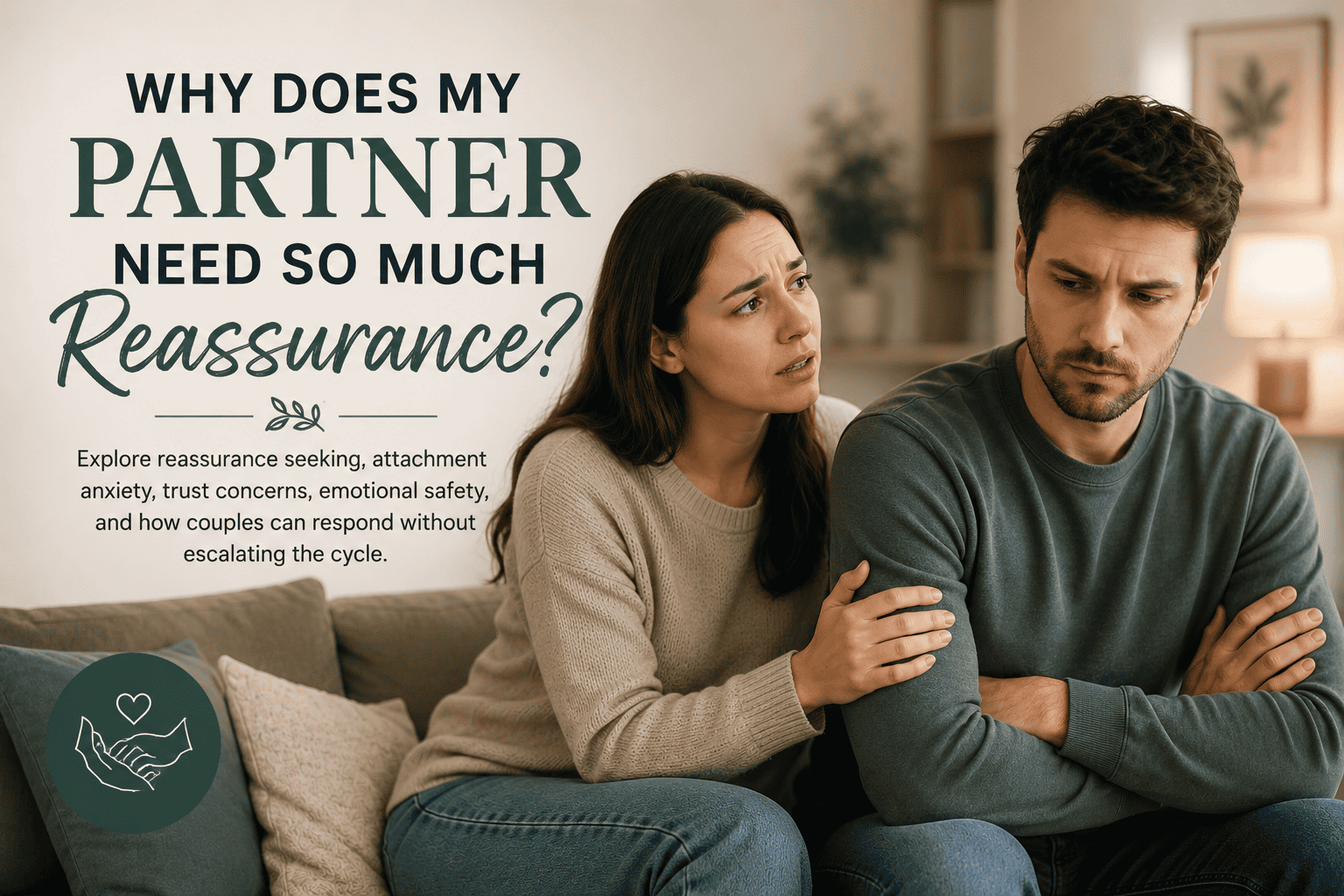
Why Does My Partner Need So Much Reassurance?
Reassurance can be a healthy part of a close relationship. Partners naturally want to know that they matter, that the bond is secure, and that conflict does not mean abandonment. Reassurance becomes exhausting, however, when relief lasts only a few minutes, the same questions return repeatedly, or one partner feels responsible for constantly proving love, loyalty, or safety. This pattern may involve attachment anxiety, unresolved hurt, current trust concerns, emotional inconsistency, or a cycle in which both partners become increasingly reactive.
Start Here
Reassurance Seeking Is Often an Attempt to Restore Safety
A reassurance-seeking partner is often trying to answer an emotionally urgent question: “Are we okay?” The visible question may be about a text message, facial expression, delayed response, past relationship, social event, or disagreement. Beneath it may be fear of rejection, betrayal, inadequacy, abandonment, or emotional disconnection.
Reassurance may bring temporary relief, but when the underlying fear remains unresolved, the nervous system begins searching again for certainty. The partner may ask the same question in a slightly different way, monitor tone or behavior, request more details, or interpret ordinary distance as evidence that something is wrong. The other partner may become frustrated, defensive, withdrawn, or less emotionally available—responses that can unintentionally confirm the original fear.
Frequent reassurance seeking is not always irrational. If there is current deception, inconsistent behavior, broken agreements, unexplained distance, or unresolved betrayal, the relationship may need greater honesty and accountability—not simply fewer questions.
Recognizing the Pattern
Reassurance Seeking Can Take Many Forms
Some requests are direct and vulnerable. Others appear as repeated questions, checking, testing, conflict, or attempts to eliminate uncertainty. Understanding the form helps couples respond to the need without reinforcing an exhausting cycle.
Repeated Questions
“Do you still love me?” “Are you mad?” or “Are you sure we are okay?” may return even after a clear answer has been given.
Looking for Hidden Meaning
A neutral tone, delayed text, brief response, or distracted expression may be examined for signs of rejection or dishonesty.
Checking and Monitoring
The partner may repeatedly check messages, online activity, location, schedules, or interactions to reduce uncertainty.
Urgent Need for Contact
Temporary distance may create a strong need for immediate replies, physical closeness, repeated affection, or confirmation that the bond is intact.
Testing the Relationship
A partner may withdraw, threaten to leave, become cold, or ask impossible questions to see whether the other person will pursue and prove their care.
Revisiting Old Injuries
Past conflicts, betrayals, or moments of disconnection may be brought up repeatedly because the emotional meaning still feels unresolved.
Why Reassurance Feels Necessary
The Need May Come From the Past, the Present, or Both
Reassurance seeking is not caused by one personality type. It may reflect attachment learning, relationship history, self-doubt, trauma, current instability, or a pattern created between the partners over time.
Early Attachment Learning
Inconsistent comfort, unpredictable caregiving, emotional absence, or separation may make closeness feel uncertain even in adulthood.
Past Betrayal or Abandonment
Infidelity, sudden breakups, deception, rejection, or emotional abandonment can increase alertness to signs that the injury may happen again.
Trauma and Hypervigilance
A nervous system shaped by threat may search intensely for changes in tone, distance, anger, secrecy, or loss of control.
Low Self-Worth
A person who expects to be unwanted, replaceable, or not enough may struggle to believe reassurance even when it is sincere.
Inconsistent Relationship Signals
Warmth followed by withdrawal, mixed messages, unreliable follow-through, or unpredictable availability can make reassurance feel continually necessary.
The Couple’s Interaction Cycle
One partner seeks more certainty while the other feels pressured and retreats, creating more fear and even stronger reassurance seeking.
Attachment Anxiety
Closeness May Feel Essential and Uncertain at the Same Time
A partner with anxious attachment patterns may be highly sensitive to changes in connection. They may notice distance quickly, seek reassurance urgently, and have difficulty settling until the relationship feels emotionally restored. Their distress is often less about wanting attention and more about fearing that the bond is weakening or disappearing.
Attachment anxiety may involve:
- Strong sensitivity to delayed responses, changed tone, or reduced affection
- Difficulty believing that conflict can occur without threatening the relationship
- Fear that a partner’s independence means rejection or loss of interest
- Repeated comparison with former partners, friends, coworkers, or social media contacts
- Urgency to resolve uncertainty immediately
- Temporary relief that fades quickly after reassurance is received
Avoid Oversimplifying
Not Every Concern Is “Just Anxiety”
Attachment language should not be used to dismiss legitimate questions. If a partner has been deceptive, emotionally inconsistent, unavailable, dismissive, or unwilling to honor relationship agreements, reassurance seeking may be a response to real instability.
Couples need to examine both the internal fear and the external relationship environment. One partner may need help tolerating uncertainty while the other needs to become more honest, predictable, responsive, or accountable.
Trust and Emotional Safety
Reassurance Cannot Substitute for Trustworthy Behavior
Words such as “You can trust me” may provide comfort, but trust develops through patterns that make the relationship more predictable. When words and actions repeatedly conflict, requests for reassurance often increase because the partner is trying to resolve evidence that does not fit together.
Trust is strengthened when partners:
- Communicate proactively rather than waiting to be questioned
- Follow through on agreements and acknowledge when they cannot
- Tell the truth even when honesty is uncomfortable
- Respond to concerns without ridicule, contempt, or deliberate confusion
- Maintain appropriate boundaries with former partners, friends, coworkers, and online contacts
- Repair hurt instead of demanding that it be forgotten
- Remain reasonably consistent during closeness, conflict, and ordinary daily life
Reassurance is most believable when it is supported by behavior. A warm statement, clear plan, and consistent follow-through usually provide more security than repeated promises without change.
The Reassurance Cycle
Short-Term Relief Can Keep the Fear Returning
The cycle often makes sense from both perspectives. One partner tries to remove uncertainty; the other tries to escape pressure. Each response unintentionally increases the other person’s distress.
A delayed reply, conflict, changed tone, social interaction, or memory of past hurt creates uncertainty.
The partner imagines rejection, betrayal, loss of love, anger, or abandonment.
Questions, checking, pursuit, testing, or demands for proof increase.
An answer reduces distress briefly, but the deeper fear remains unprocessed.
The other partner becomes defensive, irritated, distant, or less willing to engage.
The distance is interpreted as confirmation that the relationship is unsafe, and the cycle begins again.
Change the Cycle, Not the Partner
Both People Usually Need a Different Response
The reassurance-seeking partner may need to name the underlying fear, tolerate some uncertainty, and build internal ways to regulate. The other partner may need to respond with more warmth, clarity, consistency, and follow-through instead of contempt, argument, or disappearance. The goal is not zero reassurance. It is reassurance that supports connection without becoming the only way either person can feel safe.
For the Partner Receiving the Questions
Warmth and Clarity Usually Work Better Than Debate
Repeated reassurance can feel exhausting, especially when no answer seems to last. A compassionate response does not require answering indefinitely, surrendering privacy, or proving innocence on demand. It begins by responding to the emotion before deciding what practical information is reasonable.
Hear the Fear Beneath the Question
Respond to the concern—“You seem afraid that my distance means I am leaving”—instead of debating every detail immediately.
Offer Clear, Specific Reassurance
A grounded answer such as “I am upset about the issue, but I am committed to us” may be more useful than a vague “Everything is fine.”
Match Words With Behavior
Follow through on plans, communicate changes, and avoid secrecy so reassurance has evidence behind it.
Slow the Urgency
When the conversation becomes repetitive, agree to pause and revisit it at a specific time rather than escalating or disappearing.
Avoid Mocking or Shaming
Labels such as “needy,” “crazy,” or “obsessive” increase shame and make honest vulnerability less likely.
Set a Kind Limit
Acknowledge the fear, answer once clearly, and explain what you can discuss now and what needs a calmer conversation later.
Instead of: “I already answered you. Nothing I say is ever enough.”
Try: “I hear that you are still afraid. My answer has not changed, and I do not want us to keep repeating the same question tonight. I can sit with you for ten minutes, and tomorrow we can talk about what makes this fear return.”
Healthy Reassurance
Connection Can Include Comfort, Information, and Choice
Healthy reassurance is responsive without becoming compulsory. It may include affection, honest answers, clear plans, accountability, and reminders that conflict does not erase the bond. Both partners retain dignity, privacy, and the ability to say what they can reasonably provide.
Examples include:
- “I love you, and I am still committed even though we disagree.”
- “I will text when I arrive and let you know if the plan changes.”
- “I understand why this reminds you of what happened before.”
- “I can answer your question, but I cannot participate in repeated accusations.”
- “Let us identify what would help rebuild trust over time.”
When Reassurance Becomes Control
Fear Does Not Remove the Need for Boundaries
Reassurance seeking can become harmful when it turns into surveillance, forced access to private communication, isolation from friends or family, threats, interrogation, repeated accusations, punishment, or demands that one partner organize their entire life around preventing anxiety.
A partner can be compassionate about fear while still declining coercive or controlling behavior. If boundaries lead to threats, intimidation, stalking, or retaliation, safety assessment and individual support may be necessary.
For the Reassurance-Seeking Partner
Internal Reassurance Can Support—Not Replace—Relationship Security
Learning to regulate does not mean pretending that needs do not matter. It means creating enough steadiness to ask directly, evaluate evidence, tolerate reasonable uncertainty, and avoid using repeated questions as the only path to relief.
Name the Primary Fear
Replace “Why did you take so long?” with “The delay activated a fear that I am not important or that something is being hidden.”
Regulate Before Checking Again
Slow breathing, movement, grounding, sensory orientation, or a short pause may reduce the urgency to seek another answer immediately.
Separate Facts From Predictions
Write down what is known, what is assumed, and what evidence supports or contradicts the feared conclusion.
Make One Direct Request
Ask clearly for reassurance, information, affection, or a plan rather than testing, hinting, accusing, or repeating the same question.
Build a Wider Base of Security
Friendships, meaningful activity, competence, rest, and self-respect reduce the pressure for one relationship to regulate every emotion.
Explore the Original Wound
Individual counseling may help address betrayal trauma, abandonment fears, shame, obsessive doubt, or earlier attachment experiences.
Self-soothing should not be used to tolerate ongoing dishonesty or neglect. Internal regulation helps a person make clearer decisions about the relationship; it does not require them to ignore evidence that trust is being damaged.
A Better Conversation
Talk About the Pattern When Neither Partner Is in Crisis
Couples are more likely to change the reassurance cycle when they discuss it during a calm period. The purpose is not to decide who is too needy or too distant. It is to understand what triggers the cycle, what each person experiences, and what a more secure response would look like.
Questions to explore together:
- What situations most often activate the need for reassurance?
- What fear appears beneath the repeated question?
- What does the receiving partner feel when reassurance is requested?
- Which forms of reassurance are genuinely helpful and which create only brief relief?
- Are there current behaviors that make trust difficult?
- What information, affection, boundaries, or follow-through would increase security?
- How can either partner signal that the cycle is beginning without blame?
- When should the couple pause, and when will they reliably return?
Reassurance-seeking partner: “When you become quiet after work, I start telling myself that you are pulling away. I know I ask repeatedly because I am trying to make the fear stop.”
Other partner: “When I am asked the same question many times, I feel accused and want to withdraw. I can tell you directly when I need quiet and reassure you that I will reconnect after dinner.”
Shared plan: “We will use one clear reassurance statement, identify whether more information is actually needed, and revisit the deeper fear during our weekly check-in.”
Attachment Patterns
Different Protection Strategies Can Intensify Each Other
Attachment patterns are not fixed labels. They describe common ways people seek closeness, manage fear, and protect themselves when the relationship feels uncertain.
Anxious Patterns
May involve heightened sensitivity to distance, repeated reassurance seeking, fear of rejection, and urgency to restore connection.
Avoidant Patterns
May involve minimizing emotional needs, valuing self-reliance, withdrawing under pressure, or experiencing reassurance requests as control.
Fearful or Mixed Patterns
May involve seeking intense closeness and then distrusting, testing, or withdrawing from the connection once vulnerability increases.
Secure Functioning
Includes direct requests, honest answers, boundaries, consistency, repair, and the ability to tolerate some temporary uncertainty.
Patterns Can Be Relationship-Specific
A person may feel secure in one relationship and anxious in another depending on trust, responsiveness, betrayal, and current circumstances.
Security Can Grow
Repeated experiences of reliability, emotional responsiveness, self-regulation, and repair may support greater attachment security over time.
How Emotionally Focused Therapy Helps
EFT Helps Couples Reach the Fear Beneath Reassurance and Withdrawal
Emotionally Focused Therapy helps couples identify the negative interaction cycle rather than treating either partner as the problem. Reassurance seeking may be understood as a protest against feared disconnection, while defensiveness or withdrawal may be understood as protection from criticism, failure, pressure, or emotional overwhelm.
EFT may help couples:
- Recognize the triggers and sequence of the reassurance cycle
- Identify attachment fears beneath checking, questioning, defensiveness, or withdrawal
- Express needs for closeness, honesty, space, respect, and reliability more directly
- Respond to vulnerability without ridicule, argument, or disappearance
- Create new experiences of reaching and receiving a more secure response
- Build emotional accessibility, responsiveness, engagement, trust, and repair
When the Pattern Persists
One Partner Cannot Create Security Alone
One person can practice self-regulation and make clearer requests, but relationship security also depends on how the other person behaves. Chronic dishonesty, emotional disappearance, contempt, broken agreements, or refusal to repair may keep the relationship unstable regardless of how much internal work the anxious partner does.
Similarly, one partner cannot provide enough reassurance to eliminate every fear. Lasting change usually requires the reassurance-seeking partner to build tolerance for uncertainty and the other partner to become reliably responsive and trustworthy.
Safety and Coercion
Fear Does Not Justify Surveillance, Threats, or Control
Demanding passwords, tracking a partner without consent, isolating them from support, threatening self-harm or retaliation, blocking exits, stalking, or using accusations to control behavior goes beyond ordinary reassurance seeking. These patterns require careful safety assessment and may make standard conjoint couples therapy inappropriate.
Individual support, specialized domestic violence resources, safety planning, trauma treatment, or psychiatric care may be needed before or alongside relationship work.
Therapist Spotlight
Work With Carolina Román for EFT-Focused Couples Counseling
At Motivations Counseling, Carolina Román, LMFT works with couples using an attachment-focused approach that helps partners understand reassurance seeking, emotional withdrawal, trust injuries, blocked vulnerability, and recurring cycles of pursuit and distance.
Her couples work emphasizes emotional safety and the relationship pattern rather than labeling one partner as needy or the other as uncaring. She helps couples slow automatic reactions, identify the fears beneath them, and practice more direct, responsive ways of reaching, reassuring, setting boundaries, and repairing.
Carolina serves clients through Motivations Counseling’s Houston-area couples counseling services and through telehealth across Texas when clinically appropriate.
Free Relationship Resource
Take the Free Relationship Attachment Style Quiz
Attachment patterns may influence how partners seek reassurance, respond to uncertainty, tolerate independence, interpret distance, and protect themselves during conflict. The free Relationship Attachment Style Quiz can help individuals and couples reflect on patterns associated with secure, anxious, avoidant, mixed, or fearful-avoidant attachment.
- No name, email address, phone number, or other identifying information is required
- Immediate educational feedback is provided
- The quiz can be completed by one or both partners
- Results are for self-reflection and are not a diagnosis or formal psychological assessment
Partners may receive different results. The goal is not to label either person, but to create language for discussing reassurance, independence, trust, emotional safety, and connection needs.
EFT and Couples Counseling Learning Center
Continue Learning About Attachment, Trust, and Emotional Connection
These resources explore reassurance, emotional safety, negative interaction cycles, trust repair, and the ways couples protect themselves when connection feels uncertain.
The Pursuer-Withdrawer Cycle
Learn why one partner may pursue reassurance while the other withdraws under pressure—and how the pattern can intensify.
Read article →Emotional Safety in Relationships
Explore how consistency, responsiveness, boundaries, and repair help vulnerability feel safer.
Read article →Can a Relationship Recover After Trust Is Broken?
Understand what rebuilding trust may require after betrayal, secrecy, emotional injury, or repeated hurt.
Read article →How to Rebuild Emotional Intimacy
Learn how couples may begin rebuilding emotional safety, vulnerability, trust, and connection.
Read article →Why Do I Feel Lonely in My Relationship?
Explore emotional disconnection, unmet attachment needs, unresolved hurt, and protective distance.
Read article →My Partner Shuts Down During Conflict
Learn why shutdown may become protective and how couples can create safer pauses and reliable return.
Read article →Frequently Asked Questions
Common Questions About Reassurance Seeking
Why does my partner need constant reassurance?
Frequent reassurance seeking may be connected to attachment anxiety, previous betrayal or abandonment, trauma, low self-worth, current relationship inconsistency, or fear that conflict means the relationship is ending. The pattern often continues because reassurance provides only temporary relief.
Is reassurance seeking a sign of anxious attachment?
It can be, but not always. Anxious attachment may increase sensitivity to distance and the need for confirmation. Reassurance seeking can also reflect current dishonesty, unresolved betrayal, obsessive doubt, trauma, depression, or other emotional concerns.
How should I respond when my partner asks for reassurance repeatedly?
Acknowledge the fear, give a clear and honest response, and avoid mocking or shaming. If the question continues, set a kind limit and suggest discussing the underlying fear during a calmer conversation rather than repeating the same answer indefinitely.
Should I stop reassuring my partner?
Usually the goal is not to eliminate reassurance. Healthy partners comfort one another. The goal is to combine reassurance with trustworthy behavior, direct communication, boundaries, and skills that help the anxious partner tolerate some uncertainty.
What if reassurance never feels like enough?
When relief fades quickly, the couple may need to address the deeper fear instead of continuing the same question-and-answer cycle. Individual or couples counseling may help identify attachment wounds, trust concerns, trauma responses, or obsessive patterns.
Can current relationship behavior cause reassurance seeking?
Yes. Secrecy, inconsistent communication, broken agreements, emotional withdrawal, mixed messages, or unresolved betrayal can make reassurance feel necessary. In those situations, the relationship may require accountability and behavioral change as well as anxiety management.
When does reassurance seeking become controlling?
It may become controlling when fear is used to justify surveillance, forced access to private communication, isolation, threats, interrogation, punishment, or demands that remove the other partner’s autonomy. Compassion and firm boundaries may both be necessary.
Can couples counseling help with reassurance seeking?
Couples counseling may help partners understand the cycle, communicate the underlying attachment fears, rebuild trust, set reasonable boundaries, and create more consistent ways of reaching for and responding to connection.
Can individual therapy help the partner who seeks reassurance?
Individual therapy may help with self-regulation, self-worth, attachment wounds, betrayal trauma, obsessive doubt, abandonment fears, and the ability to evaluate relationship concerns without relying only on repeated reassurance.
When is couples therapy not the right first step?
Standard conjoint couples therapy may be unsafe when there is violence, coercive control, stalking, credible threats, intimidation, fear of retaliation, or severe instability that prevents honest participation. A qualified clinician should assess safety and recommend appropriate support.

Couples Counseling in Sugar Land, Katy & Online Across Texas
Reassurance Does Not Have to Become an Endless Cycle
If one partner repeatedly seeks certainty while the other feels pressured, defensive, or emotionally distant, couples counseling can provide a structured space to understand the fear beneath the pattern, strengthen trust, create healthier boundaries, and practice more secure ways of reaching and responding.