
Tag: Communication Problems

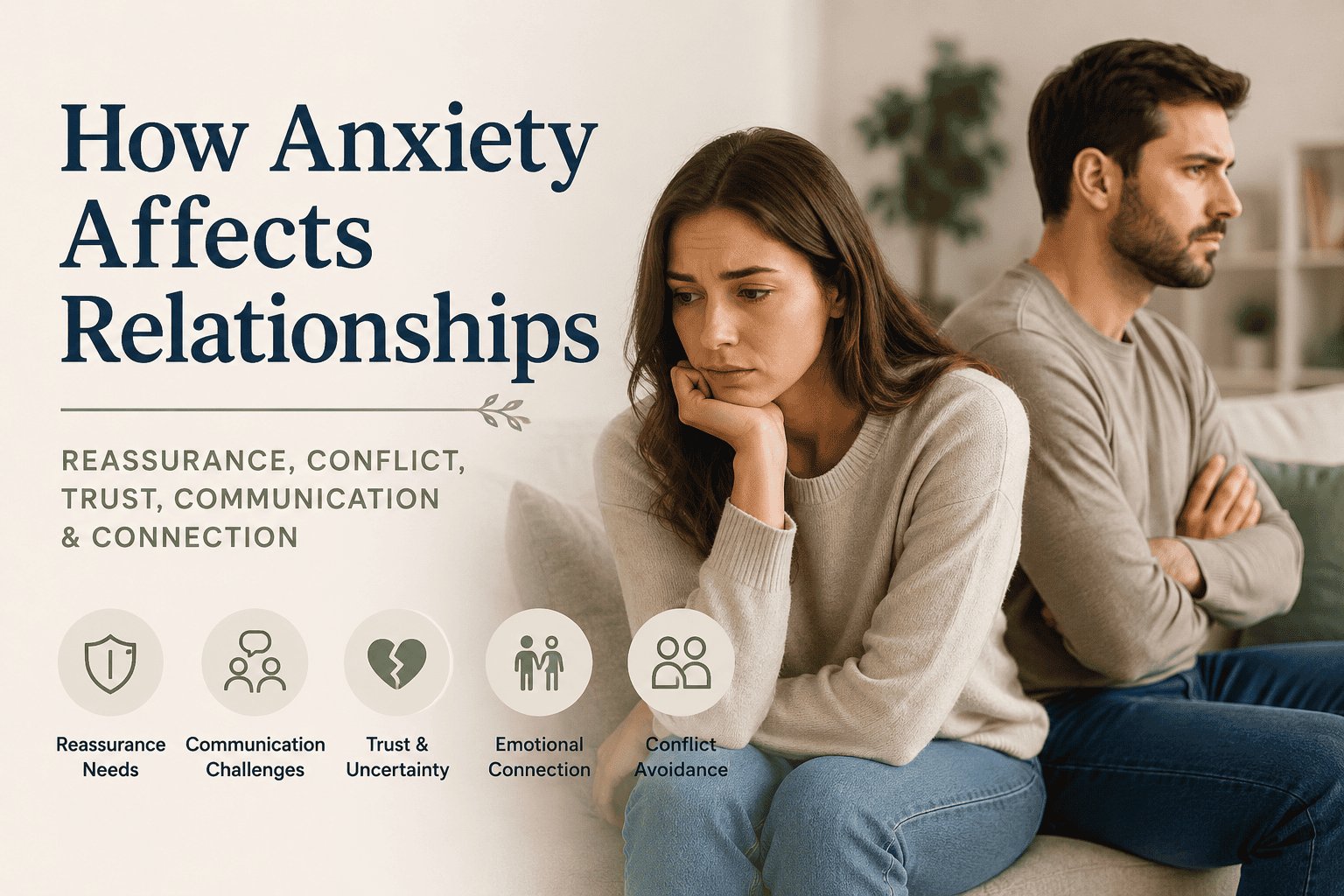
How Anxiety Affects Relationships: Reassurance, Trust, Conflict & Communication

Anxiety & Relationship Resources

How Anxiety Affects Relationships: Reassurance, Conflict, Trust, and Connection

Anxiety can affect reassurance needs, conflict avoidance, communication patterns, trust, emotional closeness, and connection. This guide explains how anxiety can show up in relationships, why anxious patterns are often protective rather than intentional, and how counseling can help people communicate more clearly and feel more secure with others.

Start Here

Anxiety Can Shape the Way People Ask for Closeness, Protection, and Reassurance

Anxiety can affect relationships even when someone deeply cares about the other person. It may lead to overthinking conversations, needing repeated reassurance, avoiding hard topics, reading too much into tone or response time, or feeling easily unsettled when connection feels uncertain.

These patterns are not usually about being difficult, dramatic, or needy. Often, they are attempts to reduce emotional threat. Anxiety may push the mind and body to search for certainty, prevent rejection, avoid conflict, or protect the relationship from imagined loss.

What Does It Mean When Anxiety Affects Relationships?

Anxiety affects relationships when worry, fear of rejection, conflict sensitivity, overthinking, nervous system activation, or a need for certainty begins to shape communication, trust, closeness, boundaries, or emotional safety. This can happen in romantic relationships, friendships, family relationships, parenting, and workplace relationships.

What It Feels Like

What Relationship Anxiety Can Feel Like

Anxiety in relationships does not always look like panic. Sometimes it looks like overthinking, withdrawing, apologizing too much, needing certainty, avoiding conflict, or feeling emotionally unsettled after small changes in connection.

Needing Reassurance

You may repeatedly ask if everything is okay, if someone is upset, or if the relationship is still secure.

Fear of Conflict

Disagreement may feel threatening, even when the other person sees it as a normal conversation or repair opportunity.

Overthinking Conversations

You may replay texts, facial expressions, tone, pauses, or small comments and wonder what they really meant.

People-Pleasing

You may minimize your needs, avoid saying no, or agree quickly to reduce the risk of disappointment or rejection.

Difficulty Trusting

Anxiety can make uncertainty feel unsafe, leading to checking, suspicion, or fear that connection could disappear.

Feeling Disconnected

Even when you want closeness, anxiety may make it harder to relax, receive care, or feel emotionally present.

Why It Happens

Why Anxiety Shows Up So Strongly in Relationships

Relationships matter because they involve attachment, belonging, vulnerability, emotional safety, and the possibility of being misunderstood or rejected. When anxiety is present, the brain may treat relational uncertainty as a threat that must be solved quickly.

This can make small changes feel bigger than they are. A delayed text, a different tone, a quiet mood, a disagreement, or a partner needing space may trigger worry. The anxious mind may begin searching for explanations, signs of danger, or ways to restore certainty.

Anxiety can influence relationships by creating:

  • Fear that others are upset, disappointed, or pulling away
  • Difficulty tolerating uncertainty or emotional distance
  • Urgency to fix problems before they are fully understood
  • Overinterpretation of tone, silence, facial expressions, or response time
  • Avoidance of difficult conversations to prevent conflict
  • People-pleasing, apologizing, or minimizing needs
  • Emotional withdrawal when closeness feels overwhelming

Relationship anxiety is often a protection pattern. The goal is not to shame the pattern, but to understand what it is trying to prevent and build healthier ways to seek security and connection.

Reassurance Needs

Anxiety Can Create a Strong Need to Know Everything Is Okay

Reassurance can be healthy in relationships. People need comfort, clarity, repair, and emotional responsiveness. But when anxiety is high, reassurance may become urgent and repetitive because the relief does not last very long.

  • “Are you mad at me?”
  • “Are we okay?”
  • “Did I say something wrong?”
  • “Do you still want to be with me?”

The Reassurance Loop

Reassurance May Help Briefly, Then Anxiety Returns

When reassurance becomes the main way anxiety is managed, the relationship may get stuck in a loop. One person seeks certainty, the other person tries to provide it, and anxiety returns when uncertainty appears again.

  • Relief may be temporary.
  • The anxious brain may ask for more proof.
  • The other person may feel pressured or exhausted.
  • Both people may feel misunderstood.

The goal is not to stop needing comfort. The goal is to combine relational reassurance with internal soothing, clear communication, and stronger tolerance for uncertainty.

Conflict Avoidance

Anxiety Can Make Conflict Feel More Dangerous Than It Is

Many people with anxiety avoid conflict because disagreement feels like a sign that the relationship is unsafe. A hard conversation may trigger fear of rejection, criticism, anger, abandonment, or emotional overwhelm.

Avoidance may reduce anxiety in the moment, but it can create longer-term disconnection. Important needs may go unspoken. Resentment may build. The other person may not know what is wrong, and the anxious person may feel increasingly unseen.

Conflict avoidance may look like:

  • Saying “it’s fine” when something is not fine
  • Apologizing quickly to end discomfort
  • Changing the subject when emotions rise
  • Agreeing externally while feeling resentful internally
  • Withdrawing instead of saying what you need
  • Delaying hard conversations until anxiety builds

Healthy relationships do not require avoiding every disagreement. They require learning how to move through disagreement with respect, clarity, emotional regulation, and repair.

Communication Patterns

How Anxiety Can Affect Communication

Anxiety can make communication feel urgent, guarded, indirect, overly apologetic, or emotionally intense. These patterns are usually attempts to prevent disconnection, but they can accidentally create more confusion.

Repeating the Same Concern

Anxiety may keep circling back to the same question because the mind is looking for complete certainty.

Reading Between the Lines

A short response, quiet mood, or change in tone may feel like evidence that something is wrong.

Going Quiet

Some people shut down because they feel overwhelmed, afraid of saying the wrong thing, or unsure how to ask for what they need.

Texting for Certainty

Anxiety may create urgency to send another message, clarify again, explain more, or seek reassurance quickly.

Overexplaining

You may give long explanations because being misunderstood feels risky or emotionally unsafe.

Repair Seeking

Anxiety may push for immediate repair, even when the other person needs time to process before reconnecting.

Clear communication often improves when anxiety is regulated first. A calmer nervous system can make it easier to ask directly, listen accurately, and tolerate a slower repair process.

Trust and Uncertainty

Anxiety Can Make Trust Feel Fragile

Trust requires some ability to tolerate uncertainty. Anxiety struggles with uncertainty because the anxious brain wants proof, predictability, and protection from emotional pain. This can make trust feel difficult even when the other person has not done anything wrong.

When anxiety takes over, the mind may scan for signs of change, rejection, dishonesty, or distance. This can lead to checking, questioning, comparing, monitoring, or mentally rehearsing worst-case scenarios.

Trust-related anxiety may include:

  • Fear that someone is losing interest
  • Worry that silence means rejection
  • Difficulty believing reassurance
  • Checking social media, texts, tone, or patterns
  • Feeling unsettled when someone needs space
  • Interpreting uncertainty as danger

Anxiety and intuition can feel similar in the body. Therapy can help people slow down, sort out the difference between a current relational concern and an old fear being activated.

Emotional Connection

Anxiety Can Make Closeness Feel Both Wanted and Overwhelming

People with anxiety often want deep connection. At the same time, closeness can feel vulnerable. Being known, depending on someone, expressing needs, or allowing someone to matter can trigger fear of rejection, disappointment, or loss.

This can create mixed signals. One part of you may reach for closeness while another part pulls back to stay safe. You may want comfort but feel uncomfortable receiving it. You may long for connection but also feel guarded, tense, or emotionally flooded.

Anxiety may affect connection through:

  • Difficulty being emotionally present
  • Fear of needing too much
  • Pulling away after feeling vulnerable
  • Testing whether someone will stay
  • Feeling rejected when someone is simply tired, busy, or distracted
  • Struggling to receive care without questioning it

Connection often grows when people can name the pattern without blame: “This is my anxiety getting activated,” rather than “You are the problem” or “I am too much.”

An Educational Framework

The Anxiety-Relationship Cycle

Anxiety can create a repeating cycle in relationships. Understanding the pattern can help both people respond with more clarity and less blame.

1. Something Feels Uncertain

A delayed reply, change in tone, disagreement, or emotional distance triggers concern.

2. The Mind Starts Scanning

Anxiety looks for evidence, meaning, danger, or proof that the relationship is secure.

3. The Body Activates

You may feel tightness, urgency, dread, restlessness, nausea, or emotional flooding.

4. Reassurance or Avoidance Begins

You may ask repeated questions, overexplain, withdraw, people-please, or avoid the issue.

5. The Relationship Reacts

The other person may reassure, defend, pull back, become frustrated, or feel pressured.

6. The Pattern Repeats

Temporary relief fades, uncertainty returns, and both people may feel stuck.

The goal is not to blame either person. The goal is to recognize the cycle, slow it down, and build more secure ways to communicate, repair, and reconnect.

What Helps

Ways to Support Healthier Relationship Patterns

Anxiety does not have to control the relationship. With awareness, regulation, and healthier communication, people can learn to seek connection without becoming trapped in reassurance, avoidance, or fear.

Pause Before Reacting

Give your nervous system time to settle before sending another message, withdrawing, or assuming the worst.

Name the Anxiety Pattern

Try saying, “My anxiety is getting activated,” instead of treating every anxious thought as a relationship fact.

Ask Clearly

Direct requests are often healthier than hints, testing, withdrawing, or repeated reassurance seeking.

Build Internal Safety

Grounding, self-talk, breathing, journaling, and emotional regulation can help reduce urgency.

Practice Repair

Healthy repair can include taking responsibility, listening, clarifying, apologizing, and reconnecting.

Seek Counseling Support

Therapy can help identify the anxiety cycle and build healthier relational responses.

When to Seek Help

When to Seek Counseling for Anxiety in Relationships

It may be time to reach out when anxiety repeatedly affects communication, trust, conflict, emotional closeness, or your ability to feel secure with others. Counseling can help you understand the pattern and develop more grounded ways to respond.

Consider counseling if you notice:

  • You often need reassurance but still do not feel settled
  • You avoid conflict until resentment builds
  • You overthink texts, tone, silence, or facial expressions
  • You feel easily rejected, abandoned, or replaced
  • You shut down, withdraw, or people-please when anxious
  • Your relationship feels stuck in repeated arguments or repair attempts
  • Anxiety is affecting closeness, trust, intimacy, or communication

If relationship stress includes emotional abuse, physical violence, coercive control, threats, or fear for your safety, seek immediate support from a trusted person, local emergency services, or a domestic violence resource. Counseling is not a substitute for safety planning in dangerous situations.

Counseling at Motivations Counseling

Therapy Can Help When Anxiety Is Affecting Relationships

Motivations Counseling provides therapy for adults and couples experiencing anxiety, relationship stress, communication difficulties, conflict avoidance, emotional disconnection, trust concerns, trauma-related activation, and chronic stress. Counseling can help clients better understand the cycle underneath the symptoms and begin building healthier ways to communicate and reconnect.

Our counseling team serves clients in Sugar Land, Katy, Richmond, Fort Bend County, West Houston, and through telehealth across Texas when clinically appropriate.

Counseling Support

Anxiety and Relationship Counseling in Sugar Land, Katy, and Online Across Texas

If anxiety is affecting reassurance needs, conflict, trust, communication, or emotional connection, counseling can help you better understand what is happening and take manageable next steps.

  • Individual counseling for anxiety and relationship patterns
  • Couples counseling for communication, conflict, and connection
  • Trauma-informed support for nervous system activation
  • In-person options in Sugar Land and Katy when available
  • Telehealth counseling across Texas when clinically appropriate
Call or Text: (281) 858-3001

Frequently Asked Questions

Common Questions About Anxiety and Relationships

Can anxiety affect relationships?

Yes. Anxiety can affect reassurance needs, communication, conflict avoidance, trust, emotional closeness, and connection. It may lead to overthinking, people-pleasing, withdrawal, repeated reassurance seeking, or fear that something is wrong in the relationship.

Why do I need so much reassurance in relationships?

Reassurance needs often come from anxiety, fear of rejection, attachment concerns, past hurt, or difficulty tolerating uncertainty. Reassurance may help briefly, but anxiety can return if the deeper pattern is not addressed.

Can anxiety make me avoid conflict?

Yes. Anxiety can make disagreement feel dangerous, even when conflict is normal and repairable. Some people avoid hard conversations because they fear rejection, anger, abandonment, criticism, or emotional overwhelm.

Why do I overthink texts and conversations?

Anxiety often scans for signs of danger, rejection, or disconnection. This can make you replay conversations, analyze tone, read into response times, or worry that you said something wrong.

Can anxiety cause trust issues?

Anxiety can make trust feel difficult because trust requires tolerating uncertainty. When anxiety is high, the mind may look for proof, reassurance, or signs that the relationship is still secure.

How can I communicate better when I am anxious?

It can help to pause before reacting, regulate your body first, name the anxiety pattern, ask directly for what you need, and avoid relying only on hints, testing, withdrawal, or repeated reassurance seeking.

Can couples counseling help with anxiety in a relationship?

Couples counseling can help partners understand the cycle underneath conflict, reassurance, avoidance, and disconnection. Therapy can support clearer communication, emotional safety, repair, and healthier connection.

When should I seek therapy for relationship anxiety?

Consider therapy when anxiety regularly affects communication, trust, conflict, emotional closeness, or daily functioning. Therapy may also help if you feel stuck in repeated reassurance, overthinking, avoidance, or relationship distress.

Susan Baker, M.Ed., NCC, LPC-S, Licensed Professional Counselor Supervisor in Texas

Article Author

Written by a Licensed Texas Mental Health Professional

This article was written for Motivations Counseling by Susan Baker, M.Ed., NCC, LPC-S, a Texas Licensed Professional Counselor Supervisor and clinical leader at Motivations Counseling.

Susan Baker, M.Ed., NCC, LPC-S
Texas Licensed Professional Counselor Supervisor
EMDR Therapist & EMDRIA Member
Texas LPC License #73957

Susan Baker is the Clinical Director of Motivations Counseling and provides trauma-informed counseling, EMDR therapy, anxiety treatment, depression counseling, couples counseling, immigration psychological evaluations, and mental health assessment services. Motivations Counseling serves clients from offices in Sugar Land and Katy, Texas, with telehealth services available statewide for Texas residents.

Take the Next Step

Anxiety and Relationship Counseling in Sugar Land, Katy, and Online Across Texas

If anxiety is affecting reassurance, conflict, communication, trust, or emotional connection, counseling can help you understand the pattern and begin building healthier ways to relate.
×

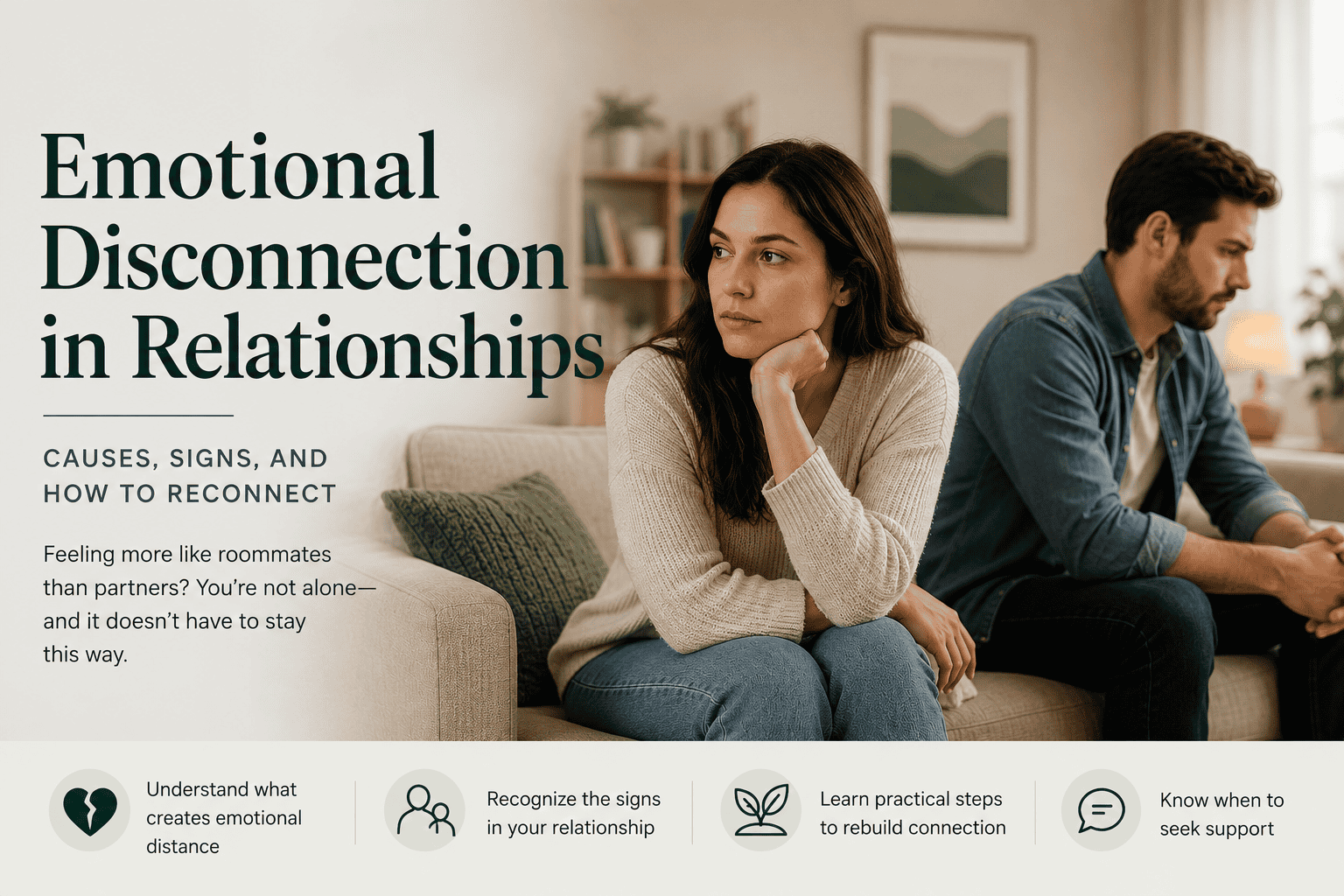
Emotional Disconnection in Relationships

Relationship Learning Center

Emotional Disconnection in Relationships

Emotional disconnection can feel lonely, confusing, and painful, especially when both partners still care about each other. Many couples do not become disconnected because love disappears. They become disconnected when stress, conflict, avoidance, anxiety, hurt, or repeated misattunement makes emotional closeness feel harder to reach.

Start Here

Emotional Distance Does Not Always Mean the Relationship Is Over

Emotional disconnection often happens slowly. A couple may still share a home, parent together, manage responsibilities, and care about each other, but the relationship may begin to feel less warm, safe, playful, affectionate, or emotionally close.

In many relationships, emotional distance is a signal that the relationship needs attention, repair, and safer ways to talk about needs, fear, hurt, loneliness, and longing. Couples counseling can help partners understand the pattern instead of blaming each other for the pain.

Read About Emotional Safety

What Is Emotional Disconnection?

Emotional Disconnection Means the Bond Feels Harder to Reach

Emotional disconnection means partners no longer feel as emotionally accessible, responsive, engaged, or safe with each other. They may still love each other, but the sense of being known, comforted, understood, wanted, or emotionally important may feel weaker.

Emotional connection is not only about having deep conversations. It also includes small moments of warmth, affection, eye contact, repair, reassurance, shared humor, checking in, and knowing your partner cares about what is happening inside of you.

Emotional disconnection is often less about one single problem and more about a repeated pattern: one or both partners stop feeling safe enough to reach, soften, listen, repair, or be vulnerable.

Couples may describe emotional disconnection as:

  • Feeling more like roommates than partners
  • Feeling lonely even when physically together
  • Avoiding conversations that could lead to conflict
  • Not knowing how to repair after arguments
  • Feeling unseen, dismissed, criticized, or unimportant
  • Experiencing less affection, warmth, closeness, or playfulness

Common Signs

Emotional Disconnection Can Show Up Quietly or Loudly

Some couples experience disconnection through frequent conflict. Others experience it through silence, distance, avoidance, or a quiet sense that the relationship no longer feels emotionally safe.

Feeling Like Roommates

Daily life continues, but the relationship feels more practical than emotionally connected.

Loneliness in the Relationship

One or both partners may feel alone, unseen, or emotionally unsupported even when together.

Avoiding Hard Conversations

Partners may avoid topics because they expect defensiveness, shutdown, criticism, or escalation.

Conflict Without Repair

Arguments may stop because people are exhausted, not because anyone feels understood.

Less Affection or Warmth

Physical affection, laughter, curiosity, small gestures, and softness may begin to fade.

The Same Pattern Repeats

The topics may change, but the emotional pattern underneath the arguments often stays the same.

Why It Happens

Emotional Disconnection Usually Develops for a Reason

Couples rarely become emotionally distant out of nowhere. Disconnection often grows through unresolved hurt, stress, missed repair, anxiety, trauma responses, attachment patterns, parenting demands, grief, betrayal, health problems, or years of feeling unheard.

One partner may reach for connection through urgency, questioning, criticism, or repeated attempts to talk. The other partner may feel overwhelmed and respond by defending, minimizing, going quiet, working more, leaving the room, or avoiding difficult topics. Both people may be trying to protect themselves, but the relationship becomes less safe for both.

Unresolved Hurt

Painful moments can create distance when they are never acknowledged, understood, or repaired.

Chronic Stress

Work, parenting, financial strain, caregiving, or burnout can leave little emotional energy for connection.

Anxiety and Overthinking

Anxiety can lead to reassurance seeking, fear of rejection, emotional urgency, irritability, or repeated checking.

Emotional Shutdown

Some partners pull away because they feel criticized, overwhelmed, helpless, or afraid of making things worse.

Attachment Patterns

Attachment patterns can shape how partners respond to closeness, distance, conflict, reassurance, and vulnerability.

Trauma Responses

Past emotional injuries can make conflict, silence, criticism, withdrawal, or rejection feel especially threatening.

The Relationship Cycle

The Problem Is Often the Pattern, Not Just the Topic

Couples may believe they are fighting about chores, parenting, money, intimacy, phones, tone, schedules, or extended family. Those topics matter, but the deeper issue is often the emotional cycle underneath the disagreement.

When the cycle takes over, each partner reacts to the other person’s protection strategy. The more one partner pushes, the more the other may shut down. The more one partner withdraws, the more the other may feel abandoned, rejected, or alone.

Common Pursue-Withdraw Pattern

Two Different Forms of Protection

One partner may be saying, “I need to know you care.” The other may be saying, “I do not know how to fix this without making it worse.” Both responses can make sense, but together they can deepen the disconnection.

  • Pursuing can look like questioning, criticizing, protesting, or pushing for immediate resolution.
  • Withdrawing can look like silence, defensiveness, leaving the conversation, or emotional shutdown.
  • Repair begins when both partners can see the cycle as the shared enemy.

Attachment Patterns

Attachment Can Shape How Partners Respond to Distance

Attachment patterns are not diagnoses. They are learned ways of managing closeness, independence, fear, reassurance, emotional safety, and vulnerability in relationships.

Anxious Patterns

A partner may feel highly sensitive to distance, silence, changes in tone, or delayed responses and may seek reassurance when the relationship feels uncertain.

Avoidant Patterns

A partner may value independence and feel overwhelmed by emotional intensity, pressure, criticism, or vulnerability.

Mixed Patterns

A partner may want closeness but also fear being hurt, leading to movement toward connection and then away from it.

Understanding attachment patterns can help couples move away from blame and toward curiosity: “What happens inside of me when I feel disconnected?” and “What happens inside of you when I reach for connection?”

How Counseling Can Help

Couples Counseling Can Help Partners Slow Down the Pattern

Couples counseling can help partners understand what happens beneath conflict, withdrawal, criticism, defensiveness, and emotional shutdown. Rather than focusing only on who is right or wrong, therapy can help couples identify the negative cycle and create safer ways to reach for each other.

Emotionally Focused Therapy, or EFT, is especially relevant when couples feel emotionally disconnected. EFT helps couples understand the emotional bond, attachment needs, and repeated negative cycles that create distance.

Identify the Cycle

Therapy can help couples see repeated patterns such as pursue-withdraw, criticize-defend, or pressure-shutdown.

Communicate Softly

Partners can learn to express deeper emotions and needs instead of only communicating through frustration or silence.

Build Emotional Safety

Emotional safety grows when partners feel heard, respected, and responded to without fear of shame, attack, or abandonment.

Practice Repair

Repair may include accountability, empathy, reassurance, changed behavior, and new ways of returning to each other.

Strengthen the Bond

Couples can begin creating moments of connection, responsiveness, trust, comfort, and emotional accessibility.

Reduce Escalation

When partners understand the cycle, conflict can become less reactive and more focused on repair.

Free Relationship Resource

Take the Free Attachment Style Quiz

Emotional disconnection may be connected to attachment patterns, reassurance needs, conflict responses, emotional withdrawal, or fear of vulnerability. Our free attachment style quiz can help individuals and couples reflect on patterns related to closeness, independence, conflict, reassurance, and emotional safety.

Attachment Style Quiz

Reflect on Your Relationship Patterns

This free educational quiz does not require personal information and provides immediate feedback to help you better understand your relationship patterns.

  • No personal information required
  • Immediate educational feedback
  • Designed for individuals and couples
  • For informational purposes only

Learning Center

Continue Learning About Connection, Attachment, and Couples Counseling

These related resources can help you better understand emotional safety, attachment patterns, repeated conflict, anxiety in relationships, and how couples counseling may help.

Frequently Asked Questions

Common Questions About Emotional Disconnection in Relationships

Does emotional disconnection mean the relationship is ending?

Not always. Emotional disconnection can be painful and serious, but it often means the relationship needs attention, repair, safer communication, and more intentional connection. Many couples seek counseling because they still care about each other but feel unsure how to reconnect.

Why do couples become emotionally disconnected?

Couples may become disconnected because of unresolved conflict, chronic stress, parenting demands, anxiety, trauma, attachment patterns, emotional shutdown, betrayal, grief, or years of feeling unseen or unheard.

Can couples counseling help if we feel like roommates?

Couples counseling may help partners identify the patterns creating distance, communicate more openly, rebuild emotional safety, and practice repair. Counseling is not a guarantee of a specific outcome, but it can provide structure for difficult conversations and reconnection.

What if one partner wants closeness and the other pulls away?

This is a common relationship pattern. One partner may pursue connection when they feel anxious or alone, while the other withdraws when they feel overwhelmed, criticized, or unsure how to respond. Therapy can help both partners understand the cycle and respond in new ways.

Is emotional disconnection related to attachment styles?

It can be. Attachment patterns may influence how partners respond to conflict, reassurance, vulnerability, closeness, and distance. Understanding these patterns can help couples approach disconnection with more compassion and less blame.

When should a couple consider therapy?

Couples may consider therapy when they feel emotionally distant, repeatedly stuck in the same conflict, unable to repair, lonely in the relationship, less affectionate, or unsure how to talk about painful topics without escalation or shutdown.

Susan Baker, M.Ed., NCC, LPC-S

Article Author

Written by a Licensed Texas Mental Health Professional

This article was written for Motivations Counseling by Susan Baker, M.Ed., NCC, LPC-S, a Texas Licensed Professional Counselor Supervisor and clinical leader at Motivations Counseling.

Susan Baker, M.Ed., NCC, LPC-S
Texas Licensed Professional Counselor Supervisor
EMDR Therapist & EMDRIA Member
Texas LPC License #73957

Susan Baker is the Clinical Director of Motivations Counseling and provides trauma-informed counseling, EMDR therapy, depression counseling, anxiety treatment, immigration psychological evaluations, and mental health assessment services. Motivations Counseling serves clients from offices in Sugar Land and Katy, Texas, with telehealth services available statewide for Texas residents.

Couples Counseling in Sugar Land, Katy, and Online in Texas

Support for Emotional Disconnection in Relationships

If you and your partner feel distant, stuck, lonely, or unsure how to reconnect, couples counseling can provide a structured space to understand the pattern, rebuild emotional safety, and begin practicing healthier communication and repair.

×
×

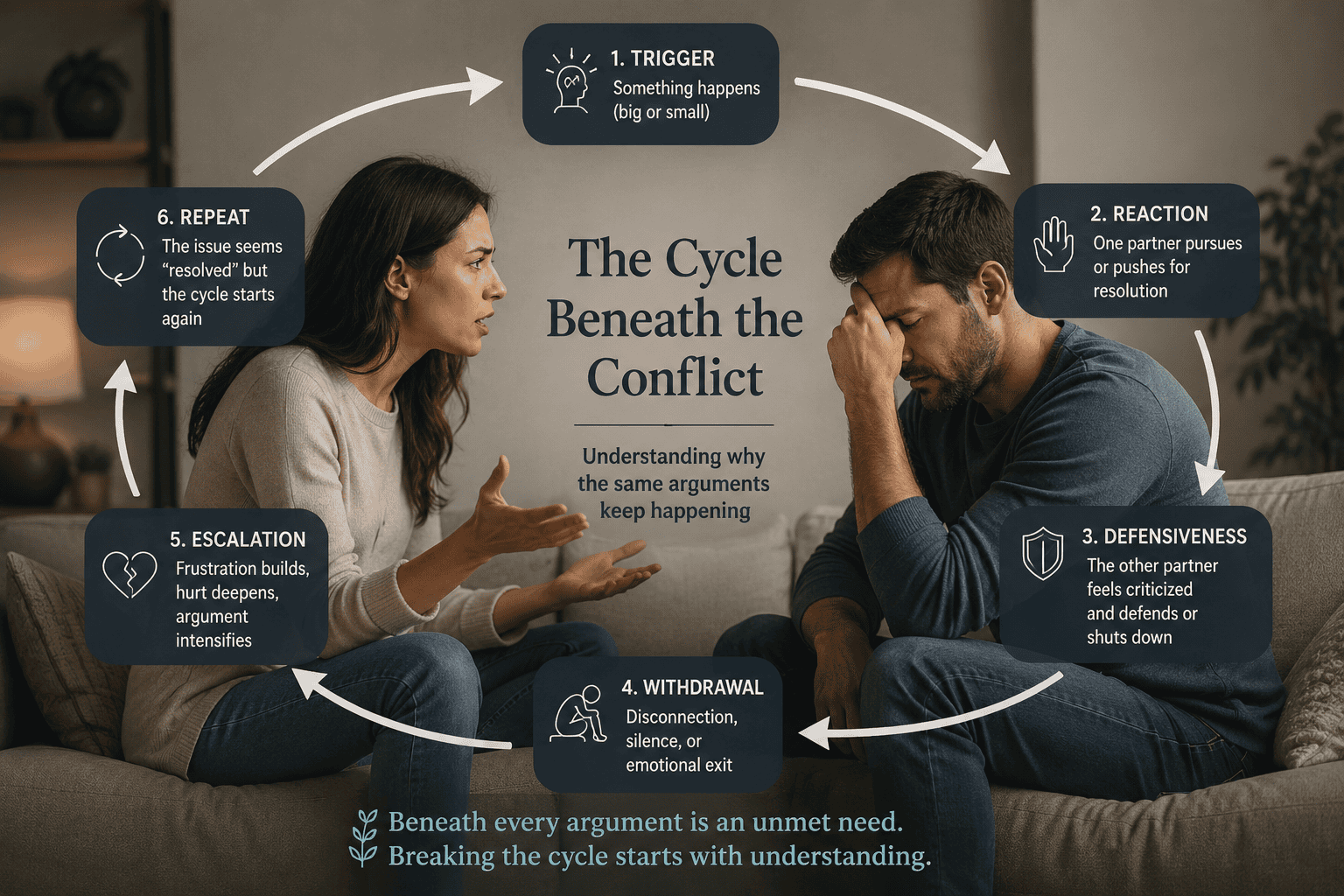
Why Couples Get Stuck in the Same Arguments: Understanding the Cycle Beneath the Conflict

Couples Counseling Resource Center

Why Couples Get Stuck in the Same Arguments

Many couples do not keep arguing because they lack love, intelligence, or good intentions. They often get stuck because the visible argument is only part of a deeper emotional cycle. Repeated conflict may reflect unmet needs, defensiveness, fear, withdrawal, emotional flooding, old wounds, or a pattern where both partners are trying to protect themselves but end up hurting each other.

Start Here

The Same Argument Usually Means the Same Emotional Pattern Is Repeating

Couples often describe recurring arguments as if they are about chores, parenting, money, intimacy, tone of voice, family boundaries, phones, schedules, or who said what. Those issues may matter. But when the same disagreement keeps returning, the surface topic is often connected to a deeper emotional pattern.

One partner may feel dismissed, alone, controlled, criticized, unimportant, or emotionally unsafe. The other may feel blamed, attacked, pressured, inadequate, misunderstood, or unable to get it right. As each person reacts to their own pain, the couple can become trapped in a cycle where both partners are trying to be heard but neither feels understood.

Couples Counseling Services

The Deeper Issue

The Argument Is Often Not Really About the Thing You Are Arguing About

Repeated conflict often becomes confusing because the topic seems too small to explain the intensity of the reaction. A conversation about dishes may turn into a fight about respect. A disagreement about spending may become a fight about trust. A scheduling conflict may become a fight about whether one partner matters.

This does not mean the practical issue is unimportant. Couples still need to solve real-life problems. But when the emotional intensity is much larger than the topic, it can be helpful to ask what the argument represents underneath the surface.

In couples counseling, the goal is often not to decide who is right about the surface issue first. The goal is to understand the cycle that keeps turning a solvable problem into a painful argument.

Surface arguments may represent deeper questions such as:

  • “Do I matter to you?”
  • “Can I trust you to consider me?”
  • “Are you really listening?”
  • “Am I safe being vulnerable with you?”
  • “Will you show up for me when I need you?”
  • “Do you see how much I am carrying?”
  • “Can we disagree without one of us shutting down or exploding?”

The Conflict Cycle

Couples Often Get Stuck in a Predictable Loop

When partners are emotionally activated, they may respond in ways that feel protective in the moment but painful to the relationship. Over time, the couple may begin repeating the same sequence almost automatically.

A Trigger Appears

A comment, facial expression, delay, mistake, tone, or unmet expectation activates a familiar feeling or old relationship fear.

Protection Takes Over

One partner may criticize, push, explain, withdraw, defend, shut down, correct, or try to prove their point.

The Pattern Repeats

Each person’s response activates the other. The argument escalates, the original issue gets lost, and both partners feel more alone.

Disconnection Builds

After repeated conflict, partners may begin avoiding certain topics or bracing for the next argument before it even begins.

Old Meanings Attach

The current issue may connect with past hurts, attachment fears, trauma history, family patterns, or previous relationship injuries.

Repair Becomes Harder

When the cycle repeats often enough, even small misunderstandings may feel loaded, unsafe, or impossible to discuss calmly.

Pursuer-Withdrawer Pattern

One Common Cycle Is When One Partner Pushes and the Other Pulls Away

A common relationship pattern happens when one partner responds to disconnection by pursuing more conversation, reassurance, answers, or resolution, while the other responds to emotional intensity by withdrawing, shutting down, avoiding, or becoming quiet. Both reactions can make sense from the inside, but together they can create a painful loop.

The pursuing partner may feel abandoned, ignored, or emotionally alone. The withdrawing partner may feel criticized, overwhelmed, or unable to say anything right. The more one pushes for connection, the more the other may pull away. The more one pulls away, the more the other may push harder.

This cycle can sound like:

  • “You never want to talk about anything.”
  • “I can’t talk to you when you come at me like this.”
  • “You always shut down.”
  • “You always criticize me.”
  • “I just want you to care.”
  • “Nothing I say is ever good enough.”

In many couples, the pursuer is not simply “needy” and the withdrawer is not simply “uncaring.” Both partners may be reacting to fear, overwhelm, shame, loneliness, or the belief that they cannot get their needs met safely.

Emotional Flooding

When the Nervous System Is Flooded, Good Communication Gets Harder

Emotional flooding happens when a person becomes so activated that their nervous system shifts into protection mode. At that point, the goal may no longer be understanding. The goal becomes defending, escaping, proving, shutting down, or trying to regain control.

Couples may think they are having a communication problem when they are actually having a regulation problem. If one or both partners are flooded, the conversation may need calming and repair before problem-solving can happen.

Signs of emotional flooding may include:

  • Racing heart, tight chest, shaking, or feeling hot
  • Going blank or not being able to find words
  • Wanting to leave, shut down, or end the conversation immediately
  • Repeating the same point more forcefully
  • Interrupting, criticizing, or becoming defensive
  • Feeling trapped, attacked, rejected, or unsafe
  • Remembering the conversation differently afterward

Learning to recognize flooding can help couples pause before the conflict becomes more damaging. A pause is not the same as avoidance when both partners agree to return to the conversation with more calm and intention.

Unmet Needs

Repeated Arguments Often Point to Unspoken Emotional Needs

Many couples argue about behavior, but underneath the behavior is often a need. One partner may need reassurance, appreciation, follow-through, affection, honesty, partnership, rest, respect, sexual connection, emotional safety, or help carrying responsibilities. The problem is that needs often come out as criticism when a partner already feels hurt.

For example, “You never help me” may mean “I feel alone and overwhelmed.” “You are always on your phone” may mean “I miss feeling close to you.” “You only care about yourself” may mean “I do not feel considered.” When the need is hidden underneath blame, the other partner is more likely to defend than respond with care.

Common needs underneath recurring conflict include:

  • Feeling emotionally important to your partner
  • Feeling respected during disagreement
  • Feeling supported with responsibilities
  • Feeling safe enough to be honest
  • Feeling wanted, chosen, or prioritized
  • Feeling trusted rather than controlled
  • Feeling understood before being corrected

Why Logic Alone Rarely Solves It

Repeating the Facts Usually Does Not Heal the Emotional Injury

Many couples try to solve repeated arguments by explaining more clearly, proving what really happened, listing evidence, or showing why the other person is being unfair. Sometimes facts matter. But when the deeper issue is emotional safety, attachment fear, shame, loneliness, or resentment, logic alone may not repair the injury.

A partner who feels dismissed may not be helped by a more detailed explanation. A partner who feels attacked may not become more open because the criticism becomes more accurate. A partner who feels alone may not feel comforted by being told they are “too sensitive.” The couple may need a different kind of conversation.

Less blame More clarity Less defensiveness More emotional safety Less mind-reading More repair Less escalation More listening

How Counseling Helps

Couples Counseling Helps Partners Understand and Interrupt the Cycle

Couples counseling can help partners slow down the argument and identify what happens before, during, and after the conflict. Instead of focusing only on who started it or who is right, therapy can help the couple understand how both partners participate in the cycle and what each person is needing underneath their reaction.

Counseling may help couples develop healthier ways to communicate, pause during escalation, name needs more clearly, repair emotional injuries, and create a stronger sense of partnership. The goal is not to eliminate every disagreement. Healthy couples still disagree. The goal is to disagree in ways that do not repeatedly damage trust, connection, and emotional safety.

Couples counseling may focus on:

  • Identifying the couple’s repeated conflict cycle
  • Recognizing emotional triggers and protective reactions
  • Improving communication during difficult conversations
  • Reducing blame, criticism, defensiveness, and withdrawal
  • Helping each partner express needs more clearly
  • Building emotional safety and trust
  • Strengthening repair after conflict
  • Creating practical agreements for recurring issues

Couples counseling is not about assigning one partner as the problem. It is about helping both partners see the pattern clearly enough to respond differently.

When to Seek Help

Signs the Argument Cycle May Need Professional Support

Many couples wait until they are exhausted before starting counseling. Support may be helpful earlier, especially when the same arguments keep returning without meaningful repair.

The Same Fight Keeps Repeating

You may change the topic, but the emotional pattern feels the same: hurt, defense, escalation, withdrawal, and distance.

Conversations Escalate Quickly

Small disagreements may become intense before either partner understands what happened or how to calm things down.

One or Both Partners Shut Down

Important topics may be avoided because they feel too overwhelming, hopeless, or likely to become another fight.

Resentment Is Building

Unrepaired hurts may make partners more guarded, less affectionate, less patient, or less willing to assume good intent.

Trust Feels Fragile

Even when there has not been a major betrayal, repeated disconnection can make the relationship feel emotionally unsafe.

You Want to Repair but Feel Stuck

Both partners may care about the relationship but not know how to stop repeating the same painful pattern.

Learning Center

Continue Learning About Relationships, Communication, and Emotional Patterns

These related resources can support clients who are trying to understand relationship conflict, emotional triggers, anxiety, trauma responses, and counseling options.

Emotional Safety in Relationships

Understand why emotional safety matters and how couples can begin rebuilding trust, steadiness, and connection.

Read article →

Emotional Disconnection in Relationships

Learn why couples can feel emotionally distant, lonely, or disconnected even when they still care about each other, and how counseling may help rebuild emotional safety, communication, and repair.

Read article →

Couples Counseling

Learn how couples counseling can help partners improve communication, repair conflict, and rebuild emotional connection.

View service page →

Attachment Styles in Relationships

Learn how attachment patterns may affect trust, closeness, conflict, reassurance, and emotional safety in adult relationships.

Read article →

Individual Counseling

Individual therapy can help clients understand emotional triggers, anxiety, trauma responses, boundaries, and relationship patterns.

View service page →

Anxiety Counseling

Anxiety can affect communication, conflict, reassurance seeking, avoidance, and emotional regulation in relationships.

View service page →

Trauma-Informed Therapy

Past experiences can shape how people respond to closeness, conflict, trust, rejection, and emotional safety.

View service page →

EMDR Therapy

EMDR may help clients process distressing memories, triggers, and negative beliefs that affect present-day relationships.

View service page →

Depression Counseling

Depression can affect motivation, intimacy, irritability, emotional availability, and the ability to repair after conflict.

View service page →

How to Talk Without Escalating

A future relationship resource on slowing down hard conversations before they become emotionally overwhelming.

Coming soon →

Repair After Conflict

A future guide on apologies, accountability, emotional repair, and rebuilding connection after an argument.

Coming soon →

Emotional Needs in Relationships

A future article explaining how unspoken needs can turn into criticism, withdrawal, defensiveness, or distance.

Coming soon →

Start Counseling

Ready to Understand the Pattern Beneath the Argument?

If you and your partner keep returning to the same painful conversations, couples counseling may help you slow down the cycle, communicate more clearly, and rebuild emotional safety. Our counseling team can help you explore whether couples therapy is a good fit for your relationship.

×

When Should You Seek Marriage Counseling? 8 Signs Your Relationship May Need Support

Relationship Resource Center

8 Signs It May Be Time for Marriage Counseling

Marriage counseling is not only for couples who are on the edge of separation. Many couples benefit from support when communication becomes strained, emotional closeness fades, conflict becomes repetitive, or life stress starts affecting the relationship. Understanding the signs that counseling may help can make it easier to seek support before patterns become more painful or difficult to repair.

Start Here

Couples Often Wait Longer Than They Need To

Many couples wait until communication has broken down, resentment has built up, or one partner feels emotionally checked out before reaching for help. While counseling can still be useful during a crisis, couples often have more options when they seek support earlier — when both partners still want to understand what is happening and are willing to work toward repair.

Marriage counseling can help couples slow down recurring patterns, identify the emotions underneath conflict, rebuild emotional safety, improve communication, and understand why the same problems keep returning. It is not about choosing sides or deciding who is “right.” It is about helping the relationship become safer, clearer, and more connected.

Sign 1

Communication Has Become Difficult, Defensive, or Avoided

One of the clearest signs that marriage counseling may help is when communication no longer feels safe or productive. Couples may talk often, but still feel unheard. They may avoid certain topics because every conversation turns into an argument. Or one partner may pursue the conversation while the other shuts down, withdraws, or tries to end the conflict quickly.

Communication problems are not always about poor word choice. Often, communication breaks down because both partners are reacting from hurt, fear, exhaustion, defensiveness, or the belief that they will not be understood. The content of the argument may matter, but the pattern underneath the argument often matters even more.

Communication concerns may include:

  • Conversations quickly turn into arguments, criticism, blame, or defensiveness
  • One or both partners avoid difficult topics because they feel too stressful
  • You repeat yourself often but still do not feel understood
  • Small disagreements escalate into larger emotional reactions
  • One partner shuts down while the other pushes harder for a response
  • You feel like you are talking at each other instead of with each other

Marriage counseling can help couples identify the communication cycle rather than focusing only on the latest disagreement. When the pattern becomes clearer, couples can begin responding to each other differently.

Signs 2 and 3

You Feel More Like Roommates, or Emotional Intimacy Has Faded

Some couples do not fight constantly. Instead, they slowly become distant. They may manage schedules, parenting, finances, chores, and responsibilities, but feel less like partners emotionally.

You Feel Like Roommates

The relationship may function practically, but feel emotionally distant. You may share a home, schedule, or responsibilities without feeling deeply connected.

Closeness Feels Reduced

Emotional intimacy may decline when partners stop sharing feelings, dreams, worries, affection, appreciation, or vulnerable parts of themselves.

Conversations Stay Surface-Level

You may talk about tasks and logistics, but rarely talk about emotions, needs, loneliness, disappointment, or what each of you is experiencing internally.

You Feel Alone Together

A person can feel lonely inside a relationship when emotional needs are not being expressed, received, understood, or responded to consistently.

Vulnerability Feels Risky

If past attempts to share feelings led to criticism, dismissal, conflict, or withdrawal, partners may stop risking emotional openness.

Affection Feels Strained

Physical or emotional affection may feel less natural when resentment, stress, avoidance, or emotional distance has built up over time.

Sign 4

The Same Arguments Keep Happening Without Resolution

Many couples get stuck in repeated arguments. The topic may change — money, parenting, chores, intimacy, in-laws, time, phones, work, or household responsibilities — but the emotional pattern feels familiar. One partner may feel criticized or controlled. The other may feel ignored or unsupported. Both may leave the conversation feeling more hurt than before.

Repeated conflict often continues because the deeper needs underneath the argument are not being recognized. A fight about dishes may actually involve feeling unappreciated. A fight about time may involve loneliness. A fight about tone may involve feeling unsafe, dismissed, or emotionally attacked.

Recurring conflict may indicate counseling could help when:

  • You argue about the same issue repeatedly without lasting change
  • Disagreements become more intense than the topic seems to justify
  • One partner feels pursued while the other feels pressured or criticized
  • Apologies happen, but the same cycle returns
  • You both feel misunderstood, even when you are trying to explain yourselves
  • You avoid certain topics because they feel impossible to discuss peacefully

A therapist can help couples slow the cycle down, identify each partner’s protective reactions, and uncover the emotional meaning beneath recurring arguments.

Signs 5 and 6

Trust Has Been Damaged, or Conflict Feels Increasingly Intense

Trust can be damaged by infidelity, secrecy, dishonesty, repeated broken promises, emotional withdrawal, unresolved resentment, betrayal, addiction concerns, financial decisions, or a pattern of not feeling protected by the relationship.

Conflict can also become concerning when arguments feel more intense, frequent, or emotionally unsafe than they used to. Counseling can help couples address these concerns with more structure, emotional containment, and support.

Trust and conflict concerns may include:

  • One or both partners are struggling to believe the other will follow through
  • There has been betrayal, secrecy, or a repeated pattern of broken trust
  • Arguments include threats, contempt, name-calling, or emotional withdrawal
  • One partner feels they must monitor, check, or control to feel safe
  • Conflict leaves one or both partners feeling emotionally flooded or shut down
  • Repair attempts do not seem to restore safety or reassurance

When trust has been damaged, couples often need more than a simple apology. They may need accountability, emotional repair, consistent behavior change, and a safe process for discussing what happened and what is needed moving forward.

Signs 7 and 8

One or Both Partners Feel Alone, or Life Stress Is Affecting the Relationship

Couples often seek counseling when one or both partners feel emotionally alone. This can happen even when both people are physically present and committed to the relationship. Loneliness in a relationship may show up as feeling unsupported, unseen, unimportant, dismissed, or like your needs have become too much to bring up.

Major life stress can also strain even strong relationships. Parenting demands, financial pressure, work stress, illness, grief, trauma, blended family concerns, caregiving responsibilities, infertility, relocation, or family conflict can reduce patience, affection, communication, and emotional availability.

Stress may be affecting the relationship when:

  • You feel like you are managing life beside each other rather than together
  • There is less patience, warmth, affection, or curiosity between you
  • Stress from work, parenting, family, or finances spills into conflict
  • One partner feels unsupported while the other feels overwhelmed or criticized
  • You are both exhausted and have little emotional energy left for connection
  • The relationship feels more like another demand than a source of comfort

Why earlier support can matter

Couples do not have to wait until the relationship feels desperate to begin counseling. Therapy may be helpful when partners still care but feel stuck, disconnected, defensive, overwhelmed, or unsure how to repair the pattern. Seeking help earlier can reduce resentment and make it easier to rebuild closeness.

Common Misconceptions

Marriage Counseling Is Often Misunderstood

Some couples avoid counseling because they are afraid of what it means. In reality, therapy can be a practical, supportive space for understanding patterns and strengthening the relationship.

It Is Not About Taking Sides

Couples counseling is not about deciding who is the “problem.” It focuses on the relationship pattern and how both partners experience the cycle.

It Does Not Mean the Marriage Is Failing

Many couples use counseling to strengthen communication, prevent deeper problems, and rebuild connection before the relationship becomes more distressed.

It Is More Than Communication Tips

Communication skills matter, but therapy also explores emotional safety, attachment needs, hurt, stress, repair, and recurring patterns.

You Do Not Have to Wait for Crisis

Counseling can help when the relationship is still functioning but feels strained, distant, tense, or emotionally disconnected.

Both Partners Do Not Have to Be Perfectly Ready

It is common for one partner to feel more motivated at first. Therapy can help both partners clarify concerns, goals, and willingness.

Safety Matters

A therapist can help determine whether couples counseling is appropriate or whether individual support, safety planning, or specialized care is needed first.

How Counseling Helps

Marriage Counseling Can Help Couples Understand the Pattern Beneath the Problem

Couples often come to therapy focused on the visible issue: communication, intimacy, parenting, money, trust, household responsibilities, or feeling disconnected. These issues matter. But therapy also looks at the pattern that keeps the issue from being resolved. What happens when one partner feels hurt? What does the other partner do to protect themselves? How do both people end up feeling misunderstood?

Counseling can help couples slow down the cycle, identify emotional triggers, communicate needs more clearly, and practice repair. It can also help partners understand how stress, trauma history, attachment patterns, anxiety, depression, or family-of-origin experiences may affect the way they respond in the relationship.

Marriage counseling may help couples:

  • Understand recurring conflict patterns and reduce emotional escalation
  • Improve communication without blame, criticism, or shutdown
  • Rebuild emotional safety and trust after hurt or disconnection
  • Identify unmet needs beneath anger, withdrawal, or defensiveness
  • Strengthen emotional intimacy, friendship, affection, and teamwork
  • Navigate parenting, family stress, life transitions, grief, or major decisions
  • Develop healthier ways to repair after conflict

When couples counseling may not be the first step

Couples counseling is not always the first or only form of support needed. If there is ongoing abuse, coercive control, intimidation, active addiction, untreated severe mental health symptoms, or safety concerns, a therapist may recommend individual therapy, specialized treatment, safety planning, or additional support before or alongside relationship work.

A consultation can help clarify whether couples counseling is appropriate and what type of support may best fit the situation.

Important Note

Seeking Help Is Not a Sign That the Relationship Is Broken

Many couples seek counseling because the relationship matters. They want to understand each other better, stop repeating painful patterns, rebuild emotional closeness, or learn how to navigate stress with more support. Therapy can provide structure for conversations that feel too difficult to manage alone.

If your relationship feels strained, distant, reactive, or stuck, counseling may help you understand what is happening and what steps could support healthier communication and connection.

Learning Center

Continue Learning About Relationships, Communication, and Emotional Safety

These related resources can help you better understand relationship patterns, emotional disconnection, trauma responses, anxiety, attachment needs, and counseling options.

Start Counseling

Ready to Get Support for Your Relationship?

If communication, conflict, trust, emotional disconnection, or life stress is affecting your relationship, our counseling team can help you explore couples counseling options and take the next step toward healthier communication and connection.

×