Can Depression Affect Relationships? | Communication, Intimacy & Connection
Depression & Relationship Resources
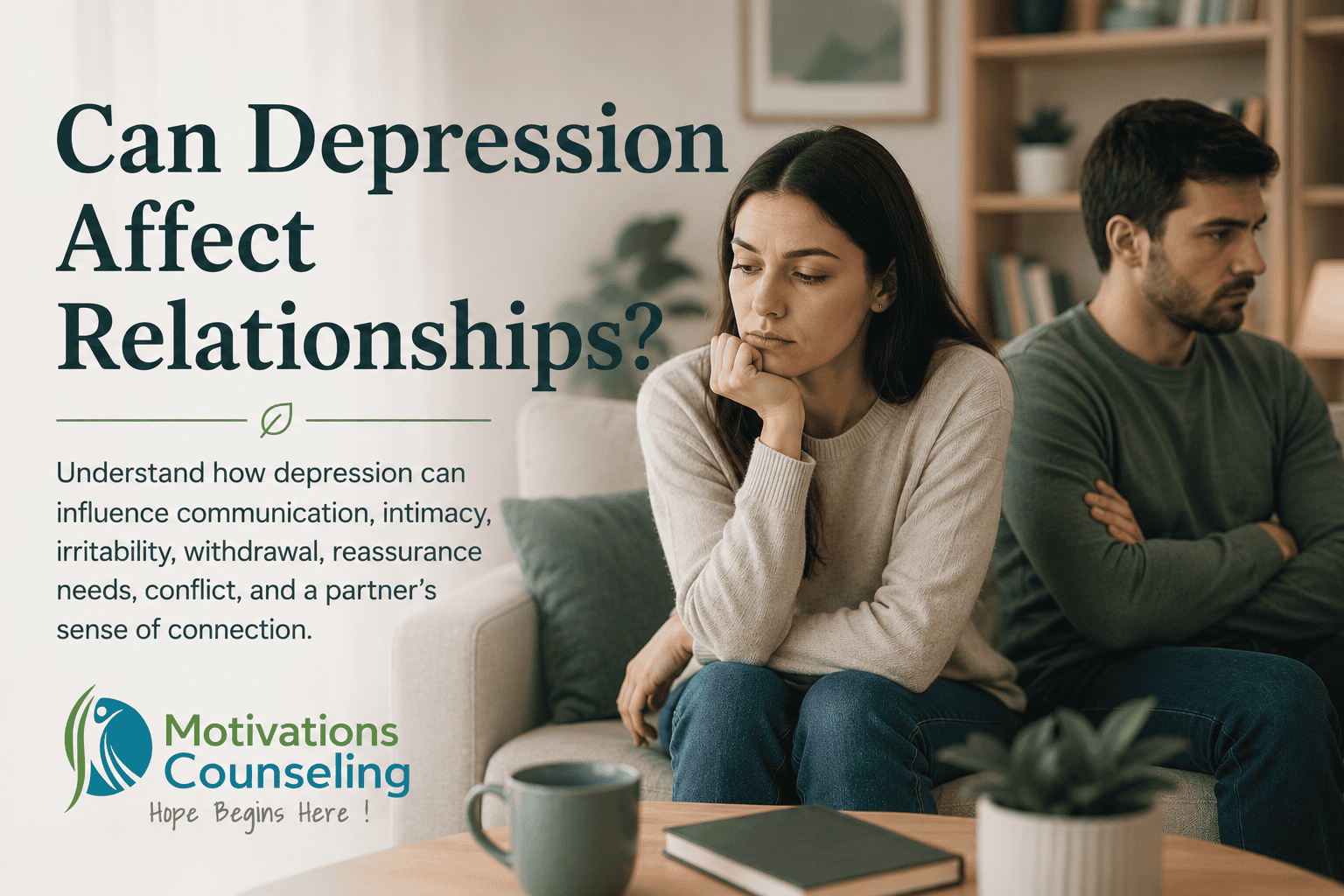
Can Depression Affect Relationships?
Depression can influence communication, intimacy, irritability, withdrawal, reassurance needs, conflict, emotional availability, and a partner’s sense of connection. Understanding these patterns can help couples respond with more compassion and support.
Start Here
Depression Can Affect the Relationship, Not Just the Individual
Depression does not stay neatly contained inside one person. It can affect how someone communicates, responds to support, expresses affection, handles conflict, asks for reassurance, manages responsibilities, and connects emotionally with a partner.
This does not mean a person with depression is choosing to hurt their relationship. Depression can change energy, attention, patience, desire, hope, emotional availability, and the ability to engage. At the same time, partners may feel confused, rejected, helpless, frustrated, or unsure how to support someone they love.
How Can Depression Affect Relationships?
Depression can affect relationships by changing communication, emotional availability, intimacy, motivation, irritability, reassurance needs, conflict patterns, and connection. It may lead to withdrawal, reduced affection, difficulty making plans, increased sensitivity, or feeling distant from a partner even when love is still present.
What It Looks Like
Common Ways Depression Can Show Up in Relationships
Depression can affect relationships in quiet, subtle ways or through more visible patterns like conflict, withdrawal, frustration, or emotional distance.
Less Communication
A person may have less energy to explain what they feel, ask for what they need, or stay emotionally engaged in conversations.
Withdrawal
Depression may lead someone to isolate, cancel plans, avoid intimacy, or seem emotionally distant.
Irritability
Depression may show up as frustration, shortness, impatience, or sensitivity rather than obvious sadness.
Reduced Intimacy
Emotional or physical closeness may feel harder when depression affects energy, desire, self-worth, or connection.
Reassurance Needs
Depression can increase insecurity, fear of being a burden, or needing repeated reminders that the relationship is safe.
Conflict Cycles
One partner may pursue connection while the other withdraws, creating a painful loop both partners struggle to stop.
Communication
Depression Can Make Communication Harder
Depression can make it harder to find words, explain feelings, respond thoughtfully, or stay present during difficult conversations. A person may feel overwhelmed by questions, unable to describe what is wrong, or too emotionally drained to talk.
Partners may misread this as disinterest, avoidance, secrecy, or lack of care. In reality, depression may be reducing the person’s ability to communicate clearly in the moment.
Communication changes may include:
- Shorter responses or less conversation
- Difficulty naming emotions or needs
- Avoiding serious conversations because they feel overwhelming
- Feeling mentally foggy during conflict
- Misunderstanding tone or intent
- Shutting down when asked too many questions
Helpful communication often starts with slowing down, reducing blame, and making room for simple statements such as, “I’m overwhelmed and need a few minutes,” or “I care, but I’m having trouble explaining what I feel.”
Withdrawal
Depression Can Cause Pulling Away
Withdrawal is one of the most painful ways depression can affect relationships. A person may isolate because they feel exhausted, ashamed, numb, overwhelmed, or convinced they are a burden.
- They may cancel plans or avoid conversations.
- They may spend more time alone or distracted.
- They may seem emotionally unavailable.
- They may love their partner but feel unable to connect.
Important Reframe
Withdrawal Is Not Always Rejection
Partners often experience withdrawal as rejection. Sometimes it is. But when depression is involved, withdrawal may reflect low energy, emotional shutdown, shame, fear, numbness, or feeling unable to meet relational expectations.
- Withdrawal can still hurt the relationship.
- It can be understood without excusing harm.
- Both partners may need support.
- Small moments of connection can matter.
Irritability
Depression Can Look Like Irritability or Frustration
Depression is not always quiet sadness. It can also show up as irritability, impatience, sensitivity, anger, criticism, or emotional reactivity. When someone is depleted, small stressors can feel harder to tolerate.
This can be confusing for both partners. One partner may feel hurt by sharp responses, while the depressed partner may feel guilty, misunderstood, or unable to regulate emotions as easily as before.
Irritability may show up as:
- Snapping over small things
- Feeling easily criticized or misunderstood
- Becoming defensive during conversations
- Having less patience for normal relationship stress
- Feeling overstimulated by noise, requests, or conflict
- Feeling guilty afterward but unsure how to repair
Depression may explain irritability, but it does not make hurtful communication harmless. Repair, accountability, and support are still important parts of protecting the relationship.
Intimacy
Depression Can Affect Emotional and Physical Intimacy
Depression can reduce emotional closeness, physical desire, affection, playfulness, and the sense of being connected. A person may want closeness but feel too tired, numb, ashamed, distracted, or disconnected to participate the way they normally would.
Partners may interpret reduced intimacy as loss of attraction, loss of love, or relationship failure. Sometimes intimacy changes are about the relationship, but sometimes they are strongly affected by mood, stress, trauma, medication, self-image, or emotional exhaustion.
Intimacy changes may include:
- Less affection or physical closeness
- Reduced sexual desire or interest
- Feeling emotionally distant during time together
- Avoiding touch because it feels overwhelming
- Feeling ashamed of needing support
- Difficulty relaxing into connection
Intimacy often improves when depression is addressed directly, pressure is reduced, and couples learn to rebuild connection in small, emotionally safe ways.
Reassurance Needs
Depression Can Increase the Need for Reassurance
Depression can affect self-worth and create thoughts such as, “I’m too much,” “They would be better off without me,” “I’m failing as a partner,” or “They must be tired of me.” These thoughts can increase the need for reassurance.
Reassurance can be helpful, but if depression is driving the fear, reassurance may only provide short-term relief. The person may need repeated confirmation while the partner may begin to feel helpless or drained.
Reassurance patterns may include:
- Frequently asking if the relationship is okay
- Worrying about being a burden
- Needing repeated reminders of love or commitment
- Interpreting neutral tone as rejection
- Feeling guilty for needing support
- Feeling briefly reassured, then anxious again
Supportive reassurance can help, but it works best alongside therapy, coping skills, communication tools, and treatment for the depression itself.
Partner Impact
Depression Can Affect the Partner Too
A partner may feel worried, lonely, rejected, helpless, frustrated, or unsure how to respond. They may want to support the person they love but also feel emotionally drained by the uncertainty, distance, conflict, or changes in the relationship.
It is possible to have compassion for depression while also acknowledging that the relationship needs care. Partners do not need to ignore their own needs in order to be supportive.
Partners may experience:
- Feeling shut out or emotionally alone
- Walking on eggshells to avoid conflict
- Uncertainty about whether to give space or move closer
- Compassion fatigue or caregiver strain
- Feeling responsible for fixing the depression
- Missing the connection the couple used to have
A supportive relationship can be deeply helpful, but a partner cannot be the entire treatment plan. Depression often requires support that extends beyond the relationship.
An Educational Framework
The Depression and Relationship Disconnection Cycle
Depression can create a painful loop where one partner feels overwhelmed and withdraws while the other feels rejected and pursues connection more urgently.
1. Depression Reduces Capacity
Energy, patience, communication, affection, and emotional availability may become harder to access.
2. One Partner Pulls Away
Withdrawal may happen because of shame, exhaustion, numbness, irritability, or emotional overwhelm.
3. The Other Feels Rejected
The partner may feel lonely, unwanted, confused, or afraid the relationship is no longer secure.
4. Pressure or Conflict Increases
Attempts to reconnect may come out as criticism, repeated questions, frustration, or emotional protest.
5. More Shutdown Happens
Increased pressure can make the depressed partner feel more overwhelmed, ashamed, or defensive.
6. The Pattern Repeats
Without support, both partners may feel unseen, hurt, and stuck in the same painful cycle.
Breaking the cycle often requires naming the pattern, treating depression, improving communication, and helping both partners understand the fear and pain underneath their reactions.
What Helps
What Can Help When Depression Affects a Relationship
Support often works best when the depression is addressed directly and the relationship pattern is treated with compassion, clarity, and practical tools.
Name the Pattern
It can help to identify how depression is affecting communication, withdrawal, intimacy, conflict, and reassurance needs.
Reduce Blame
Depression is not an excuse for harm, but reducing blame can make repair and honest communication more possible.
Use Clear Communication
Simple statements about needs, limits, and feelings may work better than long conversations during overwhelm.
Build Small Connection Rituals
Short, predictable moments of connection can help rebuild closeness without overwhelming either partner.
Protect Both Partners
The depressed partner needs support, and the other partner also needs boundaries, care, and emotional support.
Treat the Depression
Relationship repair is easier when depression, anxiety, burnout, trauma, or grief are also being addressed.
When to Seek Help
When to Seek Counseling
It may be time to seek counseling when depression is affecting communication, emotional connection, intimacy, conflict, withdrawal, reassurance, trust, or daily functioning in the relationship.
Consider counseling if you notice:
- One partner is withdrawing and the other feels rejected or alone
- Communication frequently turns into conflict or shutdown
- Depression is affecting intimacy, affection, or connection
- Irritability, criticism, or defensiveness has increased
- One partner feels responsible for fixing the other
- Reassurance helps briefly but the same fears return
- Both partners feel stuck in a repeating cycle
- Depression, trauma, grief, anxiety, or burnout may be affecting the relationship
If depression occurs with thoughts of death, self-harm, or suicide, seek immediate support. In the United States, call or text 988 for the Suicide & Crisis Lifeline, call 911, or go to the nearest emergency room.
Counseling at Motivations Counseling
Therapy Can Help When Depression Is Affecting Connection
Motivations Counseling provides therapy for adults and couples experiencing depression, relationship stress, withdrawal, emotional disconnection, anxiety, burnout, trauma-related symptoms, grief, intimacy concerns, communication difficulties, and recurring conflict patterns.
Our counseling team serves clients in Sugar Land, Katy, Richmond, Fort Bend County, West Houston, and through telehealth across Texas when clinically appropriate.
Counseling Support
Depression and Relationship Counseling in Sugar Land, Katy, and Online Across Texas
If depression is affecting your relationship, counseling can help you understand the pattern, communicate more clearly, rebuild emotional connection, and support both partners with care.
- Individual counseling for depression, withdrawal, irritability, and emotional numbness
- Couples counseling for communication, disconnection, conflict, and intimacy concerns
- Support for partners impacted by depression, burnout, anxiety, trauma, or grief
- Trauma-informed therapy and EMDR therapy when clinically appropriate
- In-person options in Sugar Land and Katy when available
- Telehealth counseling across Texas when clinically appropriate
Therapy Learning Center
Continue Learning About Depression, Relationships, and Emotional Connection
These related resources can help adults and couples better understand depression symptoms, emotional disconnection, burnout, anxiety, trauma responses, and relationship patterns.
Depression Counseling
Learn how counseling can support adults experiencing depression, low motivation, numbness, and emotional exhaustion.
Learn more →Couples Counseling
Learn how couples counseling can help with communication, conflict, intimacy, and emotional connection.
Learn more →Why Couples Get Stuck
Understand how repeated arguments can become a pattern that leaves both partners feeling unheard.
Read article →Emotional Disconnection
Learn why numbness, shutdown, and emotional distance can happen during stress or depression.
Read article →Why Do I Feel Numb Instead of Sad?
Understand emotional numbness, shutdown, disconnection, and why feelings may become hard to access.
Read article →Signs of Depression in Adults
Learn how depression may show up emotionally, physically, cognitively, and relationally.
Read article →Full Resource Center
Explore the Full Counseling Resource Center
Our Counseling Resource Center includes educational articles on anxiety, depression, trauma, EMDR therapy, relationships, teen counseling, emotional overwhelm, nervous system responses, and practical ways to understand mental health symptoms.
Frequently Asked Questions
Common Questions About Depression and Relationships
Can depression affect relationships?
Yes. Depression can affect communication, intimacy, irritability, withdrawal, reassurance needs, conflict patterns, emotional availability, and a partner’s sense of connection.
Can depression make someone pull away from their partner?
Yes. Depression may lead to withdrawal when someone feels exhausted, ashamed, numb, overwhelmed, or afraid of being a burden. Pulling away can still hurt the relationship, even when it is not intended as rejection.
Can depression cause irritability in relationships?
Yes. Depression can show up as irritability, defensiveness, impatience, emotional sensitivity, or frustration, especially when someone feels depleted or overwhelmed.
Can depression affect intimacy?
Depression can affect emotional and physical intimacy by reducing energy, desire, affection, self-worth, emotional availability, and the ability to feel connected.
How can a partner support someone with depression?
Support may include listening without blame, encouraging counseling or treatment, offering practical help, creating small moments of connection, respecting boundaries, and caring for their own emotional needs too.
What should I avoid saying to a depressed partner?
Try to avoid statements that imply laziness, weakness, or blame, such as “just snap out of it” or “you have nothing to be sad about.” Supportive communication is usually more effective when it is calm, specific, and compassionate.
Can couples counseling help when depression affects the relationship?
Couples counseling can help partners understand the pattern, communicate more clearly, reduce blame, rebuild connection, and support both the depressed partner and the partner who feels impacted.
When should we seek counseling?
Consider counseling when depression is affecting communication, intimacy, emotional connection, conflict, withdrawal, reassurance, trust, or the ability to function as a couple.

Take the Next Step
Depression and Relationship Counseling in Sugar Land, Katy, and Online Across Texas
If depression is affecting communication, intimacy, withdrawal, irritability, or emotional connection, counseling can help you understand the pattern and begin rebuilding support in a manageable way.