
Navigating ESA Letter Verification: What Texas Renters Should Know
Emotional Support Animal Resource Center
Navigating ESA Letter Verification: What Texas Renters Should Know
Submitting your ESA letter may be only one part of requesting a housing accommodation. Learn what verification involves, how to respond to additional forms, and how your clinician can help when a property or screening company has questions.
Start Here
An ESA Letter May Be the Beginning of the Housing Review
You complete an emotional support animal evaluation. Your therapist provides a letter. You upload it to your apartment’s website. Then an email arrives asking for another form, a provider response, or more information. It can feel as though the process has started over.
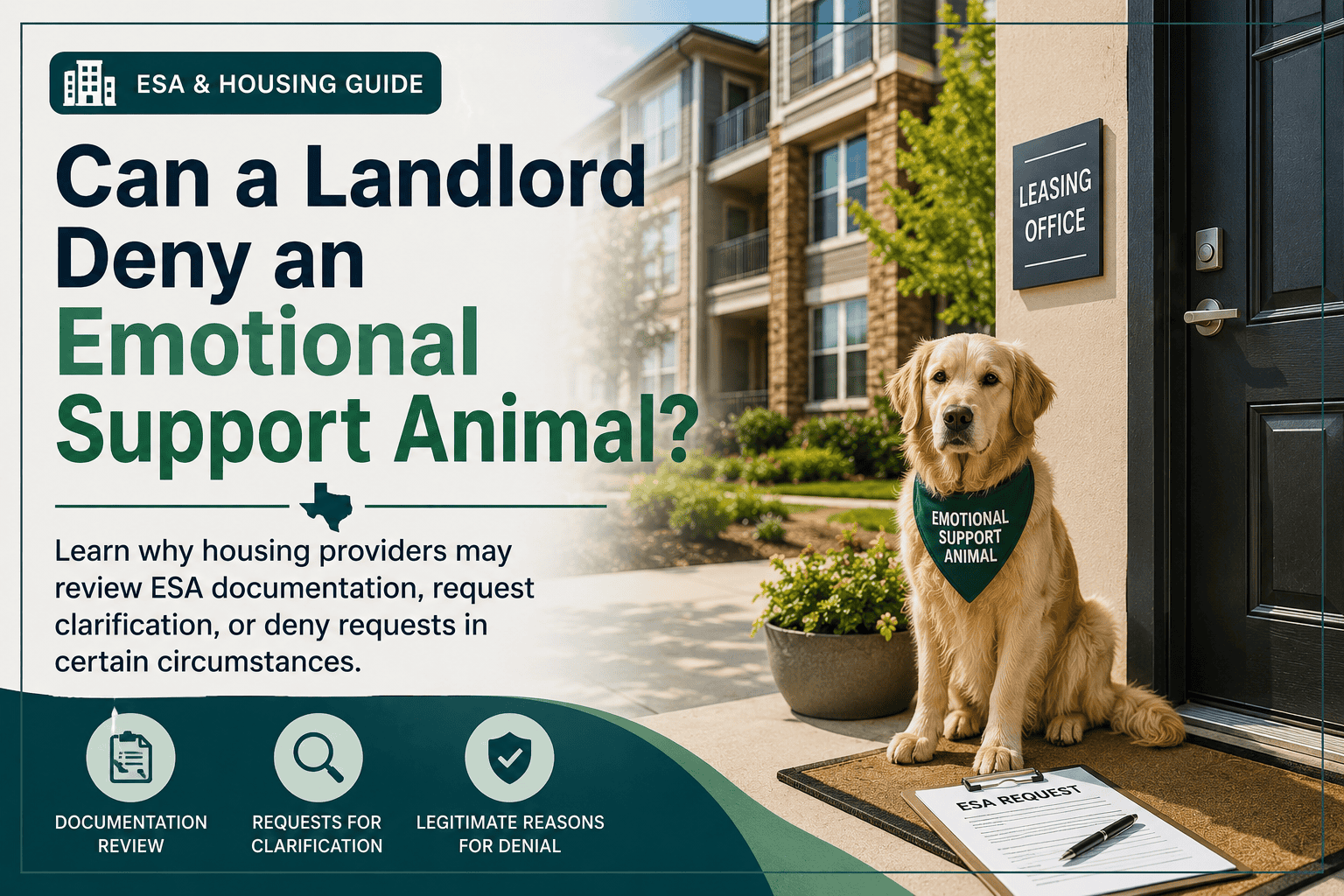
ESA letter verification is the review of documentation supporting a housing accommodation request. It may involve confirming who issued a letter, whether the clinician can support the recommendation, and whether information needed to evaluate the request is clear. Receiving a follow-up message does not, by itself, mean your documentation is fraudulent or your request has been finally denied.
For Texas renters, the most useful next step is usually to identify the exact question and involve the clinician who completed the evaluation. Repeatedly uploading the same file may not resolve a request for direct provider confirmation.
Keep the complete message. Your therapist can respond more effectively when you provide the actual request, the property name, any reference number, and the stated deadline.
Understanding the Request
How ESA Documentation Fits Into Texas Housing
A housing accommodation is a change to a rule or procedure because of a disability-related need. The Texas Workforce Commission explains that fair housing protections include reasonable accommodations needed for a person with a disability to use and enjoy a dwelling. Coverage and exceptions depend on the housing situation. See Texas fair housing information.
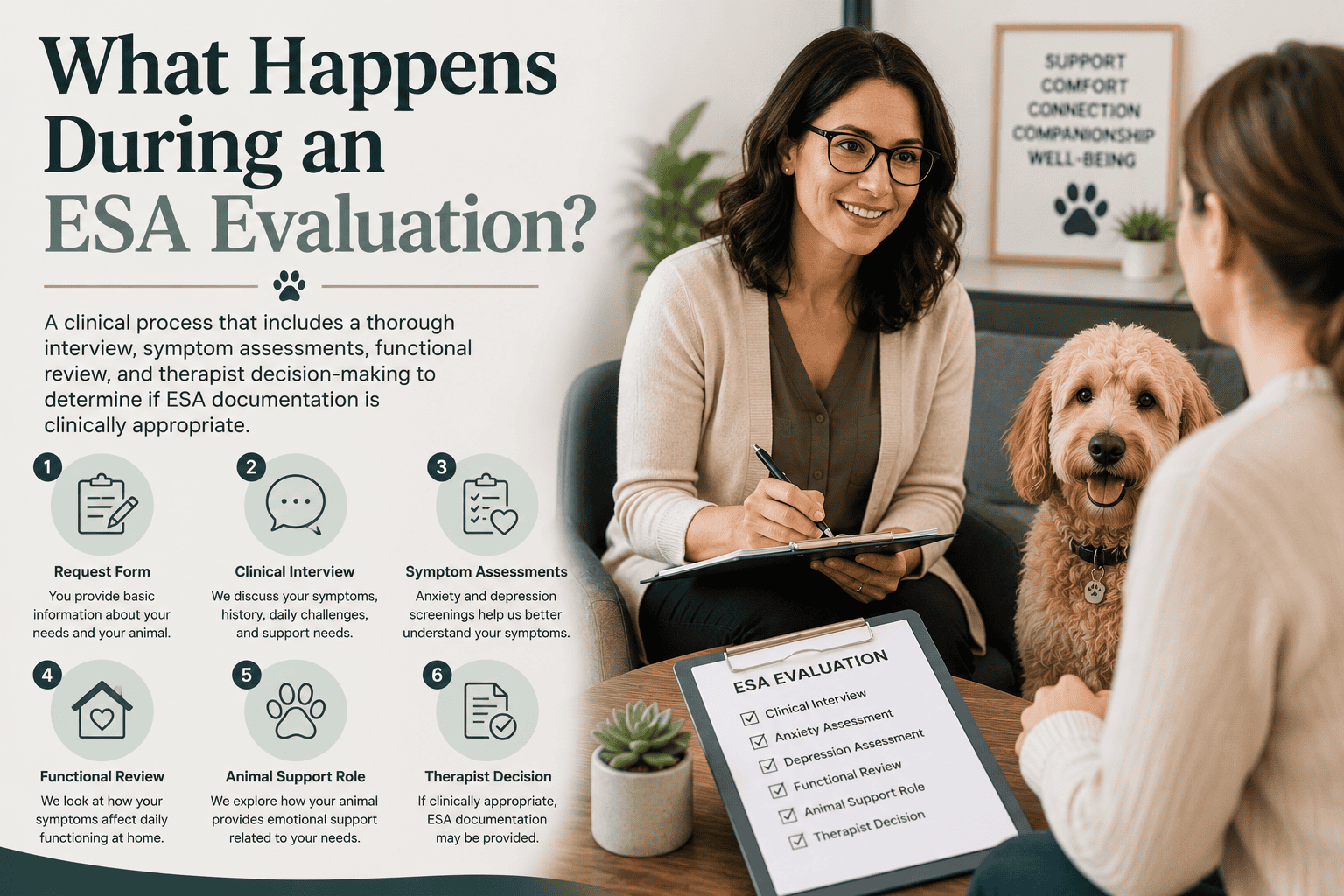
An emotional support animal may provide support connected to a person’s mental health impairment. A clinical evaluation considers symptoms, their effect on daily functioning, and the animal’s relationship to those limitations. Enjoying an animal’s companionship, wanting to avoid pet fees, or having a diagnosis does not automatically establish a need for an accommodation.
Housing accommodations and public access are different
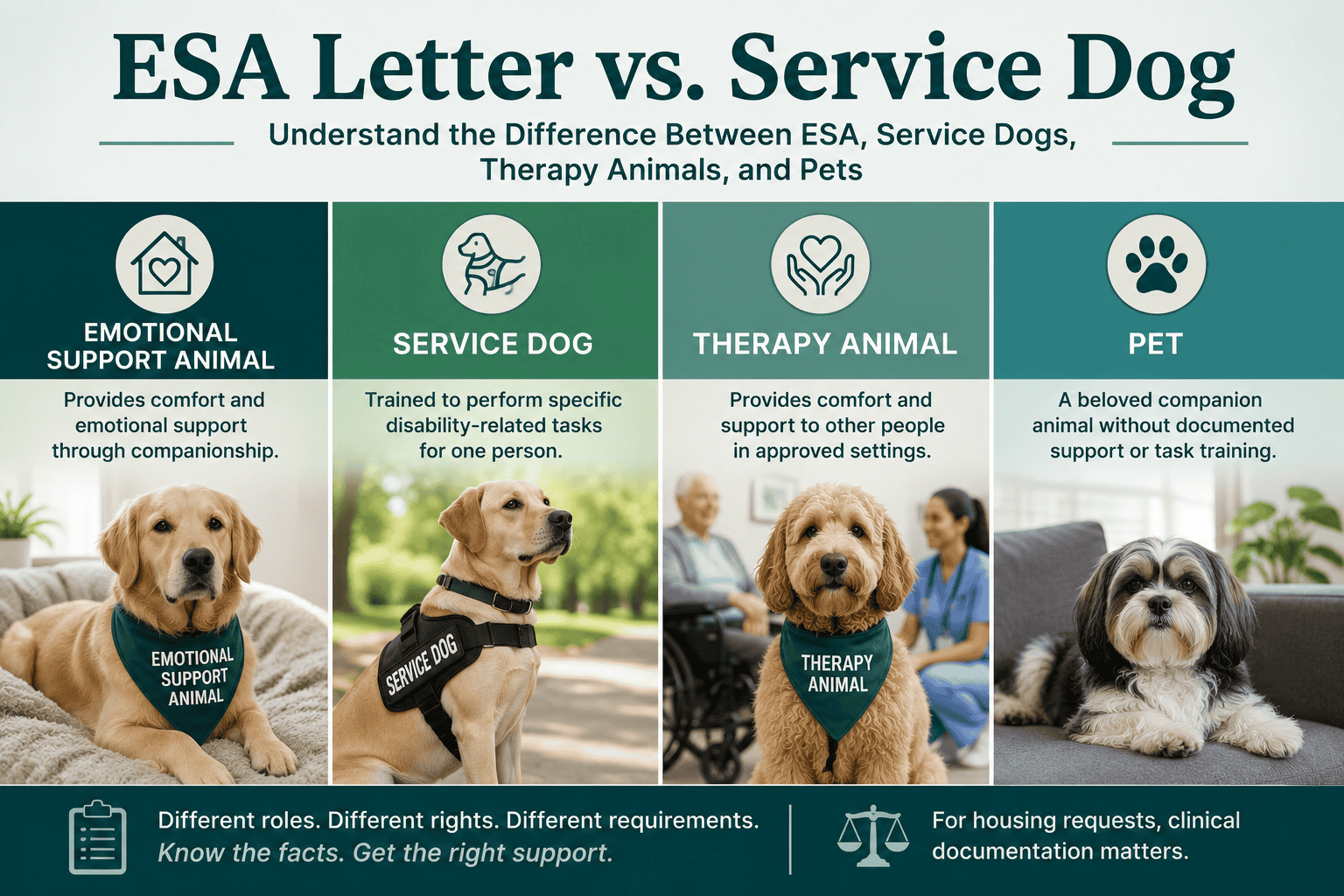
An ESA letter does not turn an animal into an ADA service dog. Under the ADA, service dogs are individually trained to perform disability-related work or tasks. Comfort provided by an animal’s presence alone does not meet that definition. Housing requests involve a different legal framework from access to restaurants and stores. Read the Department of Justice’s service animal FAQs.
This article focuses on practical steps for rental housing. A dispute involving coverage, fees, a denial, or an eviction requires advice specific to the facts and applicable law.
At a Glance
Who Handles Each Part of Verification?
| Person or organization | Typical role | What to ask |
|---|---|---|
| You, the renter | Request the accommodation, provide accurate information, and respond to messages. | What is missing, who needs to send it, and when is it needed? |
| Your clinician | Evaluate clinical need and provide appropriate documentation or clarification with authorization. | Can you review this request and respond directly if appropriate? |
| Verification company | Review information for the housing provider and communicate about the submission. | Is the request pending clarification or has a decision been issued? |
| Housing provider | Handle the housing accommodation and communicate its implementation. | Has the accommodation been recorded for my unit and each approved animal? |
Ask the property who handles reconsideration if you disagree with a portal result. Your clinician can explain a recommendation, but cannot promise the outcome of the housing review.
Step by Step
A Practical Way to Navigate ESA Letter Verification
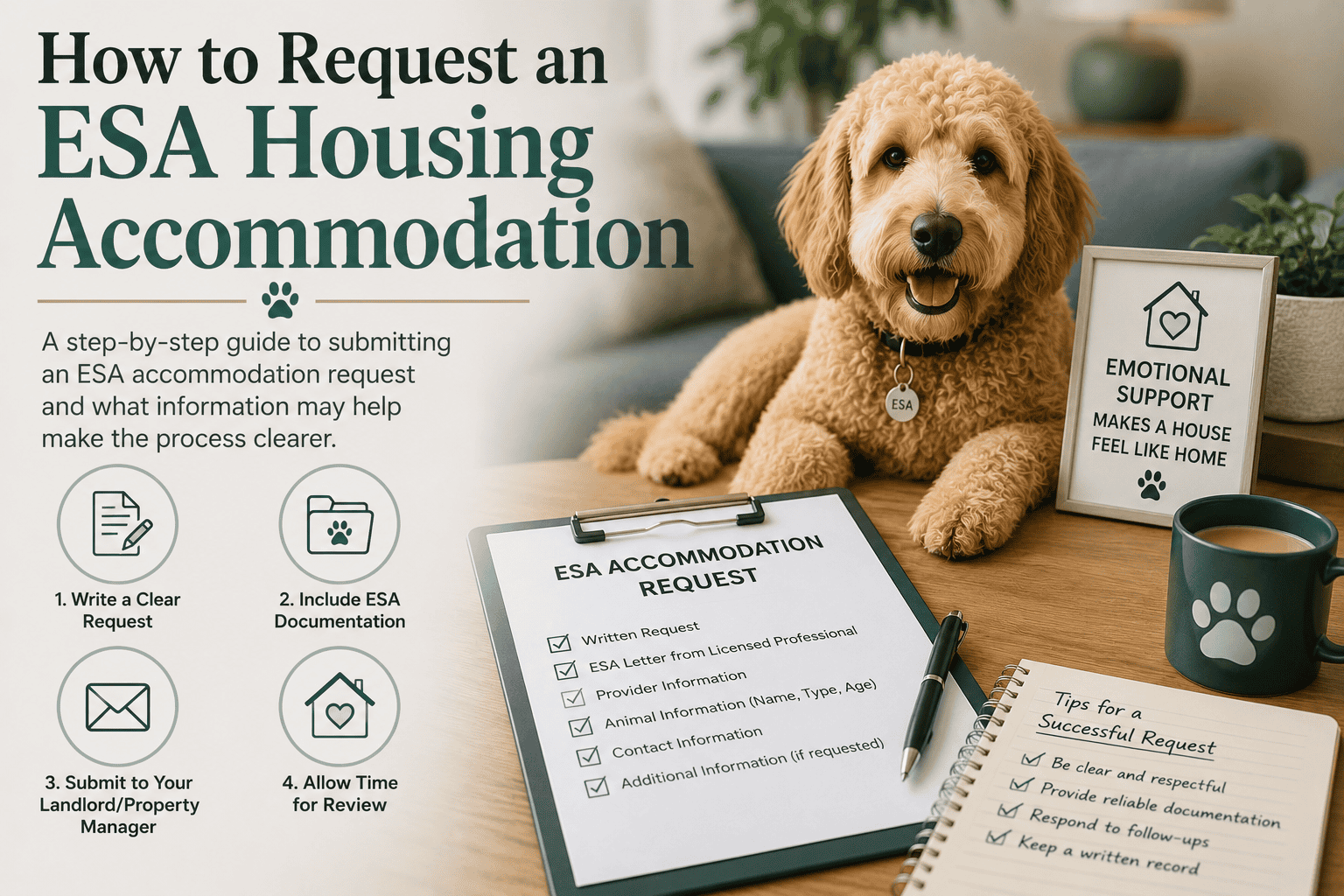
1. Ask how to submit your accommodation request
Use the property’s verified contact information to ask where documentation should go. Confirm whether it uses a resident portal, email, or a third-party service. If a portal is inaccessible or confusing, ask the property for assistance or an alternative way to communicate your request.
Begin early enough to allow for follow-up. Tell both your clinician and the property about a scheduled move, renewal, or other deadline. An evaluation appointment and completion of the housing review are separate events.
2. Submit a clear, complete copy of your letter
Check that every page is readable and that your name matches your application. Avoid screenshots that cut off the signature, date, or clinician’s contact information. If something is wrong, ask the issuing office to correct it. Do not edit the clinician’s letter yourself.
3. Review the animal information
Keep animal names and identifying details consistent across your letter, application, and veterinary records. An animal profile may ask for a photograph or vaccination information. Those details concern the animal; they do not replace documentation of your clinical need.
4. Save confirmation and monitor follow-up
Save the submission receipt or take a screenshot of the status. Check email, spam folders, and portal messages. Keep one folder with your letter, submitted forms, correspondence, and final decision so you can see what has already been supplied.
5. Connect your clinician with the actual request
If follow-up is needed, send your clinician the complete message and any attached form. Include the property name, recipient contact information, and reference number. Ask whether a release of information is needed before the office can respond.
6. Confirm the result with the property
Once review is complete, request written confirmation. Check that the decision identifies the correct animal or animals and is reflected in your housing records. If your account still shows a disputed animal charge, ask management to review it and explain the status in writing.
OurPetPolicy & PetScreening
What If Your Apartment Uses a Verification Company?
Some properties use OurPetPolicy or PetScreening to manage animal information and review assistance animal documentation. You may interact with the platform even though you applied to rent directly through the property.
Working through OurPetPolicy
OurPetPolicy’s resident guidance describes a process involving animal profiles, supporting documentation, and provider verification. It says assistance animal review times depend in part on document reliability and the time needed for the health practitioner to verify documentation. A quick pet application timeline should not be treated as a promised ESA approval timeline. Read OurPetPolicy’s resident FAQ.
If you receive a provider verification form, forward it to the clinician who evaluated you. Ask whether the company needs a response directly from the clinician. A form uploaded by a resident may leave an authentication question unresolved if the reviewer has specifically requested provider contact.
Working through PetScreening
PetScreening also offers assistance animal review services. Start with the link supplied by your property and select the profile that accurately describes your request. Read any follow-up instructions carefully; do not assume the steps or status labels are identical to another company’s. Visit PetScreening.
Keep the housing office involved. Ask management to clarify a conflicting instruction, an unclear charge, or a deadline that does not account for pending verification. A platform message is not a substitute for understanding the status of your housing request.
Company procedures may change. Their websites describe their services and processes; those descriptions are not a substitute for an independent interpretation of housing law.
Clinical Evaluation Matters
What If the Reviewer Questions an “Online ESA Letter”?
The phrase “online ESA letter” can refer to very different experiences. One person may have obtained a document without a meaningful clinical assessment. Another may have met with a licensed clinician through telehealth and discussed symptoms, history, daily functioning, and the animal’s role.
OurPetPolicy’s article on online letters emphasizes the clinician’s knowledge of the patient and concerns about brief questionnaires or calls. It also describes contacting the issuing professional. If you receive that type of concern, ask what information about your actual evaluation needs clarification. Read the company’s explanation.
The clinician should describe what actually occurred
At Motivations Counseling, the assessment considers clinical history, current symptoms, functional limitations, and the potential therapeutic role of the animal. Screening measures may inform the assessment, but a score alone does not determine whether documentation is appropriate.
Your clinician should answer questions accurately about the relationship and assessment. That includes distinguishing an evaluation from ongoing treatment. Additional assessment or treatment may be recommended when needed. A reviewer’s question is not a reason to invent visits, exaggerate impairment, or describe care that did not occur.
A useful response addresses the concern. Clarifying the evaluation and the clinician’s basis for the recommendation may be more helpful than changing the letter’s appearance or purchasing another document.
Forms & Confidentiality
How to Handle Additional Questions Without Oversharing
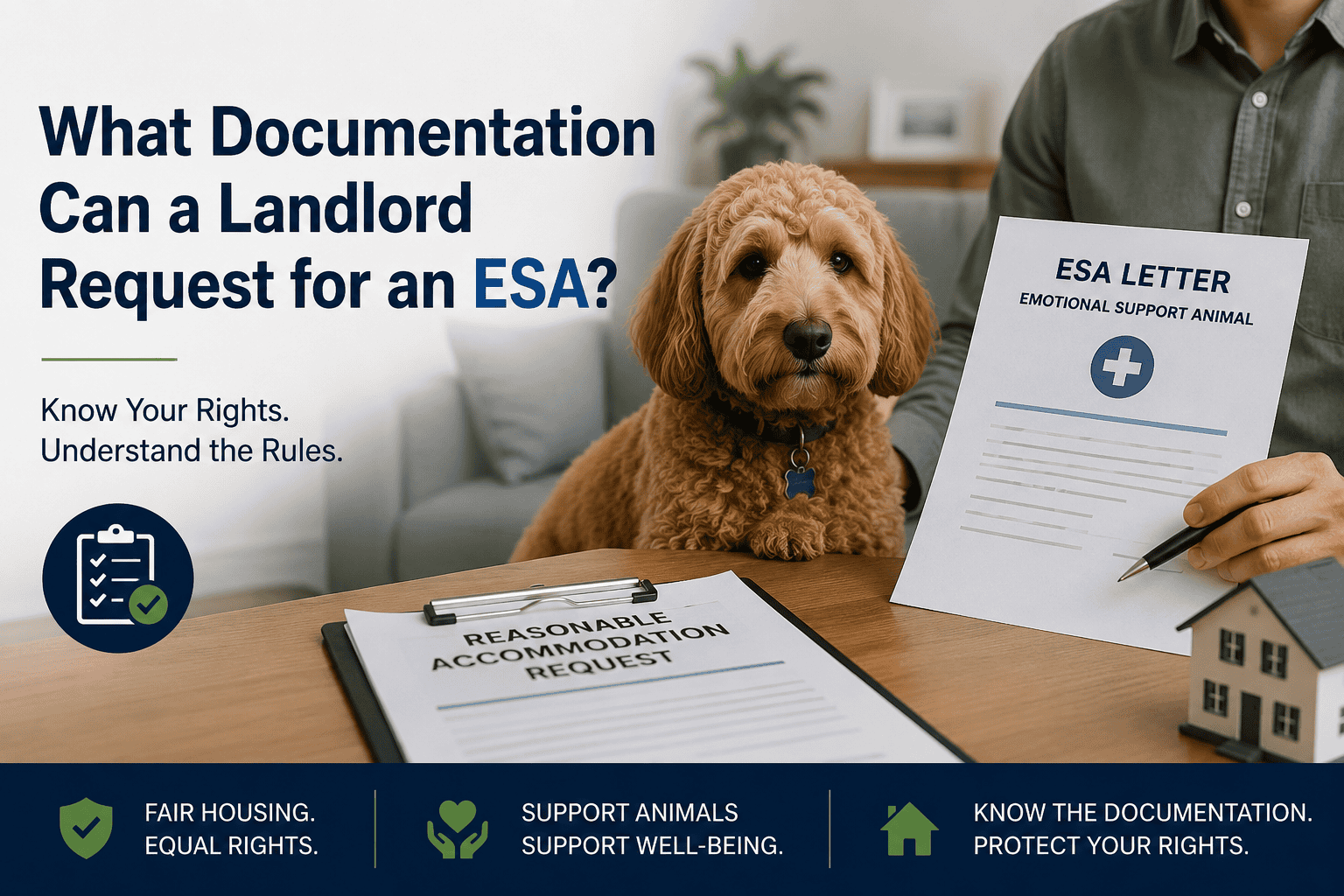
When disability or need is not apparent, reliable information may be requested to evaluate an accommodation. The HUD–DOJ joint statement explains that detailed medical records are usually unnecessary. The focus is disability, the requested accommodation, and the relationship between them. See the joint statement, questions 17–18.
Send forms to your clinician before answering clinical questions
Complete the portions intended for you. Leave clinical statements, professional credentials, and signatures to the clinician. Questions about functional limitations or the reason for a recommendation require professional judgment.
Understand what a release of information allows
A release of information, often called an ROI, gives your clinician permission to communicate within its stated scope. Read who may receive information, what information may be shared, and when the authorization expires. Ask the office to explain anything unclear before signing.
For accommodation verification, discuss an authorization limited to that purpose. Do not assume you must send therapy notes, trauma narratives, medication lists, or your complete mental health record simply because a portal has an upload field.
A requested form and a legal requirement are different questions
The joint statement explains that housing providers must consider accommodation requests even when a resident does not use their preferred form. A clinician may still choose to complete an appropriate verification form to clarify the request. See questions 12–13.
If a form asks your clinician to make a legal conclusion, guarantee an animal’s behavior, or confirm information outside their knowledge, the clinician may need to explain the limits of what they can verify.
When There Is a Problem
What to Do If Your ESA Letter Is Questioned or Rejected
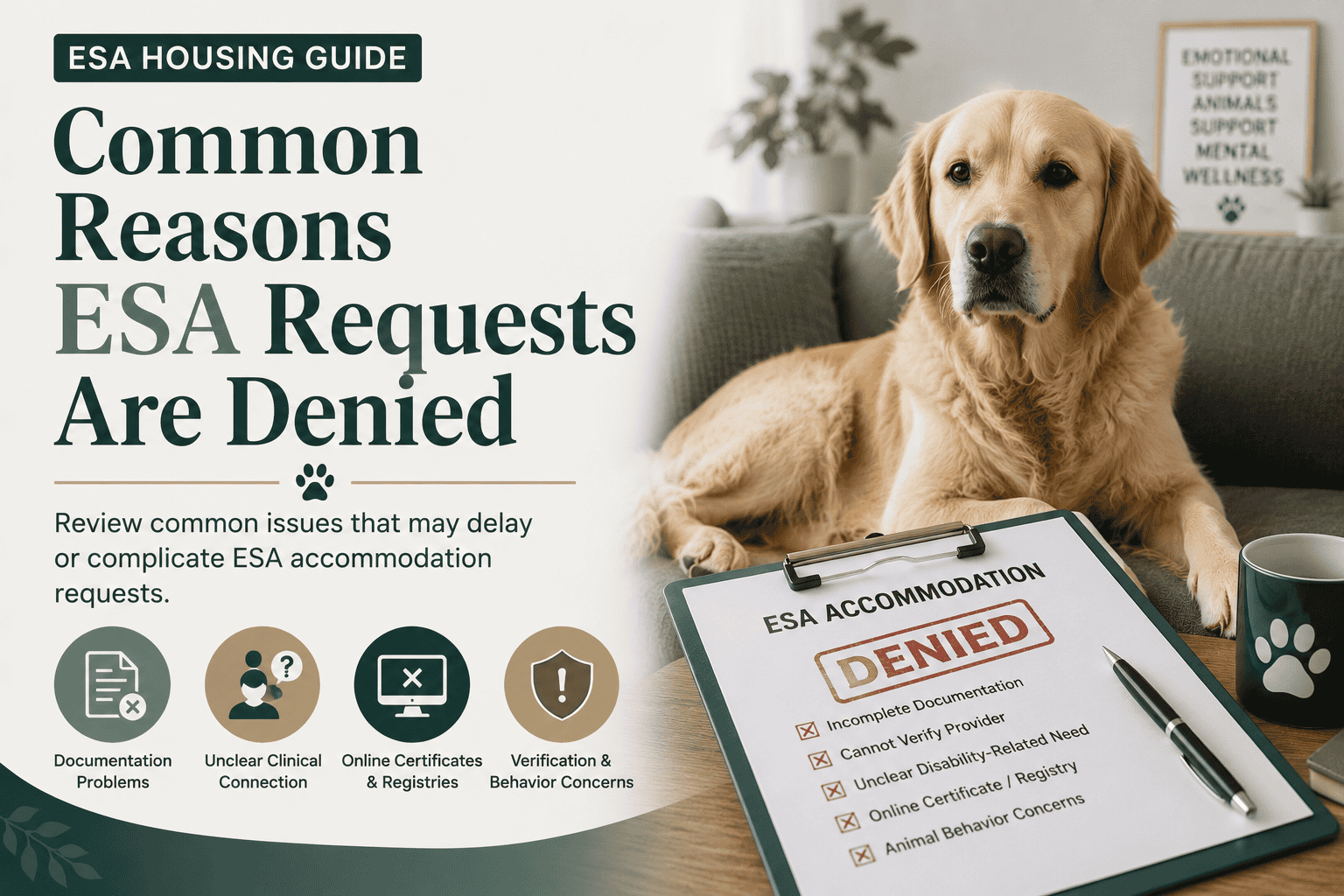
Start by separating a request for clarification from a final denial. Words such as “incomplete,” “pending provider response,” and “not approved” may refer to different stages. Ask for a plain-language explanation.
| Message or concern | Useful next step |
|---|---|
| Provider has not responded | Confirm the office received the request, has your authorization, and has the correct return address. |
| Information is missing | Request a specific list and forward it to the clinician. Ask which submitted document was reviewed. |
| Letter appears to come from an online service | Ask which aspect of the assessment or provider relationship needs clarification. |
| Animal details do not match | Compare the profile, letter, and veterinary records. Have the responsible party correct any error. |
| Request denied after clarification | Obtain the reason in writing, ask about reconsideration, and seek housing advice if the dispute continues. |
Keep your response brief and specific
You do not need to send a long personal history to ask what remains unresolved. A message such as the following can help organize the next step:
Please clarify whether my assistance animal accommodation request is pending additional information or has been denied. If information is missing, please identify the specific issue and where my clinician should send an authorized response. Please also confirm any deadline for responding.
When to seek help beyond your clinician
Your therapist can address clinical documentation. A fair housing organization or attorney can assess a disputed requirement or denial. The Texas Workforce Commission Civil Rights Division provides housing discrimination information and a complaint process. Contact it promptly about eligibility and filing deadlines.
If a notice threatens eviction, animal removal, or another immediate consequence, seek legal help promptly. Do not assume a clinical letter or pending reconsideration pauses a deadline. Keep paying attention to official notices while the issue is being reviewed.
Details That Deserve Attention
Multiple Animals, Renewals, Fees, and Student Housing
If you are requesting more than one animal
Discuss each animal with your clinician. The evaluation should consider why the requested number of animals is needed and what support each provides. Different personalities do not automatically establish separate clinical needs.
For example, a client might describe one animal helping with distress at home and another supporting activity when depressive symptoms lead to withdrawal. Those are starting points for discussion, not ready-made justifications to copy. The clinician must decide whether the reported benefits support the recommendation.
If you move or renew your lease
Keep your previous approval and original documentation. Ask what the new property or reviewer needs and why. An animal profile renewal, a request to confirm a continuing clinical need, and a new clinical evaluation are different things. Your clinician can determine whether updated assessment is appropriate.
If a fee appears during the process
Ask whether the amount is for a pet profile, a housing charge, or a clinical service. The HUD–DOJ joint statement says an extra fee or deposit cannot be a condition of granting a reasonable accommodation. Responsibility for actual damage is separate. See question 11.
If you believe a charge was applied incorrectly, ask for a written explanation and review. Keep the receipt and related messages. Avoid assuming that a charge displayed by software has already been individually reviewed.
If you live in university housing
Ask the campus housing or accessibility office which team reviews requests. Share its form with your clinician before the deadline. University forms may ask how symptoms affect the residential setting or how an animal fits into the student’s care. Answers should reflect the actual assessment and treatment recommendations.
Motivations Counseling
Clinical Evaluation With Support Through Verification
Motivations Counseling serves Texas clients from offices in Sugar Land and Katy, with telehealth evaluations available across Texas when clinically appropriate. Our ESA process includes intake information, a clinical interview, assessment of symptoms and functioning, and consideration of the animal’s therapeutic role.
When documentation is clinically supported, our office can review appropriate follow-up requests for clients we have evaluated. With client authorization, that may include confirming our documentation, clarifying the recommendation, and responding directly to a housing provider or verification company.
Do we work with OurPetPolicy and PetScreening?
We assist our evaluated clients with appropriate verification requests from OurPetPolicy and PetScreening. If you receive a form or follow-up message, contact our office and provide the complete request. We can help determine what clinical response and authorization are needed.
Motivations Counseling is an independent clinical practice. We are not affiliated with either company, and participation in verification does not guarantee accommodation approval.
What if another provider issued your letter?
Start with that provider whenever possible. We cannot authenticate someone else’s evaluation or sign as if we performed it. If you are seeking a new evaluation, contact our office to discuss the process and any housing deadline. A new evaluation does not promise a different housing outcome.
Know What Support Is Available Before You Schedule
Ask about the evaluation, documentation, follow-up forms, and timing. Our goal is to provide clear clinical information and appropriate communication so you understand the next step.
Before You Submit
Your ESA Verification Checklist
- Confirm the property’s submission instructions and contact person.
- Use accurate names and consistent animal information.
- Submit a readable, complete document supplied by your clinician.
- Save the confirmation, reference number, and every follow-up message.
- Tell your clinician about any forms and deadlines.
- Review and complete any needed authorization for communication.
- Ask what specifically remains unresolved before resubmitting.
- Obtain the final status in writing and check your housing records.
You do not need to manage every clinical question yourself. A well-organized request helps your clinician and the housing reviewer address the actual issue.
Frequently Asked Questions
Common Questions About ESA Letter Verification
Does a request for another form mean my ESA letter is invalid?
Not necessarily. It may mean the reviewer is seeking clarification or provider confirmation. Ask what issue remains and share the complete message with your clinician.
Can Motivations Counseling respond to OurPetPolicy?
Yes. For clients we have evaluated, we can review appropriate verification requests and provide an authorized clinical response when supported by our assessment. Contact our office with the form or message.
Can I upload a completed verification form myself?
Follow the specific instructions. If the reviewer requires direct provider confirmation, uploading a copy yourself may not complete that step. Ask your clinician whether an authorized response can be sent directly.
Can I complete my evaluation through telehealth?
Motivations Counseling offers telehealth ESA evaluations for clients located in Texas when clinically appropriate. The clinician still needs enough information to assess symptoms, functioning, and the recommendation. Additional assessment may be needed.
Should I send all my therapy records to the apartment?
Ask your clinician to review the request first. Keep the response focused on the information needed for accommodation verification, and discuss the scope of any release before signing it.
How long will verification take?
There is no single processing time we can promise. Ask the reviewer for its expected timeline and tell our office about your deadline. Missing information or pending provider communication can affect completion.
Will a new letter automatically reverse a denial?
No. First identify why the original request was questioned. The next step may be clarification from the existing provider, correction of an error, further assessment, or housing advice.
Does an ESA letter guarantee my animal will be approved?
No. A clinician provides a clinical recommendation. The housing request is evaluated separately, and disputed decisions may need review by a fair housing agency or attorney.
What should I send Motivations Counseling when verification is requested?
Send the complete request through the method our office provides, including any form, recipient information, property name, reference number, and deadline. Ask whether an authorization is needed. Avoid posting clinical information publicly.
Continue Learning
More Resources for Texas Renters
The Complete ESA Guide
Explore evaluations, housing requests, and the role of emotional support animals.
Read the guide →Choosing an ESA Provider
Questions to ask about assessment, documentation, and follow-up support.
Explore the provider guide →ESA Resource Center
Browse additional articles from Motivations Counseling.
Browse ESA articles →Sources & Further Reading
Where to Find Housing and Verification Information
The legal resources below address accommodation principles and public access distinctions. Company resources explain each company’s stated procedures. They serve different purposes.
- Texas Workforce Commission: Housing Discrimination—Fair Housing. Texas protections, reasonable accommodations, and complaint information.
- HUD–DOJ Joint Statement: Reasonable Accommodations Under the Fair Housing Act (May 14, 2004). Questions 11–13 and 17–18 address fees, forms, and documentation. This is agency guidance, not the text of the statute.
- U.S. Department of Justice: Service Animals and the ADA. Explains the distinction between emotional support and trained service work.
- OurPetPolicy: Resident Resources and FAQ. Company information on profiles, documentation, and processing.
- OurPetPolicy: Online Emotional Support Animal Letters & How to Spot Them. The company’s description of its documentation concerns.
- PetScreening. Company information on animal profiles and assistance animal review.
Sources accessed September 20, 2026. This article provides general educational information and describes our clinical services. It is not legal advice. Laws, agency guidance, and company procedures can change; obtain current, individualized advice for a housing dispute.

Sugar Land • Katy • Telehealth Across Texas
Get Help Understanding Your Next Step
If you need an ESA evaluation or have received a verification request for documentation we issued, contact Motivations Counseling. We can explain the clinical process and help identify the appropriate follow-up.