
Tag: ESA Letter

How to Request an ESA Housing Accommodation

ESA Learning Center

How to Request an ESA Housing Accommodation

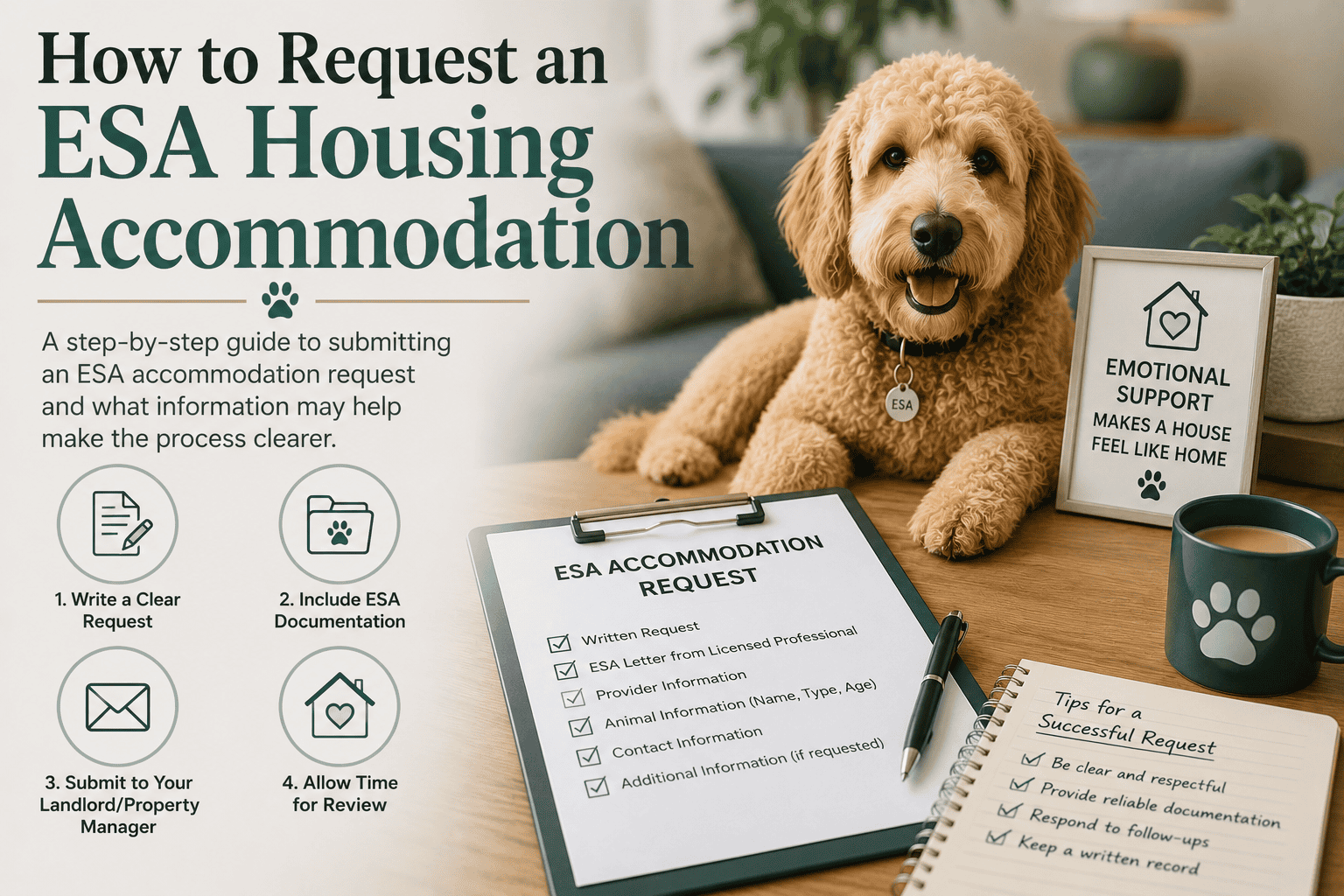
Requesting an emotional support animal housing accommodation usually involves submitting a clear written request, providing reliable ESA documentation when appropriate, and allowing the housing provider to review the request. This guide explains how to make the process clearer, what information may help, and common mistakes to avoid.

Start Here

ESA Housing Requests Should Be Clear, Professional, and Documented

An emotional support animal housing accommodation request is usually a request for an exception or adjustment to a housing rule, such as a no-pet policy, pet restriction, breed restriction, or pet fee requirement. The request should explain that the animal is being requested as an accommodation related to a mental health need.

A clear written request and reliable ESA documentation can help reduce confusion. The landlord or housing provider may still review the request, ask for verification when appropriate, and consider legitimate animal behavior or safety concerns.

View ESA Service Page

Request Process

Steps to Request an ESA Housing Accommodation

The process may vary by landlord, apartment community, property manager, or housing provider, but these steps can help make the request clearer.

1. Complete an ESA Evaluation

A licensed professional evaluates symptoms, functioning, emotional support needs, and whether ESA documentation is clinically appropriate.

2. Obtain ESA Documentation

If clinically appropriate, an ESA letter may be provided to support a housing accommodation request.

3. Make a Written Request

Submit a clear request to your landlord, property manager, or housing office explaining that you are requesting an ESA accommodation.

4. Attach Documentation

Include the ESA letter or documentation requested by the housing provider, while avoiding unnecessary private medical details.

5. Allow Review

The housing provider may review the request, verify the provider, or ask for clarification when appropriate.

6. Respond to Follow-Up

If the request is questioned, ask what information is missing and respond in writing when possible.

ESA Documentation

What Documentation Should You Include?

When a disability-related need is not obvious, the housing provider may request reliable documentation. This usually means documentation from a qualified licensed professional who has completed an evaluation and determined that an ESA recommendation is clinically appropriate.

The documentation should be focused. It should support the accommodation request without including unnecessary private therapy records, detailed treatment notes, or excessive medical history.

ESA documentation may include:

  • The provider’s name and professional credentials
  • The provider’s license type, license number, and state of licensure
  • The date the letter was issued
  • Confirmation that an evaluation occurred
  • A statement that ESA documentation is clinically appropriate
  • Provider contact information for verification when authorized

Online ESA certificates, registries, ID cards, and badges are not the same as clinical documentation from a licensed professional. Note: Motivations Counseling ESA letters include all of these elements that landlords will require to consider your accomodation request.

Written Request

What Should the ESA Request Say?

A written request does not need to be long. It should clearly state that you are requesting a reasonable housing accommodation for an emotional support animal and that supporting documentation is attached or available.

Keeping the request written and dated can help reduce confusion and create a clearer record of what was submitted.

Privacy Boundary

You Usually Do Not Need to Share Everything

The request does not usually need to include your full diagnosis history, therapy notes, medication list, trauma history, or detailed private treatment information.

  • Keep the request simple and respectful.
  • Attach reliable ESA documentation.
  • Avoid oversharing private health details.
  • Ask for clarification if more information is requested.

Sample language: “I am requesting a reasonable housing accommodation for an emotional support animal. I have attached documentation from a licensed professional supporting this request.”

Housing Provider Review

What Happens After You Submit the Request?

After you submit the ESA accommodation request, the landlord or housing provider may review the documentation. They may confirm that the letter is from a licensed professional, ask for clarification, or review whether the animal creates any legitimate safety, behavior, or property concerns.

An ESA letter can support the request, but it does not guarantee automatic approval. The process is usually clearer when the documentation is current, professionally written, and connected to a real clinical evaluation.

The landlord may review:

  • Whether the request is connected to a disability-related need
  • Whether the documentation appears reliable and current
  • Whether the provider can be verified
  • Whether the animal creates legitimate safety or behavior concerns
  • Whether additional clarification is needed

Verification

Can a Landlord Verify an ESA Letter?

Housing providers may seek to verify that the provider exists, is licensed, and issued the ESA letter. Verification is one reason it is important for ESA documentation to include provider credentials, license information, and appropriate contact information.

Verification should not require full therapy records or unnecessary private treatment details. If a landlord requests more information than seems appropriate, ask them to clarify what they need and why.

A provider may need written authorization before confirming certain information. Privacy rules may limit what can be shared without consent.

Common Mistakes

Mistakes That Can Delay an ESA Housing Request

Many ESA accommodation problems come from unclear requests, weak documentation, or misunderstanding what an ESA letter does and does not do.

Using Only a Certificate

Online ESA certificates, ID cards, and registries may look official but are not substitutes for clinical documentation.

No Licensed Provider

Requests may be questioned if there is no licensed professional who completed an evaluation.

Unclear Clinical Connection

The request may be delayed if it does not show how the animal supports a mental health-related need.

Animal Behavior Problems

Ongoing noise, aggression, sanitation issues, or property damage can complicate an ESA request.

Oversharing Private Details

Sharing full therapy records or excessive medical details is usually unnecessary for an ESA request.

Claiming Public Access

ESA letters do not make an animal a service animal or grant access to restaurants, stores, or public places.

If the Request Is Questioned

What If the Landlord Asks for More Information?

If the landlord says the request is incomplete, ask what specific information is missing. Sometimes the issue is simple, such as needing the provider’s license number, a clearer date, or a way to verify the letter.

Responding in writing can help keep the process organized and reduce misunderstandings.

Legal Concerns

When to Seek Legal Guidance

A mental health provider can complete a clinical ESA evaluation and provide documentation when appropriate, but legal advice should come from an attorney or fair housing resource.

  • If you believe the denial was discriminatory
  • If the landlord refuses to review documentation
  • If you are facing eviction or penalties
  • If the landlord requests unusually invasive information

ESA Evaluations at Motivations Counseling

Texas ESA Evaluations Through a Licensed Counseling Practice

Motivations Counseling provides emotional support animal evaluations for Texas residents. Evaluations may be completed through secure telehealth when clinically appropriate, with in-person services available through our Sugar Land and Katy-area counseling practice when scheduling allows.

Our process is designed to be clear, ethical, and clinically grounded. Documentation is provided only when the evaluator determines that an ESA recommendation is clinically appropriate based on the evaluation.

Clinical ESA Evaluation

Schedule an ESA Evaluation in Texas

The ESA evaluation fee is currently $99. If you qualify and ESA documentation is clinically appropriate, there is no additional charge for the letter.

  • Licensed Texas mental health professionals
  • Telehealth available statewide for Texas residents
  • Same-day options may be available when scheduling allows
  • Documentation provided only when clinically appropriate
  • No guarantee of landlord approval

Frequently Asked Questions

Common Questions About Requesting an ESA Housing Accommodation

How do I request an ESA housing accommodation?

Submit a clear written request to your landlord or property manager, attach reliable ESA documentation when appropriate, and ask for confirmation that the request was received.

Do I need an ESA letter before submitting the request?

In many situations, reliable documentation from a qualified licensed professional can help support the request, especially when the disability-related need is not obvious.

Should I submit my full medical records?

Usually no. ESA documentation should be focused and limited. Full therapy records, treatment notes, and extensive private medical history are usually not necessary.

Can my landlord verify the ESA letter?

A landlord may seek to verify that the provider exists, is licensed, and issued the documentation. Privacy rules may limit what the provider can share without authorization.

Can an ESA request be denied?

Yes. ESA letters do not guarantee approval. Requests may be delayed or denied because of weak documentation, unclear clinical need, verification problems, or legitimate animal behavior concerns.

Does an ESA letter give my animal public access rights?

No. ESA letters are usually connected to housing accommodation requests. They do not make the animal a service animal or allow access to restaurants, stores, or other public places.

How much does an ESA evaluation cost?

Motivations Counseling currently offers ESA clinical evaluations for $99. If the evaluator determines that ESA documentation is clinically appropriate, there is no additional charge for the letter.

Susan Baker, M.Ed., NCC, LPC-S

Article Author

Written by a Licensed Texas Mental Health Professional

This article was written for Motivations Counseling by Susan Baker, M.Ed., NCC, LPC-S, a Texas Licensed Professional Counselor Supervisor and clinical leader at Motivations Counseling.

Susan Baker, M.Ed., NCC, LPC-S
Texas Licensed Professional Counselor Supervisor
EMDR Therapist & EMDRIA Member
Texas LPC License #73957

Susan Baker is the Clinical Director of Motivations Counseling and provides trauma-informed counseling, EMDR therapy, depression counseling, anxiety treatment, emotional support animal evaluations, and mental health assessment services. Motivations Counseling serves clients from offices in Sugar Land and Katy, Texas, with telehealth services available statewide for Texas residents.

Start Your ESA Evaluation

Schedule an Emotional Support Animal Evaluation in Texas

If you are preparing to request an ESA housing accommodation, Motivations Counseling can help you complete a clinical evaluation and determine whether emotional support animal documentation may be appropriate.

×

ESA Letter vs. Service Dog: What Is the Difference?

ESA Learning Center

ESA Letter vs. Service Dog: What Is the Difference?

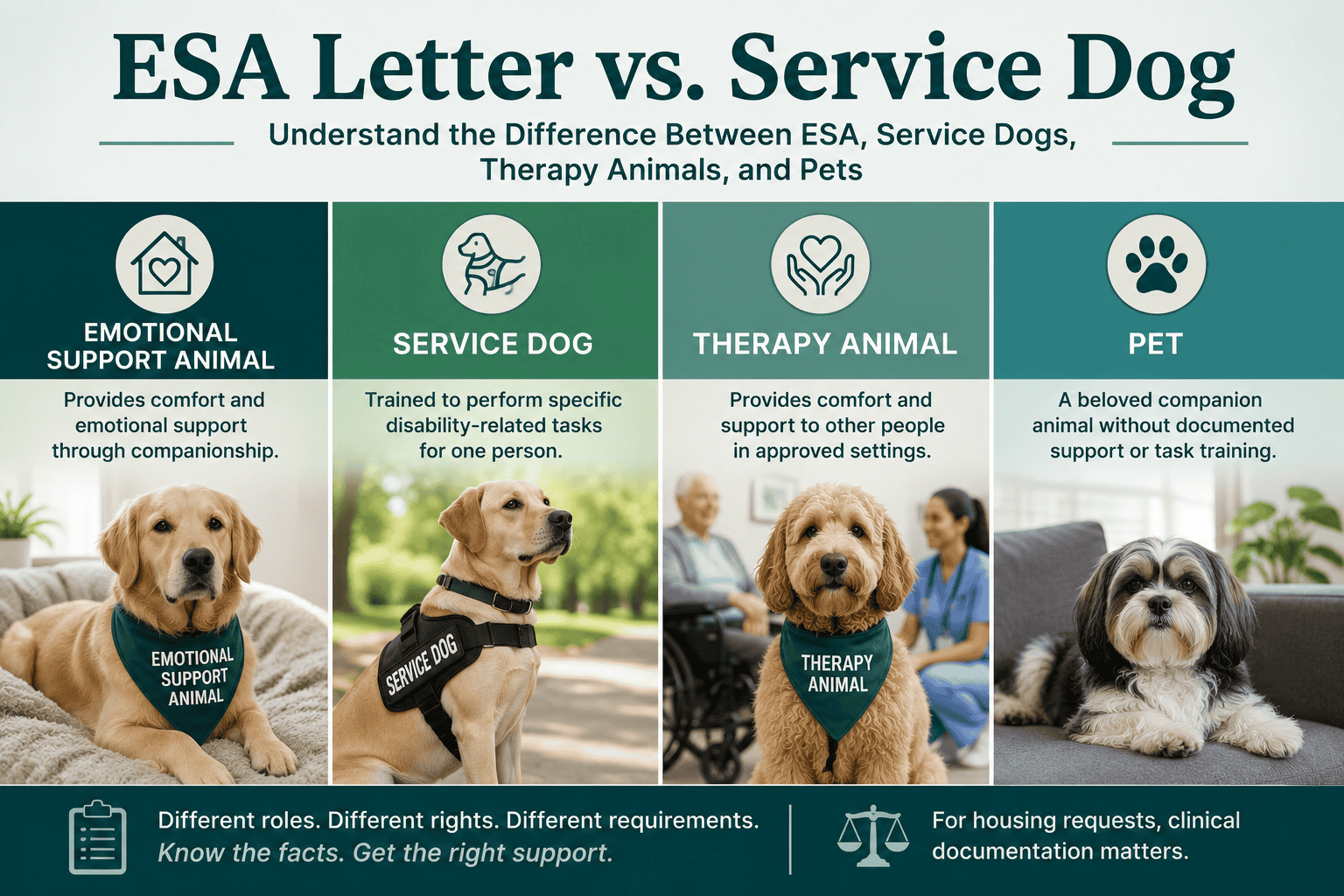
Emotional support animals, service dogs, therapy animals, and pets are often confused, but they are not the same. This guide explains the practical differences between ESA letters, service dogs, therapy animals, and ordinary pets so Texas residents can better understand housing documentation, public access, and clinical recommendations.

Start Here

ESA Letters and Service Dogs Serve Different Purposes

An emotional support animal may provide comfort, routine, companionship, grounding, or emotional support for someone with a mental health condition. A service dog is different because it is trained to perform specific tasks directly related to a person’s disability.

This distinction matters because different rules may apply in housing, public places, travel, workplaces, schools, and other settings. An ESA letter may support a housing accommodation request, but it does not give an animal the same public access rights as a trained service dog.

View ESA Service Page

Emotional Support Animals

What Is an Emotional Support Animal?

An emotional support animal is an animal that may help reduce emotional distress or support functioning through its presence, companionship, routine, or relationship with the person. ESAs are often discussed in connection with housing accommodation requests.

An ESA does not need to be trained to perform a specific disability-related task in the same way a service dog does. The support usually comes from the animal’s presence and the emotional or therapeutic benefit the person experiences.

ESA documentation should be based on a clinical evaluation. It is not the same as buying a certificate, registering an animal online, or placing a vest on a pet.

An ESA may support a person by helping with:

  • Reducing loneliness, distress, or emotional isolation
  • Providing comfort during anxiety, depression, or trauma-related symptoms
  • Creating routine, grounding, and daily structure
  • Supporting emotional regulation during stressful periods
  • Encouraging responsibility, connection, and consistency

Service Dogs

What Makes a Service Dog Different?

A service dog is trained to perform specific work or tasks for a person with a disability. The task must be directly related to the person’s disability. That training is the key difference between a service dog and an emotional support animal.

A psychiatric service dog may help a person with a mental health condition when the dog is trained to perform a specific task. For example, a dog might be trained to interrupt a panic episode, remind a person to take medication, guide a person away from a trigger, or perform a grounding task during a trauma response.

Examples of service dog tasks may include:

  • Guiding a person who is blind or has low vision
  • Alerting a person who is deaf or hard of hearing
  • Retrieving items or opening doors for a person with mobility limitations
  • Alerting to seizures or medical episodes
  • Interrupting panic symptoms or trauma-related dissociation when trained to do so
  • Reminding a person to take medication as a trained task

A dog’s calming presence alone does not make it a service dog. The service dog distinction depends on task training related to the person’s disability.

Therapy Animals

Therapy Animals Usually Support Other People

Therapy animals are commonly used in hospitals, schools, counseling settings, nursing homes, disaster response settings, or community programs to provide comfort to other people. They may be specially selected, trained, and handled for visits, but they are not the same as service animals.

A therapy animal’s role is usually to support clients, patients, students, or community members. The animal may be part of a structured program, but it generally does not have the same individual public access rights as a service dog.

Common Confusion

Therapy Animal Does Not Mean Service Dog

The word “therapy” can make this confusing. A therapy animal may be therapeutic for people, but that does not automatically make the animal a service dog or an emotional support animal for housing purposes.

  • Therapy animals often serve multiple people.
  • Service dogs are trained for one person’s disability-related tasks.
  • ESAs provide emotional support to their owner or handler.
  • Ordinary pets may be loved and comforting but are not automatically ESAs.

Pets

A Pet Can Be Deeply Meaningful Without Being an ESA or Service Dog

Many people feel emotionally connected to their pets. Pets can reduce loneliness, bring joy, create routine, and provide comfort during difficult seasons. That does not automatically mean a pet is an emotional support animal or service dog.

The difference is the purpose and documentation. A pet is usually kept for companionship. An ESA may be clinically recommended when the animal helps alleviate symptoms or supports functioning for someone with a mental health-related need. A service dog is trained to perform disability-related tasks.

Questions that help clarify the difference:

  • Is the animal simply a beloved companion?
  • Is there a mental health-related need for the animal’s emotional support?
  • Has a licensed professional evaluated whether an ESA recommendation is appropriate?
  • Has the animal been trained to perform a specific disability-related task?
  • Is the request about housing, public access, or another setting?

Public Access

ESA Letters Do Not Create Service Dog Public Access Rights

One of the most important differences is where the animal may go. Public access rules are different from housing accommodation rules.

Service Dogs

Service dogs may have public access rights because they are trained to perform disability-related tasks for their handler.

Emotional Support Animals

ESA documentation is usually connected to housing accommodation requests and does not make the animal a service dog.

Therapy Animals

Therapy animals may visit approved settings through a program, but that is different from general service dog public access.

Pets

Pets may be allowed where a business, housing provider, or property policy permits animals, but they do not have disability-based access rights.

Vests Are Not Proof

A vest, ID card, online certificate, or registration does not prove that an animal is a service dog or legitimate ESA.

Setting Matters

Housing, restaurants, stores, airplanes, workplaces, schools, and medical settings may follow different rules.

Housing Accommodation Requests

ESAs Are Most Often Discussed in Housing

Many people seek ESA documentation because they live in housing with pet restrictions, pet rent, animal deposits, breed limits, or no-pet policies. A clinically appropriate ESA letter may support a request for a reasonable housing accommodation.

The letter does not register the animal or guarantee approval. It provides clinical documentation that may help explain the disability-related need for the animal when an ESA recommendation is appropriate.

Important Clarification

Housing Rules Are Not the Same as Public Access Rules

A resident may have ESA documentation for housing, but that does not mean the animal can go into restaurants, stores, offices, or other public places as a service dog.

  • ESA letters are commonly used for housing requests.
  • Service dogs are task-trained for disability-related work.
  • Therapy animals usually serve people in approved settings.
  • Pets are companions unless another category applies.
  • Legal disputes may require legal guidance.

Side-by-Side Comparison

ESA, Service Dog, Therapy Animal, or Pet?

These categories can overlap emotionally, but they are different in purpose, documentation, training, and access.

Emotional Support Animal

Provides emotional or therapeutic support through companionship or presence. ESA documentation may support a housing accommodation request when clinically appropriate.

Service Dog

Trained to perform specific disability-related tasks for one person. Public access rules generally focus on task training and disability-related work.

Therapy Animal

Provides comfort or support to people in settings such as hospitals, schools, counseling offices, or community programs when allowed.

Pet

A companion animal that may be deeply loved and emotionally meaningful but is not automatically an ESA or service animal.

Documentation

ESA letters should come from a licensed professional after clinical evaluation. Service dogs are not made legitimate by online certificates.

Best Question to Ask

Is the animal providing emotional support, performing a trained task, supporting others in a program, or simply serving as a beloved companion?

ESA Evaluations at Motivations Counseling

Texas ESA Evaluations Through a Licensed Counseling Practice

Motivations Counseling provides emotional support animal evaluations for Texas residents. Evaluations may be completed through secure telehealth when clinically appropriate, with in-person services available through our Sugar Land and Katy-area counseling practice when scheduling allows.

Our process is designed to be clear, ethical, and clinically grounded. Documentation is provided only when the evaluator determines that an ESA recommendation is clinically appropriate based on the evaluation.

Clinical ESA Evaluation

Schedule an ESA Evaluation in Texas

The ESA evaluation fee is currently $99. If you qualify and ESA documentation is clinically appropriate, there is no additional charge for the letter.

  • Licensed Texas mental health professionals
  • Telehealth available statewide for Texas residents
  • Same-day options may be available when scheduling allows
  • Documentation provided only when clinically appropriate
  • No guarantee of landlord approval

Frequently Asked Questions

Common Questions About ESA Letters, Service Dogs, Therapy Animals, and Pets

Is an emotional support animal the same as a service dog?

No. A service dog is trained to perform specific disability-related tasks. An emotional support animal provides comfort or emotional support through its presence, companionship, or relationship with the person.

Does an ESA letter allow my animal to go into stores or restaurants?

Generally, no. ESA documentation is most often used for housing accommodation requests. It does not give an emotional support animal the same public access rights as a trained service dog.

Can a dog be both an ESA and a service dog?

The categories depend on the animal’s role. If the dog is trained to perform specific disability-related tasks, it may be a service dog. If the dog’s role is emotional comfort through presence and companionship, it is more commonly discussed as an ESA.

Is a psychiatric service dog the same as an emotional support animal?

No. A psychiatric service dog is trained to perform specific tasks related to a psychiatric disability. An emotional support animal may help emotionally, but does not qualify as a service dog based on comfort alone.

Is a therapy animal the same as an ESA?

No. Therapy animals often provide comfort to other people in approved settings such as hospitals, schools, counseling offices, or community programs. An ESA supports its owner or handler through emotional or therapeutic support.

Can my pet become an ESA?

A beloved pet may be clinically meaningful, but an ESA recommendation should be based on a mental health evaluation. The question is whether the animal helps alleviate symptoms or supports functioning in a clinically relevant way.

Do service dogs need certificates or online registration?

No. Online registration, certificates, ID cards, and vests do not determine whether a dog is a service dog. The key issue is whether the dog is trained to perform disability-related tasks.

How much does an ESA evaluation cost?

Motivations Counseling currently offers ESA clinical evaluations for $99. If the evaluator determines that ESA documentation is clinically appropriate, there is no additional charge for the letter.

Susan Baker, M.Ed., NCC, LPC-S

Article Author

Written by a Licensed Texas Mental Health Professional

This article was written for Motivations Counseling by Susan Baker, M.Ed., NCC, LPC-S, a Texas Licensed Professional Counselor Supervisor and clinical leader at Motivations Counseling.

Susan Baker, M.Ed., NCC, LPC-S
Texas Licensed Professional Counselor Supervisor
EMDR Therapist & EMDRIA Member
Texas LPC License #73957

Susan Baker is the Clinical Director of Motivations Counseling and provides trauma-informed counseling, EMDR therapy, depression counseling, anxiety treatment, emotional support animal evaluations, and mental health assessment services. Motivations Counseling serves clients from offices in Sugar Land and Katy, Texas, with telehealth services available statewide for Texas residents.

Start Your ESA Evaluation

Schedule an Emotional Support Animal Evaluation in Texas

If you are seeking ESA documentation for a housing accommodation request, Motivations Counseling can help you complete a clinical evaluation and determine whether an emotional support animal recommendation may be appropriate.

×

Emotional Support Animal Letters in Texas: What You Need to Know

ESA Learning Center

Emotional Support Animal Letters in Texas: What You Need to Know

Emotional support animal letters can be confusing because there is so much misinformation online about ESA registration, instant letters, housing rights, and what a licensed mental health professional actually evaluates. This guide explains how ESA documentation works in Texas, what an ESA letter can and cannot do, and what to consider before seeking an evaluation.

Start Here

ESA Documentation Is a Clinical Recommendation, Not a Pet Registration

An emotional support animal letter is documentation from a licensed mental health professional stating that an emotional support animal may be clinically appropriate for a person with a mental health condition. It is not the same as registering a pet, buying a certificate, or obtaining a service dog credential.

A legitimate ESA letter should be based on a clinical evaluation. The evaluator considers symptoms, functioning, mental health needs, and whether the animal appears to provide therapeutic benefit related to the individual’s emotional or psychological condition.

View ESA Service Page

What Is an Emotional Support Animal?

An ESA Provides Emotional or Therapeutic Support Through Its Presence

An emotional support animal is an animal that may help reduce symptoms or provide emotional support for someone with a mental health condition. For some people, the presence of an animal may help with anxiety, depression, trauma-related symptoms, panic, emotional regulation, loneliness, or stress-related difficulties.

Emotional support animals are different from service animals. A service animal is trained to perform specific tasks for a person with a disability. An ESA does not need specialized task training in the same way. Instead, the therapeutic benefit usually comes from the animal’s presence, companionship, routine, grounding effect, or emotional support.

Emotional support animals may be clinically meaningful for some individuals, but ESA documentation should be based on an actual mental health evaluation rather than a quick online purchase or generic certificate.

An ESA may provide support by helping with:

  • Reducing feelings of loneliness or emotional isolation
  • Providing routine, comfort, and companionship
  • Helping with grounding during anxiety or trauma-related distress
  • Supporting emotional regulation during periods of stress
  • Encouraging daily structure, care, and responsibility

How ESA Letters Work

A Letter Should Come After a Clinical Evaluation

ESA documentation should reflect a licensed professional’s clinical judgment, not a guaranteed transaction.

Clinical Evaluation

A licensed professional reviews the individual’s mental health history, current symptoms, and treatment-related needs.

Mental Health Assessment

The evaluation considers emotional symptoms, functional limitations, and whether the animal may help alleviate symptoms.

Clinical Determination

Documentation is provided only when the clinician determines that an ESA recommendation is clinically appropriate.

Documentation

If clinically justified, the provider may issue ESA documentation that can be used as part of a housing accommodation request.

Ethical Standards

A legitimate ESA process avoids guarantees, fake registries, and documentation that is issued without clinical review.

Follow-Up Support

When authorized and appropriate, a provider’s office may clarify documentation while protecting client confidentiality.

Who May Qualify?

Qualification Depends on Clinical Factors, Not Just Wanting to Keep a Pet

A person may potentially qualify for ESA documentation when they have a mental health condition and the emotional support animal helps alleviate symptoms or supports functioning in a clinically meaningful way. The decision is not based only on loving an animal or wanting to avoid pet fees.

The clinical question is whether the animal provides emotional or therapeutic support connected to the person’s mental health needs. A clinician may consider diagnosis, symptoms, daily functioning, emotional distress, treatment history, and the role the animal plays in helping the person manage symptoms.

Clinical concerns that may be considered include:

  • Anxiety-related symptoms
  • Depression or mood-related symptoms
  • Trauma-related symptoms or PTSD
  • Panic symptoms
  • Emotional regulation difficulties
  • Other mental health concerns that substantially affect functioning

A diagnosis alone does not automatically mean ESA documentation is appropriate. The evaluator also considers functional limitations and whether the animal helps alleviate symptoms in a clinically relevant way.

Housing Accommodation Requests

ESA Letters Are Often Used for Housing Accommodation Requests

Many people seek ESA documentation because they live in housing with pet restrictions, pet rent, breed limitations, or other animal-related policies. ESA documentation may support a reasonable accommodation request when the individual has a qualifying mental health condition and the animal helps alleviate symptoms.

However, an ESA letter does not force automatic approval. Housing providers may review documentation, request clarification in appropriate situations, and make accommodation decisions based on applicable laws, policies, and facts.

Important Clarification

No Therapist Can Guarantee Housing Approval

ESA documentation is a clinical recommendation. It does not guarantee that a landlord, property manager, university housing office, or other housing provider will approve a request.

  • ESA documentation is not pet registration.
  • There is no official national ESA registry.
  • Housing providers may review documentation.
  • Accommodation decisions are made by the housing provider.
  • Documentation should be issued only when clinically appropriate.

Common Misconceptions

ESA Myths Can Lead People Toward Bad Information

Many websites sell certificates, ID cards, or instant letters that may look official but do not replace a clinical evaluation.

Myth: ESAs Must Be Registered

There is no official national emotional support animal registry. Registration websites do not determine whether an ESA is clinically appropriate.

Myth: ESA Letters Are Guaranteed

A legitimate provider should not guarantee documentation before completing a clinical evaluation.

Myth: ESAs Are Service Dogs

Emotional support animals and service animals are different. Service animals are trained to perform specific disability-related tasks.

Reality: Evaluation Matters

ESA documentation should be based on symptoms, functioning, treatment needs, and the clinical role of the animal.

Reality: Housing Rules Differ

Housing accommodations are different from airline policies, public access rules, and ordinary pet policies.

Reality: Ethics Matter

A careful ESA process protects the client, the clinician, and the credibility of legitimate mental health documentation.

Choosing an Evaluator

Choose a Licensed Professional Who Takes the Evaluation Seriously

Because ESA documentation can affect housing accommodation requests, it is important to work with a licensed mental health professional who understands the difference between ethical clinical documentation and quick online letter sales.

A qualified evaluator should complete an actual assessment, explain that documentation is not guaranteed, and avoid making promises about housing approval. The process should focus on mental health needs rather than simply producing a letter.

Licensed Professional

Look for a licensed mental health professional who is legally and clinically qualified to evaluate mental health concerns.

Real Evaluation Process

The provider should gather clinical information and assess whether an ESA recommendation is appropriate.

Avoid Instant-Letter Claims

Be cautious of websites that promise instant approval, registration, certification, or guaranteed acceptance.

ESA Evaluations at Motivations Counseling

Texas ESA Evaluations Through a Licensed Counseling Practice

Motivations Counseling provides emotional support animal evaluations for Texas residents. Evaluations may be completed through secure telehealth when clinically appropriate, with in-person services available through our Sugar Land and Katy-area counseling practice when scheduling allows.

Our process is designed to be clear, ethical, and clinically grounded. Documentation is provided only when the evaluator determines that an ESA recommendation is clinically appropriate based on the evaluation.

Clinical ESA Evaluation

Schedule an ESA Evaluation in Texas

The ESA evaluation fee is currently $99. If you qualify and ESA documentation is clinically appropriate, there is no additional charge for the letter.

  • Licensed Texas mental health professionals
  • Telehealth available statewide for Texas residents
  • Same-day options may be available when scheduling allows
  • Documentation provided only when clinically appropriate

ESA Learning Center

Continue Learning About ESA Letters, Housing, and Mental Health Support

These related resources can help you better understand emotional support animal documentation, housing accommodation requests, and when an ESA evaluation may be clinically appropriate.

Frequently Asked Questions

Common Questions About Emotional Support Animal Letters in Texas

Is an ESA the same as a service dog?

No. A service dog is trained to perform specific tasks for a person with a disability. An emotional support animal provides emotional or therapeutic support through its presence and relationship with the individual, but it is not the same as a service animal.

Do emotional support animals need to be registered?

No. There is no official national ESA registry. Websites that sell registrations, certificates, ID cards, or vests do not replace a clinical evaluation from a licensed mental health professional.

Can anxiety qualify for an emotional support animal?

Anxiety may be considered during an ESA evaluation when symptoms substantially affect functioning and the animal helps alleviate symptoms in a clinically meaningful way. Qualification depends on the individual evaluation.

Can a landlord deny an emotional support animal?

Housing providers may review accommodation requests and documentation. An ESA letter may support a request, but it does not guarantee approval. Housing decisions depend on applicable laws, documentation, and the specific circumstances.

Are ESA letters guaranteed?

No. ESA documentation should not be guaranteed before an evaluation. A licensed clinician may provide documentation only when it is clinically appropriate based on the assessment.

How much does an ESA evaluation cost at Motivations Counseling?

Motivations Counseling currently offers ESA clinical evaluations for $99. If the evaluator determines that ESA documentation is clinically appropriate, there is no additional charge for the letter.

Can the evaluation be completed online?

In many cases, ESA evaluations may be completed through secure telehealth for Texas residents when clinically appropriate. Some situations may require additional clinical follow-up before documentation can be issued.

Susan Baker, M.Ed., NCC, LPC-S

Article Author

Written by a Licensed Texas Mental Health Professional

This article was written for Motivations Counseling by Susan Baker, M.Ed., NCC, LPC-S, a Texas Licensed Professional Counselor Supervisor and clinical leader at Motivations Counseling.

Susan Baker, M.Ed., NCC, LPC-S
Texas Licensed Professional Counselor Supervisor
EMDR Therapist & EMDRIA Member
Texas LPC License #73957

Susan Baker is the Clinical Director of Motivations Counseling and provides trauma-informed counseling, EMDR therapy, depression counseling, anxiety treatment, emotional support animal evaluations, and mental health assessment services. Motivations Counseling serves clients from offices in Sugar Land and Katy, Texas, with telehealth services available statewide for Texas residents.

Start Your ESA Evaluation

Schedule an Emotional Support Animal Evaluation in Texas

If you are seeking ESA documentation, Motivations Counseling can help you complete a clinical evaluation and determine whether an emotional support animal recommendation may be appropriate. Evaluations are available for Texas residents through telehealth and through our Sugar Land and Katy-area counseling practice when scheduling allows.

×