Emotional Disconnection in Relationships
Relationship Learning Center
Emotional Disconnection in Relationships
Emotional disconnection can feel lonely, confusing, and painful, especially when both partners still care about each other. Many couples do not become disconnected because love disappears. They become disconnected when stress, conflict, avoidance, anxiety, hurt, or repeated misattunement makes emotional closeness feel harder to reach.
Start Here
Emotional Distance Does Not Always Mean the Relationship Is Over
Emotional disconnection often happens slowly. A couple may still share a home, parent together, manage responsibilities, and care about each other, but the relationship may begin to feel less warm, safe, playful, affectionate, or emotionally close.
In many relationships, emotional distance is a signal that the relationship needs attention, repair, and safer ways to talk about needs, fear, hurt, loneliness, and longing. Couples counseling can help partners understand the pattern instead of blaming each other for the pain.
What Is Emotional Disconnection?
Emotional Disconnection Means the Bond Feels Harder to Reach
Emotional disconnection means partners no longer feel as emotionally accessible, responsive, engaged, or safe with each other. They may still love each other, but the sense of being known, comforted, understood, wanted, or emotionally important may feel weaker.
Emotional connection is not only about having deep conversations. It also includes small moments of warmth, affection, eye contact, repair, reassurance, shared humor, checking in, and knowing your partner cares about what is happening inside of you.
Emotional disconnection is often less about one single problem and more about a repeated pattern: one or both partners stop feeling safe enough to reach, soften, listen, repair, or be vulnerable.
Couples may describe emotional disconnection as:
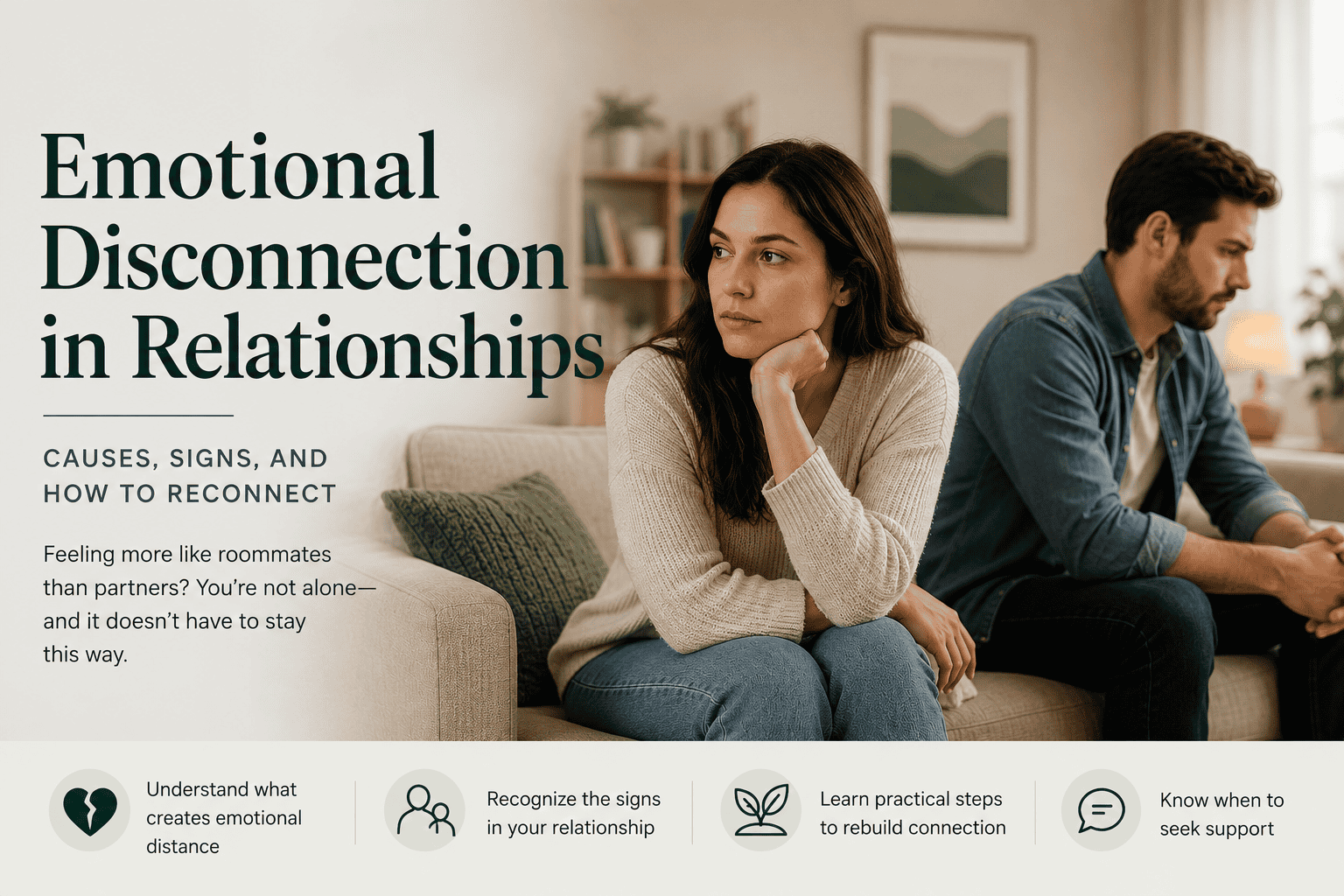
- Feeling more like roommates than partners
- Feeling lonely even when physically together
- Avoiding conversations that could lead to conflict
- Not knowing how to repair after arguments
- Feeling unseen, dismissed, criticized, or unimportant
- Experiencing less affection, warmth, closeness, or playfulness
Common Signs
Emotional Disconnection Can Show Up Quietly or Loudly
Some couples experience disconnection through frequent conflict. Others experience it through silence, distance, avoidance, or a quiet sense that the relationship no longer feels emotionally safe.
Feeling Like Roommates
Daily life continues, but the relationship feels more practical than emotionally connected.
Loneliness in the Relationship
One or both partners may feel alone, unseen, or emotionally unsupported even when together.
Avoiding Hard Conversations
Partners may avoid topics because they expect defensiveness, shutdown, criticism, or escalation.
Conflict Without Repair
Arguments may stop because people are exhausted, not because anyone feels understood.
Less Affection or Warmth
Physical affection, laughter, curiosity, small gestures, and softness may begin to fade.
The Same Pattern Repeats
The topics may change, but the emotional pattern underneath the arguments often stays the same.
Why It Happens
Emotional Disconnection Usually Develops for a Reason
Couples rarely become emotionally distant out of nowhere. Disconnection often grows through unresolved hurt, stress, missed repair, anxiety, trauma responses, attachment patterns, parenting demands, grief, betrayal, health problems, or years of feeling unheard.
One partner may reach for connection through urgency, questioning, criticism, or repeated attempts to talk. The other partner may feel overwhelmed and respond by defending, minimizing, going quiet, working more, leaving the room, or avoiding difficult topics. Both people may be trying to protect themselves, but the relationship becomes less safe for both.
Unresolved Hurt
Painful moments can create distance when they are never acknowledged, understood, or repaired.
Chronic Stress
Work, parenting, financial strain, caregiving, or burnout can leave little emotional energy for connection.
Anxiety and Overthinking
Anxiety can lead to reassurance seeking, fear of rejection, emotional urgency, irritability, or repeated checking.
Emotional Shutdown
Some partners pull away because they feel criticized, overwhelmed, helpless, or afraid of making things worse.
Attachment Patterns
Attachment patterns can shape how partners respond to closeness, distance, conflict, reassurance, and vulnerability.
Trauma Responses
Past emotional injuries can make conflict, silence, criticism, withdrawal, or rejection feel especially threatening.
The Relationship Cycle
The Problem Is Often the Pattern, Not Just the Topic
Couples may believe they are fighting about chores, parenting, money, intimacy, phones, tone, schedules, or extended family. Those topics matter, but the deeper issue is often the emotional cycle underneath the disagreement.
When the cycle takes over, each partner reacts to the other person’s protection strategy. The more one partner pushes, the more the other may shut down. The more one partner withdraws, the more the other may feel abandoned, rejected, or alone.
Common Pursue-Withdraw Pattern
Two Different Forms of Protection
One partner may be saying, “I need to know you care.” The other may be saying, “I do not know how to fix this without making it worse.” Both responses can make sense, but together they can deepen the disconnection.
- Pursuing can look like questioning, criticizing, protesting, or pushing for immediate resolution.
- Withdrawing can look like silence, defensiveness, leaving the conversation, or emotional shutdown.
- Repair begins when both partners can see the cycle as the shared enemy.
Attachment Patterns
Attachment Can Shape How Partners Respond to Distance
Attachment patterns are not diagnoses. They are learned ways of managing closeness, independence, fear, reassurance, emotional safety, and vulnerability in relationships.
Anxious Patterns
A partner may feel highly sensitive to distance, silence, changes in tone, or delayed responses and may seek reassurance when the relationship feels uncertain.
Avoidant Patterns
A partner may value independence and feel overwhelmed by emotional intensity, pressure, criticism, or vulnerability.
Mixed Patterns
A partner may want closeness but also fear being hurt, leading to movement toward connection and then away from it.
Understanding attachment patterns can help couples move away from blame and toward curiosity: “What happens inside of me when I feel disconnected?” and “What happens inside of you when I reach for connection?”
How Counseling Can Help
Couples Counseling Can Help Partners Slow Down the Pattern
Couples counseling can help partners understand what happens beneath conflict, withdrawal, criticism, defensiveness, and emotional shutdown. Rather than focusing only on who is right or wrong, therapy can help couples identify the negative cycle and create safer ways to reach for each other.
Emotionally Focused Therapy, or EFT, is especially relevant when couples feel emotionally disconnected. EFT helps couples understand the emotional bond, attachment needs, and repeated negative cycles that create distance.
Identify the Cycle
Therapy can help couples see repeated patterns such as pursue-withdraw, criticize-defend, or pressure-shutdown.
Communicate Softly
Partners can learn to express deeper emotions and needs instead of only communicating through frustration or silence.
Build Emotional Safety
Emotional safety grows when partners feel heard, respected, and responded to without fear of shame, attack, or abandonment.
Practice Repair
Repair may include accountability, empathy, reassurance, changed behavior, and new ways of returning to each other.
Strengthen the Bond
Couples can begin creating moments of connection, responsiveness, trust, comfort, and emotional accessibility.
Reduce Escalation
When partners understand the cycle, conflict can become less reactive and more focused on repair.
Free Relationship Resource
Take the Free Attachment Style Quiz
Emotional disconnection may be connected to attachment patterns, reassurance needs, conflict responses, emotional withdrawal, or fear of vulnerability. Our free attachment style quiz can help individuals and couples reflect on patterns related to closeness, independence, conflict, reassurance, and emotional safety.
Attachment Style Quiz
Reflect on Your Relationship Patterns
This free educational quiz does not require personal information and provides immediate feedback to help you better understand your relationship patterns.
- No personal information required
- Immediate educational feedback
- Designed for individuals and couples
- For informational purposes only
Learning Center
Continue Learning About Connection, Attachment, and Couples Counseling
These related resources can help you better understand emotional safety, attachment patterns, repeated conflict, anxiety in relationships, and how couples counseling may help.
Couples Counseling
Learn how couples counseling can help partners reduce conflict, rebuild communication, and strengthen connection.
View service page →Emotionally Focused Therapy
Explore how EFT helps couples understand negative cycles, attachment needs, and emotional connection.
Read article →Emotional Safety in Relationships
Learn why emotional safety matters and how couples can build trust, vulnerability, and repair.
Read article →Why Couples Get Stuck
Understand the repeated conflict cycle beneath arguments, defensiveness, withdrawal, and emotional flooding.
Read article →Attachment Styles in Relationships
Explore how attachment patterns affect closeness, reassurance, conflict, independence, and emotional safety.
Read article →Free Attachment Style Quiz
Take a free educational quiz to reflect on relationship attachment patterns. No personal information required.
Anxiety Counseling
Anxiety can affect reassurance seeking, overthinking, avoidance, communication, and emotional closeness.
View service page →High-Functioning Anxiety
Learn how anxiety can hide behind achievement, perfectionism, overthinking, and constant productivity.
Read article →View Therapy Resources
Browse articles on anxiety, trauma, depression, EMDR, teen counseling, relationships, and emotional wellness.
View resources →Frequently Asked Questions
Common Questions About Emotional Disconnection in Relationships
Does emotional disconnection mean the relationship is ending?
Not always. Emotional disconnection can be painful and serious, but it often means the relationship needs attention, repair, safer communication, and more intentional connection. Many couples seek counseling because they still care about each other but feel unsure how to reconnect.
Why do couples become emotionally disconnected?
Couples may become disconnected because of unresolved conflict, chronic stress, parenting demands, anxiety, trauma, attachment patterns, emotional shutdown, betrayal, grief, or years of feeling unseen or unheard.
Can couples counseling help if we feel like roommates?
Couples counseling may help partners identify the patterns creating distance, communicate more openly, rebuild emotional safety, and practice repair. Counseling is not a guarantee of a specific outcome, but it can provide structure for difficult conversations and reconnection.
What if one partner wants closeness and the other pulls away?
This is a common relationship pattern. One partner may pursue connection when they feel anxious or alone, while the other withdraws when they feel overwhelmed, criticized, or unsure how to respond. Therapy can help both partners understand the cycle and respond in new ways.
Is emotional disconnection related to attachment styles?
It can be. Attachment patterns may influence how partners respond to conflict, reassurance, vulnerability, closeness, and distance. Understanding these patterns can help couples approach disconnection with more compassion and less blame.
When should a couple consider therapy?
Couples may consider therapy when they feel emotionally distant, repeatedly stuck in the same conflict, unable to repair, lonely in the relationship, less affectionate, or unsure how to talk about painful topics without escalation or shutdown.

Couples Counseling in Sugar Land, Katy, and Online in Texas
Support for Emotional Disconnection in Relationships
If you and your partner feel distant, stuck, lonely, or unsure how to reconnect, couples counseling can provide a structured space to understand the pattern, rebuild emotional safety, and begin practicing healthier communication and repair.