Why Do I Feel Lonely in My Relationship?
Couples Counseling & EFT Resource Center
Why Do I Feel Lonely in My Relationship?
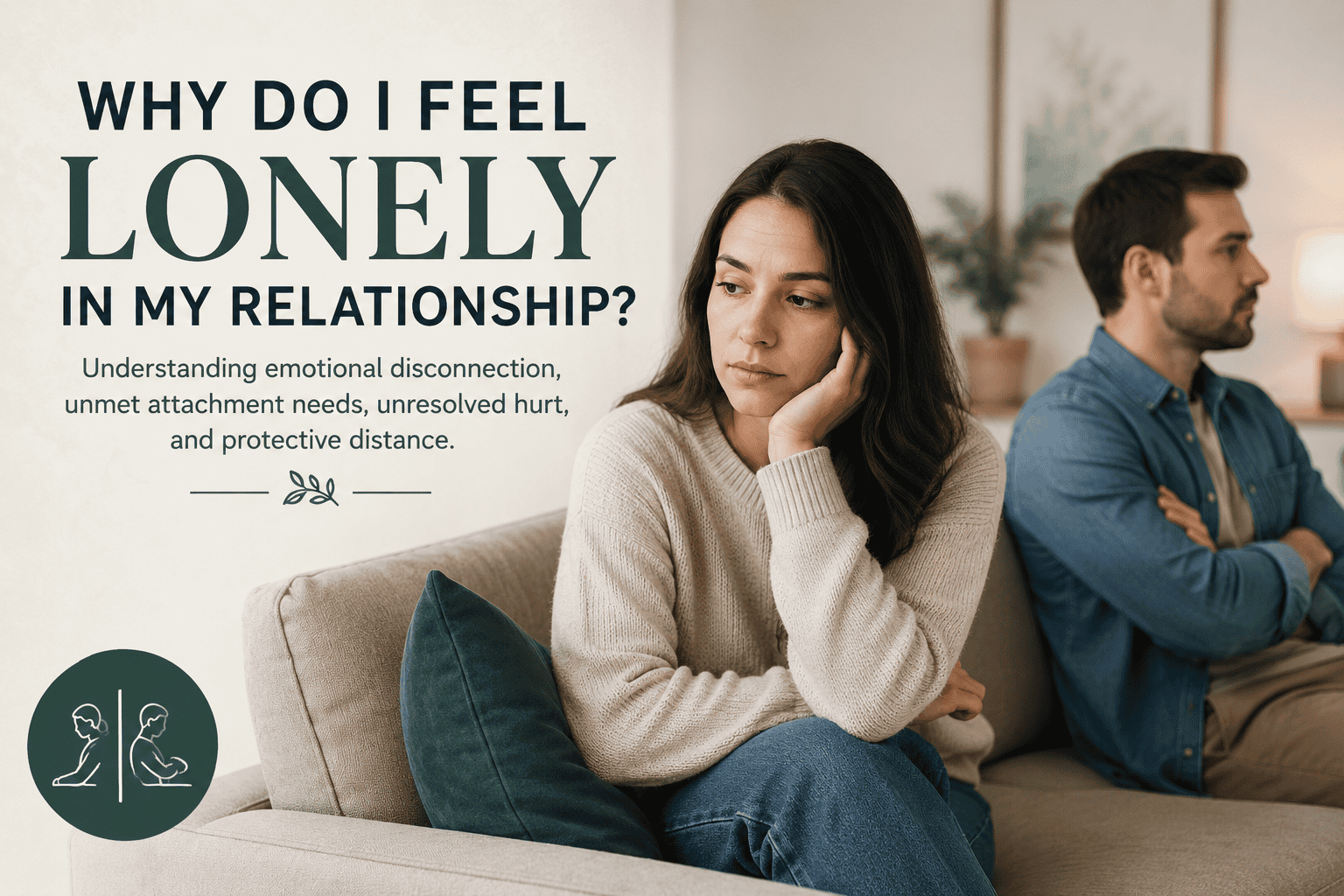
Feeling lonely while partnered can be confusing because companionship and emotional connection are not the same thing. A couple may share a home, responsibilities, routines, children, affection, or years of history while one or both partners still feel emotionally alone. Relationship loneliness may be connected to emotional disconnection, unmet attachment needs, unresolved hurt, communication patterns, chronic stress, or protective distance that once helped a person feel safer.
Start Here
Relationship Loneliness Often Means the Emotional Bond Feels Difficult to Reach
Loneliness in a relationship does not necessarily mean that love is gone or that the relationship must end. It may mean that important emotional needs are not being noticed, expressed, understood, or responded to in a way that creates a felt sense of connection.
Some people describe this experience as living beside their partner rather than with them. Others feel lonely mainly during conflict, stress, illness, parenting challenges, sexual disconnection, or moments when they most need comfort. The feeling may be constant, intermittent, or activated by a familiar relationship pattern.
Feeling lonely is information, not proof that either partner is uncaring. It can signal a need for more emotional availability, clearer communication, repair, practical support, boundaries, or a different way of reaching for connection.
Recognizing Relationship Loneliness
You Can Feel Lonely Even When You Spend a Great Deal of Time Together
Emotional loneliness is less about physical proximity and more about whether a person feels seen, known, important, supported, and able to reach their partner when connection matters.
Conversations Stay on the Surface
Most communication centers on schedules, children, bills, chores, or tasks rather than feelings, hopes, fears, or personal experiences.
You Feel Unseen
Your partner may know what happened during your day but seem less aware of how those experiences affected you emotionally.
You Stop Reaching
After repeated disappointment, you may share less, ask for less, or decide it feels safer not to need anything.
You Feel Alone Beside Them
Time together may still feel emotionally empty because attention, curiosity, responsiveness, or affection is limited.
Support Feels Unavailable
You may hesitate to turn toward your partner during stress because you expect advice, dismissal, irritation, silence, or defensiveness.
You Miss Who You Used to Be Together
The relationship may still function, but warmth, playfulness, affection, friendship, or shared meaning feels harder to access.
Why Loneliness Develops
Emotional Distance Usually Grows Through Repeated Interactions and Unmet Needs
Relationship loneliness rarely has only one cause. Several patterns may interact until partners no longer feel confident that reaching for each other will lead to comfort, understanding, or repair.
Emotional Disconnection
Partners may care deeply but struggle to remain emotionally accessible, responsive, and engaged with one another.
Unmet Attachment Needs
Needs for reassurance, comfort, closeness, reliability, autonomy, or emotional presence may remain unspoken or misunderstood.
Unresolved Hurt
Betrayal, repeated disappointment, harsh conflict, abandonment during distress, or broken promises may reduce emotional openness.
Protective Distance
Withdrawal, self-reliance, emotional numbing, humor, overworking, or avoidance may protect against rejection or overwhelm.
Chronic Stress and Depletion
Parenting, work, caregiving, illness, financial pressure, grief, and poor sleep can reduce emotional capacity.
A Negative Interaction Cycle
One partner may pursue connection while the other withdraws, causing both people to feel increasingly alone and misunderstood.
Attachment Needs
Loneliness Can Reflect a Need to Know That Your Partner Is Emotionally Available
Attachment needs are the relational needs that help people feel secure in an important bond. They may include knowing that a partner will notice distress, respond with care, remain emotionally present, return after conflict, respect boundaries, and communicate that the relationship matters.
Common attachment questions include:
- Can I reach you when I need you?
- Do my feelings matter to you?
- Will you stay emotionally present when things are difficult?
- Can I depend on you without losing myself?
- Will you respect my need for space and still return?
- Are we on the same team?
Needs May Look Different
Partners Can Experience Connection in Different Ways
One partner may feel connected through conversation and reassurance, while another experiences connection through shared activity, practical help, touch, humor, or quiet companionship. Differences are not automatically incompatibility, but they can create loneliness when each partner offers connection mainly in the form they would prefer to receive it.
Naming what helps each person feel emotionally close can reduce guessing, resentment, and the belief that a partner should simply know what is needed.
Protective Distance
Sometimes the Behaviors That Create Loneliness Began as Attempts to Stay Safe
People often distance themselves for understandable reasons. A person may have learned that expressing needs leads to criticism, that conflict becomes overwhelming, that dependence creates vulnerability, or that important feelings are likely to be dismissed. Withdrawal can reduce immediate distress even while increasing long-term loneliness.
Protective distance may include:
- Keeping conversations practical and avoiding emotional subjects
- Using work, parenting, screens, hobbies, substances, or constant activity to stay occupied
- Saying “I am fine” when hurt, disappointed, or afraid
- Becoming highly self-reliant and rarely asking for help
- Shutting down during conflict or leaving without a plan to return
- Using sarcasm, criticism, or anger to cover sadness, fear, or longing
- Assuming that needing reassurance is weak, demanding, or unsafe
Protective behaviors are not character flaws. They may have developed for a reason. Change becomes more possible when partners understand what the behavior is protecting and build safer alternatives rather than demanding immediate openness.
Unresolved Relationship Hurt
Closeness Becomes Difficult When Important Injuries Have Not Been Repaired
A couple may try to move forward after betrayal, secrecy, criticism, emotional abandonment, broken promises, or a painful conflict without fully understanding the impact. Daily life resumes, but the injured partner may remain guarded, watchful, resentful, or uncertain about whether vulnerability is safe.
Repair may require:
- Honest acknowledgment of what happened
- Responsibility without minimizing or shifting blame
- Understanding the emotional impact
- Clear boundaries and changed behavior
- Appropriate transparency
- Patience and consistent follow-through
Distance Can Be Protective
The Hurt Partner Should Not Be Pressured to Reconnect Quickly
Emotional or physical closeness should not be used as proof of forgiveness. A partner may need time, information, boundaries, emotional processing, and repeated evidence of reliability before the relationship feels safer.
Ongoing deception, an active affair, intimidation, repeated boundary violations, or refusal to take responsibility may prevent trust and emotional connection from being rebuilt.
Communication and Loneliness
Partners May Talk Often Without Feeling Emotionally Understood
Communication creates connection when partners can share meaning, emotion, and need—not only information. Certain responses may unintentionally leave a person feeling more alone even when the other partner is trying to help.
Immediate Problem-Solving
Advice may feel dismissive when a partner first needs empathy, comfort, or help feeling understood.
Defensiveness
A concern may become a debate about intent, facts, or fairness before the emotional impact is acknowledged.
Shutdown or Silence
Withdrawal may help one partner regulate but can feel like abandonment when there is no reassurance or plan to return.
Minimizing
Statements such as “It is not a big deal” or “You are overthinking” can make emotional experience feel invalid.
Assuming Instead of Asking
Partners may rely on old explanations rather than staying curious about what the other person currently feels or needs.
Poor Timing
Important conversations may repeatedly happen when one or both partners are exhausted, distracted, rushed, or emotionally flooded.
The Loneliness Cycle
The More Alone Partners Feel, the More Their Protective Reactions May Push Them Apart
Couples often become trapped in a self-reinforcing cycle. Each person's reaction makes sense from inside their own experience, but the pattern creates the very distance both partners fear.
One partner notices distance, limited attention, or reduced emotional availability.
The distance may be interpreted as rejection, lack of love, criticism, pressure, or inevitable conflict.
One partner pursues, criticizes, protests, shuts down, withdraws, appeases, or becomes highly self-reliant.
The other partner feels pressured, unimportant, blamed, overwhelmed, or unable to respond successfully.
Communication narrows, emotional safety decreases, and both partners feel less understood.
Each person sees the cycle as evidence that reaching out is dangerous, pointless, or likely to fail.
The cycle—not either partner—is often the central relationship problem. Identifying the pattern can reduce blame and help partners notice the fear, hurt, longing, or overwhelm beneath their protective reactions.
Talking About Loneliness
Lead With Your Experience and a Clear Request Rather Than a Global Judgment
Statements such as “You never care,” “We are basically roommates,” or “You make me feel completely alone” may express real pain, but they can also invite defensiveness. Softer language can make the underlying loneliness easier to hear.
Possible conversation starters:
- “I have been feeling emotionally alone lately, and I miss feeling close to you.”
- “I know we spend time together, but I do not feel like we have been emotionally connecting.”
- “When I share something difficult and we move immediately into solutions, I feel less understood. Could you listen first?”
- “I have stopped bringing things up because I expect us to argue or shut down. I want to find a safer way to talk.”
- “I need reassurance that we are okay before we solve the problem.”
- “What helps you feel close to me, and what makes closeness harder?”
- “Could we protect twenty minutes this week to talk without phones or other tasks?”
Instead of: “You are never there for me.”
Try: “When I was upset yesterday and we did not return to the conversation, I felt alone. I would like us to check back in tonight.”
A request is more actionable than a test. Asking for ten minutes of listening, a return time after a break, a weekly check-in, or a reassuring response gives the partner a clearer opportunity to respond.
Rebuilding Connection
Small, Repeated Experiences of Responsiveness Can Reduce Emotional Loneliness
Reconnection usually develops through ordinary interactions that communicate attention, reliability, warmth, interest, and care. The goal is not constant closeness but a stronger expectation that partners can find each other again.
Use Emotional Check-Ins
Ask what felt heavy, meaningful, stressful, encouraging, or lonely rather than discussing only events and tasks.
Protect Attention
Create brief periods without phones, television, work, chores, or multitasking so emotional contact has room to develop.
Listen Before Solving
Ask whether the partner wants empathy, advice, practical help, reassurance, or space before deciding how to respond.
Notice What Is Working
Specific appreciation can help partners feel seen and can strengthen positive interactions that otherwise go unrecognized.
Return After Disconnection
Repair grows when partners acknowledge hurt, clarify misunderstandings, apologize, and try the conversation again.
Create Shared Experiences
Time together can include conversation, affection, play, novelty, shared interests, or quiet companionship that both partners enjoy.
Individual Reflection
Understanding Your Own Needs Can Make Connection Easier to Request
Relationship loneliness is relational, but individual awareness still matters. A person may benefit from identifying what connection means to them, which situations activate loneliness, what they tend to assume, and how they protect themselves when they expect disappointment.
Questions to consider:
- When do I feel most alone in this relationship?
- What response am I hoping for in those moments?
- Do I communicate the need directly or expect my partner to infer it?
- Do I pursue, criticize, withdraw, appease, or become self-reliant when I feel disconnected?
- What past experiences may influence how I interpret distance?
- Which needs can be met through friendship, community, interests, spirituality, or individual support?
A Relationship Cannot Meet Every Need
Healthy Connection Includes Partnership, Individuality, and Community
A partner can be an important source of emotional support without becoming the only source. Friendships, family, community, meaningful activities, spiritual life, rest, and personal interests may all protect against isolation and help a person remain connected to a broader sense of self.
This does not mean ignoring chronic relationship loneliness. It means approaching connection as both a relational and individual responsibility rather than asking one person to meet every emotional need.
How Emotionally Focused Therapy Helps
EFT Helps Couples Understand the Cycle That Creates Emotional Loneliness
Emotionally Focused Therapy helps couples move beyond arguments about who is too needy, too distant, too emotional, or too unavailable. The therapist helps partners identify the interaction cycle, understand the attachment fears and needs beneath protective reactions, and create new experiences of reaching and responding.
EFT may help couples:
- Recognize the pattern that leaves both partners feeling alone
- Understand pursuit, criticism, withdrawal, shutdown, and defensiveness as protective responses
- Identify fear, sadness, shame, longing, and unmet attachment needs beneath conflict
- Communicate loneliness without blame or accusation
- Respond with greater emotional accessibility, responsiveness, and engagement
- Repair unresolved hurt and rebuild trust when appropriate
- Create a stronger expectation that partners can reach and find one another
Connection Requires Reciprocity
One Partner Cannot Create Emotional Availability for Both People
One person can make clearer requests, listen more carefully, take responsibility, and work on their own protective patterns. However, a safe emotional bond requires some willingness from both partners. Repeated contempt, deception, punishment, refusal to repair, or persistent emotional unavailability may limit what one person can rebuild alone.
When Loneliness Exists With Fear
Safety Must Come Before Vulnerability
Active violence, coercive control, credible threats, stalking, surveillance, intimidation, or fear of retaliation require careful safety assessment. Standard conjoint couples therapy may be unsafe when one partner cannot speak freely or when disclosures could lead to punishment.
A qualified clinician may recommend individual support, specialized services, safety planning, substance-use treatment, or psychiatric stabilization before or alongside relationship work.
Therapist Spotlight
Work With Carolina Román for EFT-Focused Couples Counseling
At Motivations Counseling, Carolina Román, LMFT works with couples using an attachment-focused approach that helps partners understand emotional loneliness, negative interaction cycles, blocked vulnerability, and difficulty reaching one another during stress or conflict.
Her couples work emphasizes emotional safety, responsiveness, and the relationship pattern rather than treating one partner as the sole problem. She helps couples slow protective reactions and practice new ways of reaching, listening, responding, and repairing.
Carolina serves clients through Motivations Counseling’s Houston-area couples counseling services and through telehealth across Texas when clinically appropriate.
Free Relationship Resource
Take the Free Relationship Attachment Style Quiz
Attachment patterns may influence how partners seek closeness, interpret distance, ask for reassurance, protect themselves during conflict, and respond when they feel emotionally alone. The free Relationship Attachment Style Quiz can help individuals and couples reflect on patterns associated with secure, anxious, avoidant, mixed, or fearful-avoidant attachment.
- No name, email address, phone number, or other identifying information is required
- Immediate educational feedback is provided
- The quiz can be completed by one or both partners
- Results are for self-reflection and are not a diagnosis or formal psychological assessment
Partners may receive different results. The goal is not to label either person, but to create language for discussing closeness, independence, reassurance, emotional safety, and connection needs.
EFT and Couples Counseling Learning Center
Continue Learning About Loneliness, Connection, Attachment, and Trust
These companion articles explore patterns that often accompany emotional distance, repeated conflict, withdrawal, unmet attachment needs, communication breakdown, and difficulty rebuilding connection.
Emotional Disconnection in Relationships
Explore how stress, hurt, shutdown, and repeated misattunement can make the emotional bond harder to reach.
Read article →How to Rebuild Emotional Intimacy
Learn how couples may begin rebuilding emotional safety, vulnerability, trust, and connection.
Read article →When Communication Breaks Down
Understand why conversations turn into criticism, defensiveness, silence, escalation, or misunderstanding.
Read article →The Pursuer-Withdrawer Cycle
Learn why one partner may push for connection while the other distances or shuts down.
Read article →Emotional Safety in Relationships
Explore how respect, responsiveness, boundaries, trust, and repair support safer emotional connection.
Read article →Attachment Styles in Relationships
Understand how attachment patterns may affect reassurance, closeness, independence, conflict, and withdrawal.
Read article →Can a Relationship Recover After Trust Is Broken?
Explore repair after betrayal, secrecy, emotional injury, disconnection, or repeated hurt.
Read article →Frequently Asked Questions
Common Questions About Feeling Lonely in a Relationship
Why do I feel lonely even though I am in a relationship?
You may feel lonely when emotional needs for attention, understanding, reassurance, affection, support, or responsiveness are not being met consistently. Physical proximity and relationship status do not automatically create emotional connection.
Does feeling lonely mean I no longer love my partner?
Not necessarily. People can love their partners and still feel emotionally disconnected, unseen, unsupported, or unsure how to reach one another. Loneliness may signal that the relationship bond needs attention rather than proving that love is gone.
Can both partners feel lonely at the same time?
Yes. One partner may feel lonely because they are not receiving enough reassurance or emotional engagement, while the other feels lonely because they experience criticism, pressure, or little room to express themselves safely. Both may be reacting to the same negative cycle in different ways.
How do I tell my partner that I feel lonely?
Choose a calmer time and describe your experience without making a global judgment about your partner's character. Name a specific situation, the feeling it created, and a realistic request such as listening for ten minutes, scheduling a check-in, or returning to an unresolved conversation.
Can emotional intimacy return after a long period of distance?
It may be possible when both partners are willing to understand the pattern, create greater emotional safety, communicate more honestly, repair hurt, and follow through consistently. The pace depends on the relationship history and the seriousness of unresolved injuries.
Can attachment styles contribute to relationship loneliness?
Yes. Anxious patterns may increase sensitivity to distance and reassurance seeking, while avoidant patterns may increase self-reliance, emotional withdrawal, or discomfort with dependence. Attachment patterns are not fixed diagnoses and can change.
What if my partner does not think there is a problem?
Focus on your lived experience and specific changes you are requesting rather than trying to prove that the relationship is objectively lonely. If your concerns are repeatedly dismissed or mocked, individual counseling may help you clarify your needs, boundaries, and available choices.
Can couples counseling help with relationship loneliness?
Couples counseling may help partners identify the cycle that creates distance, understand unmet attachment needs, communicate vulnerable emotions more safely, repair unresolved hurt, and practice more responsive ways of connecting.
Should I work on loneliness individually or as a couple?
Either or both may be appropriate. Couples work can address the relationship cycle, while individual counseling may help with depression, anxiety, trauma, grief, self-worth, social isolation, or protective patterns that also affect loneliness.
When is couples therapy not the right first step?
Standard conjoint couples therapy may be unsafe when there is active violence, coercive control, credible threats, stalking, intimidation, or fear of retaliation. A qualified clinician should assess safety and determine whether individual support, specialized services, or safety planning should come first.

Couples Counseling in Sugar Land, Katy & Online Across Texas
You Do Not Have to Keep Feeling Emotionally Alone in Your Relationship
If you and your partner care about each other but struggle to feel emotionally connected, couples counseling can provide a structured space to understand the pattern, communicate unmet needs, address unresolved hurt, and practice new ways of reaching and responding.