EFT vs. Gottman vs. Imago: Which Couples Therapy Is Right for You?
Couples Counseling & Relationship Therapy Resource Center
EFT vs. Gottman vs. Imago: Which Couples Therapy Approach Is Right for You?
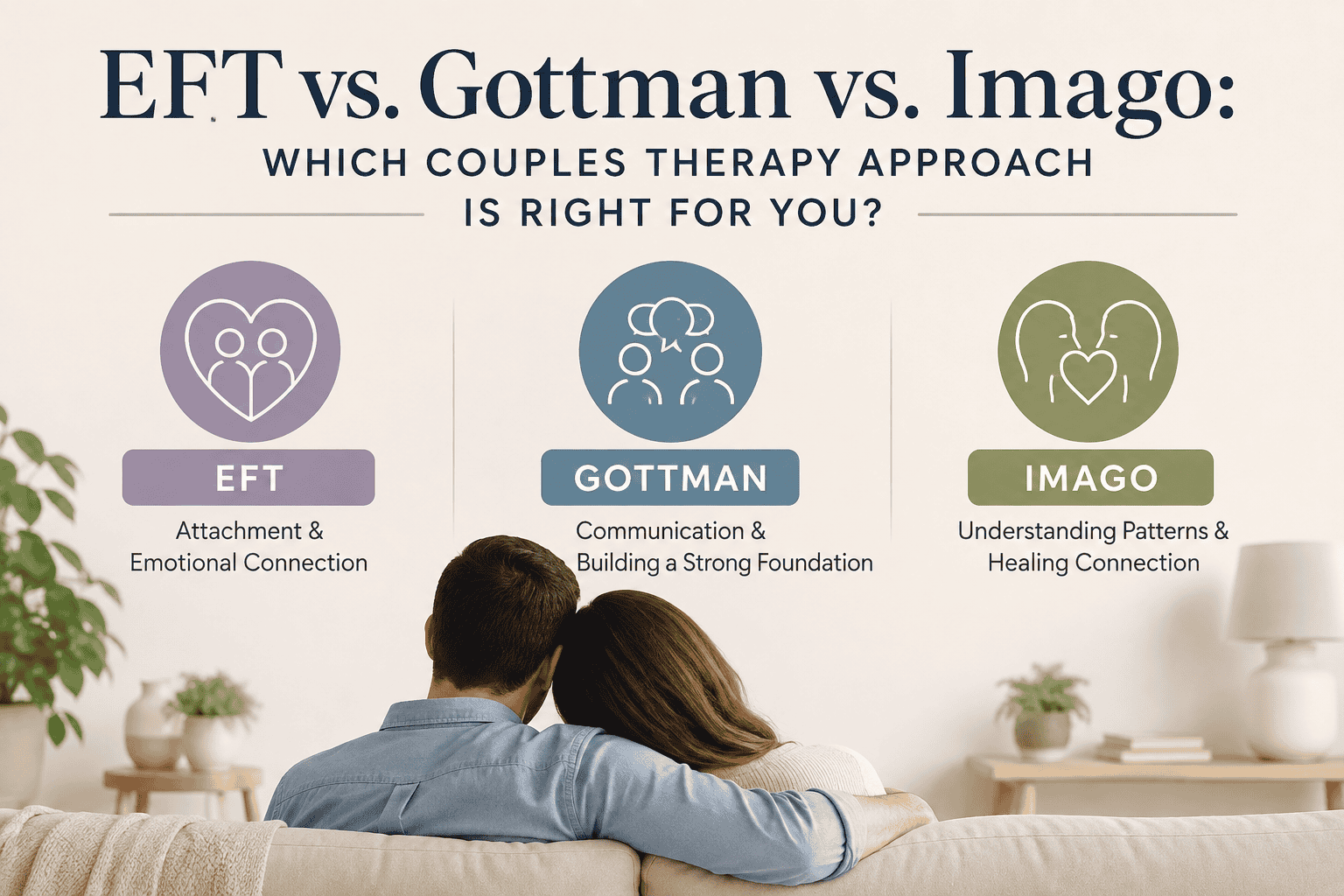
Emotionally Focused Therapy (EFT), Gottman-informed couples therapy, and Imago Relationship Therapy are three well-known approaches to helping couples improve their relationships. They overlap in important ways, but they do not focus on exactly the same things. EFT often goes deeper into attachment and emotional connection, Gottman-informed work tends to offer practical structure for communication and conflict, and Imago emphasizes understanding how each partner's history and emotional needs influence the relationship. The right approach may depend less on which model is "best" and more on what is keeping your particular relationship stuck.
Start Here
There Is No Single Couples Therapy Approach That Fits Every Relationship
Couples often begin counseling by asking a very practical question: What kind of couples therapy should we choose? The answer is not always as simple as picking the approach with the most recognizable name.
A couple who understands each other well but cannot stop escalating during disagreements may need something different from a couple who communicates politely but feels emotionally disconnected. Partners rebuilding trust after betrayal may have different needs from a couple struggling with parenting stress, sexual intimacy, attachment insecurity, or a long-standing pursue-withdraw cycle.
EFT, Gottman-informed therapy, and Imago all attempt to strengthen relationships, but they enter the problem from somewhat different directions. Understanding those differences can help you make a more informed decision about what you want from couples counseling.
The important question is not simply, "Which approach is best?" A more useful question may be, "What keeps happening between us, and which therapeutic approach may help us change that pattern?"
At a Glance
EFT, Gottman, and Imago Share a Goal but Take Different Paths
All three approaches can help couples understand relationship patterns, communicate more effectively, and create stronger connection. Their emphasis, structure, and therapeutic language are different.
| Area | Emotionally Focused Therapy | Gottman-Informed Therapy | Imago-Informed Therapy |
|---|---|---|---|
| Primary Emphasis | Attachment, emotional safety, connection, and negative relationship cycles | Friendship, communication, conflict management, repair, trust, and shared meaning | Relational connection, empathy, emotional needs, and patterns influenced by earlier experiences |
| Often Asks | "What happens emotionally between you when connection feels threatened?" | "What behaviors and interaction patterns are strengthening or damaging the relationship?" | "What is your partner helping you understand about your own emotional history and unmet needs?" |
| Therapy Style | Emotionally experiential and attachment-focused | Structured, skills-oriented, observational, and relationship-focused | Relational, reflective, and often structured around intentional dialogue |
| Conflict | Examines the emotional cycle beneath conflict | Builds healthier ways to manage conflict and repair interactions | Uses conflict as an opportunity to better understand each partner's inner experience |
| Connection | Strengthens emotional accessibility, responsiveness, and security | Builds friendship, fondness, intimacy, trust, and shared meaning | Builds empathy, understanding, intentional listening, and relational connection |
| May Appeal To Couples Who Want | Deeper emotional and attachment work | Practical tools and clearer structure for relationship change | A structured way to understand each other's history, needs, and perspectives |
Emotionally Focused Therapy
EFT Focuses on the Emotional Bond Beneath the Argument
Emotionally Focused Therapy, commonly called EFT, is an attachment-based approach that helps couples understand how fear, hurt, disconnection, and attempts to protect themselves can create repeating negative cycles.
Attachment and Connection
EFT pays close attention to whether partners experience each other as emotionally available, responsive, dependable, and safe.
The Negative Cycle
Couples learn to identify the repeated interaction pattern that takes over when one or both partners feel hurt, rejected, criticized, dismissed, overwhelmed, or alone.
Emotional Safety
Therapy helps partners express vulnerable emotions and relationship needs in ways that make safer responses and deeper connection possible.
What might an EFT therapist notice?
Imagine that one partner says, "You never want to talk to me," while the other responds, "Nothing I say is ever good enough, so why bother?" On the surface, the argument appears to be about communication.
EFT may look underneath those statements. The first partner may be protesting emotional distance because they fear losing connection. The second may be withdrawing because criticism creates shame, inadequacy, or emotional overload.
The more one partner pursues, the more the other withdraws. The more the other withdraws, the more urgently the first partner pursues. Eventually, the cycle itself becomes the shared problem.
EFT often helps couples move from statements such as "You do not care" or "Leave me alone" toward more vulnerable communication, such as "I become scared when I cannot reach you" or "I shut down because I am afraid I will disappoint you again."
EFT may be especially relevant when couples struggle with:
- Pursue-withdraw patterns
- Emotional disconnection
- Attachment insecurity
- Fear of abandonment or rejection
- Emotional shutdown
- Difficulty expressing vulnerability
- Relationship injuries and loss of emotional safety
- Recurring conflict that seems to have deeper emotional meaning
Gottman-Informed Couples Therapy
Gottman-Informed Work Brings Structure to Relationship Patterns
Gottman-informed couples therapy draws from decades of research on couple interaction and focuses on strengthening friendship, improving conflict management, supporting intimacy and respect, repairing relationship injuries, and building shared meaning.
Many couples appreciate the practical nature of Gottman-informed work because it provides language and strategies for understanding behaviors that occur during conflict rather than relying only on insight.
Areas may include:
- Strengthening friendship and knowledge of each other's inner world
- Increasing fondness and appreciation
- Responding to bids for connection
- Managing conflict more constructively
- Reducing criticism, defensiveness, contempt, and stonewalling
- Improving repair after disagreements
- Building trust and commitment
- Creating shared goals, rituals, and meaning
What It Can Look Like
Some Problems Need Better Management, Not a Perfect Resolution
Couples sometimes enter counseling believing that a healthy relationship means eventually agreeing about everything important. In reality, some disagreements reflect enduring differences in personality, priorities, habits, values, preferences, or temperament.
Gottman-informed work can help partners distinguish between problems that can be solved and differences that may need to be managed with respect, compromise, humor, boundaries, and ongoing dialogue.
This can be especially helpful when couples are exhausted from trying to "win" the same argument and need a more workable way to live with differences without damaging the relationship.
Gottman-informed therapy can be a good fit for couples who appreciate practical language, observable relationship patterns, exercises, and concrete strategies they can use outside of the therapy room.
Imago-Informed Couples Therapy
Imago Helps Partners Become Curious About the History Beneath the Conflict
Imago Relationship Therapy emphasizes relational connection and the idea that present-day conflict may reveal important emotional needs, sensitivities, and patterns shaped by earlier experiences.
Intentional Dialogue
Structured conversation helps one partner speak while the other slows down, listens carefully, and works to understand the speaker's experience.
Understanding the Other
Partners practice moving from immediate defensiveness toward curiosity about why an issue carries so much emotional meaning for the other person.
Connecting Past and Present
Therapy may explore how earlier relationship experiences influence expectations, sensitivities, needs, and protective responses in the current partnership.
A familiar disagreement can look different when both partners understand its meaning
One partner may see being late as a minor scheduling problem. The other may experience it as evidence that they are unimportant. One partner may experience repeated questions as controlling. The other may experience asking questions as the only way to feel included.
An Imago-informed approach may help the couple slow the exchange enough to understand why each person experiences the same event so differently. The goal is not necessarily to prove whose interpretation is correct. It is to increase understanding and create a more intentional relational response.
Imago-informed work may appeal to couples who want to:
- Understand the emotional history beneath recurring disagreements
- Practice more intentional listening
- Reduce reactive or defensive conversations
- Develop empathy for each other's perspective
- Understand unmet emotional needs
- Explore why particular interactions feel unusually painful or activating
- Create more conscious patterns of connection
The Most Important Differences
The Approaches Often Look at the Same Relationship Through Different Lenses
A couple could bring the same argument into EFT, Gottman-informed therapy, or Imago-informed therapy and discover that each approach asks somewhat different questions.
What happens to your sense of connection when this conflict begins? What fear, hurt, loneliness, or attachment need is underneath the anger, criticism, defensiveness, or withdrawal?
What happens behaviorally during this conflict? Are criticism, defensiveness, contempt, or stonewalling taking over? Can you use softer communication, repair attempts, compromise, and healthier conflict-management skills?
Why does this particular interaction have so much meaning for each of you? What earlier experiences, expectations, unmet needs, or sensitivities may be entering the present conversation?
These questions are not mutually exclusive. An experienced couples therapist may notice attachment needs, communication habits, emotional histories, nervous-system responses, trust injuries, and practical relationship skills within the same session.
This is one reason couples counseling does not always fit neatly into a single label.
Choosing an Approach
Which Type of Couples Therapy Might Fit Your Relationship?
These are not strict rules. They are useful starting points for thinking about what you hope will be different as a result of counseling.
You Feel Emotionally Disconnected
EFT may be especially useful when the central concern is emotional distance, attachment insecurity, pursue-withdraw patterns, difficulty reaching one another, or fear that the relationship bond is weakening.
You Need Better Conflict Skills
Gottman-informed work may appeal to couples who need practical help reducing destructive communication patterns, managing disagreements, improving repair, and strengthening friendship.
The Same Issues Feel Deeply Personal
Imago-informed work may be useful when couples want to understand why present-day interactions activate old pain, unmet emotional needs, or powerful reactions that seem larger than the immediate situation.
You Keep Having the Same Argument
Any of the three approaches may be helpful. EFT may explore the emotional cycle, Gottman may examine conflict behavior and repair, and Imago may explore the personal meaning underneath the recurring issue.
Trust Has Been Damaged
Couples rebuilding after hurt, secrecy, betrayal, or emotional injury may need elements of emotional processing, accountability, communication, trust-building, boundaries, and new patterns of responsiveness.
You Are Not Sure What You Need
You do not need to diagnose your relationship or choose the perfect therapy model before scheduling. A couples therapist can help identify the patterns that appear most important and discuss an appropriate treatment direction.
An Integrative Approach
Couples Therapy Does Not Always Have to Choose One Model and Ignore the Others
The three approaches have different theoretical foundations, but many of the relationship concerns they address overlap. A couple may need emotional safety and better conflict-management skills. They may benefit from understanding an attachment cycle while also learning how to begin a difficult conversation more gently. They may need to explore the history behind a trigger and still need practical ways to repair after an argument.
At Motivations Counseling, couples therapy is not based on the assumption that every relationship should be treated exactly the same way. Our therapists may draw from established relationship approaches including Emotionally Focused Therapy, Gottman-informed strategies, Imago-informed concepts, attachment-based work, and trauma-informed couples counseling depending on the therapist's training, the couple's concerns, and treatment goals.
The goal is not to fit the couple into the therapy model. The goal is to use the therapeutic approach thoughtfully in service of the couple.
Beyond the Modality
The Therapist May Matter as Much as the Name of the Approach
Couples sometimes search for a therapy model as though choosing EFT, Gottman, or Imago automatically determines what treatment will feel like. In practice, therapist fit also matters.
A couples therapist needs to manage two perspectives at once, recognize escalating patterns, maintain a balanced therapeutic environment, notice when one partner is becoming flooded or shutting down, and help both partners discuss difficult material without turning therapy into another place where the same argument simply repeats.
When considering a couples therapist, it may be useful to ask:
- Does this therapist regularly work with couples?
- What approaches does the therapist use?
- How does the therapist understand recurring conflict?
- How are emotional shutdown, defensiveness, or escalation handled?
- How does the therapist approach attachment and emotional safety?
- Does treatment include practical relationship skills when appropriate?
- How does the therapist address trauma or anxiety when those concerns affect the relationship?
- Does the therapist appear able to understand both partners without turning treatment into a search for who is at fault?
A modality can provide an excellent roadmap, but the therapist still has to understand the people sitting in the room.
EFT Therapist Spotlight
Work With Carolina Román, LMFT, for Emotionally Focused Couples Therapy
At Motivations Counseling, Carolina Román, LMFT has a particular focus on Emotionally Focused Therapy and attachment-based work with couples.
Carolina helps partners identify the negative cycles underneath repeated conflict, understand how each person protects themselves when connection feels threatened, and communicate the deeper emotions and attachment needs that may be hidden beneath criticism, defensiveness, reassurance seeking, or withdrawal.
Other Motivations Counseling therapists who work with couples may draw from Gottman-informed methods, Imago-informed concepts, attachment-based approaches, trauma-informed therapy, and other relationship-focused interventions according to their training, clinical judgment, and the couple's needs.
Trauma & Attachment
Sometimes the Relationship Pattern Is Also a Nervous-System Pattern
Couples may understand intellectually that they are safe with each other and still react strongly during conflict. Trauma, attachment injuries, betrayal, chronic stress, anxiety, previous abusive relationships, grief, or earlier experiences of rejection can influence how the nervous system responds to tone, silence, criticism, emotional distance, or perceived abandonment.
One partner may become highly activated and pursue reassurance. Another may become flooded and shut down. Neither reaction automatically means that the person does not care. The response may be protective, even when its impact on the relationship is painful.
More Than Communication Tips
Skills Work Better When Couples Understand What Activates the Pattern
Communication strategies are important, but a perfectly worded sentence may not solve a problem if one partner's nervous system is already interpreting the interaction as rejection, danger, criticism, or abandonment.
Trauma-informed couples work may therefore include regulation, emotional safety, pacing, attachment awareness, boundaries, and individual treatment when needed in addition to relationship communication skills.
When Standard Couples Counseling May Not Be Appropriate
The Right Question Is Sometimes About Safety Before It Is About Modality
EFT, Gottman-informed work, Imago-informed therapy, and other couples approaches assume that both partners can participate in treatment with enough emotional and physical safety to speak honestly.
Standard joint couples counseling may not be appropriate when there is ongoing violence, coercive control, credible threats, stalking, severe intimidation, fear of retaliation, active abuse, or circumstances in which one partner cannot safely disagree or disclose information.
Active addiction, severe untreated mental health symptoms, or acute instability may also require individual, psychiatric, substance-use, medical, or specialized treatment before or alongside relationship counseling.
In these situations, determining whether couples counseling is appropriate is more important than choosing between EFT, Gottman, or Imago.
Relationship & Couples Counseling Learning Center
Continue Learning About Attachment, Conflict, and Emotional Connection
These resources explore many of the relationship patterns addressed by EFT, Gottman-informed therapy, Imago-informed work, and trauma-informed couples counseling.
Emotionally Focused Therapy for Couples
Learn how EFT helps partners identify negative cycles, understand attachment needs, and strengthen emotional safety and connection.
Read article →Why Couples Get Stuck in the Same Arguments
Understand how repeated disagreements can become a relationship cycle involving criticism, defensiveness, pursuit, withdrawal, or flooding.
Read article →Attachment Styles in Relationships
Explore how secure, anxious, avoidant, and mixed attachment patterns may affect closeness, trust, reassurance, conflict, and vulnerability.
Read article →Emotional Safety in Relationships
Learn how trust, predictability, empathy, accountability, boundaries, and repair help relationships feel emotionally safer.
Read article →Emotional Disconnection in Relationships
Learn why couples can feel distant or lonely even when they still care about each other and how counseling may help rebuild connection.
Read article →Couples Counseling
Explore couples counseling for communication problems, conflict, trust concerns, emotional disconnection, attachment injuries, and relationship repair.
Explore Couples Counseling →Frequently Asked Questions
Common Questions About EFT, Gottman, and Imago Couples Therapy
What is the difference between EFT and the Gottman Method?
EFT places particular emphasis on attachment, emotional bonding, vulnerable emotions, and the negative cycles that develop when partners feel disconnected or unsafe. Gottman-informed therapy tends to place more explicit emphasis on observable relationship patterns, friendship, conflict management, repair, trust, intimacy, and practical relationship skills. There is meaningful overlap between the approaches.
What is the difference between EFT and Imago?
Both can explore deeper emotional needs and relationship patterns. EFT focuses strongly on attachment security and the interaction cycle occurring between partners in the present. Imago also examines how earlier relationship experiences and unmet emotional needs may influence present-day reactions and emphasizes intentional dialogue and relational understanding.
What is the difference between Gottman and Imago?
Gottman-informed therapy is generally more focused on observable relationship dynamics, friendship, communication, conflict management, repair, trust, and shared meaning. Imago-informed work places greater emphasis on intentional dialogue, empathy, personal history, emotional needs, and understanding why particular conflicts carry deeper meaning.
Which couples therapy approach is best?
There is not one approach that is best for every couple. The most appropriate approach depends on the couple's concerns, relationship pattern, goals, preferences, safety, and the therapist's training and clinical judgment. Some couples may also benefit from an integrative approach.
Is EFT good for couples who feel emotionally disconnected?
EFT may be particularly relevant when partners struggle with emotional distance, attachment insecurity, pursue-withdraw cycles, fear of rejection, emotional shutdown, or difficulty expressing vulnerable needs.
Is Gottman therapy good for communication problems?
Gottman-informed work can be useful when couples want structured ways to improve communication, manage conflict, strengthen friendship, recognize damaging interaction patterns, and repair more effectively after disagreements.
What kinds of couples may benefit from Imago-informed therapy?
Imago-informed work may appeal to couples who want to better understand each other's emotional histories, reduce reactive conversations, practice more intentional listening, develop empathy, and explore why recurring conflicts trigger strong personal reactions.
Can a couples therapist use more than one approach?
Yes. Depending on training and clinical judgment, a therapist may integrate concepts or interventions from multiple relationship approaches. A couple may benefit from attachment-focused work, practical communication strategies, emotional processing, trauma-informed care, and structured dialogue at different points in treatment.
Do I need to know which therapy approach I want before scheduling couples counseling?
No. Many couples begin therapy knowing only that something in the relationship is not working. A therapist can help identify the patterns contributing to distress and discuss what therapeutic approach may be appropriate.
Does Motivations Counseling offer EFT, Gottman-informed, and Imago-informed couples counseling?
Motivations Counseling therapists may draw from Emotionally Focused Therapy, Gottman-informed methods, Imago-informed concepts, attachment-based therapy, trauma-informed couples counseling, and other relationship-focused interventions depending on the therapist's training and the couple's concerns and treatment goals. Carolina Román, LMFT, has a particular focus on Emotionally Focused Therapy and attachment-based couples work.
When might couples counseling not be appropriate?
Standard joint couples counseling may not be appropriate when there is ongoing violence, coercive control, credible threats, stalking, severe intimidation, fear of retaliation, or active abuse. Individual or specialized assessment and treatment may be recommended when safety or severe mental health concerns are present.

Couples Counseling in Sugar Land, Katy & Online Across Texas
You Do Not Have to Know Which Therapy Model You Need Before You Begin
If you and your partner are struggling with repeated conflict, emotional distance, communication breakdowns, attachment concerns, trust difficulties, shutdown, or relationship stress, the first step does not have to be choosing between EFT, Gottman, and Imago. It can simply be finding a therapist who understands couples and can help you identify what is keeping the relationship stuck.