
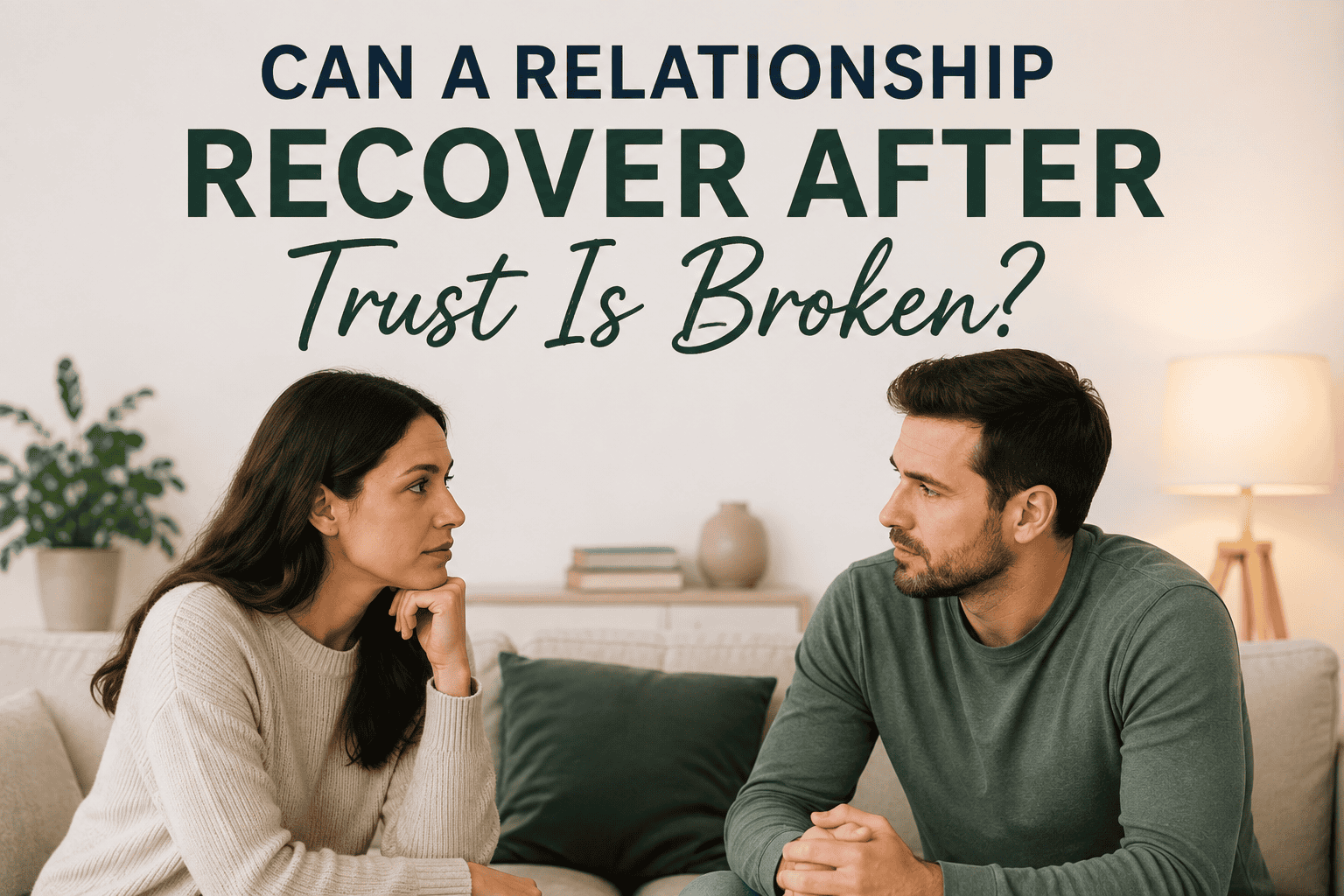
Can a Relationship Recover After Trust Is Broken?
Couples Counseling & EFT Resource Center
Can a Relationship Recover After Trust Is Broken?
Trust can be damaged by infidelity, secrecy, dishonesty, emotional abandonment, hidden spending, broken promises, repeated boundary violations, or years of hurt that never fully repaired. Some relationships can recover, but trust usually does not return because a couple decides to move forward or because the person who caused the injury apologizes. Repair develops through honesty, accountability, emotional safety, changed behavior, and consistent follow-through over time.
Start Here
Trust Is Rebuilt Through Repeated Evidence, Not Pressure to Move On
Broken trust can change how a person understands the relationship, the past, and their own judgment. The injured partner may wonder what was real, whether more information remains hidden, and whether future promises can be believed. Even after the harmful behavior has stopped, the nervous system may remain alert for signs that it could happen again.
Repair does not require pretending that the injury no longer matters. It involves creating a relationship in which honesty becomes more reliable, questions can be addressed without punishment, boundaries are respected, and apologies are followed by observable change.
Recovery is possible in some relationships, but it is not guaranteed. The hurt partner retains the right to decide whether reconciliation feels safe, healthy, and consistent with their values.
Understanding Trust Injuries
Trust Can Be Broken by a Crisis, a Secret, or a Long Pattern of Unreliability
Betrayal is not limited to one type of behavior. Trust may be injured whenever a partner experiences an important agreement, emotional bond, expectation of safety, or shared reality as having been violated.
Infidelity
Sexual or emotional involvement outside agreed boundaries can disrupt attachment, identity, intimacy, and the meaning of the relationship.
Secrecy and Deception
Hidden communication, concealed behavior, changing stories, omitted information, or partial truths can make reality feel unstable.
Financial Betrayal
Secret debt, spending, accounts, gambling, or major financial decisions can affect both emotional security and practical stability.
Broken Boundaries
Repeatedly ignoring relationship agreements, privacy, consent, or stated limits can make future promises feel less credible.
Emotional Abandonment
Being unavailable, dismissive, humiliating, or absent during a crisis may create a deep injury even without a hidden affair.
Repeated Hurt
A long pattern of promises, apologies, and recurrence can erode trust more gradually than a single discovery.
The Emotional Impact
Broken Trust Can Affect the Past, Present, and Future at the Same Time
The injured partner may revisit earlier memories and question whether they understood the relationship accurately. In the present, they may feel anxious, angry, numb, ashamed, grief-stricken, or unable to concentrate. Looking toward the future, they may struggle to imagine safety without certainty that the injury will not happen again.
Common responses may include:
- Intrusive thoughts, mental replay, or repeated questions
- Difficulty sleeping, concentrating, eating, or relaxing
- Hypervigilance about phones, schedules, money, or changes in behavior
- Anger, grief, numbness, shame, or self-doubt
- Fear of being deceived again
- Conflicting wishes to reconnect and protect oneself
Why Small Events Can Feel Large
Triggers Often Represent the Original Loss of Safety
A late arrival, changed tone, private message, unexplained expense, or period of emotional distance may activate more than the immediate event. It may remind the hurt partner of how the truth was previously hidden or how their concerns were dismissed.
The goal is not to eliminate every trigger immediately. Repair involves responding to triggers with honesty, steadiness, empathy, and enough consistency that the relationship gradually becomes more predictable.
Can the Relationship Recover?
The Answer Depends Less on the Promise to Change Than on What Happens Next
Some couples rebuild a relationship that becomes more honest, emotionally responsive, and intentional than it was before the injury. Others remain together but continue to feel unsafe or disconnected. Some decide that separation is the healthiest outcome. No single choice proves greater love, strength, or commitment.
Recovery may be more possible when:
- The harmful behavior has fully stopped
- Important information is no longer being concealed
- The partner who caused the injury accepts responsibility without blaming the hurt partner
- Questions and emotional reactions are met with patience rather than punishment
- Boundaries and new agreements are respected
- Behavior becomes consistently more trustworthy over time
- Both partners participate freely rather than through fear, coercion, or pressure
Recovery may remain blocked when:
- Deception, secret contact, or the harmful behavior continues
- New information repeatedly emerges only after discovery
- The injury is minimized or reframed as the hurt partner's fault
- Forgiveness is demanded before enough safety has been rebuilt
- Boundaries are mocked, punished, or treated as unreasonable
- Apologies repeatedly occur without practical change
- There is intimidation, coercive control, retaliation, or violence
Love can motivate repair, but love alone does not create safety. Trust depends on whether the relationship can begin producing reliable evidence that the injury is being understood and is less likely to be repeated.
The Foundation of Repair
Trust Repair Usually Develops Through Several Interconnected Steps
These steps are not always linear. Couples may move forward, encounter a trigger, return to an earlier conversation, and then continue building safety through new experiences.
The betrayal, secrecy, intimidation, or boundary violation must end before trust can begin to rebuild.
The hurt partner needs enough accurate information to understand what happened and make informed choices.
Accountability means owning choices and impact without minimizing, defending, or shifting blame.
The injury must be allowed to matter without requiring the hurt partner to recover on someone else's timeline.
New boundaries, transparency, treatment, routines, or communication practices may be necessary.
Trust grows through many ordinary moments in which words, actions, and agreements become more consistent.
A Central Principle
Trust Is Not Restored by Asking for Certainty Before Enough Evidence Exists
The person who caused the injury may want reassurance that the relationship will survive. The injured partner may not yet know. Sustainable repair allows uncertainty while both people observe whether honesty, empathy, and behavioral change become dependable.
Truth and Disclosure
Repeated Discovery Can Reopen the Injury
When information emerges in small pieces, each new discovery may make the earlier disclosure feel misleading. The hurt partner may begin to believe that the truth appears only when evidence makes denial impossible.
Helpful disclosure is generally:
- Truthful rather than strategically incomplete
- Responsive to reasonable questions
- Appropriately paced when emotions are overwhelming
- Focused on informed choice and relationship safety
- Free from unnecessary cruelty or graphic detail
Transparency Has Limits
Accountability Should Not Become Permanent Coercive Surveillance
Temporary transparency may help address a specific injury—for example, clarity about contact, finances, treatment, or schedule changes. It should be discussed openly and connected to the behavior that damaged trust.
Monitoring, humiliation, forced disclosure unrelated to the injury, or loss of all privacy can become controlling. Couples may need professional guidance to distinguish reasonable accountability from coercion.
Accountability and Remorse
A Meaningful Apology Addresses Impact, Responsibility, and Change
Remorse may be sincere, but the injured partner often needs more than an expression of guilt. Accountability includes understanding how the behavior affected safety, dignity, identity, finances, attachment, or the ability to trust one's own judgment.
A more complete repair statement may sound like:
Responsibility: “I chose to hide this, and that was dishonest.”
Impact: “I understand that you now question what else was real and whether you can rely on me.”
Empathy: “You should not have had to discover this or carry the uncertainty I created.”
Change: “I am ending the behavior, answering questions honestly, and taking specific steps to prevent repetition.”
Patience: “I will not pressure you to trust me before my actions have become trustworthy.”
Statements that often interfere with repair include:
- “You made me do it.”
- “It was not that serious.”
- “I already apologized. Why are we still talking about it?”
- “You are ruining our future by staying upset.”
- “You should trust me because I said it will never happen again.”
- “My guilt proves how much I care.”
For the Hurt Partner
Your Pace, Boundaries, and Need for Clarity Matter
The injured partner may feel pressure to decide quickly whether to stay, forgive, trust, resume affection, or stop asking questions. Recovery is rarely helped by forcing certainty before enough information and emotional processing are available.
You may need:
- Accurate information and freedom from continued deception
- Time to process grief, anger, fear, numbness, or ambivalence
- Clear boundaries that protect emotional and practical safety
- Reassurance supported by behavior rather than promises alone
- Space to decide whether reconciliation is genuinely desired
- Individual support for anxiety, trauma responses, shame, or self-doubt
- Freedom to decline physical or sexual intimacy while trust is uncertain
Caution after betrayal is not automatically bitterness, punishment, or a refusal to heal. It may be a protective response while the relationship's safety is being reassessed.
For the Partner Who Caused the Injury
Repair Requires Tolerating Discomfort Without Making the Hurt Partner Manage It
Shame, guilt, fear of losing the relationship, or frustration about repeated questions may be intense. These emotions need support, but they should not become reasons to rush the hurt partner or avoid accountability.
Answer Honestly
Respond to reasonable questions without changing the story, hiding behind technicalities, or waiting for more evidence to emerge.
Respect Boundaries
Follow new agreements even when they feel inconvenient, emotionally difficult, or more restrictive than before.
Listen to Impact
Understand the injury without immediately defending intent, correcting details, or asking for reassurance.
Address the Pattern
Seek individual treatment, substance-use support, financial safeguards, or other help when underlying patterns require it.
Allow Time
Do not use your own readiness to move forward as proof that the injured partner should feel safe again.
Repeat Reliability
Communicate proactively, keep agreements, acknowledge mistakes promptly, and remain consistent when no one is watching.
Responding to Triggers
A Trigger Is an Opportunity to Practice a Different Relationship Response
Triggers may occur unexpectedly and do not always mean the relationship is failing. They often reveal where the injured partner still needs clarity, reassurance, or evidence that the current relationship differs from the one in which the betrayal occurred.
A more supportive response may include:
- Pause and identify what activated the fear
- Answer the immediate question directly
- Acknowledge why the situation resembles the earlier injury
- Offer relevant reassurance without demanding that it work instantly
- Follow through on any practical action that increases clarity
- Return to the topic later if either partner becomes emotionally flooded
Hurt partner: “When I did not hear from you, I started imagining that something was being hidden again.”
Repairing response: “I understand why the silence activated that fear. I should have communicated the delay. Here is what happened, and next time I will send an update rather than leaving you uncertain.”
Reassurance is most effective when it is accurate and paired with behavior. Repeating “nothing is wrong” while withholding information is not reassurance; it continues the pattern that damaged trust.
Rebuilding Trust in Daily Life
Ordinary Reliability Often Matters More Than Occasional Grand Gestures
Trust becomes believable through everyday experiences in which the relationship is increasingly predictable, emotionally responsive, and aligned with its agreements.
Keep Small Promises
Follow through on everyday commitments so reliability becomes visible in routine life.
Communicate Proactively
Share relevant changes before uncertainty grows rather than waiting to be questioned.
Create Financial Clarity
Use shared agreements, access, budgets, or safeguards when money was part of the trust injury.
Respond Emotionally
Notice fear, hurt, or longing instead of responding only to the accusation or surface wording.
Protect Connection
Create regular time for emotional check-ins, affection, shared enjoyment, and conversations not limited to the betrayal.
Own Mistakes Quickly
Correct omissions, broken agreements, or defensiveness before they become another hidden problem.
Forgiveness, Reconciliation, and Trust
These Are Related but Separate Processes
Treating them as one decision can create unnecessary pressure. A person may forgive without reconciling, reconcile while trust is still developing, or decide that ending the relationship is healthiest even when love remains.
Forgiveness
A personal process that may reduce the burden of the injury. It does not require forgetting, excusing, or restoring access.
Reconciliation
A mutual decision to continue or rebuild the partnership. It requires participation and willingness from both people.
Trust
Confidence grounded in evidence. It often returns gradually as honest and reliable behavior becomes consistent.
Forgiveness should not be used to remove appropriate consequences, silence questions, require intimacy, or bypass the behavioral work necessary for repair.
Common Repair Barriers
Some Attempts to End the Conflict Can Deepen the Trust Injury
Repair becomes less possible when relief from discomfort is prioritized over honesty, safety, accountability, and consent.
Rushing Forgiveness
Pressure to “move on” may communicate that the responsible partner's comfort matters more than the injury.
Trickle Truth
Revealing only what has already been discovered can make every disclosure feel incomplete.
Equalizing Blame
Relationship problems can be discussed without making the hurt partner responsible for another person's betrayal.
Defending Every Detail
Arguing over wording, intent, or technicalities can prevent understanding of the larger emotional impact.
Demanding Intimacy
Affection or sex should not be required as proof of forgiveness, love, or commitment to repair.
Repeating the Pattern
Another secret, boundary violation, or unexplained inconsistency can undo substantial repair work.
How Emotionally Focused Therapy Helps
EFT Helps Couples Address Both the Trust Injury and the Cycle That Develops Around It
After betrayal, one partner may pursue answers, reassurance, or closeness with increasing urgency while the other becomes defensive, overwhelmed, ashamed, or withdrawn. The more one partner presses, the more the other distances; the more the other distances, the more danger the injured partner may feel.
Emotionally Focused Therapy helps couples slow this cycle without treating the cycle as an excuse for the betrayal. Accountability for harmful choices remains essential while partners learn to communicate fear, grief, shame, longing, and attachment needs more directly.
EFT may help couples:
- Understand the emotional and attachment impact of the trust injury
- Reduce cycles of interrogation, defensiveness, escalation, and withdrawal
- Support honest disclosure and meaningful accountability
- Help the hurt partner communicate pain, fear, and need without carrying the repair alone
- Help the responsible partner remain emotionally present without minimizing or collapsing into shame
- Create new experiences of accessibility, responsiveness, engagement, and repair
- Clarify whether both partners genuinely want and can safely participate in reconciliation
Repair Requires Reciprocity
One Partner Cannot Rebuild Mutual Trust Alone
One person can communicate clearly, regulate their reactions, establish boundaries, and make thoughtful decisions. They cannot make another person become honest, accountable, emotionally available, or willing to change.
Continued deception, contempt, retaliation, refusal to repair, or repeated broken agreements may place a real limit on what the relationship can become.
When Couples Therapy May Be Unsafe
Safety Must Come Before Reconciliation
Active violence, coercive control, credible threats, stalking, forced monitoring, intimidation, or fear of retaliation require careful safety assessment. Standard conjoint couples therapy may be unsafe when one partner cannot speak freely or disclosures could lead to punishment.
A qualified clinician may recommend individual support, specialized domestic-violence services, safety planning, substance-use treatment, psychiatric stabilization, or legal resources before or instead of couples counseling.
Therapist Spotlight
Work With Carolina Román for EFT-Focused Couples Counseling
At Motivations Counseling, Carolina Román, LMFT works with couples using an attachment-focused approach that helps partners understand trust injuries, emotional disconnection, defensive cycles, blocked vulnerability, and difficulty reconnecting after hurt.
Her couples work emphasizes emotional safety, accountability, responsiveness, and the relationship pattern rather than treating one partner as the sole problem. When betrayal has occurred, responsibility for the harmful behavior remains clear while the couple learns new ways to communicate, respond, and repair.
Carolina serves clients through Motivations Counseling’s Houston-area couples counseling services and through telehealth across Texas when clinically appropriate.
Free Relationship Resource
Take the Free Relationship Attachment Style Quiz
Attachment patterns may influence how partners respond after trust is broken. One partner may seek frequent reassurance, answers, or proximity, while another may withdraw, minimize, become defensive, or rely heavily on self-protection.
- No name, email address, phone number, or other identifying information is required
- Immediate educational feedback is provided
- The quiz can be completed by one or both partners
- Results are for self-reflection and are not a diagnosis or formal psychological assessment
Attachment language should not be used to excuse betrayal or blame the hurt partner. It can help couples understand how fear, reassurance, withdrawal, vulnerability, and emotional safety interact during the repair process.
EFT and Couples Counseling Learning Center
Continue Learning About Trust, Closeness, Conflict, and Emotional Safety
These companion articles explore the relationship patterns that often accompany betrayal, repeated hurt, emotional distance, communication breakdown, attachment insecurity, and difficulty rebuilding connection.
How to Rebuild Emotional Intimacy
Learn how couples may begin rebuilding emotional safety, vulnerability, trust, responsiveness, and connection.
Read article →Emotional Safety in Relationships
Explore how respect, boundaries, reliability, responsiveness, and repair support safer emotional connection.
Read article →Emotionally Focused Therapy for Couples
Learn how EFT addresses negative cycles, attachment needs, emotional injuries, and vulnerable feelings beneath conflict.
Read article →When Communication Breaks Down
Understand why conversations turn into criticism, defensiveness, silence, escalation, or misunderstanding.
Read article →The Pursuer-Withdrawer Cycle
Learn why one partner may seek answers or reassurance while the other becomes defensive, distant, or shut down.
Read article →Emotional Disconnection in Relationships
Explore how stress, hurt, withdrawal, and repeated misattunement can make the emotional bond harder to reach.
Read article →Attachment Styles in Relationships
Understand how attachment patterns may affect reassurance, trust, closeness, independence, conflict, and withdrawal.
Read article →Frequently Asked Questions
Common Questions About Rebuilding Trust After Relationship Hurt
Can a relationship recover after trust is broken?
Some relationships recover when the harmful behavior stops, the truth becomes clearer, responsibility is accepted, boundaries are respected, and trustworthy behavior remains consistent over time. Recovery is not guaranteed, and the hurt partner retains the right to decide whether reconciliation feels safe and healthy.
Can trust be rebuilt after cheating or repeated lying?
Trust may sometimes be rebuilt after infidelity or repeated dishonesty, but an apology alone is rarely enough. Repair usually requires honest disclosure, accountability, appropriate transparency, changed behavior, patience, and repeated follow-through.
How long does it take to rebuild trust?
There is no universal timeline. The process may depend on the type and duration of the injury, whether more information continues to emerge, how the responsible partner responds, the couple's prior relationship, and whether both partners feel safe participating in repair.
Why does the hurt partner keep bringing up what happened?
Repeated questions may reflect uncertainty, triggers, fear of additional deception, or an effort to understand the event. Calm and consistent answers generally help more than defensiveness, avoidance, or pressure to move on.
Does rebuilding trust require complete access to phones and accounts?
Transparency should be connected to the specific injury and agreed upon thoughtfully. Temporary access or increased clarity may be useful in some situations, but permanent surveillance, humiliation, or coercive monitoring can become unhealthy or unsafe.
Does the hurt partner have to forgive?
Forgiveness cannot be demanded or rushed. It does not require forgetting, excusing the behavior, immediately restoring trust, resuming intimacy, or remaining in the relationship.
Can a relationship become stronger after betrayal?
Some couples develop greater honesty, clearer boundaries, stronger communication, and deeper emotional awareness through repair. This outcome depends on sustained accountability and change; simply remaining together does not automatically create a stronger relationship.
How can Emotionally Focused Therapy help rebuild trust?
EFT helps couples understand the negative cycle that develops around the injury, communicate vulnerable emotions more directly, strengthen accountability and responsiveness, and create new experiences of emotional safety and repair.
When might couples therapy not be appropriate?
Standard conjoint couples therapy may be unsafe when there is active violence, coercive control, credible threats, stalking, intimidation, or fear of retaliation. Individual support, specialized services, or safety planning may need to come first.
What if only one partner wants to repair the relationship?
One partner can establish boundaries, seek support, communicate clearly, and make informed decisions. Mutual trust cannot be rebuilt by one person alone when the other partner continues deception, refuses accountability, or does not participate in change.

Couples Counseling in Sugar Land, Katy & Online Across Texas
Trust Can Begin to Return Through Honest, Consistent, and Emotionally Safer Interactions
If betrayal, secrecy, repeated hurt, or emotional disconnection has changed how safe your relationship feels, couples counseling can provide a structured space to understand the injury, clarify boundaries, strengthen accountability, and explore whether trust and connection can be rebuilt.