
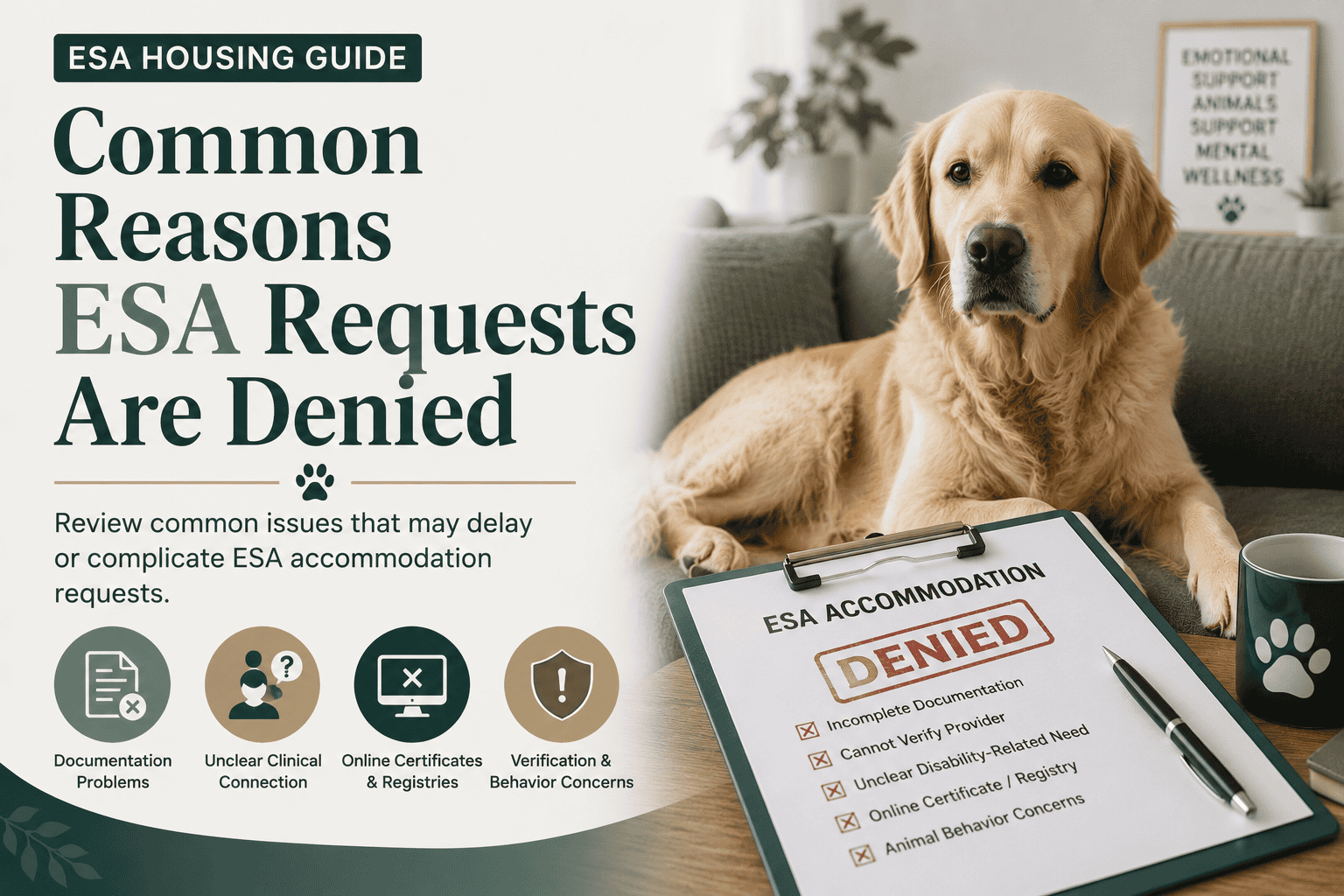
Common Reasons ESA Requests Are Denied
ESA Learning Center
Common Reasons ESA Requests Are Denied
Emotional support animal accommodation requests may be delayed, questioned, or denied when documentation is incomplete, the clinical connection is unclear, the animal creates legitimate safety or property concerns, or the request relies on misleading online certificates instead of a clinical evaluation from a qualified professional.
Start Here
ESA Requests Can Be Denied or Delayed for Several Different Reasons
An ESA letter can support a housing accommodation request, but it does not automatically guarantee approval. Housing providers may review the request, ask for reliable documentation when appropriate, and consider whether the request is supported by a disability-related need.
Many ESA requests are delayed not because someone needs an emotional support animal, but because the documentation cannot be verified, comes from a provider who is difficult to reach, relies on online certificates instead of a clinical evaluation, or does not clearly connect the animal to a mental health-related need.
Documentation Problems
Incomplete or Unclear ESA Documentation
One common reason ESA requests are delayed or denied is that the documentation does not provide enough reliable information for the landlord or housing provider to evaluate the accommodation request.
ESA documentation should usually identify the licensed professional, confirm that an evaluation occurred, and support the connection between the resident’s mental health-related need and the emotional support animal.
Documentation problems may include:
- No provider license number
- No provider contact information
- No clear date on the letter
- No evidence that an evaluation occurred
- Documentation that appears copied, generic, or automated
- Letter issued by a provider who cannot be verified
- Documentation that makes claims beyond ESA housing support
Strong ESA documentation should be clear, current, professionally written, and connected to an actual clinical evaluation.
Clinical Need
The Clinical Connection May Be Unclear
A housing provider may question an ESA request when the documentation does not explain why the animal is connected to a mental health-related need. It is usually not enough to say that the person likes the animal or feels comforted by pets in general.
The request is stronger when the animal’s role is connected to symptoms, functional limitations, emotional regulation, routine, isolation, panic, depression, trauma symptoms, or another clinically relevant need.
Common Issue
Comfort Alone May Not Be Enough
Many people love their pets. ESA documentation requires a clearer connection between the person’s mental health condition, functional limitations, and the support the animal provides.
- What symptoms are being supported?
- How do symptoms affect daily functioning?
- How does the animal help with those symptoms?
- Why is the animal part of the housing-related need?
Online ESA Products
Online Certificates, Registries, and ID Cards Can Create Problems
Many ESA denials involve documentation that looks official but does not reflect a real clinical evaluation.
ESA Certificates
Purchased certificates may look official, but they are not a substitute for clinical documentation from a licensed professional.
ESA ID Cards
ID cards do not establish a disability-related need or show that a qualified provider completed an evaluation.
ESA Registries
There is no single official registry that automatically makes an animal approved as an ESA for housing.
Instant Approval
Letters issued without a meaningful evaluation may be questioned by landlords or housing providers.
No Provider Relationship
Some online ESA companies separate the evaluation from follow-up support. If questions arise later, tenants may be routed through customer service rather than the clinician who completed the evaluation.
Red Flags
No license number, no verification process, no real evaluation, or exaggerated legal claims may create delays.
Verification Issues
The Landlord May Not Be Able to Verify the ESA Letter
As online ESA certificates and instant approval websites have become more common, many housing providers now routinely verify ESA documentation before making a decision. In many cases, they are simply confirming that the clinician is licensed, that an evaluation occurred, and that the documentation is authentic.
If the letter cannot be verified, appears outdated, was issued by someone who is not licensed appropriately, or routes questions through a third-party customer service system rather than the evaluating clinician, the request may be delayed or denied.
Verification concerns may include:
- The provider’s license cannot be located
- The provider is not licensed in the relevant state
- The letter has no contact information
- The letter appears outdated or inconsistent
- The provider will not confirm the letter was issued
- The documentation appears to come from a certificate or registry website
Verification does not mean a landlord should receive full therapy records or private treatment notes. ESA documentation should provide enough reliable information while still protecting privacy.
Avoid Common Mistakes
Choose an ESA Provider Who Can Stand Behind Their Documentation
Many ESA request problems begin before the letter is ever submitted. If the provider is difficult to verify, charges extra for landlord forms, or cannot connect the landlord with the evaluating clinician, the resident may be left trying to solve the problem alone.
Before choosing an ESA provider, ask whether the evaluator is licensed in Texas, whether the therapist personally completes the evaluation, whether landlord verification is included, and whether someone who understands your evaluation can respond if your housing provider has questions.
Some National ESA Websites May Involve
- Customer support instead of direct therapist access
- Additional fees for custom forms or verification
- Out-of-state providers who may be harder for Texas landlords to verify
- Limited follow-up after the letter is issued
Motivations Counseling Provides
- Licensed Texas mental health professionals
- Clinical evaluations, not automated approvals
- No additional charge for the ESA letter when clinically appropriate
- Therapist-managed verification requests when authorized
Animal-Related Concerns
Safety, Behavior, or Property Damage Concerns
ESA documentation supports the person’s accommodation request, but the animal’s behavior can still matter. Housing providers may have concerns if the animal creates a direct safety risk, causes significant property damage, or creates ongoing disruption.
This is especially important because emotional support animals are not the same as service animals and are not required to have specialized task training.
Practical Reminder
ESA Approval Does Not Remove All Responsibilities
- The animal should be manageable in the housing setting.
- The resident may still be responsible for damage.
- Noise, aggression, or sanitation issues may create problems.
- Landlords may evaluate legitimate safety concerns.
- An ESA letter does not grant public access rights.
Next Steps
What Should You Do if Your ESA Request Is Delayed or Denied?
If your ESA request is questioned, start by reviewing what the landlord is actually asking for. Sometimes the issue is a missing license number, unclear letter language, outdated documentation, or a request for verification.
If the concern involves a legal dispute, retaliation, discrimination, or a disagreement about housing rights, it may be important to speak with an attorney or a fair housing resource. A mental health provider can help with clinical documentation, but legal advice should come from a legal professional.
Helpful steps may include:
- Ask the landlord to clarify what information is missing
- Review whether the letter includes provider license information
- Confirm that the documentation came from a real clinical evaluation
- Avoid relying only on ESA certificates, registries, badges, or ID cards
- Make sure the request explains the disability-related need
- Address any legitimate animal behavior or safety concerns
- Consult an attorney for legal disputes or fair housing concerns
ESA Evaluations at Motivations Counseling
Texas ESA Evaluations Through a Licensed Counseling Practice
Motivations Counseling provides emotional support animal evaluations for Texas residents. Evaluations may be completed through secure telehealth when clinically appropriate, with in-person services available through our Sugar Land and Katy-area counseling practice when scheduling allows.
Our process is designed to be clear, ethical, and clinically grounded. Documentation is provided only when the evaluator determines that an ESA recommendation is clinically appropriate based on the evaluation.
Clinical ESA Evaluation
Schedule an ESA Evaluation in Texas
The ESA evaluation fee is currently $99. If you qualify and ESA documentation is clinically appropriate, there is no additional charge for the letter.
- Licensed Texas mental health professionals
- Telehealth available statewide for Texas residents
- Same-day options may be available when scheduling allows
- Documentation provided only when clinically appropriate
- No guarantee of landlord approval
ESA Learning Center
Continue Learning About ESA Letters and Housing Accommodations
These related resources can help Texas residents better understand ESA evaluations, documentation, housing requests, and landlord review.
How to Choose an ESA Provider Your Landlord Can Trust
Learn how to compare local counseling practices with national ESA companies, avoid hidden fees, and understand why therapist availability matters during landlord verification.
Read Provider Guide →What Documentation Can a Landlord Request for an ESA?
Learn what landlords may request, what documentation usually includes, and how privacy is protected.
Read article →Can Anxiety Qualify for an Emotional Support Animal?
Learn how anxiety symptoms, panic, avoidance, and functional limitations may be considered.
Read article →Can Depression Qualify for an ESA?
Learn how depression symptoms, isolation, low motivation, and impairment may be assessed.
Read article →Emotional Support Animal Letters in Texas: What You Need to Know
A broader guide to ESA letters, clinical evaluations, housing requests, and common myths about ESA registration.
Read article →ESA Letter vs. Service Dog: What Is the Difference?
Understand the difference between emotional support animals, service dogs, therapy animals, and pets.
Read article →Emotional Support Animal Resource Center
Browse our complete library of emotional support animal articles, FAQs, and practical resources covering housing, Texas laws, landlord requests, evaluations, and more.
Explore Resource Center →Featured Page
The Complete Emotional Support Animal Guide
Looking for the complete picture? Our clinician-written guide explains emotional support animal evaluations, ESA letters, Texas housing accommodations, landlord documentation, eligibility, service animal differences, and answers to the most common questions about Emotional Support Animals.
Frequently Asked Questions
Common Questions About ESA Request Denials
Can a landlord deny an ESA request?
Yes, an ESA letter does not automatically guarantee approval. A landlord may review the documentation, evaluate whether the request is supported, and consider legitimate safety or property concerns.
Why would an ESA request be denied?
Common reasons include incomplete documentation, no provider license information, no real clinical evaluation, unclear disability-related need, online ESA certificates, or animal behavior concerns.
Are online ESA certificates enough?
Usually not. ESA certificates, registries, ID cards, and badges are not substitutes for a clinical evaluation and professional documentation from a qualified licensed provider.
Can a landlord ask to verify my ESA letter?
A landlord may seek to confirm that the provider exists, is licensed, and issued the letter. Verification should not require full therapy records or private treatment notes.
Can an ESA request be denied because of animal behavior?
Animal behavior may matter. Safety concerns, property damage, severe disruption, or sanitation problems may complicate an ESA accommodation request.
What should I do if my ESA request is denied?
Ask what information is missing, review the documentation, make sure it came from a real clinical evaluation, and consult an attorney or fair housing resource if the issue involves legal rights or discrimination concerns.
Should I use a national ESA website or a local Texas therapist?
Some national companies provide legitimate services, but before paying, ask who performs the evaluation, whether the provider is licensed in Texas, whether landlord verification is included, whether additional documentation costs extra, and whether the evaluating clinician will be available if your housing provider has questions.
How much does an ESA evaluation cost?
Motivations Counseling currently offers ESA clinical evaluations for $99. If the evaluator determines that ESA documentation is clinically appropriate, there is no additional charge for the letter.

Start Your ESA Evaluation
Schedule an Emotional Support Animal Evaluation in Texas
If you are seeking ESA documentation for a housing accommodation request, Motivations Counseling can help you complete a clinical evaluation and determine whether an emotional support animal recommendation may be appropriate.

