

Tag: Texas ESA letter

ESA Letter vs. Service Dog: What Is the Difference?

ESA Learning Center

ESA Letter vs. Service Dog: What Is the Difference?

Emotional support animals, service dogs, therapy animals, and pets are often confused, but they are not the same. This guide explains the practical differences between ESA letters, service dogs, therapy animals, and ordinary pets so Texas residents can better understand housing documentation, public access, and clinical recommendations.

Start Here

ESA Letters and Service Dogs Serve Different Purposes

An emotional support animal may provide comfort, routine, companionship, grounding, or emotional support for someone with a mental health condition. A service dog is different because it is trained to perform specific tasks directly related to a person’s disability.

This distinction matters because different rules may apply in housing, public places, travel, workplaces, schools, and other settings. An ESA letter may support a housing accommodation request, but it does not give an animal the same public access rights as a trained service dog.

View ESA Service Page

Emotional Support Animals

What Is an Emotional Support Animal?

An emotional support animal is an animal that may help reduce emotional distress or support functioning through its presence, companionship, routine, or relationship with the person. ESAs are often discussed in connection with housing accommodation requests.

An ESA does not need to be trained to perform a specific disability-related task in the same way a service dog does. The support usually comes from the animal’s presence and the emotional or therapeutic benefit the person experiences.

ESA documentation should be based on a clinical evaluation. It is not the same as buying a certificate, registering an animal online, or placing a vest on a pet.

An ESA may support a person by helping with:

  • Reducing loneliness, distress, or emotional isolation
  • Providing comfort during anxiety, depression, or trauma-related symptoms
  • Creating routine, grounding, and daily structure
  • Supporting emotional regulation during stressful periods
  • Encouraging responsibility, connection, and consistency

Service Dogs

What Makes a Service Dog Different?

A service dog is trained to perform specific work or tasks for a person with a disability. The task must be directly related to the person’s disability. That training is the key difference between a service dog and an emotional support animal.

A psychiatric service dog may help a person with a mental health condition when the dog is trained to perform a specific task. For example, a dog might be trained to interrupt a panic episode, remind a person to take medication, guide a person away from a trigger, or perform a grounding task during a trauma response.

Examples of service dog tasks may include:

  • Guiding a person who is blind or has low vision
  • Alerting a person who is deaf or hard of hearing
  • Retrieving items or opening doors for a person with mobility limitations
  • Alerting to seizures or medical episodes
  • Interrupting panic symptoms or trauma-related dissociation when trained to do so
  • Reminding a person to take medication as a trained task

A dog’s calming presence alone does not make it a service dog. The service dog distinction depends on task training related to the person’s disability.

Therapy Animals

Therapy Animals Usually Support Other People

Therapy animals are commonly used in hospitals, schools, counseling settings, nursing homes, disaster response settings, or community programs to provide comfort to other people. They may be specially selected, trained, and handled for visits, but they are not the same as service animals.

A therapy animal’s role is usually to support clients, patients, students, or community members. The animal may be part of a structured program, but it generally does not have the same individual public access rights as a service dog.

Common Confusion

Therapy Animal Does Not Mean Service Dog

The word “therapy” can make this confusing. A therapy animal may be therapeutic for people, but that does not automatically make the animal a service dog or an emotional support animal for housing purposes.

  • Therapy animals often serve multiple people.
  • Service dogs are trained for one person’s disability-related tasks.
  • ESAs provide emotional support to their owner or handler.
  • Ordinary pets may be loved and comforting but are not automatically ESAs.

Pets

A Pet Can Be Deeply Meaningful Without Being an ESA or Service Dog

Many people feel emotionally connected to their pets. Pets can reduce loneliness, bring joy, create routine, and provide comfort during difficult seasons. That does not automatically mean a pet is an emotional support animal or service dog.

The difference is the purpose and documentation. A pet is usually kept for companionship. An ESA may be clinically recommended when the animal helps alleviate symptoms or supports functioning for someone with a mental health-related need. A service dog is trained to perform disability-related tasks.

Questions that help clarify the difference:

  • Is the animal simply a beloved companion?
  • Is there a mental health-related need for the animal’s emotional support?
  • Has a licensed professional evaluated whether an ESA recommendation is appropriate?
  • Has the animal been trained to perform a specific disability-related task?
  • Is the request about housing, public access, or another setting?

Public Access

ESA Letters Do Not Create Service Dog Public Access Rights

One of the most important differences is where the animal may go. Public access rules are different from housing accommodation rules.

Service Dogs

Service dogs may have public access rights because they are trained to perform disability-related tasks for their handler.

Emotional Support Animals

ESA documentation is usually connected to housing accommodation requests and does not make the animal a service dog.

Therapy Animals

Therapy animals may visit approved settings through a program, but that is different from general service dog public access.

Pets

Pets may be allowed where a business, housing provider, or property policy permits animals, but they do not have disability-based access rights.

Vests Are Not Proof

A vest, ID card, online certificate, or registration does not prove that an animal is a service dog or legitimate ESA.

Setting Matters

Housing, restaurants, stores, airplanes, workplaces, schools, and medical settings may follow different rules.

Housing Accommodation Requests

ESAs Are Most Often Discussed in Housing

Many people seek ESA documentation because they live in housing with pet restrictions, pet rent, animal deposits, breed limits, or no-pet policies. A clinically appropriate ESA letter may support a request for a reasonable housing accommodation.

The letter does not register the animal or guarantee approval. It provides clinical documentation that may help explain the disability-related need for the animal when an ESA recommendation is appropriate.

Important Clarification

Housing Rules Are Not the Same as Public Access Rules

A resident may have ESA documentation for housing, but that does not mean the animal can go into restaurants, stores, offices, or other public places as a service dog.

  • ESA letters are commonly used for housing requests.
  • Service dogs are task-trained for disability-related work.
  • Therapy animals usually serve people in approved settings.
  • Pets are companions unless another category applies.
  • Legal disputes may require legal guidance.

Side-by-Side Comparison

ESA, Service Dog, Therapy Animal, or Pet?

These categories can overlap emotionally, but they are different in purpose, documentation, training, and access.

Emotional Support Animal

Provides emotional or therapeutic support through companionship or presence. ESA documentation may support a housing accommodation request when clinically appropriate.

Service Dog

Trained to perform specific disability-related tasks for one person. Public access rules generally focus on task training and disability-related work.

Therapy Animal

Provides comfort or support to people in settings such as hospitals, schools, counseling offices, or community programs when allowed.

Pet

A companion animal that may be deeply loved and emotionally meaningful but is not automatically an ESA or service animal.

Documentation

ESA letters should come from a licensed professional after clinical evaluation. Service dogs are not made legitimate by online certificates.

Best Question to Ask

Is the animal providing emotional support, performing a trained task, supporting others in a program, or simply serving as a beloved companion?

ESA Evaluations at Motivations Counseling

Texas ESA Evaluations Through a Licensed Counseling Practice

Motivations Counseling provides emotional support animal evaluations for Texas residents. Evaluations may be completed through secure telehealth when clinically appropriate, with in-person services available through our Sugar Land and Katy-area counseling practice when scheduling allows.

Our process is designed to be clear, ethical, and clinically grounded. Documentation is provided only when the evaluator determines that an ESA recommendation is clinically appropriate based on the evaluation.

Clinical ESA Evaluation

Schedule an ESA Evaluation in Texas

The ESA evaluation fee is currently $99. If you qualify and ESA documentation is clinically appropriate, there is no additional charge for the letter.

  • Licensed Texas mental health professionals
  • Telehealth available statewide for Texas residents
  • Same-day options may be available when scheduling allows
  • Documentation provided only when clinically appropriate
  • No guarantee of landlord approval

Frequently Asked Questions

Common Questions About ESA Letters, Service Dogs, Therapy Animals, and Pets

Is an emotional support animal the same as a service dog?

No. A service dog is trained to perform specific disability-related tasks. An emotional support animal provides comfort or emotional support through its presence, companionship, or relationship with the person.

Does an ESA letter allow my animal to go into stores or restaurants?

Generally, no. ESA documentation is most often used for housing accommodation requests. It does not give an emotional support animal the same public access rights as a trained service dog.

Can a dog be both an ESA and a service dog?

The categories depend on the animal’s role. If the dog is trained to perform specific disability-related tasks, it may be a service dog. If the dog’s role is emotional comfort through presence and companionship, it is more commonly discussed as an ESA.

Is a psychiatric service dog the same as an emotional support animal?

No. A psychiatric service dog is trained to perform specific tasks related to a psychiatric disability. An emotional support animal may help emotionally, but does not qualify as a service dog based on comfort alone.

Is a therapy animal the same as an ESA?

No. Therapy animals often provide comfort to other people in approved settings such as hospitals, schools, counseling offices, or community programs. An ESA supports its owner or handler through emotional or therapeutic support.

Can my pet become an ESA?

A beloved pet may be clinically meaningful, but an ESA recommendation should be based on a mental health evaluation. The question is whether the animal helps alleviate symptoms or supports functioning in a clinically relevant way.

Do service dogs need certificates or online registration?

No. Online registration, certificates, ID cards, and vests do not determine whether a dog is a service dog. The key issue is whether the dog is trained to perform disability-related tasks.

How much does an ESA evaluation cost?

Motivations Counseling currently offers ESA clinical evaluations for $99. If the evaluator determines that ESA documentation is clinically appropriate, there is no additional charge for the letter.

Start Your ESA Evaluation

Schedule an Emotional Support Animal Evaluation in Texas

If you are seeking ESA documentation for a housing accommodation request, Motivations Counseling can help you complete a clinical evaluation and determine whether an emotional support animal recommendation may be appropriate.

×

Can a Landlord Deny an Emotional Support Animal?

ESA Learning Center

Can a Landlord Deny an Emotional Support Animal?

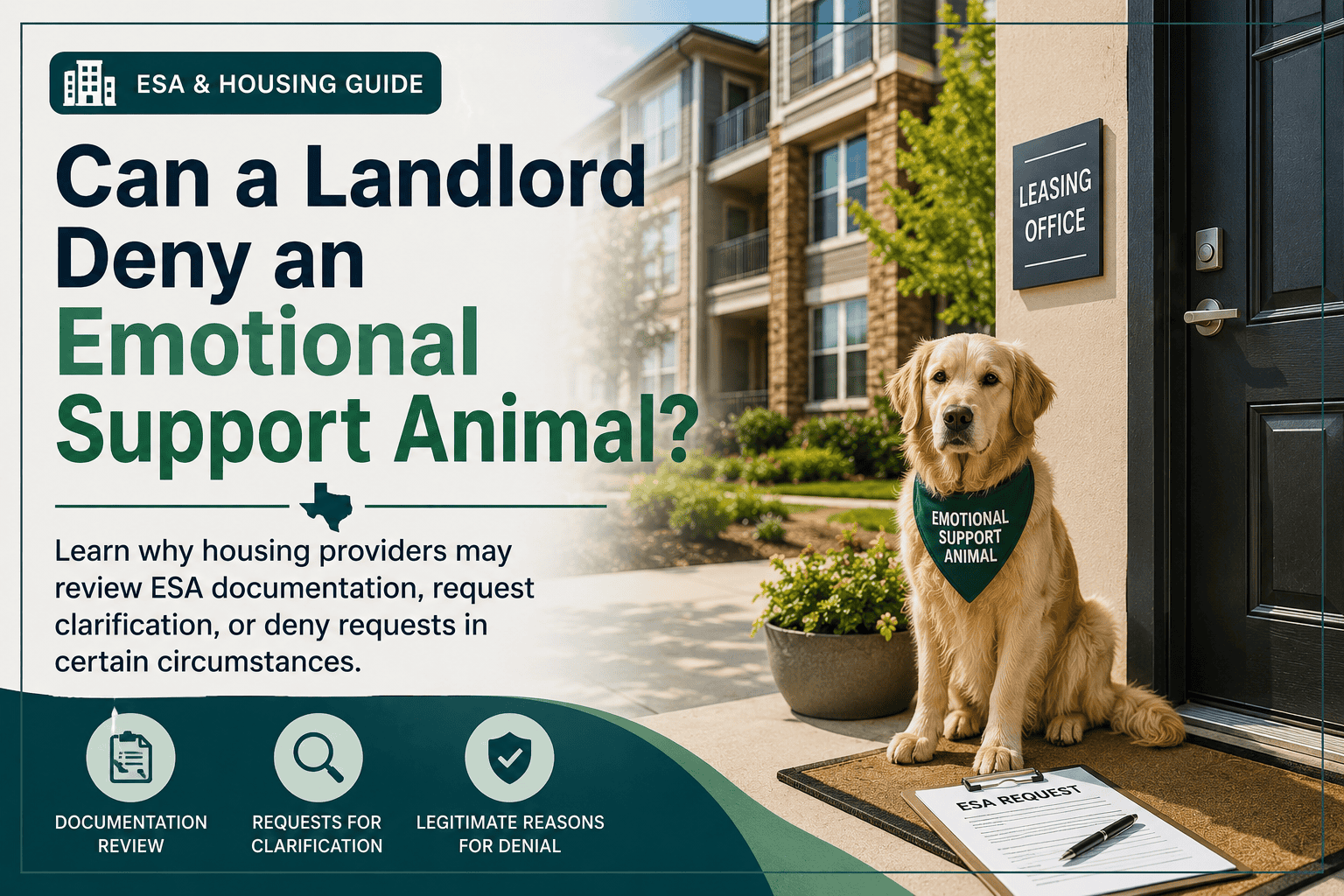
A landlord or housing provider may review an emotional support animal request, ask for appropriate clarification, and deny requests in certain circumstances. This guide explains why ESA documentation is reviewed, what may create problems, and how a clinically appropriate ESA letter can support a housing accommodation request without guaranteeing approval.

Start Here

Yes, a Landlord May Review an ESA Request — But It Should Not Be an Automatic No

Emotional support animal requests are usually handled as housing accommodation requests. A landlord, apartment community, property manager, or housing provider may review the request and the supporting documentation before making a decision.

At the same time, housing providers should be cautious about automatically denying every emotional support animal request. ESA requests often require individualized review of the resident’s disability-related need, the documentation provided, the animal-related policy, and any legitimate safety or property concerns.

View ESA Service Page

Landlord Review

Why Housing Providers Review ESA Documentation

A landlord may have animal-related policies such as no-pet rules, pet rent, pet deposits, breed restrictions, weight limits, or limits on the number of animals in a unit. When a resident requests an exception to one of those policies because of a mental health-related need, the housing provider may review whether the request is supported.

The review is not supposed to be about curiosity into a person’s private therapy history. The practical question is whether the documentation supports a disability-related need for the animal and whether the requested accommodation is reasonable under the circumstances.

A landlord’s review does not mean the request will be denied. It means the housing provider is evaluating whether the accommodation request is supported, reasonable, and consistent with applicable housing rules.

A housing provider may review questions such as:

  • Is the resident requesting an accommodation to an animal-related housing policy?
  • Is the disability-related need obvious or supported by documentation?
  • Does the documentation come from an appropriate professional source?
  • Does the letter explain the connection between the person’s need and the animal?
  • Is there a specific safety, disruption, or property concern?
  • Is more clarification needed before a decision can be made?

Requests for Clarification

Why a Landlord May Ask Follow-Up Questions

Sometimes an ESA letter is not rejected, but the housing provider asks for more information or clarification before making a decision.

Incomplete Letter

The letter may not clearly identify the clinician, license information, evaluation process, or disability-related need for the animal.

Need for Verification

A housing provider may want to verify that the documentation came from a real licensed professional.

Unclear Connection

The letter may not explain how the animal relates to the person’s emotional or mental health-related need.

Animal Concern

The housing provider may have a specific concern about animal behavior, safety, property damage, or disruption.

Property Policy

The accommodation may require an exception to a pet policy, breed policy, animal limit, or no-pet rule.

Interactive Process

Some situations require back-and-forth communication before the housing provider makes a final decision.

Possible Denial Reasons

When an ESA Request May Be Denied

A housing provider may deny an ESA request in certain circumstances. Denial may happen when the documentation is not sufficient, the request is not connected to a disability-related need, the animal creates a legitimate safety issue, or the request would create an unreasonable burden.

Denial may also occur when the resident submits fake registration documents, generic online certificates, or documentation that does not appear to come from a legitimate clinical evaluation.

Important Clarification

An ESA Letter Does Not Guarantee Approval

A therapist or evaluator can provide a clinical recommendation when it is appropriate, but the landlord or housing provider makes the accommodation decision.

  • ESA documentation is not pet registration.
  • There is no official national ESA registry.
  • Online certificates may not be meaningful.
  • Landlords may review documentation.
  • Housing disputes may require legal guidance.

Documentation Problems

Common Problems That Can Weaken an ESA Request

Not all ESA documentation is equally useful. Many housing problems begin when a resident buys a quick online certificate, downloads a generic letter, or submits documentation that does not show a real clinical relationship or evaluation.

Stronger ESA documentation is typically clear, professional, limited, and clinically grounded. It should not overpromise, make legal conclusions, or claim that approval is guaranteed.

Documentation may be questioned when it:

  • Comes from an instant-letter website with no meaningful clinical evaluation
  • Relies on “registration,” ID cards, certificates, or vests instead of clinical documentation
  • Does not identify the licensed professional or license information
  • Does not explain that an evaluation was completed
  • Does not connect the animal to a disability-related emotional or mental health need
  • Uses broad, generic language that appears copied or automated
  • Claims that the landlord must automatically approve the request
  • Includes unnecessary private clinical details instead of focused documentation

Good ESA documentation should support the request while protecting the client’s privacy. A landlord does not generally need a full therapy record, trauma history, medication list, or detailed diagnostic narrative to review an accommodation request.

If Your Request Is Questioned

What to Do if Your ESA Request Is Reviewed, Delayed, or Denied

A denial or clarification request can feel stressful, but it is important to respond calmly, keep records, and understand whether the issue is clinical, documentation-related, or legal.

Keep Copies

Save the ESA letter, your written request, landlord responses, emails, forms, and any documentation you submitted.

Ask for the Reason

If the request is denied, ask for the reason in writing so you can understand whether the issue involves documentation, policy, safety, or another concern.

Review the Letter

Make sure your documentation includes the clinician’s credentials, license information, and a clear clinical recommendation when appropriate.

Request Clarification

If the housing provider needs clarification, ask what specific information is missing while protecting unnecessary private health details.

Contact the Evaluator

With proper client authorization, the evaluator’s office may be able to verify documentation or clarify the clinical recommendation.

Seek Legal Guidance

If the dispute continues, a tenant may need to speak with an attorney, fair housing agency, or appropriate housing authority.

What Clinicians Can Do

A Therapist Provides a Clinical Recommendation

A licensed mental health professional can evaluate whether an emotional support animal recommendation is clinically appropriate. The clinician may consider symptoms, functioning, mental health history, treatment needs, and whether the animal appears to help alleviate symptoms.

  • Complete a clinical evaluation
  • Assess symptoms and functioning
  • Determine whether an ESA recommendation is appropriate
  • Provide documentation when clinically justified
  • Protect client privacy

What Clinicians Cannot Do

A Therapist Does Not Make the Housing Decision

A therapist cannot guarantee that a landlord will approve an ESA request. The housing provider makes the accommodation decision based on the request, documentation, applicable policies, and the specific facts.

  • Cannot guarantee approval
  • Cannot force a landlord to accept a request
  • Cannot provide legal advice
  • Cannot erase legitimate safety or property concerns
  • Cannot make false or unsupported claims

ESA Evaluations at Motivations Counseling

Texas ESA Evaluations Through a Licensed Counseling Practice

Motivations Counseling provides emotional support animal evaluations for Texas residents. Evaluations may be completed through secure telehealth when clinically appropriate, with in-person services available through our Sugar Land and Katy-area counseling practice when scheduling allows.

Our process is designed to be clear, ethical, and clinically grounded. Documentation is provided only when the evaluator determines that an ESA recommendation is clinically appropriate based on the evaluation.

Clinical ESA Evaluation

Schedule an ESA Evaluation in Texas

The ESA evaluation fee is currently $99. If you qualify and ESA documentation is clinically appropriate, there is no additional charge for the letter.

  • Licensed Texas mental health professionals
  • Telehealth available statewide for Texas residents
  • Same-day options may be available when scheduling allows
  • Documentation provided only when clinically appropriate
  • No guarantee of landlord approval

Frequently Asked Questions

Common Questions About Landlords and Emotional Support Animals

Can a landlord deny an emotional support animal?

A landlord may deny an ESA request in certain circumstances, such as when documentation is insufficient, the animal creates a legitimate safety concern, the request is not connected to a disability-related need, or the request is not reasonable under the circumstances.

Can a landlord ask for more documentation?

A housing provider may request appropriate clarification when the disability-related need is not obvious or the documentation is unclear. The request should be focused on the accommodation need and should not require unnecessary private therapy records.

Can a landlord reject an online ESA certificate?

Yes. Online registrations, certificates, ID cards, and vests are not the same as clinical documentation from a licensed mental health professional. A housing provider may question documentation that appears generic, purchased, or unsupported by an evaluation.

Can a landlord charge pet rent for an ESA?

ESA accommodation requests often involve an exception to ordinary pet policies. However, disputes about fees, deposits, damage, or specific lease terms may require legal guidance.

Can a landlord deny an ESA because of breed or size?

Breed, size, and property policies may be reviewed as part of the accommodation request. A provider should generally consider the specific facts rather than relying only on assumptions. Safety, behavior, and property concerns may still matter.

What should I do if my ESA request is denied?

Ask for the reason in writing, keep copies of all documentation, review whether your letter is complete, and consider seeking legal guidance or contacting an appropriate fair housing resource if you believe the denial was improper.

Can Motivations Counseling guarantee my landlord will approve my ESA?

No. Motivations Counseling can complete a clinical evaluation and provide documentation when clinically appropriate, but the housing provider makes the final accommodation decision.

How much does an ESA evaluation cost?

Motivations Counseling currently offers ESA clinical evaluations for $99. If the evaluator determines that ESA documentation is clinically appropriate, there is no additional charge for the letter.

Start Your ESA Evaluation

Schedule an Emotional Support Animal Evaluation in Texas

If you are seeking ESA documentation for a housing accommodation request, Motivations Counseling can help you complete a clinical evaluation and determine whether an emotional support animal recommendation may be appropriate.

×

Texas Emotional Support Animal Laws Explained

ESA Learning Center

Texas Emotional Support Animal Laws Explained

Emotional support animal laws in Texas can be confusing because housing rules, disability accommodation requests, service animal rules, and online ESA letter claims often get mixed together. This guide explains ESA housing documentation, landlord review, reasonable accommodation requests, and the important difference between a clinician’s recommendation and a legal housing decision.

Plain-Language Overview

ESA Laws Are Mostly About Housing Accommodation Requests

In Texas, most emotional support animal questions come up in housing. A person may request a reasonable accommodation when they have a disability-related need for an animal that provides emotional support, therapeutic benefit, or assistance connected to their mental health condition.

An ESA letter does not “register” an animal, create automatic approval, or turn a pet into a service animal. It is clinical documentation that may support a housing accommodation request when the recommendation is appropriate based on the person’s symptoms, functioning, and disability-related need.

View ESA Service Page

Texas ESA Law

Texas ESA Housing Questions Usually Involve Federal Fair Housing Principles

Texas residents often search for “Texas ESA laws,” but many housing accommodation questions are shaped by federal fair housing principles as well as housing-provider policies and the facts of the individual request. This is why ESA questions should be handled carefully rather than treated like a simple online certificate.

In housing, an emotional support animal may be considered as part of a disability-related accommodation request. The main question is not whether the animal is loved, registered, certified, or wearing a vest. The question is whether the person has a disability-related need for the animal and whether the requested accommodation is reasonable under the circumstances.

This article is educational and is not legal advice. Housing rules and enforcement guidance can change. Clients and housing providers should consult an attorney or appropriate housing authority when they need legal guidance about a specific dispute.

Key points Texas residents should understand:

  • ESA documentation is usually used for housing accommodation requests.
  • An ESA is not the same as a service animal under public access rules.
  • There is no official national ESA registry that creates housing rights.
  • A landlord may review a request and supporting documentation.
  • A clinician can provide a clinical recommendation but cannot guarantee approval.
  • Housing providers may consider safety, property damage, undue burden, and other relevant facts.

Reasonable Accommodation Requests

How ESA Housing Requests Usually Work

A housing accommodation request asks a landlord, property manager, apartment community, or housing provider to make an exception to an animal-related rule because of a disability-related need.

Housing Policy

The resident may live in housing with a no-pet rule, pet rent, breed restriction, weight limit, animal deposit, or other animal-related policy.

Clinical Need

The resident may have a mental health condition where the animal provides emotional support or helps alleviate symptoms in a meaningful way.

ESA Letter

If clinically appropriate, a licensed mental health professional may provide documentation supporting the accommodation request.

Request Submitted

The resident submits the request and supporting documentation to the housing provider through the property’s preferred process.

Landlord Review

The housing provider reviews whether the documentation supports a disability-related need and whether the request is reasonable.

Housing Decision

The final accommodation decision is made by the housing provider, not by the therapist or evaluator.

Landlord Review

Can a Texas Landlord Review an ESA Request?

Yes. A housing provider may review an ESA accommodation request and the supporting documentation. A landlord does not have to accept fake registration papers, ID cards, vests, or certificates as a substitute for meaningful documentation.

In many situations, the housing provider is trying to determine whether the person has a disability-related need for the animal and whether the requested accommodation is reasonable. The review should focus on the accommodation request, not unnecessary private details about a person’s therapy history.

Important Caution

An ESA Letter Does Not Override Every Housing Concern

ESA documentation does not give an animal unlimited rights. Housing providers may still consider legitimate issues such as safety, serious disruption, property damage, local animal rules, or whether the request creates an undue burden.

  • The animal may need to be under control.
  • The resident may remain responsible for damage caused by the animal.
  • Dangerous or disruptive behavior can create problems.
  • Documentation does not guarantee approval.
  • Housing disputes may require legal guidance.

ESA Documentation

What Should an ESA Letter Explain?

A legitimate ESA letter should be based on a clinical evaluation by a licensed mental health professional. The purpose is not to disclose a client’s entire mental health history. The purpose is to provide clinically appropriate documentation that supports the connection between the person’s mental health needs and the animal’s emotional support role.

A well-written ESA letter is usually clear, professional, and limited. It should avoid exaggeration, legal conclusions, guaranteed approval language, or statements that are not clinically supported.

ESA documentation may include:

  • The clinician’s name, credentials, and license information
  • Confirmation that a clinical evaluation was completed
  • A statement that the individual has a mental health-related need for the animal when clinically appropriate
  • A description of the animal’s emotional support role in general terms
  • Professional contact information for appropriate verification
  • Language clarifying that the housing provider makes the final accommodation decision

A landlord generally does not need a detailed therapy record, trauma history, medication list, or full diagnostic explanation to review an ESA accommodation request. Documentation should be clinically useful while still protecting client privacy.

Limits and Misunderstandings

What ESA Laws Do Not Mean

Many people get into trouble because they rely on misleading claims from instant ESA letter websites or confuse emotional support animals with service animals.

No Official ESA Registry

Online registrations, certificates, ID cards, or vests do not prove that an animal is clinically appropriate as an ESA.

No Public Access Right

ESA documentation is generally about housing. It does not give the animal the same public access rights as a trained service animal.

No Guaranteed Approval

A clinician may recommend an ESA when clinically appropriate, but the housing provider makes the accommodation decision.

Clinical Evaluation Matters

The strongest ESA documentation is based on symptoms, functioning, clinical need, and the animal’s support role.

Responsible Ownership Still Matters

ESA documentation does not excuse dangerous behavior, serious disruption, property damage, or failure to follow basic animal care rules.

Privacy Should Be Protected

Documentation should support the request without unnecessarily exposing private mental health details.

ESA Evaluations at Motivations Counseling

Texas ESA Evaluations Through a Licensed Counseling Practice

Motivations Counseling provides emotional support animal evaluations for Texas residents. Evaluations may be completed through secure telehealth when clinically appropriate, with in-person services available through our Sugar Land and Katy-area counseling practice when scheduling allows.

Our process is designed to be clear, ethical, and clinically grounded. Documentation is provided only when the evaluator determines that an ESA recommendation is clinically appropriate based on the evaluation.

Clinical ESA Evaluation

Schedule an ESA Evaluation in Texas

The ESA evaluation fee is currently $99. If you qualify and ESA documentation is clinically appropriate, there is no additional charge for the letter.

  • Licensed Texas mental health professionals
  • Telehealth available statewide for Texas residents
  • Same-day options may be available when scheduling allows
  • Documentation provided only when clinically appropriate
  • No guarantee of landlord approval

Frequently Asked Questions

Common Questions About Texas Emotional Support Animal Laws

Are emotional support animals legal in Texas?

Emotional support animals may be considered in housing accommodation requests when a person has a disability-related need for the animal. The request should be supported by appropriate documentation when the need is not obvious.

Is an ESA the same as a service animal?

No. A service animal is trained to perform specific tasks for a person with a disability. An emotional support animal may provide comfort, emotional support, routine, or therapeutic benefit, but it is not the same as a task-trained service animal.

Can a landlord ask for ESA documentation in Texas?

A housing provider may generally review documentation when a disability-related need is not obvious. The documentation should support the need for the accommodation without unnecessarily disclosing private therapy details.

Can a landlord deny an emotional support animal?

A landlord or housing provider may review the request and may deny it in some situations, including when documentation is insufficient, the request is not reasonable, the animal presents safety concerns, or the facts do not support the accommodation.

Do ESA animals have to be registered?

No. There is no official national ESA registry. Online registrations, certificates, ID cards, and vests do not replace a clinical evaluation or meaningful housing documentation.

Can a therapist guarantee that my landlord will accept my ESA letter?

No. A therapist can provide a clinical recommendation when appropriate, but the housing provider makes the accommodation decision.

Can I take my ESA into stores, restaurants, or public places?

ESA documentation generally does not provide the same public access rights as a trained service animal. Public access rules are different from housing accommodation rules.

How much does an ESA evaluation cost at Motivations Counseling?

Motivations Counseling currently offers ESA clinical evaluations for $99. If the evaluator determines that ESA documentation is clinically appropriate, there is no additional charge for the letter.

Start Your ESA Evaluation

Schedule an Emotional Support Animal Evaluation in Texas

If you are seeking ESA documentation for a housing accommodation request, Motivations Counseling can help you complete a clinical evaluation and determine whether an emotional support animal recommendation may be appropriate.

×