
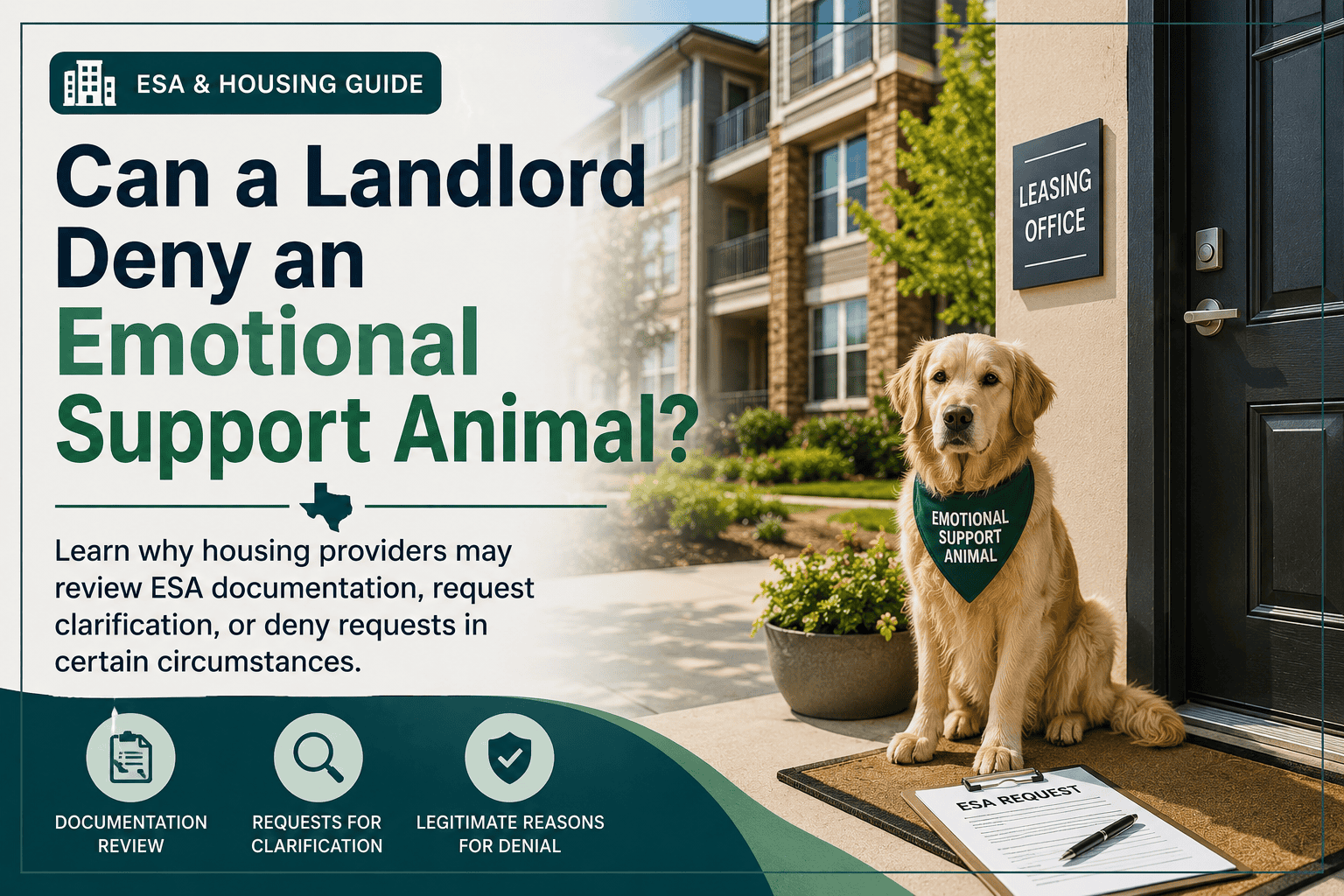
Can a Landlord Deny an Emotional Support Animal?
ESA Learning Center
Can a Landlord Deny an Emotional Support Animal?
A landlord or housing provider may review an emotional support animal request, ask for appropriate clarification, and deny requests in certain circumstances. This guide explains why ESA documentation is reviewed, what may create problems, and how a clinically appropriate ESA letter can support a housing accommodation request without guaranteeing approval.
Start Here
Yes, a Landlord May Review an ESA Request — But It Should Not Be an Automatic No
Emotional support animal requests are usually handled as housing accommodation requests. A landlord, apartment community, property manager, or housing provider may review the request and the supporting documentation before making a decision.
At the same time, housing providers should be cautious about automatically denying every emotional support animal request. ESA requests often require individualized review of the resident’s disability-related need, the documentation provided, the animal-related policy, and any legitimate safety or property concerns.
Landlord Review
Why Housing Providers Review ESA Documentation
A landlord may have animal-related policies such as no-pet rules, pet rent, pet deposits, breed restrictions, weight limits, or limits on the number of animals in a unit. When a resident requests an exception to one of those policies because of a mental health-related need, the housing provider may review whether the request is supported.
The review is not supposed to be about curiosity into a person’s private therapy history. The practical question is whether the documentation supports a disability-related need for the animal and whether the requested accommodation is reasonable under the circumstances.
A landlord’s review does not mean the request will be denied. It means the housing provider is evaluating whether the accommodation request is supported, reasonable, and consistent with applicable housing rules.
A housing provider may review questions such as:
- Is the resident requesting an accommodation to an animal-related housing policy?
- Is the disability-related need obvious or supported by documentation?
- Does the documentation come from an appropriate professional source?
- Does the letter explain the connection between the person’s need and the animal?
- Is there a specific safety, disruption, or property concern?
- Is more clarification needed before a decision can be made?
Requests for Clarification
Why a Landlord May Ask Follow-Up Questions
Sometimes an ESA letter is not rejected, but the housing provider asks for more information or clarification before making a decision.
Incomplete Letter
The letter may not clearly identify the clinician, license information, evaluation process, or disability-related need for the animal.
Need for Verification
A housing provider may want to verify that the documentation came from a real licensed professional.
Unclear Connection
The letter may not explain how the animal relates to the person’s emotional or mental health-related need.
Animal Concern
The housing provider may have a specific concern about animal behavior, safety, property damage, or disruption.
Property Policy
The accommodation may require an exception to a pet policy, breed policy, animal limit, or no-pet rule.
Interactive Process
Some situations require back-and-forth communication before the housing provider makes a final decision.
Possible Denial Reasons
When an ESA Request May Be Denied
A housing provider may deny an ESA request in certain circumstances. Denial may happen when the documentation is not sufficient, the request is not connected to a disability-related need, the animal creates a legitimate safety issue, or the request would create an unreasonable burden.
Denial may also occur when the resident submits fake registration documents, generic online certificates, or documentation that does not appear to come from a legitimate clinical evaluation.
Important Clarification
An ESA Letter Does Not Guarantee Approval
A therapist or evaluator can provide a clinical recommendation when it is appropriate, but the landlord or housing provider makes the accommodation decision.
- ESA documentation is not pet registration.
- There is no official national ESA registry.
- Online certificates may not be meaningful.
- Landlords may review documentation.
- Housing disputes may require legal guidance.
Documentation Problems
Common Problems That Can Weaken an ESA Request
Not all ESA documentation is equally useful. Many housing problems begin when a resident buys a quick online certificate, downloads a generic letter, or submits documentation that does not show a real clinical relationship or evaluation.
Stronger ESA documentation is typically clear, professional, limited, and clinically grounded. It should not overpromise, make legal conclusions, or claim that approval is guaranteed.
Documentation may be questioned when it:
- Comes from an instant-letter website with no meaningful clinical evaluation
- Relies on “registration,” ID cards, certificates, or vests instead of clinical documentation
- Does not identify the licensed professional or license information
- Does not explain that an evaluation was completed
- Does not connect the animal to a disability-related emotional or mental health need
- Uses broad, generic language that appears copied or automated
- Claims that the landlord must automatically approve the request
- Includes unnecessary private clinical details instead of focused documentation
Good ESA documentation should support the request while protecting the client’s privacy. A landlord does not generally need a full therapy record, trauma history, medication list, or detailed diagnostic narrative to review an accommodation request.
If Your Request Is Questioned
What to Do if Your ESA Request Is Reviewed, Delayed, or Denied
A denial or clarification request can feel stressful, but it is important to respond calmly, keep records, and understand whether the issue is clinical, documentation-related, or legal.
Keep Copies
Save the ESA letter, your written request, landlord responses, emails, forms, and any documentation you submitted.
Ask for the Reason
If the request is denied, ask for the reason in writing so you can understand whether the issue involves documentation, policy, safety, or another concern.
Review the Letter
Make sure your documentation includes the clinician’s credentials, license information, and a clear clinical recommendation when appropriate.
Request Clarification
If the housing provider needs clarification, ask what specific information is missing while protecting unnecessary private health details.
Contact the Evaluator
With proper client authorization, the evaluator’s office may be able to verify documentation or clarify the clinical recommendation.
Seek Legal Guidance
If the dispute continues, a tenant may need to speak with an attorney, fair housing agency, or appropriate housing authority.
What Clinicians Can Do
A Therapist Provides a Clinical Recommendation
A licensed mental health professional can evaluate whether an emotional support animal recommendation is clinically appropriate. The clinician may consider symptoms, functioning, mental health history, treatment needs, and whether the animal appears to help alleviate symptoms.
- Complete a clinical evaluation
- Assess symptoms and functioning
- Determine whether an ESA recommendation is appropriate
- Provide documentation when clinically justified
- Protect client privacy
What Clinicians Cannot Do
A Therapist Does Not Make the Housing Decision
A therapist cannot guarantee that a landlord will approve an ESA request. The housing provider makes the accommodation decision based on the request, documentation, applicable policies, and the specific facts.
- Cannot guarantee approval
- Cannot force a landlord to accept a request
- Cannot provide legal advice
- Cannot erase legitimate safety or property concerns
- Cannot make false or unsupported claims
ESA Evaluations at Motivations Counseling
Texas ESA Evaluations Through a Licensed Counseling Practice
Motivations Counseling provides emotional support animal evaluations for Texas residents. Evaluations may be completed through secure telehealth when clinically appropriate, with in-person services available through our Sugar Land and Katy-area counseling practice when scheduling allows.
Our process is designed to be clear, ethical, and clinically grounded. Documentation is provided only when the evaluator determines that an ESA recommendation is clinically appropriate based on the evaluation.
Clinical ESA Evaluation
Schedule an ESA Evaluation in Texas
The ESA evaluation fee is currently $99. If you qualify and ESA documentation is clinically appropriate, there is no additional charge for the letter.
- Licensed Texas mental health professionals
- Telehealth available statewide for Texas residents
- Same-day options may be available when scheduling allows
- Documentation provided only when clinically appropriate
- No guarantee of landlord approval
ESA Learning Center
Continue Learning About ESA Letters, Housing, and Mental Health Support
These related resources can help Texas residents better understand ESA documentation, landlord review, and clinical evaluation standards.
Emotional Support Animal Letters in Texas: What You Need to Know
A broader guide to ESA letters, clinical evaluations, housing requests, and common myths about ESA registration.
Read article →Texas Emotional Support Animal Laws Explained
A plain-language overview of ESA housing documentation, landlord review, and reasonable accommodation requests.
Read article →Emotional Support Animal Resource Center
Browse our complete library of emotional support animal articles, FAQs, and practical resources covering housing, Texas laws, landlord requests, evaluations, and more.
Explore Resource Center →Featured Page
The Complete Emotional Support Animal Guide
Looking for the complete picture? Our clinician-written guide explains emotional support animal evaluations, ESA letters, Texas housing accommodations, landlord documentation, eligibility, service animal differences, and answers to the most common questions about Emotional Support Animals.
Frequently Asked Questions
Common Questions About Landlords and Emotional Support Animals
Can a landlord deny an emotional support animal?
A landlord may deny an ESA request in certain circumstances, such as when documentation is insufficient, the animal creates a legitimate safety concern, the request is not connected to a disability-related need, or the request is not reasonable under the circumstances.
Can a landlord ask for more documentation?
A housing provider may request appropriate clarification when the disability-related need is not obvious or the documentation is unclear. The request should be focused on the accommodation need and should not require unnecessary private therapy records.
Can a landlord reject an online ESA certificate?
Yes. Online registrations, certificates, ID cards, and vests are not the same as clinical documentation from a licensed mental health professional. A housing provider may question documentation that appears generic, purchased, or unsupported by an evaluation.
Can a landlord charge pet rent for an ESA?
ESA accommodation requests often involve an exception to ordinary pet policies. However, disputes about fees, deposits, damage, or specific lease terms may require legal guidance.
Can a landlord deny an ESA because of breed or size?
Breed, size, and property policies may be reviewed as part of the accommodation request. A provider should generally consider the specific facts rather than relying only on assumptions. Safety, behavior, and property concerns may still matter.
What should I do if my ESA request is denied?
Ask for the reason in writing, keep copies of all documentation, review whether your letter is complete, and consider seeking legal guidance or contacting an appropriate fair housing resource if you believe the denial was improper.
Can Motivations Counseling guarantee my landlord will approve my ESA?
No. Motivations Counseling can complete a clinical evaluation and provide documentation when clinically appropriate, but the housing provider makes the final accommodation decision.
How much does an ESA evaluation cost?
Motivations Counseling currently offers ESA clinical evaluations for $99. If the evaluator determines that ESA documentation is clinically appropriate, there is no additional charge for the letter.

Start Your ESA Evaluation
Schedule an Emotional Support Animal Evaluation in Texas
If you are seeking ESA documentation for a housing accommodation request, Motivations Counseling can help you complete a clinical evaluation and determine whether an emotional support animal recommendation may be appropriate.

