
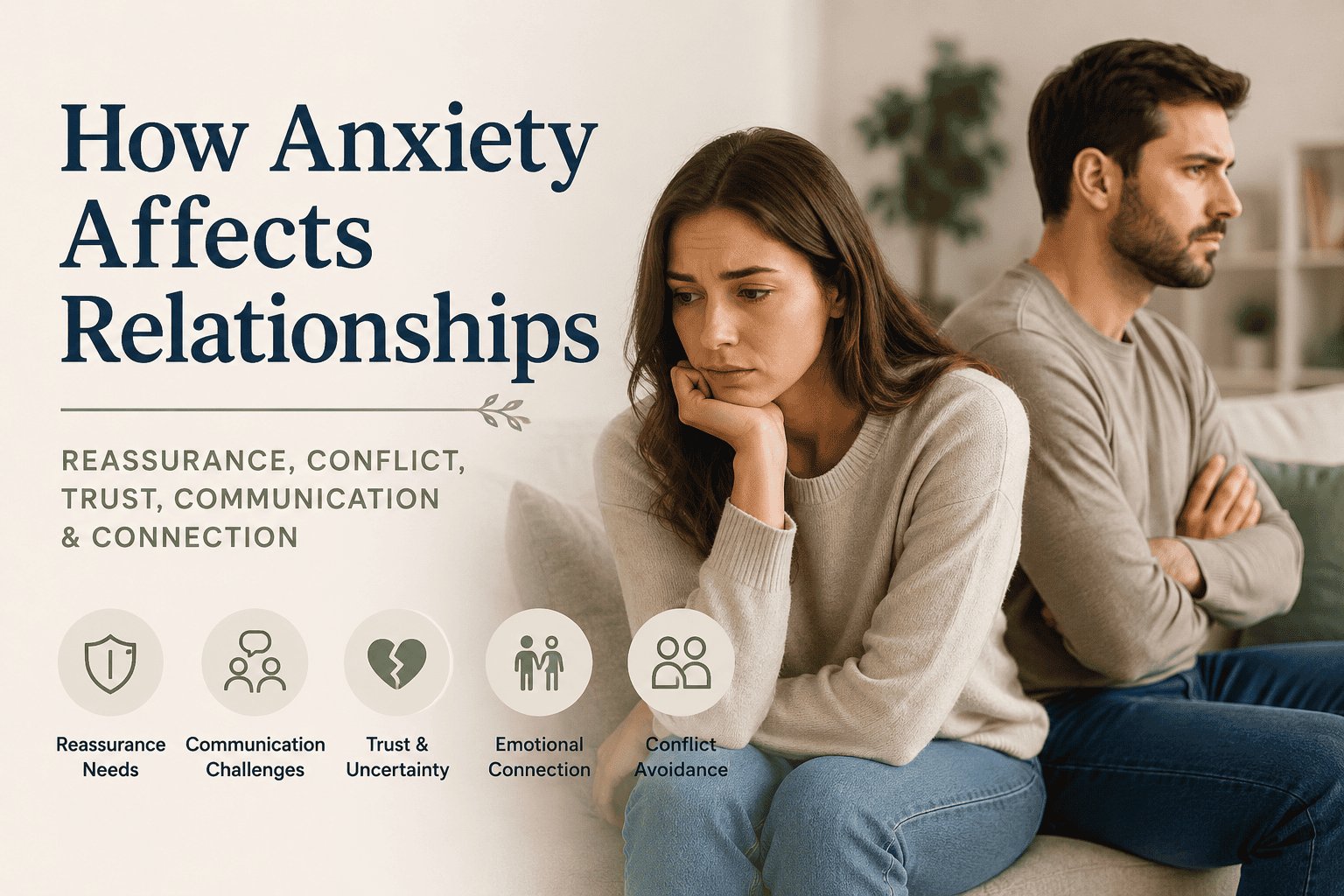
How Anxiety Affects Relationships: Reassurance, Trust, Conflict & Communication
Anxiety & Relationship Resources
How Anxiety Affects Relationships: Reassurance, Conflict, Trust, and Connection
Anxiety can affect reassurance needs, conflict avoidance, communication patterns, trust, emotional closeness, and connection. This guide explains how anxiety can show up in relationships, why anxious patterns are often protective rather than intentional, and how counseling can help people communicate more clearly and feel more secure with others.
Start Here
Anxiety Can Shape the Way People Ask for Closeness, Protection, and Reassurance
Anxiety can affect relationships even when someone deeply cares about the other person. It may lead to overthinking conversations, needing repeated reassurance, avoiding hard topics, reading too much into tone or response time, or feeling easily unsettled when connection feels uncertain.
These patterns are not usually about being difficult, dramatic, or needy. Often, they are attempts to reduce emotional threat. Anxiety may push the mind and body to search for certainty, prevent rejection, avoid conflict, or protect the relationship from imagined loss.
What Does It Mean When Anxiety Affects Relationships?
Anxiety affects relationships when worry, fear of rejection, conflict sensitivity, overthinking, nervous system activation, or a need for certainty begins to shape communication, trust, closeness, boundaries, or emotional safety. This can happen in romantic relationships, friendships, family relationships, parenting, and workplace relationships.
What It Feels Like
What Relationship Anxiety Can Feel Like
Anxiety in relationships does not always look like panic. Sometimes it looks like overthinking, withdrawing, apologizing too much, needing certainty, avoiding conflict, or feeling emotionally unsettled after small changes in connection.
Needing Reassurance
You may repeatedly ask if everything is okay, if someone is upset, or if the relationship is still secure.
Fear of Conflict
Disagreement may feel threatening, even when the other person sees it as a normal conversation or repair opportunity.
Overthinking Conversations
You may replay texts, facial expressions, tone, pauses, or small comments and wonder what they really meant.
People-Pleasing
You may minimize your needs, avoid saying no, or agree quickly to reduce the risk of disappointment or rejection.
Difficulty Trusting
Anxiety can make uncertainty feel unsafe, leading to checking, suspicion, or fear that connection could disappear.
Feeling Disconnected
Even when you want closeness, anxiety may make it harder to relax, receive care, or feel emotionally present.
Why It Happens
Why Anxiety Shows Up So Strongly in Relationships
Relationships matter because they involve attachment, belonging, vulnerability, emotional safety, and the possibility of being misunderstood or rejected. When anxiety is present, the brain may treat relational uncertainty as a threat that must be solved quickly.
This can make small changes feel bigger than they are. A delayed text, a different tone, a quiet mood, a disagreement, or a partner needing space may trigger worry. The anxious mind may begin searching for explanations, signs of danger, or ways to restore certainty.
Anxiety can influence relationships by creating:
- Fear that others are upset, disappointed, or pulling away
- Difficulty tolerating uncertainty or emotional distance
- Urgency to fix problems before they are fully understood
- Overinterpretation of tone, silence, facial expressions, or response time
- Avoidance of difficult conversations to prevent conflict
- People-pleasing, apologizing, or minimizing needs
- Emotional withdrawal when closeness feels overwhelming
Relationship anxiety is often a protection pattern. The goal is not to shame the pattern, but to understand what it is trying to prevent and build healthier ways to seek security and connection.
Reassurance Needs
Anxiety Can Create a Strong Need to Know Everything Is Okay
Reassurance can be healthy in relationships. People need comfort, clarity, repair, and emotional responsiveness. But when anxiety is high, reassurance may become urgent and repetitive because the relief does not last very long.
- “Are you mad at me?”
- “Are we okay?”
- “Did I say something wrong?”
- “Do you still want to be with me?”
The Reassurance Loop
Reassurance May Help Briefly, Then Anxiety Returns
When reassurance becomes the main way anxiety is managed, the relationship may get stuck in a loop. One person seeks certainty, the other person tries to provide it, and anxiety returns when uncertainty appears again.
- Relief may be temporary.
- The anxious brain may ask for more proof.
- The other person may feel pressured or exhausted.
- Both people may feel misunderstood.
The goal is not to stop needing comfort. The goal is to combine relational reassurance with internal soothing, clear communication, and stronger tolerance for uncertainty.
Conflict Avoidance
Anxiety Can Make Conflict Feel More Dangerous Than It Is
Many people with anxiety avoid conflict because disagreement feels like a sign that the relationship is unsafe. A hard conversation may trigger fear of rejection, criticism, anger, abandonment, or emotional overwhelm.
Avoidance may reduce anxiety in the moment, but it can create longer-term disconnection. Important needs may go unspoken. Resentment may build. The other person may not know what is wrong, and the anxious person may feel increasingly unseen.
Conflict avoidance may look like:
- Saying “it’s fine” when something is not fine
- Apologizing quickly to end discomfort
- Changing the subject when emotions rise
- Agreeing externally while feeling resentful internally
- Withdrawing instead of saying what you need
- Delaying hard conversations until anxiety builds
Healthy relationships do not require avoiding every disagreement. They require learning how to move through disagreement with respect, clarity, emotional regulation, and repair.
Communication Patterns
How Anxiety Can Affect Communication
Anxiety can make communication feel urgent, guarded, indirect, overly apologetic, or emotionally intense. These patterns are usually attempts to prevent disconnection, but they can accidentally create more confusion.
Repeating the Same Concern
Anxiety may keep circling back to the same question because the mind is looking for complete certainty.
Reading Between the Lines
A short response, quiet mood, or change in tone may feel like evidence that something is wrong.
Going Quiet
Some people shut down because they feel overwhelmed, afraid of saying the wrong thing, or unsure how to ask for what they need.
Texting for Certainty
Anxiety may create urgency to send another message, clarify again, explain more, or seek reassurance quickly.
Overexplaining
You may give long explanations because being misunderstood feels risky or emotionally unsafe.
Repair Seeking
Anxiety may push for immediate repair, even when the other person needs time to process before reconnecting.
Clear communication often improves when anxiety is regulated first. A calmer nervous system can make it easier to ask directly, listen accurately, and tolerate a slower repair process.
Trust and Uncertainty
Anxiety Can Make Trust Feel Fragile
Trust requires some ability to tolerate uncertainty. Anxiety struggles with uncertainty because the anxious brain wants proof, predictability, and protection from emotional pain. This can make trust feel difficult even when the other person has not done anything wrong.
When anxiety takes over, the mind may scan for signs of change, rejection, dishonesty, or distance. This can lead to checking, questioning, comparing, monitoring, or mentally rehearsing worst-case scenarios.
Trust-related anxiety may include:
- Fear that someone is losing interest
- Worry that silence means rejection
- Difficulty believing reassurance
- Checking social media, texts, tone, or patterns
- Feeling unsettled when someone needs space
- Interpreting uncertainty as danger
Anxiety and intuition can feel similar in the body. Therapy can help people slow down, sort out the difference between a current relational concern and an old fear being activated.
Emotional Connection
Anxiety Can Make Closeness Feel Both Wanted and Overwhelming
People with anxiety often want deep connection. At the same time, closeness can feel vulnerable. Being known, depending on someone, expressing needs, or allowing someone to matter can trigger fear of rejection, disappointment, or loss.
This can create mixed signals. One part of you may reach for closeness while another part pulls back to stay safe. You may want comfort but feel uncomfortable receiving it. You may long for connection but also feel guarded, tense, or emotionally flooded.
Anxiety may affect connection through:
- Difficulty being emotionally present
- Fear of needing too much
- Pulling away after feeling vulnerable
- Testing whether someone will stay
- Feeling rejected when someone is simply tired, busy, or distracted
- Struggling to receive care without questioning it
Connection often grows when people can name the pattern without blame: “This is my anxiety getting activated,” rather than “You are the problem” or “I am too much.”
An Educational Framework
The Anxiety-Relationship Cycle
Anxiety can create a repeating cycle in relationships. Understanding the pattern can help both people respond with more clarity and less blame.
1. Something Feels Uncertain
A delayed reply, change in tone, disagreement, or emotional distance triggers concern.
2. The Mind Starts Scanning
Anxiety looks for evidence, meaning, danger, or proof that the relationship is secure.
3. The Body Activates
You may feel tightness, urgency, dread, restlessness, nausea, or emotional flooding.
4. Reassurance or Avoidance Begins
You may ask repeated questions, overexplain, withdraw, people-please, or avoid the issue.
5. The Relationship Reacts
The other person may reassure, defend, pull back, become frustrated, or feel pressured.
6. The Pattern Repeats
Temporary relief fades, uncertainty returns, and both people may feel stuck.
The goal is not to blame either person. The goal is to recognize the cycle, slow it down, and build more secure ways to communicate, repair, and reconnect.
What Helps
Ways to Support Healthier Relationship Patterns
Anxiety does not have to control the relationship. With awareness, regulation, and healthier communication, people can learn to seek connection without becoming trapped in reassurance, avoidance, or fear.
Pause Before Reacting
Give your nervous system time to settle before sending another message, withdrawing, or assuming the worst.
Name the Anxiety Pattern
Try saying, “My anxiety is getting activated,” instead of treating every anxious thought as a relationship fact.
Ask Clearly
Direct requests are often healthier than hints, testing, withdrawing, or repeated reassurance seeking.
Build Internal Safety
Grounding, self-talk, breathing, journaling, and emotional regulation can help reduce urgency.
Practice Repair
Healthy repair can include taking responsibility, listening, clarifying, apologizing, and reconnecting.
Seek Counseling Support
Therapy can help identify the anxiety cycle and build healthier relational responses.
When to Seek Help
When to Seek Counseling for Anxiety in Relationships
It may be time to reach out when anxiety repeatedly affects communication, trust, conflict, emotional closeness, or your ability to feel secure with others. Counseling can help you understand the pattern and develop more grounded ways to respond.
Consider counseling if you notice:
- You often need reassurance but still do not feel settled
- You avoid conflict until resentment builds
- You overthink texts, tone, silence, or facial expressions
- You feel easily rejected, abandoned, or replaced
- You shut down, withdraw, or people-please when anxious
- Your relationship feels stuck in repeated arguments or repair attempts
- Anxiety is affecting closeness, trust, intimacy, or communication
If relationship stress includes emotional abuse, physical violence, coercive control, threats, or fear for your safety, seek immediate support from a trusted person, local emergency services, or a domestic violence resource. Counseling is not a substitute for safety planning in dangerous situations.
Counseling at Motivations Counseling
Therapy Can Help When Anxiety Is Affecting Relationships
Motivations Counseling provides therapy for adults and couples experiencing anxiety, relationship stress, communication difficulties, conflict avoidance, emotional disconnection, trust concerns, trauma-related activation, and chronic stress. Counseling can help clients better understand the cycle underneath the symptoms and begin building healthier ways to communicate and reconnect.
Our counseling team serves clients in Sugar Land, Katy, Richmond, Fort Bend County, West Houston, and through telehealth across Texas when clinically appropriate.
Counseling Support
Anxiety and Relationship Counseling in Sugar Land, Katy, and Online Across Texas
If anxiety is affecting reassurance needs, conflict, trust, communication, or emotional connection, counseling can help you better understand what is happening and take manageable next steps.
- Individual counseling for anxiety and relationship patterns
- Couples counseling for communication, conflict, and connection
- Trauma-informed support for nervous system activation
- In-person options in Sugar Land and Katy when available
- Telehealth counseling across Texas when clinically appropriate
Therapy Learning Center
Continue Learning About Anxiety, Relationships, and Emotional Connection
These related resources can help adults and couples better understand anxiety, overthinking, emotional disconnection, attachment patterns, conflict cycles, and when counseling may help.
Racing Thoughts and Overthinking
Learn why your mind may keep replaying, predicting, checking, or trying to solve problems that never feel fully resolved.
Read article →Why Do I Feel Anxious All the Time?
Learn why anxiety may feel constant when worry, stress, nervous system activation, and avoidance reinforce each other.
Read article →Why Couples Get Stuck in the Same Argument
Understand how repeated conflict cycles can leave both partners feeling unheard, defensive, or disconnected.
Read article →Emotional Disconnection in Relationships
Learn how distance, stress, avoidance, and unresolved hurt can affect closeness and emotional safety.
Read article →Attachment Styles and Relationships
Explore how attachment patterns may affect closeness, reassurance, trust, independence, and conflict.
Read article →Counseling Resource Center
Explore resources on anxiety, depression, trauma, EMDR, relationships, teen counseling, and emotional health.
Explore Resource Center →Frequently Asked Questions
Common Questions About Anxiety and Relationships
Can anxiety affect relationships?
Yes. Anxiety can affect reassurance needs, communication, conflict avoidance, trust, emotional closeness, and connection. It may lead to overthinking, people-pleasing, withdrawal, repeated reassurance seeking, or fear that something is wrong in the relationship.
Why do I need so much reassurance in relationships?
Reassurance needs often come from anxiety, fear of rejection, attachment concerns, past hurt, or difficulty tolerating uncertainty. Reassurance may help briefly, but anxiety can return if the deeper pattern is not addressed.
Can anxiety make me avoid conflict?
Yes. Anxiety can make disagreement feel dangerous, even when conflict is normal and repairable. Some people avoid hard conversations because they fear rejection, anger, abandonment, criticism, or emotional overwhelm.
Why do I overthink texts and conversations?
Anxiety often scans for signs of danger, rejection, or disconnection. This can make you replay conversations, analyze tone, read into response times, or worry that you said something wrong.
Can anxiety cause trust issues?
Anxiety can make trust feel difficult because trust requires tolerating uncertainty. When anxiety is high, the mind may look for proof, reassurance, or signs that the relationship is still secure.
How can I communicate better when I am anxious?
It can help to pause before reacting, regulate your body first, name the anxiety pattern, ask directly for what you need, and avoid relying only on hints, testing, withdrawal, or repeated reassurance seeking.
Can couples counseling help with anxiety in a relationship?
Couples counseling can help partners understand the cycle underneath conflict, reassurance, avoidance, and disconnection. Therapy can support clearer communication, emotional safety, repair, and healthier connection.
When should I seek therapy for relationship anxiety?
Consider therapy when anxiety regularly affects communication, trust, conflict, emotional closeness, or daily functioning. Therapy may also help if you feel stuck in repeated reassurance, overthinking, avoidance, or relationship distress.

Take the Next Step
Anxiety and Relationship Counseling in Sugar Land, Katy, and Online Across Texas
If anxiety is affecting reassurance, conflict, communication, trust, or emotional connection, counseling can help you understand the pattern and begin building healthier ways to relate.

