
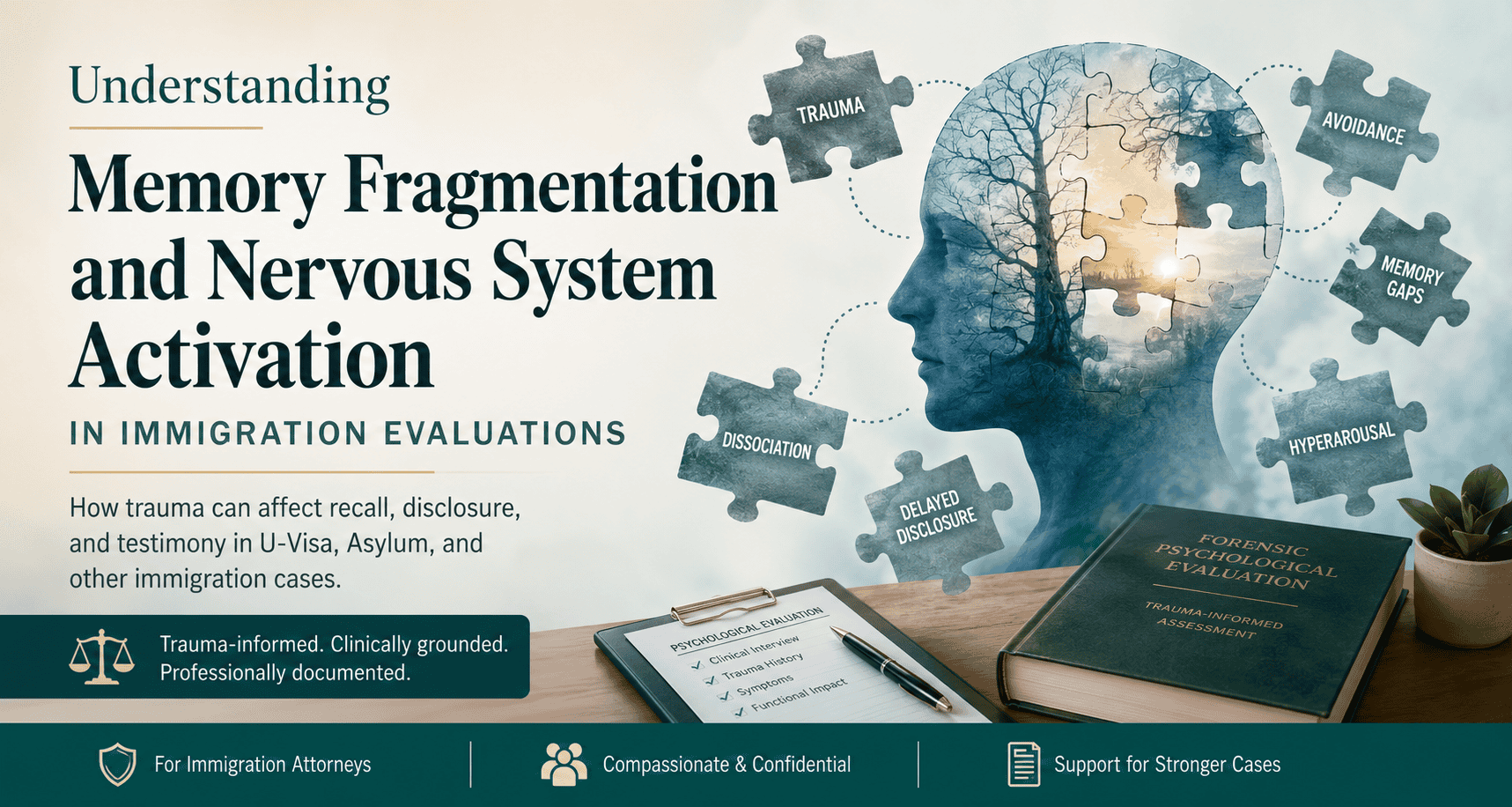
Understanding Memory Fragmentation and Nervous System Activation in Immigration Evaluations
Attorney Resource Guide
Understanding Memory Fragmentation and Nervous System Activation in U-Visa and Asylum Evaluations
Trauma-related immigration evaluations often involve painful histories that are difficult for clients to recall, organize, and describe in a linear way. In U-Visa and asylum-related evaluations, memory fragmentation, avoidance, dissociation, hyperarousal, and nervous system activation may affect how a client presents during the clinical interview and how their history is communicated over time.
Why This Matters for Attorneys
Trauma Narratives Are Often Clinically Complex, Not Simply Linear
Attorneys working on U-Visa and asylum-related matters may notice that clients struggle to provide a clear, chronological, emotionally consistent narrative of traumatic events. Some clients provide limited details at first, remember additional information later, become overwhelmed when asked about specific events, or describe experiences in fragments rather than in a complete timeline.
These patterns can raise concerns during immigration preparation because legal settings often require detailed, organized, and consistent testimony. A trauma-informed psychological evaluation does not determine whether a legal claim is true or false. However, it can help explain clinical factors that may affect recall, disclosure, emotional expression, and interview presentation.
Understanding memory fragmentation and nervous system activation can help attorneys better recognize when a client’s difficulty describing events may be related to trauma symptoms, avoidance, dissociation, fear, shame, or physiological overwhelm.
Trauma Memory
How Trauma Can Affect Recall, Sequencing, and Disclosure
Trauma memories are not always stored or retrieved in the same way as ordinary autobiographical memories. Clients may remember certain sensory details vividly while struggling to recall dates, sequence, duration, or peripheral details.
Fragmented Recall
A client may recall pieces of an event without being able to immediately organize the experience into a complete beginning, middle, and end.
Difficulty With Timeline
Dates, sequence, frequency, and duration may be difficult to recall accurately, especially when events occurred during periods of fear, captivity, repeated abuse, or prolonged stress.
Avoidance and Gaps
Trauma survivors may avoid thinking about certain details, minimize the impact, or leave out painful information because the memory feels overwhelming or unsafe to discuss.
Sensory Details
Some clients remember sounds, smells, physical sensations, images, or bodily reactions more clearly than the exact order of events.
Dissociation
During or after trauma, clients may describe feeling detached, numb, unreal, frozen, confused, or disconnected from what happened.
Delayed Disclosure
Clients may disclose additional information later as trust increases, shame decreases, or the nervous system becomes more regulated.
Nervous System Activation
The Body May Respond Before the Client Can Explain the Story
In trauma-related evaluations, the client’s body may respond as if danger is still present. Discussing the traumatic event may activate fear, panic, shutdown, trembling, tearfulness, numbness, rapid speech, difficulty concentrating, or sudden emotional withdrawal.
These reactions may interfere with the client’s ability to answer questions clearly, maintain chronological order, tolerate follow-up questions, or remain emotionally present during the interview.
U-Visa and Asylum Context
How Memory and Nervous System Issues May Appear in Different Case Types
U-Visa and asylum-related evaluations may involve different facts, but both can include trauma histories that affect recall, disclosure, emotional regulation, and interview presentation.
| Clinical Issue | How It May Appear in U-Visa Evaluations | How It May Appear in Asylum-Related Evaluations |
|---|---|---|
| Fragmented narrative | The client may recall parts of the crime, aftermath, police involvement, or emotional impact without a smooth sequence. | The client may recall persecution, threats, escape, hiding, or fear of return in non-linear fragments. |
| Avoidance | The client may avoid discussing the crime because it activates fear, shame, grief, or self-blame. | The client may avoid discussing persecution, political violence, sexual violence, detention, torture, or family threats. |
| Hypervigilance | The client may remain fearful of the perpetrator, retaliation, law enforcement contact, or community exposure. | The client may remain fearful of government actors, gangs, political groups, family retaliation, or return to the country of origin. |
| Delayed disclosure | Additional details may emerge after rapport develops or when the client feels safer describing the crime and its effects. | Additional details may emerge as the client becomes more able to discuss fear, harm, loss, persecution, or prior threats. |
| Dissociation or shutdown | The client may become numb, detached, tearful, or unable to continue when recalling the traumatic incident. | The client may shut down when discussing violence, captivity, assault, death threats, or memories of fleeing danger. |
Clinical Signs
What a Trauma-Informed Evaluator May Look For
A psychological evaluation can help identify whether the client’s presentation is clinically consistent with trauma-related symptoms and whether those symptoms affect functioning, communication, and emotional regulation.
Whether symptoms are connected to trauma reminders.
The evaluator may assess whether anxiety, panic, nightmares, intrusive memories, avoidance, numbness, or hypervigilance are triggered by reminders of the traumatic event or fear of future harm.
How the client responds when discussing painful material.
Observed tearfulness, shaking, guardedness, confusion, emotional flatness, dissociation, or difficulty continuing may help document the client’s nervous system response during the interview.
Whether memory problems are global or trauma-specific.
Some clients have broad cognitive problems, while others are generally organized but become fragmented when discussing trauma-related material.
Whether avoidance affects disclosure.
The evaluator may consider whether shame, fear, distrust, cultural stigma, language barriers, or emotional overwhelm contribute to delayed or limited disclosure.
How symptoms affect daily functioning.
Trauma-related symptoms may affect sleep, parenting, work, school, relationships, medical care, concentration, emotional stability, and the ability to participate in legal processes.
Professional Boundaries
Clinical Evaluation Is Not a Legal Credibility Determination
A trauma-informed evaluator can explain clinical patterns without replacing the role of the attorney, immigration officer, judge, or legal fact-finder.
| Appropriate Clinical Role | Clinical Question | What the Evaluator Should Avoid |
|---|---|---|
| Assess symptoms | Are the client’s symptoms clinically consistent with trauma, anxiety, depression, dissociation, or PTSD-related impairment? | Declaring that the legal claim is true or false. |
| Explain trauma presentation | Could trauma-related symptoms affect recall, sequencing, emotional expression, or disclosure? | Excusing every inconsistency or making legal credibility conclusions. |
| Document functional impact | How do symptoms affect sleep, work, relationships, parenting, concentration, safety, and daily life? | Offering legal opinions about eligibility, relief, admissibility, or case outcome. |
| Use clinical language | What symptoms, diagnostic impressions, and clinical observations are supported by the evaluation? | Writing advocacy language that exceeds the evaluator’s clinical role. |
Attorney Value
How Attorneys Can Use This Information Responsibly
Attorneys can support the evaluation process by identifying trauma-related concerns, providing relevant records, and helping the client understand the appointment without coaching clinical responses.
Provide Relevant Context
A short attorney summary can identify the traumatic event, case type, major concerns, language needs, deadlines, and records that may help the evaluator understand the referral question.
Prepare Without Coaching
Clients can be told what to expect during the evaluation, but they should not be told what symptoms to report, what diagnosis to seek, or how emotional they should appear.
Allow Time for Rapport
Trauma survivors may need a calm, structured, respectful interview process before they can disclose painful details or tolerate trauma-related questions.
Address Language Needs
Interpretation needs should be identified early. Trauma narratives can become more difficult to communicate when clients are forced to describe painful events in a less comfortable language.
Share Supporting Records
Police reports, declarations, medical records, therapy records, affidavits, victim services records, and prior documentation may help provide clinical context.
Keep Roles Clear
The attorney explains the legal theory. The evaluator assesses clinical symptoms, functioning, trauma impact, and psychologically relevant observations.
Immigration Evaluation Relevance
Why This Matters in Immigration Psychological Evaluations
Trauma-related nervous system activation can affect how a client remembers, organizes, and discloses painful events. For immigration attorneys, this is especially relevant when a client’s history appears incomplete, emotionally guarded, delayed, or difficult to sequence.
Trauma Symptoms Can Affect the Way a Client Presents
In immigration psychological evaluations, nervous system activation may contribute to difficulty recalling events chronologically, delayed disclosure, incomplete initial histories, avoidance of traumatic material, and apparent inconsistencies that are clinically understandable when viewed in the context of trauma, fear, shame, dissociation, or physiological overwhelm.
This does not mean every inconsistency is trauma-related, and it does not replace the attorney’s role or the legal decision-maker’s role. It means a clinical evaluation can help clarify whether the client’s presentation is consistent with trauma-related symptoms, emotional dysregulation, avoidance, or impaired functioning.
Structured, Trauma-Informed Evaluation Methodology
See how Motivations Counseling approaches immigration evaluations using structured clinical interviews, assessment integration, trauma-informed interviewing, and careful professional boundaries.
Trauma, Memory, and Consistency
Learn how trauma may affect memory consistency, sequencing, emotional recall, disclosure, and perceived contradictions.
Immigration Attorney Resource Hub
Access attorney-focused resources on evaluation preparation, clinical documentation, trauma-informed assessment, and appropriate report scope.
Bottom Line
Fragmented Trauma Narratives Should Be Evaluated Clinically and Carefully
Memory fragmentation, delayed disclosure, emotional shutdown, and nervous system activation do not automatically prove or disprove a legal claim. However, they may be clinically meaningful when they appear alongside trauma-related symptoms, functional impairment, avoidance, fear responses, and consistent patterns of distress.
A well-written immigration psychological evaluation can help attorneys and decision-makers understand how trauma may affect recall, disclosure, emotional expression, and daily functioning — while staying within appropriate clinical boundaries and avoiding legal conclusions.
Continue Learning
Related Immigration Evaluation Resources for Attorneys
These attorney-focused resources explain how immigration psychological evaluations can document trauma symptoms, hardship, clinical findings, memory patterns, and functional impact while staying within appropriate clinical boundaries.
How Trauma Can Affect Memory Consistency
Learn why trauma-related memory patterns may affect disclosure, sequencing, emotional recall, and perceived consistency.
The Role of PTSD Documentation in Immigration Cases
Review how PTSD-related symptoms, avoidance, hypervigilance, sleep disruption, and functional impairment may be documented.
What Makes a Clinically Strong Immigration Psychological Evaluation?
Learn what makes an evaluation clinically useful, trauma-informed, organized, and appropriate for immigration referral questions.
Clinical vs. Legal Opinions in Immigration Evaluations
Understand the difference between clinical documentation and legal conclusions in immigration evaluations.
Understanding Extreme Hardship in Immigration Psychological Evaluations
Explore how evaluations may document emotional, medical, caregiving, family separation, and functional impact concerns.
2026 Immigration Psychological Evaluation Clinical Findings Report
Review clinical trends, common symptoms, diagnoses, trauma histories, and hardship factors observed across evaluations.
U-Visa Psychological Evaluations
Learn how trauma-informed evaluations may document emotional harm, victimization impact, fear, and functional impairment.
Asylum Psychological Evaluations
Learn how asylum-related evaluations may document trauma symptoms, fear of return, and psychological impact.
Immigration Attorney Resource Library
Visit the attorney resource hub for additional articles, referral information, and evaluation guidance.

Attorney Referrals
Need to Refer a Client for a U-Visa or Asylum Psychological Evaluation?
Motivations Counseling provides trauma-informed, forensic-style immigration psychological evaluations for attorneys and clients throughout Texas. Evaluations may help document trauma symptoms, nervous system activation, memory-related clinical concerns, emotional distress, and functional impact while staying within appropriate clinical boundaries.

