Tag: nervous system activation

Emotional Flooding Explained: Why Thinking Gets Harder

Emotional Regulation & Nervous System Resources

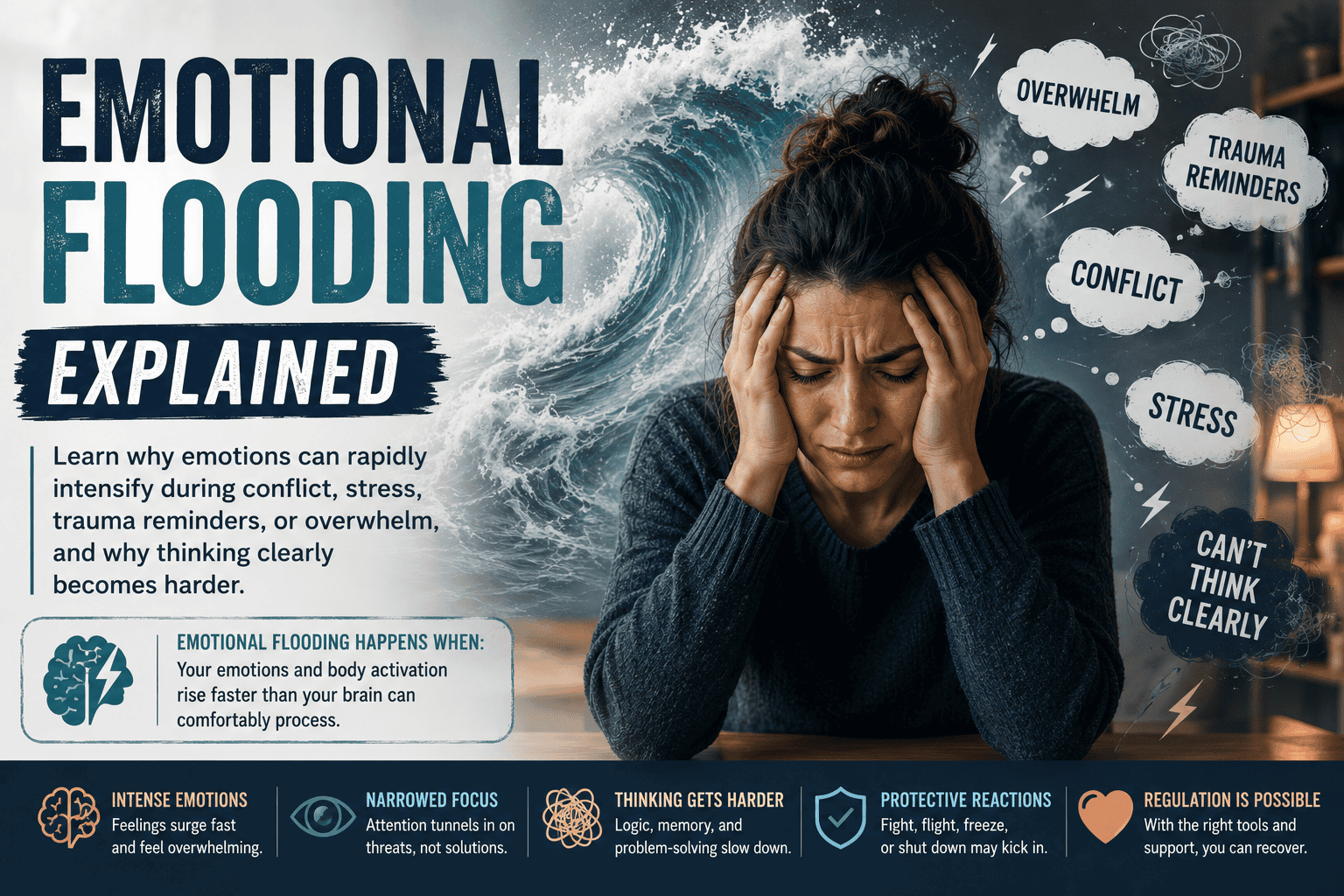
Emotional Flooding Explained

Emotional flooding can happen when feelings, physical activation, thoughts, and protective urges intensify so quickly that the brain has less access to perspective, language, memory, and flexible problem-solving. It may occur during conflict, accumulated stress, trauma reminders, uncertainty, or overwhelm.

Start Here

Emotional Flooding Is More Than Simply “Getting Too Emotional”

During emotional flooding, the nervous system may shift rapidly into protection. Heart rate can rise, muscles may tighten, attention can narrow, and the mind may become organized around threat, rejection, injustice, helplessness, or the urgent need to make the discomfort stop. The person may still be able to speak and act, but their access to reflection and flexibility may be temporarily reduced.

Flooding can look like anger, panic, crying, shutting down, leaving, arguing, overexplaining, pleading, going blank, or becoming unable to make a decision. The visible reaction is only one part of the experience. Internally, the person may feel as though several emotions and body signals have arrived at once.

What Is Emotional Flooding?

Emotional flooding is a common, non-diagnostic term for a state of intense emotional and physiological activation that temporarily reduces the ability to think clearly, communicate effectively, take in new information, or respond with flexibility. It can occur with anxiety, conflict, trauma reminders, grief, burnout, depression, relationship distress, sensory overload, sleep deprivation, or ongoing stress. It does not automatically indicate a specific mental health diagnosis.

The Flooding Sequence

Intensity Often Builds Through Several Fast-Moving Steps

Flooding may feel instantaneous, but several processes can occur in rapid succession. Understanding the sequence can help reduce shame and make earlier intervention more possible.

1. A Trigger Occurs

A comment, facial expression, delay, mistake, memory, demand, physical sensation, or unexpected change captures attention.

2. Meaning Is Assigned

The moment may be interpreted as criticism, rejection, danger, disrespect, abandonment, failure, helplessness, or loss of control.

3. The Body Activates

Heart rate, breathing, muscle tension, heat, shaking, nausea, pressure, or restless energy may increase.

4. Attention Narrows

The mind may focus on the most threatening interpretation while losing access to nuance, context, or reassuring information.

5. A Protective Urge Appears

The person may want to fight, escape, freeze, shut down, fix the problem immediately, seek reassurance, or prevent disconnection.

6. The Aftermath Begins

Exhaustion, guilt, embarrassment, rumination, confusion, numbness, or renewed conflict may follow once the activation decreases.

The goal is not to prove that the emotion was wrong. The goal is to understand why the system escalated, reduce harmful reactions, and strengthen the ability to notice and respond earlier.

Common Triggers

Flooding Can Be Triggered by the Moment—or by What the Moment Represents

The trigger may appear small from the outside while carrying significant emotional meaning for the person experiencing it.

Conflict or Criticism

A harsh tone, interruption, accusation, disagreement, or feeling misunderstood may quickly increase defensiveness or fear.

Accumulated Stress

The immediate event may land on top of financial pressure, caregiving, deadlines, grief, uncertainty, pain, or too little recovery.

Trauma Reminders

Tone, distance, silence, unpredictability, physical sensations, or power differences may resemble earlier danger or helplessness.

Physical Depletion

Sleep loss, hunger, illness, hormonal changes, pain, overstimulation, medication effects, or substance use can reduce emotional capacity.

Attachment Threats

Delayed responses, emotional distance, perceived rejection, or fear of abandonment may create intense urgency in close relationships.

Loss of Control

Unexpected changes, uncertain outcomes, too many decisions, or dependence on someone else may activate fear or helplessness.

Flooding During Conflict

Disagreement Can Begin to Feel Like an Emergency

During conflict, emotional flooding can make the conversation feel much more dangerous or urgent than it appears to the other person. The brain may prioritize defending, escaping, proving, fixing, or restoring connection over listening and considering multiple perspectives.

Once flooding increases, additional explanations may not help. More words can become more input to process, and attempts to force resolution may intensify the sense of being trapped, dismissed, or abandoned.

Possible conflict responses include:

  • Interrupting, raising the voice, or repeating the same point
  • Demanding immediate reassurance or resolution
  • Leaving abruptly or refusing to continue talking
  • Going blank, becoming silent, or losing access to words
  • Bringing in many past examples at once
  • Interpreting neutral statements as criticism or rejection

Important Distinction

Flooding Explains Reduced Capacity—It Does Not Excuse Harm

Emotional flooding can help explain why someone loses flexibility or reacts quickly. It does not make threats, intimidation, cruelty, coercion, destruction, or violence acceptable. Understanding the nervous system response should support accountability, safety, repair, and different choices.

  • Pause when the interaction is becoming unsafe or unproductive.
  • Use clear boundaries rather than punishment or humiliation.
  • Return to the issue when both people can participate more effectively.
  • Seek professional help when conflict repeatedly becomes harmful.

Accumulated Stress Load

The Final Trigger May Be Small, but the Total Load Is Not

Emotional capacity changes from day to day. A person who is rested, supported, and physically comfortable may be able to tolerate frustration that feels impossible after weeks of poor sleep, caregiving, financial pressure, conflict, pain, uncertainty, or constant responsibility.

When stress accumulates without enough recovery, the nervous system may begin reacting from a much higher baseline. The final inconvenience, comment, or request may be the point at which the remaining capacity is exceeded.

Stress load may be increased by:

  • Too many responsibilities with too little practical support
  • Repeated interruptions, decisions, or emotional demands
  • Financial, legal, medical, work, or caregiving uncertainty
  • Chronic pain, illness, hormonal changes, or poor sleep
  • Unresolved grief, trauma, betrayal, or relationship strain
  • Feeling unable to say no, ask for help, or make mistakes

A reaction can look disproportionate when compared only with the final trigger. It may become more understandable when the person’s total stress load and current physical capacity are included.

Trauma and Learned Protection

The Present Moment May Resemble an Earlier Experience

Trauma reminders are not always obvious memories or images. The nervous system may respond to tone, silence, facial expression, physical closeness, authority, unpredictability, feeling trapped, not being believed, or losing control. The present event may be safer, but the body can still react as though an earlier pattern is returning.

This can create intense fear, anger, shame, urgency, numbness, or confusion before the person consciously recognizes the connection.

Do Not Assume Trauma

Emotional Flooding Has Many Possible Contributors

Trauma can contribute, but flooding can also be related to anxiety, depression, grief, burnout, ADHD, sensory overload, relationship stress, sleep deprivation, medication effects, substance use, hormonal changes, pain, or medical conditions. A careful assessment is more useful than assigning a single explanation too quickly.

Body Signals

The Body Often Shows Flooding Before the Mind Can Explain It

Learning early physical signs can make it easier to pause before the activation reaches its highest point.

Heart and Chest

Racing heart, pounding heartbeat, chest pressure, flushing, or a sudden surge of internal urgency.

Breathing

Shallow breathing, breath-holding, frequent sighing, throat tightness, or difficulty taking a satisfying breath.

Muscle Tension

Tight jaw, raised shoulders, clenched hands, shaking, restless legs, headaches, or a strong urge to move.

Digestive Sensations

Nausea, stomach pressure, loss of appetite, urgency, reflux, or a sudden feeling of being physically unwell.

Sensory Intensity

Noise, light, touch, movement, clutter, or multiple voices may become unusually difficult to tolerate.

Freeze or Disconnection

Blurred awareness, numbness, tunnel vision, going blank, feeling unreal, or becoming unable to speak or act.

New, severe, persistent, or unexplained physical symptoms should not automatically be attributed to emotional flooding. Seek appropriate medical evaluation, especially for chest pain, fainting, severe breathing difficulty, neurological changes, or other urgent concerns.

Why Thinking Becomes Harder

Protection Can Temporarily Reduce Access to Perspective and Flexible Reasoning

During flooding, attention may become organized around the perceived threat. The mind searches for evidence, remembers related injuries, predicts consequences, and prepares a response. This can make it harder to absorb reassurance, remember what was just said, consider another interpretation, or generate several possible solutions.

Thinking changes may include:

  • All-or-nothing conclusions such as “This always happens” or “Nothing will change”
  • Difficulty remembering details or the original point of the conversation
  • Repeating the same thought because it feels unresolved or urgent
  • Assuming intent without enough information
  • Focusing on one threatening detail while missing the larger context
  • Feeling unable to choose among options or identify what is needed
  • Knowing later what you wanted to say but being unable to access it in the moment

Reduced clarity during flooding is usually temporary. It is often more effective to lower activation first and return to complex problem-solving later rather than forcing insight or resolution at the peak of the response.

Relationship Effects

Flooding Can Make Connection Feel Urgent, Unsafe, or Impossible

In close relationships, the nervous system may be especially sensitive to tone, distance, criticism, delayed responses, or signs of disconnection. One person may pursue conversation urgently while the other becomes flooded and withdraws. Each reaction can intensify the other.

Couples and family members may begin arguing about the reaction rather than the original issue. Over time, both people can become afraid of difficult conversations.

A More Helpful Response

Pause Without Abandoning the Conversation

  • Name that the conversation is becoming too activated.
  • Agree on a specific time to return rather than disappearing indefinitely.
  • Use the pause to regulate, not to build a stronger case.
  • Return to one issue at a time.
  • Describe needs and impact without humiliation or character attacks.
  • Seek couples or family support when the pattern is difficult to interrupt.

After the Flooding Passes

The Nervous System May Need Time to Recover

Once activation decreases, a person may feel physically tired, emotionally raw, embarrassed, confused, numb, or ashamed. They may replay the event, search for signs of damage, or become afraid that the same reaction will happen again.

Common aftereffects include:

  • Fatigue, headache, muscle soreness, or difficulty settling
  • Guilt about words, tone, withdrawal, or impulsive behavior
  • Rumination and mentally rewriting the conversation
  • Difficulty remembering the sequence clearly
  • Needing reassurance while also wanting distance
  • Emotional numbness or a temporary “crash” after intense activation

Repair is most effective when it includes both compassion and responsibility: acknowledge the nervous system response, address any harm, clarify what was needed, and identify a different plan for the next escalation.

When Flooding Is Happening

Reduce Urgency Before Trying to Solve the Whole Problem

The goal is not to suppress emotion or become perfectly calm. The immediate goal is to lower intensity enough to regain orientation, choice, and the ability to communicate safely.

Try a brief sequence:

  • Pause the action: Delay sending the message, making the decision, driving away impulsively, or continuing the argument when possible.
  • Name the state: “I am flooded,” “My body is in alarm,” or “I cannot think clearly yet.”
  • Orient to the present: Look around slowly and identify where you are, what day it is, and what is actually occurring now.
  • Use physical support: Feel both feet on the floor, lean against a chair, unclench the jaw, or hold an object with a clear texture.
  • Reduce input: Step away from noise, screens, multitasking, or repeated explanations when practical.
  • Lengthen the exhale gently: Let the out-breath become slightly slower without forcing large breaths.
  • Choose one next step: Ask for time, water, food, space, reassurance, information, a boundary, or professional support.

Grounding strategies are individual. Stop a technique that increases panic, dizziness, pain, dissociation, or frustration and try a different form of support.

Longer-Term Recovery

Greater Regulation Comes From Increasing Capacity and Flexibility

Lasting change usually involves more than learning a single calming technique. It may require reducing current stress, improving physical recovery, changing relationship patterns, and addressing unresolved experiences that continue signaling danger.

Notice Earlier Signals

Identify the first body changes, thoughts, meanings, and protective urges that appear before the response reaches its peak.

Restore Physical Capacity

Support sleep, nutrition, hydration, movement, medical care, sensory breaks, and realistic recovery time.

Reduce Preventable Load

Simplify decisions, adjust unsustainable demands, delegate when possible, and create limits around repeated stressors.

Improve Communication

Practice naming activation, asking for a pause, expressing needs directly, and returning to conversations after regulation.

Increase Actual Safety

Address coercion, abuse, instability, harassment, overwork, or other real conditions that cannot be regulated away through coping skills.

Process Root Experiences

When clinically appropriate, therapy may address trauma, grief, shame, attachment injuries, fear, or beliefs that intensify present-day reactions.

Progress may first look like noticing flooding sooner, pausing before acting, recovering more quickly, communicating one need clearly, or repairing conflict with less shame. The goal is flexibility, not never becoming activated.

Therapy Support

Counseling Can Help Identify What Drives the Flooding Pattern

A therapist can help assess triggers, meanings, physical activation, relationship patterns, current stressors, trauma history, anxiety, depression, grief, sensory overload, and other factors that may be contributing.

Treatment may include education about stress responses, grounding and regulation skills, cognitive and behavioral strategies, communication and boundary work, relationship repair, and trauma-focused treatment when clinically appropriate.

Medical and Psychiatric Support

Similar Symptoms Can Have More Than One Cause

A physician or other qualified healthcare professional may need to evaluate symptoms involving sleep, heart rate, breathing, faintness, pain, hormones, medication effects, stimulant use, substance use, neurological changes, or significant fatigue.

  • Seek urgent care for symptoms that may represent a medical emergency.
  • Discuss persistent physical or cognitive changes with a medical provider.
  • Consider psychiatric consultation when symptoms are severe or medication may be helpful.
  • Coordinate care when mental and physical health concerns overlap.

Counseling at Motivations Counseling

Trauma-Informed Counseling Can Support Emotional Regulation and Recovery

Motivations Counseling provides therapy for adults and teens experiencing emotional flooding, anxiety, chronic stress, trauma-related symptoms, irritability, shutdown, relationship conflict, sleep disruption, burnout, and difficulty thinking clearly when overwhelmed.

Our counseling team serves clients in Sugar Land, Katy, Richmond, Fort Bend County, West Houston, and through telehealth across Texas when clinically appropriate.

Counseling Support

Counseling in Sugar Land, Katy, and Online Across Texas

Therapy can help you understand what triggers flooding, recognize the earliest warning signs, strengthen regulation and communication skills, reduce repeated conflict, and address unresolved stress or trauma when appropriate.

  • Individual counseling for anxiety, stress, burnout, and emotional overwhelm
  • Trauma-informed therapy focused on safety, stabilization, and increased flexibility
  • EMDR therapy when clinically appropriate
  • Couples counseling for repeated escalation, withdrawal, and communication breakdown
  • In-person options in Sugar Land and Katy when available
  • Telehealth counseling across Texas when clinically appropriate
Call or Text: (281) 858-3001

Therapy Learning Center

Continue Learning About Emotional Overwhelm and Nervous System Responses

These related resources can help you understand why reactions intensify, how chronic activation affects daily life, and what may support regulation and recovery.

Frequently Asked Questions

Common Questions About Emotional Flooding

What is emotional flooding?

Emotional flooding is a state of intense emotional and physical activation that temporarily makes it harder to think clearly, communicate effectively, take in new information, or respond flexibly. It is a descriptive term rather than a formal diagnosis.

What does emotional flooding feel like?

It may feel like panic, anger, urgency, crying, shaking, chest pressure, racing thoughts, tunnel vision, numbness, going blank, wanting to escape, or needing to resolve the situation immediately. Different people may move toward fight, flight, freeze, shutdown, or reassurance-seeking.

Why can I not think clearly when I am emotionally flooded?

During flooding, attention becomes focused on perceived threat, rejection, helplessness, or urgency. The mind may have less access to perspective, working memory, language, and flexible problem-solving until the activation decreases.

Is emotional flooding the same as anger, anxiety, or a panic attack?

No. Flooding can include anger, anxiety, or panic-like symptoms, but it describes the broader state of being emotionally and physiologically overwhelmed. A panic attack has specific clinical features, and anger is only one possible emotional response.

Why does conflict trigger emotional flooding?

Conflict can activate fears of criticism, rejection, abandonment, disrespect, helplessness, or loss of control. Once the nervous system interprets the interaction as threatening, listening and problem-solving may become harder while defensive or avoidant urges become stronger.

Can trauma reminders cause emotional flooding?

Yes. A current tone, facial expression, silence, power difference, physical sensation, or feeling of being trapped may resemble an earlier dangerous or helpless experience. Trauma is one possible contributor, but flooding can also occur because of anxiety, stress, sleep loss, burnout, grief, sensory overload, or other factors.

How long does emotional flooding last?

The length varies. Some episodes decrease within minutes after the trigger ends and the person receives enough space or support. Others last longer when the stressor continues, the person keeps replaying the event, or the body is already depleted. Repeated or prolonged episodes may benefit from professional assessment.

How can I calm emotional flooding in the moment?

Pause the action, name the state, orient to the present environment, feel physical support beneath the body, reduce unnecessary input, lengthen the exhale gently, and identify one immediate need. The goal is not instant calm but enough reduction in urgency to regain choice.

Can therapy help with emotional flooding?

Therapy may help identify triggers and meanings, recognize early body signals, build regulation and communication skills, improve boundaries, reduce repeated conflict, address anxiety or depression, and process trauma or loss when clinically appropriate.

When should I seek immediate help?

Seek immediate help when there may be a life-threatening medical emergency, a person cannot remain safe, or there are thoughts of suicide or serious self-harm. In the United States, call 911 for an emergency, call or text 988 for the Suicide & Crisis Lifeline, or go to the nearest emergency room.

Susan Baker, M.Ed., NCC, LPC-S, Licensed Professional Counselor Supervisor in Texas

Article Author

Written by a Licensed Texas Mental Health Professional

This article was written for Motivations Counseling by Susan Baker, M.Ed., NCC, LPC-S, a Texas Licensed Professional Counselor Supervisor and clinical leader at Motivations Counseling.

Susan Baker, M.Ed., NCC, LPC-S
Texas Licensed Professional Counselor Supervisor
EMDR Therapist & EMDRIA Member
Texas LPC License #73957

Susan Baker is the Clinical Director of Motivations Counseling and provides trauma-informed counseling, EMDR therapy, anxiety treatment, depression counseling, couples counseling, immigration psychological evaluations, and mental health assessment services. Motivations Counseling serves clients from offices in Sugar Land and Katy, Texas, with telehealth services available statewide for Texas residents.

Take the Next Step

Counseling for Emotional Flooding in Sugar Land, Katy, and Online Across Texas

If emotions rapidly intensify during conflict, stress, trauma reminders, or overwhelm, counseling can help you understand the pattern, recognize it earlier, communicate more effectively, and build a greater ability to stay present and make choices.
×

Hypervigilance: When Your Brain Will Not Turn Off

Stress, Anxiety & Nervous System Resources

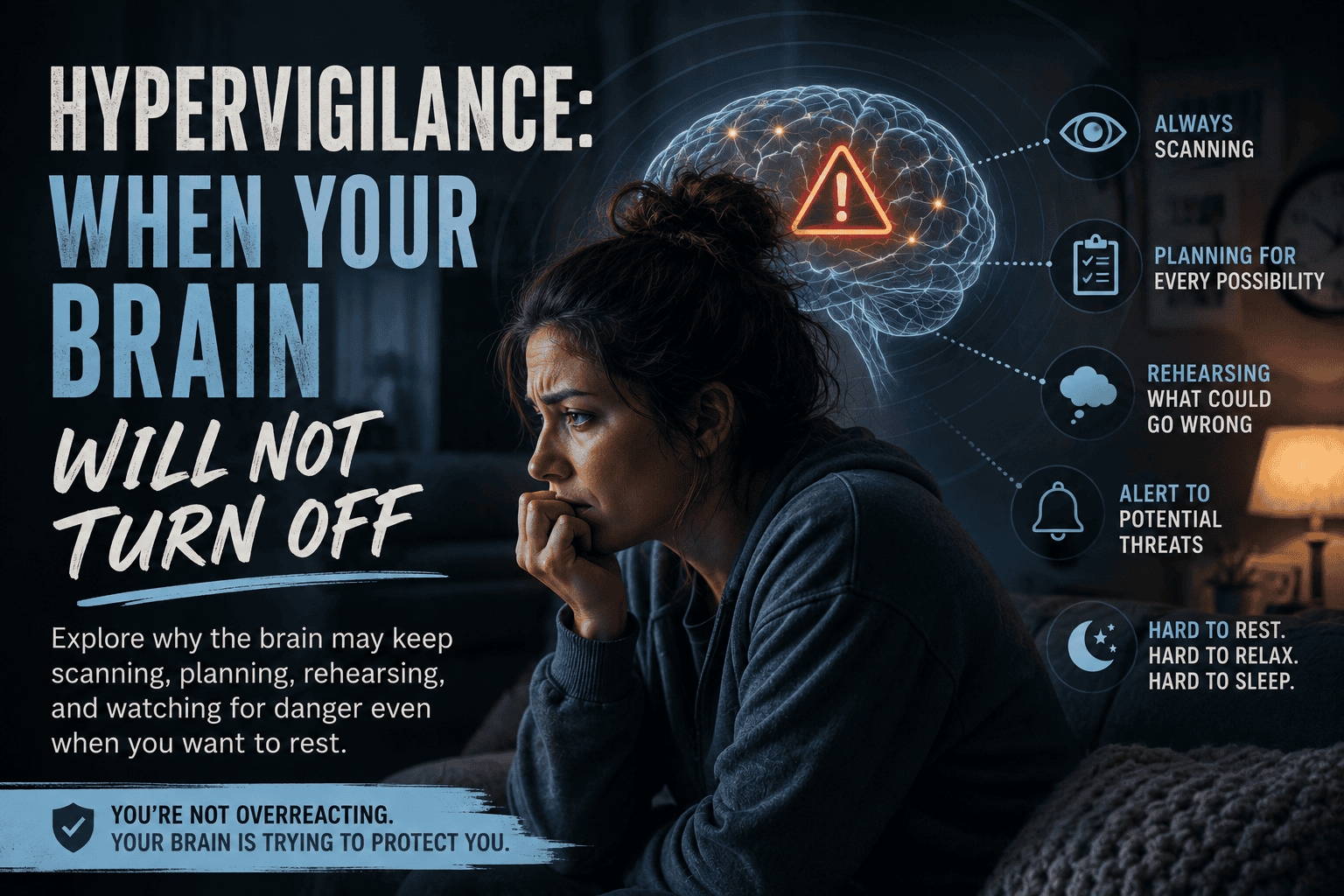
Hypervigilance: When Your Brain Will Not Turn Off

Hypervigilance can make the mind feel responsible for constantly scanning, planning, rehearsing, checking, and watching for danger—even when you are exhausted and want to rest.

Start Here

Your Brain May Be Trying to Prevent the Next Problem Before It Happens

Hypervigilance can feel like having an internal security system that rarely powers down. The mind may monitor facial expressions, tones of voice, messages, physical sensations, noises, schedules, possible mistakes, unfinished tasks, or changes in the environment. Even during quiet moments, part of the brain may remain focused on what could go wrong next.

This pattern is often exhausting because it requires continuous attention. Rest may feel unsafe, irresponsible, or impossible. The person may recognize that nothing urgent is happening and still feel unable to stop thinking, checking, preparing, or watching.

What Is Hypervigilance?

Hypervigilance is a state of heightened alertness in which attention remains strongly oriented toward possible danger, conflict, error, rejection, loss of control, or physical threat. It is a symptom or protective pattern rather than a diagnosis by itself. It may occur with trauma-related conditions, anxiety, chronic stress, sleep deprivation, burnout, ongoing danger, or other mental and physical health concerns.

A Protective Response

Hypervigilance Usually Develops for a Reason

The brain learns from experience. When anticipating problems has previously reduced harm, prevented conflict, protected someone else, or created a sense of control, constant alertness can begin to feel necessary.

Detect Danger Early

The mind may search for the earliest possible sign of anger, rejection, illness, conflict, failure, or another threat.

Stay Prepared

Planning every detail can create temporary relief by reducing uncertainty and the chance of being caught off guard.

Rehearse Responses

Replaying conversations may feel like a way to prevent mistakes, defend yourself, or prepare for criticism.

Manage Other People

Monitoring moods and needs may have helped reduce conflict or protect relationships in unpredictable environments.

Prevent Errors

Rechecking messages, work, doors, schedules, or decisions may feel necessary when mistakes have carried high consequences.

Maintain Control

Constant awareness may provide a sense of control when life has felt unsafe, unstable, or difficult to predict.

Hypervigilance is not a character flaw or evidence that someone is choosing to worry. It is an attempt to create safety through attention, preparation, certainty, or control. The pattern becomes difficult when it continues after the immediate danger has passed or when it begins interfering with sleep, relationships, concentration, and daily functioning.

Scanning for Danger

Attention May Keep Searching for Evidence That Something Is Wrong

Scanning can occur externally or internally. Externally, a person may watch facial expressions, tone, body language, exits, traffic, noises, messages, workplace changes, or signs of conflict. Internally, the person may monitor heart rate, breathing, pain, dizziness, memory, emotions, or other bodily sensations.

The more attention is directed toward possible danger, the more likely the brain is to notice ambiguous information and interpret it cautiously. A neutral pause, delayed response, ordinary body sensation, or unfamiliar sound may begin to feel significant.

Common Scanning Patterns

Hypervigilance Can Be Quiet and Nearly Constant

  • Monitoring another person’s face, tone, or response time
  • Checking doors, windows, surroundings, or exits
  • Watching the phone for messages or changes
  • Tracking physical sensations for signs of illness or panic
  • Noticing every sound while trying to sleep
  • Looking for mistakes before anyone else can find them
  • Feeling responsible for identifying problems before they grow

Not all alertness is excessive. Careful monitoring may be appropriate when there is current danger, abuse, stalking, unsafe work, serious medical risk, or another genuine threat. Support should include increasing actual safety rather than teaching someone to ignore valid warning signs.

Planning, Rehearsing and Mental Checking

Thinking Ahead Can Become an Attempt to Eliminate Uncertainty

Planning is useful when it leads to a decision or practical action. Hypervigilant planning feels different. The mind may continue generating possibilities after enough preparation has already occurred. Each answer creates another question, and certainty remains just out of reach.

Rehearsing conversations can serve a similar function. A person may imagine every possible response, refine wording repeatedly, replay what was said, or prepare defenses for criticism that has not happened. The process may feel productive while actually keeping the nervous system activated.

Hypervigilant thinking may include:

  • Planning several backup plans for ordinary situations
  • Rehearsing conversations repeatedly before they occur
  • Reviewing interactions afterward for signs of mistakes or rejection
  • Imagining worst-case outcomes to avoid being surprised
  • Checking calendars, messages, directions, or details many times
  • Feeling unable to relax until every possible issue has been considered
  • Believing that stopping the analysis could allow something bad to happen

The goal is not to stop planning altogether. It is to distinguish productive planning—which ends in a reasonable action—from repetitive mental preparation that increases anxiety without meaningfully improving safety or readiness.

Physical Signs

The Body May Remain Braced Even When the Mind Wants to Rest

Hypervigilance is not only a thought pattern. It can involve muscle tension, breathing changes, sensory sensitivity, fatigue, and a persistent feeling of being keyed up.

Cardiovascular Activation

A racing or pounding heart, flushing, trembling, chest tightness, or feeling suddenly alarmed.

Breathing Changes

Shallow breathing, frequent sighing, breath-holding, throat tightness, or difficulty taking a satisfying breath.

Muscle Tension

Tight shoulders, jaw clenching, headaches, back pain, pelvic tension, or difficulty physically settling.

Sensory Sensitivity

Increased sensitivity to sounds, light, touch, crowds, movement, or multiple conversations at once.

Tired but Wired

Feeling depleted while the mind and body remain too activated to rest or sleep comfortably.

Internal Monitoring

Repeatedly checking bodily sensations and wondering whether they signal panic, illness, or loss of control.

New, severe, persistent, or unexplained physical symptoms should not automatically be attributed to anxiety or hypervigilance. Chest pain, fainting, severe shortness of breath, sudden neurological changes, or other urgent symptoms require appropriate medical evaluation.

Sleep and Nighttime Alertness

Quiet Can Give the Brain More Room to Scan

During the day, responsibilities and distractions can temporarily contain hypervigilant thinking. At night, reduced activity may make worries, memories, sounds, and body sensations more noticeable. The brain may interpret bedtime as the first opportunity to review everything that was missed.

A person may be physically exhausted but mentally active, listening for sounds, checking the phone, replaying conversations, planning the next day, or waking suddenly with a sense that something is wrong.

Possible Sleep Effects

The Brain May Resist Fully Powering Down

  • Difficulty falling asleep because the mind keeps reviewing
  • Waking repeatedly in response to ordinary sounds
  • Checking doors, phones, children, pets, or the environment
  • Stress dreams, nightmares, or waking in a panic
  • Early-morning waking with immediate planning or worry
  • Using television, scrolling, or constant sound to avoid quiet
  • Feeling unrefreshed even after spending enough time in bed

Sleep difficulties can intensify hypervigilance the next day by reducing concentration, emotional flexibility, and tolerance for uncertainty. Persistent insomnia may also require medical or behavioral sleep assessment because stress is only one possible contributor.

Focus, Memory and Decision-Making

Attention Used for Threat Detection Is Less Available for Everyday Tasks

Hypervigilance can create the confusing experience of noticing everything and concentrating on nothing. The brain may detect small changes in the environment while struggling to read, organize work, follow a conversation, remember details, or complete multistep tasks.

Decision-making may also become exhausting because every option is evaluated for possible risk. A simple choice can expand into a long analysis involving potential mistakes, reactions, future consequences, and backup plans.

Focus-related changes may include:

  • Losing track of a task when a message or sound occurs
  • Reading the same information repeatedly without absorbing it
  • Remembering threatening details more easily than neutral ones
  • Blanking out when questioned, criticized, or placed under pressure
  • Difficulty prioritizing because several possibilities feel urgent
  • Checking completed work because the mind does not trust that it is finished
  • Feeling mentally exhausted after ordinary planning or social interaction

Concentration problems are not specific to hypervigilance. Sleep disorders, depression, ADHD, medication effects, substance use, hormonal changes, neurological conditions, and other medical concerns may produce similar symptoms. Persistent or worsening cognitive changes deserve appropriate evaluation.

Relationships and Communication

Monitoring Other People Can Make Connection Feel Like Work

Hypervigilance often extends into relationships. A person may track changes in tone, response time, facial expression, affection, distance, or routine. This monitoring may be an attempt to prevent rejection, conflict, anger, abandonment, or another painful surprise.

Because the brain is searching for meaningful changes, neutral behavior can be interpreted cautiously. A tired tone may sound critical. A delayed message may feel rejecting. A request for space may feel like evidence that the relationship is in danger.

Relationship Patterns

Protection Can Affect Both Closeness and Boundaries

  • Seeking reassurance but having difficulty believing it
  • Replaying conversations for signs of rejection or criticism
  • Becoming defensive before fully understanding the concern
  • People-pleasing to prevent conflict or disappointment
  • Trying to resolve disagreements immediately because waiting feels unsafe
  • Withdrawing when interaction creates too much stimulation
  • Feeling responsible for everyone’s mood and comfort

Understanding hypervigilance does not excuse controlling, intrusive, or hurtful behavior. It can help a person take responsibility more effectively by recognizing the protective urge, slowing the response, communicating needs directly, and learning relationship strategies that do not require constant monitoring.

Possible Contributors

Hypervigilance Can Have More Than One Cause

A careful assessment considers past experiences, current stress, health, sleep, substances, medication, and whether the person is facing actual ongoing danger.

Trauma and Chronic Unpredictability

Abuse, neglect, violence, betrayal, loss, medical trauma, or repeated unpredictability may train the brain to watch closely for early warning signs.

Anxiety and Panic

Anxiety may increase monitoring of thoughts, sensations, mistakes, uncertainty, social reactions, or possible future problems.

Ongoing Stress or Danger

Financial strain, caregiving, legal concerns, illness, discrimination, unsafe relationships, or unstable conditions may keep alertness active.

Sleep Deprivation and Burnout

Limited sleep and prolonged overwork can lower the threshold for alarm, irritability, sensory sensitivity, and repetitive thinking.

Stimulants, Medication or Substances

Caffeine, stimulant medications, withdrawal, recreational substances, and some medication effects may increase restlessness or alertness.

Medical or Hormonal Factors

Thyroid concerns, pain, hormonal changes, breathing problems, neurological conditions, and other health issues may contribute to similar symptoms.

Hypervigilance can occur with post-traumatic stress disorder, but it should not automatically be treated as proof of PTSD. Diagnosis requires a broader clinical assessment of symptoms, duration, exposure history, distress, and functional impairment.

Why the Pattern May Continue

Short-Term Relief Can Teach the Brain to Keep Checking

Hypervigilant behaviors often continue because they provide a brief sense of relief or control. The relief reinforces the belief that checking, planning, or monitoring prevented danger—even when the feared event was unlikely to occur.

Reassurance Cycles

Asking repeatedly may reduce anxiety briefly, but uncertainty quickly returns and creates the need for more reassurance.

Checking Cycles

Rechecking can make the brain less confident in memory and more dependent on another check before feeling safe.

Avoidance

Avoiding uncertainty or reminders may bring short-term relief while preventing new learning about what can be tolerated safely.

Overfunctioning

Staying useful, prepared, or indispensable can protect against vulnerability while making genuine rest feel irresponsible.

Threat Confirmation

Attention naturally finds evidence that matches what it is searching for, making danger appear more common or certain.

Depleted Capacity

Poor sleep, pain, stress, and limited support can make it harder to tolerate uncertainty and disengage from monitoring.

When Your Brain Will Not Turn Off

Aim for Less Urgency, Not Perfect Calm

Trying to command the brain to stop thinking can create another struggle. A more realistic goal is to reduce the sense that every thought requires immediate action. The nervous system may need orientation, physical support, limited planning, and permission to leave some uncertainty unresolved.

Try a brief sequence:

  • Name the pattern: “My brain is scanning because it is trying to protect me.”
  • Check current reality: Identify what is actually happening now rather than every possible future outcome.
  • Orient outward: Look slowly around the room and notice neutral or safe details.
  • Support the body: Feel both feet, lean against a chair, unclench the jaw, or lower the shoulders.
  • Choose one action: Decide whether one practical step is needed now or whether the issue can be scheduled for later.
  • Limit the review: Write the concern down once instead of continuing to mentally rehearse it.
  • Reduce input: Step away from news, messages, screens, noise, or repeated checking when practical.

Breathing exercises are not comfortable for everyone. If focusing on breathing increases panic, dizziness, or internal monitoring, use another grounding method such as movement, temperature, visual orientation, pressure, texture, or contact with a supportive person.

Longer-Term Recovery

The Brain Needs Repeated Evidence That It Does Not Have to Monitor Everything

Recovery is usually gradual. The goal is not to eliminate awareness or never feel alert. It is to increase flexibility so the brain can respond when danger is present and disengage when monitoring is no longer useful.

Notice Early Signals

Track situations, body cues, thoughts, and urges that appear before scanning or rehearsing becomes intense.

Increase Actual Safety

Address ongoing danger, coercion, instability, overwork, or unmet practical needs that cannot be regulated away.

Restore Capacity

Support sleep, nutrition, medical care, movement, sensory breaks, recovery time, and realistic limits on demands.

Practice Uncertainty

Gradually leave manageable questions unanswered, reduce unnecessary checking, and observe what happens without immediate action.

Strengthen Direct Communication

Ask for clarification, reassurance, space, or support directly rather than relying only on monitoring and interpretation.

Process Root Experiences

When clinically appropriate, therapy can address trauma, loss, betrayal, fear, shame, or relationship injuries that continue signaling danger.

Progress may first look like noticing the pattern sooner, checking one fewer time, sleeping slightly longer, recovering more quickly after a trigger, tolerating a delayed response, or allowing a manageable uncertainty to remain unresolved. Small changes teach the brain that constant monitoring is not always necessary.

Mental Health Support

Counseling Can Help Identify What the Alertness Is Protecting Against

A therapist can help assess when hypervigilance occurs, which situations or sensations activate it, what the person fears may happen, and how the pattern affects sleep, relationships, work, concentration, and quality of life.

Treatment may include education about stress responses, grounding, cognitive and behavioral strategies, gradual reduction of checking or avoidance, emotional regulation, boundary work, relationship repair, and trauma-focused treatment when appropriate.

Medical and Psychiatric Support

Similar Symptoms Can Require Different Kinds of Care

A physician or other qualified healthcare professional may need to evaluate severe insomnia, heart-rate changes, breathing concerns, pain, thyroid symptoms, medication effects, stimulant use, substance use, hormonal changes, neurological symptoms, or significant fatigue.

  • Seek urgent care for symptoms that may represent a medical emergency.
  • Discuss persistent sleep or physical symptoms with a medical provider.
  • Review caffeine, substances, and medication effects with an appropriate professional.
  • Consider psychiatric consultation when symptoms are severe or medication may be helpful.

Counseling at Motivations Counseling

Trauma-Informed Counseling Can Help Reduce Constant Alertness

Motivations Counseling provides therapy for adults experiencing hypervigilance, chronic stress, anxiety, trauma-related symptoms, repetitive mental rehearsal, sleep disruption, emotional overwhelm, irritability, shutdown, relationship strain, and difficulty relaxing or feeling present.

Our counseling team serves clients in Sugar Land, Katy, Richmond, Fort Bend County, West Houston, and through telehealth across Texas when clinically appropriate.

Counseling Support

Counseling in Sugar Land, Katy, and Online Across Texas

Therapy can help you understand why your brain remains on alert, identify what keeps the pattern active, strengthen practical regulation skills, improve sleep and communication, and gradually increase your ability to rest without feeling unprepared.

  • Individual counseling for anxiety, chronic stress, burnout, and emotional overwhelm
  • Trauma-informed therapy focused on safety, stabilization, and flexibility
  • EMDR therapy when clinically appropriate
  • Support for checking, scanning, rehearsing, irritability, and relationship strain
  • In-person options in Sugar Land and Katy when available
  • Telehealth counseling across Texas when clinically appropriate
Call or Text: (281) 858-3001

Therapy Learning Center

Continue Learning About Hypervigilance, Stress, and Emotional Overwhelm

These related resources can help you understand survival mode, emotional flooding, accumulated stress, numbness, and trauma-informed counseling.

Frequently Asked Questions

Common Questions About Hypervigilance

What does hypervigilance feel like?

Hypervigilance may feel like constant alertness, scanning the environment, monitoring other people, checking physical sensations, planning for possible problems, or being unable to relax even when nothing urgent is happening. Some people feel visibly anxious, while others appear calm but remain internally watchful.

Why does my brain keep scanning for danger?

The brain may have learned that noticing danger early helps prevent harm, criticism, conflict, rejection, or loss of control. Scanning can continue when there is ongoing stress or after earlier experiences have taught the nervous system that situations can change quickly or unpredictably.

Is hypervigilance the same as anxiety?

Not exactly. Hypervigilance can occur with anxiety, but it may also be related to trauma, chronic stress, ongoing danger, sleep deprivation, burnout, medication effects, stimulant use, or medical conditions. It is a symptom or protective pattern rather than a diagnosis by itself.

Does hypervigilance mean I have PTSD?

No. Hypervigilance is one possible PTSD symptom, but PTSD diagnosis requires a broader pattern involving trauma exposure, additional symptoms, duration, distress, and functional impairment. Hypervigilance can occur for many reasons without PTSD.

Why is hypervigilance worse at night?

Nighttime reduces distractions and may make worries, memories, sounds, and body sensations more noticeable. The brain may use the quiet to review the day, plan for tomorrow, or listen for danger. Sleep loss can then intensify alertness the following day.

Can hypervigilance cause exhaustion and brain fog?

Yes. Constant monitoring uses attention and energy. It can interfere with sleep, concentration, memory, decision-making, and emotional regulation. Fatigue and cognitive changes can also have medical or other psychological causes, so persistent symptoms should be appropriately evaluated.

How can I calm hypervigilance in the moment?

Name the protective pattern, identify what is actually happening now, orient to neutral details in the environment, feel physical support beneath the body, reduce unnecessary input, and choose one practical next step. The goal is not instant calm but enough reduction in urgency to regain choice.

How do I stop replaying and rehearsing conversations?

It may help to decide whether the review is leading to one useful action. Write down the concern, identify any necessary follow-up, and practice postponing further analysis. Therapy can help when rehearsal is persistent, connected to trauma or anxiety, or interfering with sleep and relationships.

Can therapy help with hypervigilance?

Therapy may help identify triggers and protective meanings, build regulation skills, reduce checking and avoidance, improve communication and boundaries, address anxiety or sleep disruption, and process trauma or loss when clinically appropriate. Treatment should be individualized to the person’s needs and current safety.

When should I seek immediate help?

Seek immediate help when there may be a life-threatening medical emergency, a person cannot remain safe, or there are thoughts of suicide or serious self-harm. In the United States, call 911 for an emergency, call or text 988 for the Suicide & Crisis Lifeline, or go to the nearest emergency room.

Susan Baker, M.Ed., NCC, LPC-S, Licensed Professional Counselor Supervisor in Texas

Article Author

Written by a Licensed Texas Mental Health Professional

This article was written for Motivations Counseling by Susan Baker, M.Ed., NCC, LPC-S, a Texas Licensed Professional Counselor Supervisor and clinical leader at Motivations Counseling.

Susan Baker, M.Ed., NCC, LPC-S
Texas Licensed Professional Counselor Supervisor
EMDR Therapist & EMDRIA Member
Texas LPC License #73957

Susan Baker is the Clinical Director of Motivations Counseling and provides trauma-informed counseling, EMDR therapy, anxiety treatment, depression counseling, couples counseling, immigration psychological evaluations, and mental health assessment services. Motivations Counseling serves clients from offices in Sugar Land and Katy, Texas, with telehealth services available statewide for Texas residents.

Take the Next Step

Counseling for Hypervigilance in Sugar Land, Katy, and Online Across Texas

If your brain remains on alert through scanning, planning, rehearsing, checking, or watching for danger, counseling can help you understand the protective pattern and gradually build a greater ability to rest, focus, connect, and feel present.

×

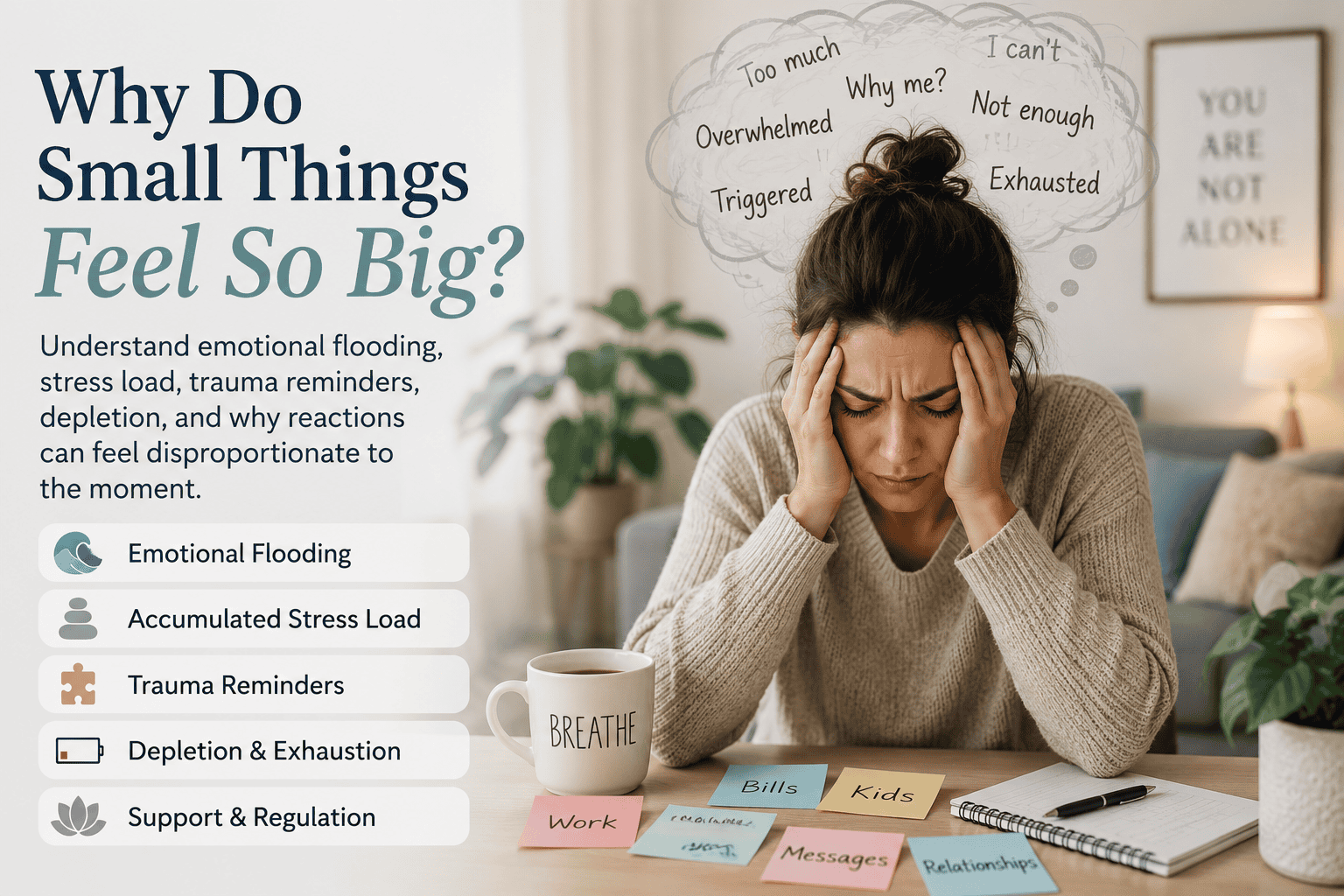
Why Do Small Things Feel So Big?

Emotional Overwhelm & Nervous System Resources

Why Do Small Things Feel So Big?

A reaction can feel much larger than the immediate moment when emotional flooding, accumulated stress, trauma reminders, exhaustion, or other forms of depletion have already reduced the amount of pressure your system can manage.

Start Here

The Final Trigger May Be Small, but the Total Load May Not Be

A spilled drink, a delayed reply, a change in plans, a critical tone, a noisy room, or one more request may appear minor from the outside. Yet the reaction can feel immediate and intense: tears, anger, panic, defensiveness, shutting down, leaving the room, or feeling unable to think clearly.

This does not necessarily mean that you are reacting only to the final event. The moment may be landing on top of hours, days, or years of pressure. The nervous system responds not only to what is happening now, but also to current capacity, expectations, physical state, prior learning, relationship history, and whether the situation resembles something that once felt dangerous, humiliating, unpredictable, or impossible to control.

Why Can a Small Thing Feel So Big?

A reaction may feel disproportionate when the immediate trigger is viewed by itself. It may feel more understandable when the full context is included: accumulated stress, low sleep, pain, anxiety, grief, unresolved conflict, sensory overload, trauma reminders, perfectionism, caregiving demands, hunger, illness, hormonal changes, or the effort required to keep functioning while overwhelmed.

Emotional Flooding

The System Can Become Too Activated to Process the Moment Flexibly

Emotional flooding describes a state in which physiological and emotional activation rises faster than the person can comfortably organize, communicate, or regulate it. The body may prepare to fight, escape, freeze, appease, or shut down before the thinking mind has fully understood what happened.

Rapid Body Activation

Heart rate, breathing, muscle tension, heat, trembling, nausea, or pressure in the chest may increase quickly.

Narrowed Attention

The mind may focus on the most threatening interpretation while losing access to context, nuance, or alternative explanations.

Communication Difficulty

Words may come out sharply, disappear completely, or feel impossible to organize while activation is high.

Urgent Action

There may be a strong urge to fix the issue immediately, defend yourself, leave, send a message, or end the conversation.

Freeze or Shutdown

Some people go blank, numb, tired, detached, unable to decide, or unable to respond even when they want to.

Repetitive Thinking

The mind may replay the event, search for certainty, rehearse arguments, or repeatedly check what happened.

Flooding is not evidence that the feeling is fake or intentionally exaggerated. It means the system is having difficulty staying within a range where emotion, reasoning, language, and choice remain available at the same time.

Accumulated Stress

The “Last Straw” Is Usually Not the Whole Story

Stress accumulates when demands continue faster than the body and mind can recover. Each individual pressure may be manageable, yet the combined load can gradually reduce patience, concentration, emotional flexibility, and the ability to tolerate additional uncertainty.

The final trigger may release a reaction that has been building through work pressure, family needs, financial concerns, caregiving, unresolved conflict, health worries, poor sleep, grief, or the effort required to appear capable when you do not feel okay internally.

Stress-Load Example

One More Request Can Feel Impossible

  • You slept poorly and started the day already depleted.
  • Several work problems required constant attention.
  • You skipped a meal and have been managing a headache.
  • A family member needed reassurance or practical help.
  • You received a message that created uncertainty.
  • Then someone asks a simple question, and you suddenly cry or snap.

The question did not necessarily create the full reaction. It may have exceeded the remaining capacity after many earlier demands had already used most of it.

Trauma Reminders and Learned Threat

The Present Moment May Resemble an Earlier Experience

Trauma reminders are cues that resemble an earlier experience of danger, helplessness, rejection, humiliation, betrayal, loss, or lack of control. The reminder may be obvious, such as a location or anniversary, or subtle, such as a facial expression, tone of voice, silence, smell, body sensation, closed door, abrupt change, or feeling ignored.

The nervous system may respond to the similarity before the person consciously recognizes the connection. A present-day disagreement can therefore feel as though it carries the emotional weight of earlier situations in which disagreement led to punishment, abandonment, intimidation, or emotional withdrawal.

Possible trauma-reminder patterns include:

  • A neutral tone feels critical because it resembles past criticism.
  • A delayed response feels like abandonment because silence once signaled rejection or danger.
  • A change in plans feels intolerable because unpredictability was once associated with chaos.
  • Being misunderstood feels unbearable because your reality was repeatedly dismissed.
  • A minor mistake triggers panic because mistakes once led to shame, punishment, or loss of safety.
  • Someone standing too close, raising their voice, or blocking an exit creates immediate physical alarm.

A strong reaction does not prove that trauma is the cause. Similar reactions can also occur with anxiety, depression, burnout, sensory sensitivity, relationship strain, sleep deprivation, ADHD, autism, medical conditions, medication effects, or other factors. A qualified professional can help assess the broader pattern without assuming a diagnosis.

Physical and Emotional Depletion

Capacity Changes From Day to Day

The same event may feel manageable one day and overwhelming another because regulation depends partly on available physical, cognitive, emotional, and social resources.

Sleep Loss

Poor or interrupted sleep can reduce concentration, frustration tolerance, impulse control, and emotional recovery.

Burnout and Overwork

Long periods of responsibility without meaningful recovery can make even ordinary demands feel excessive.

Pain or Illness

Pain, inflammation, illness, medication effects, hormonal changes, and physical discomfort can reduce available coping capacity.

Hunger and Blood-Sugar Changes

Skipped meals or inadequate nutrition may contribute to shakiness, irritability, weakness, anxiety-like sensations, or difficulty thinking clearly.

Sensory Overload

Noise, light, touch, clutter, crowds, heat, interruptions, or competing conversations can consume additional processing capacity.

Lack of Support

Carrying responsibilities alone, feeling unseen, or believing that no one can help may make every additional task feel heavier.

Emotional regulation is not separate from the body. Rest, nourishment, medical care, medication review, pain treatment, movement, and reduced sensory input may be important parts of understanding why reactions intensify.

The Meaning Attached to the Moment

We React to What an Event Seems to Mean—not Only to the Event Itself

Two people can experience the same event and respond differently because the event carries different meanings. A forgotten task may mean “a normal mistake” to one person and “I am failing everyone” to another. A delayed text may mean “they are busy” or “I am being rejected.”

Meanings are shaped by beliefs, expectations, relationship patterns, earlier experiences, culture, current mood, and what the person fears may happen next.

Common High-Impact Meanings

The Trigger May Touch a Larger Fear

  • “I am not safe.”
  • “I am going to be abandoned.”
  • “I have disappointed everyone.”
  • “I am losing control.”
  • “No one listens unless I become visibly upset.”
  • “I am responsible for keeping everyone okay.”
  • “One mistake will prove that I am incompetent.”

Understanding the meaning does not require agreeing that the feared outcome is certain. It helps explain why the nervous system responded as though the moment carried more danger, loss, or consequence than an outside observer might see.

What Happens During an Intense Reaction

The Body and Mind May Shift Into Protection at the Same Time

Emotional reactions are whole-body experiences. Physical activation, attention, memory, interpretation, and behavior can influence one another in a rapid feedback loop.

Breathing Changes

Breath-holding, shallow breathing, rapid breathing, frequent sighing, or throat tightness may increase alarm sensations.

Threat Scanning

Attention may search for evidence that something is wrong and overlook information that suggests safety or misunderstanding.

Memory Activation

Earlier experiences with a similar emotional theme may become more accessible than calm or reassuring memories.

Reduced Flexibility

It can become harder to hold two perspectives, tolerate uncertainty, delay action, or consider that the event may have several explanations.

Emotional Release

Crying, anger, panic, or numbness may reflect both the immediate event and emotion that has been contained until that moment.

Protective Behavior

Arguing, apologizing, withdrawing, overexplaining, fixing, checking, controlling, or leaving may be attempts to restore safety.

Relationships and Misunderstanding

Other People May See the Trigger but Miss the Buildup

Relationship conflict often intensifies when one person sees a “small issue” and the other experiences a much larger emotional impact. The overwhelmed person may feel dismissed, while the other person may feel confused, blamed, or afraid that any minor mistake will create a crisis.

Both experiences can be real. The reaction deserves understanding, and behavior during the reaction still matters. Emotional flooding can explain yelling, withdrawal, repeated reassurance-seeking, or defensiveness without making harmful behavior acceptable.

Communication may improve when people can say:

  • “This is landing on top of a lot, and I need a pause before we continue.”
  • “I know the immediate issue is small, but it is touching a bigger fear for me.”
  • “I want to discuss this, but I cannot do it productively while I am flooded.”
  • “I need reassurance, information, space, or practical help—not an argument about whether I should feel this way.”
  • “My reaction was intense, and I am responsible for repairing how I spoke to you.”
  • “Let us return to the actual problem after both of us have had time to settle.”

Validation means recognizing that the reaction has an understandable context. It does not require agreeing with every interpretation, accepting mistreatment, or abandoning appropriate boundaries.

When a Small Thing Feels Huge

Reduce Intensity Before Trying to Solve Everything

During flooding, the immediate goal is not to prove that the situation is small or force yourself to stop feeling. The first goal is to restore enough orientation and capacity to choose what happens next.

  • Pause: Delay messages, decisions, or continued arguing when possible.
  • Orient: Look around and identify where you are and what is happening now.
  • Support the body: Feel your feet, lean against a chair, release the jaw, or hold a textured object.
  • Reduce input: Step away from noise, screens, crowds, or multiple conversations.
  • Use a gentler exhale: Let the out-breath become slightly longer without forcing a deep breath.
  • Name the need: Ask whether you need space, information, food, water, reassurance, rest, movement, or a boundary.

What Often Makes Flooding Worse

Pressure and Shame Can Add a Second Layer of Distress

  • Arguing with yourself that you “should not” feel this way
  • Demanding an immediate explanation while the mind is overloaded
  • Sending repeated messages to obtain certainty
  • Continuing a conflict after speech and reasoning have become difficult
  • Using alcohol or substances to force the feeling away
  • Treating one intense reaction as proof that you are broken or immature

Grounding strategies are individual. Stop or modify any technique that increases panic, dizziness, pain, dissociation, or frustration. Some people respond better to movement, temperature, sensory reduction, or connection than to breath-focused exercises.

After the Intensity Decreases

Curiosity Is More Useful Than Shame

After an intense reaction, many people become embarrassed and focus only on stopping it from happening again. A more useful review considers what the system was responding to, what capacity was available, and what support was missing.

Questions that may help:

  • What had already happened earlier that day or week?
  • How had I slept, eaten, rested, and cared for physical needs?
  • What did the event seem to mean about me, the relationship, or what might happen next?
  • Did anything about the moment resemble an earlier experience?
  • What body signals appeared before I became fully flooded?
  • What did I need but have difficulty asking for?
  • Did my behavior affect someone else in a way that requires repair?
  • What could reduce the likelihood or intensity of the same pattern next time?

Responsibility and self-compassion can exist together. You can acknowledge that a reaction had understandable causes while also apologizing, repairing harm, changing behavior, or seeking additional support.

Long-Term Capacity Building

The Goal Is Greater Flexibility, Not Never Reacting Strongly

Long-term improvement often involves reducing the total load, increasing recovery, understanding triggers, strengthening relationships, and developing more choices between the first wave of activation and the eventual response.

Notice Earlier Signals

Learn the first signs of tension, urgency, sensory overload, racing thoughts, withdrawal, or reduced patience.

Plan Recovery Time

Treat rest, meals, sleep, medical care, movement, and sensory breaks as part of regulation rather than as rewards.

Address Actual Stressors

Coping skills cannot replace safety, boundaries, financial support, workload changes, or help with unsustainable responsibilities.

Practice Direct Communication

Ask for reassurance, clarification, space, practical help, or time before the need becomes a crisis.

Challenge High-Stakes Meanings

Examine beliefs that every mistake, delay, disagreement, or disappointment signals failure, rejection, or danger.

Process Root Experiences

When appropriate, therapy can address trauma, grief, shame, relationship injuries, or chronic stress that continues shaping present reactions.

Progress may look like noticing the buildup sooner, recovering faster, using fewer hurtful words, asking for a pause, tolerating uncertainty for longer, or returning to a conversation with more clarity.

Mental Health Support

Counseling Can Help Identify What the Reaction Is Protecting Against

A therapist can help assess triggers, emotional flooding, stress load, trauma reminders, relationship dynamics, avoidance, perfectionism, anxiety, depression, grief, burnout, and the physical or environmental factors that reduce capacity.

Treatment may include grounding and regulation skills, cognitive and behavioral strategies, communication and boundary work, self-compassion, relationship repair, and trauma-focused therapy or EMDR when clinically appropriate.

Medical and Psychiatric Considerations

Intense Reactions Can Have More Than One Contributor

A medical or psychiatric evaluation may be appropriate when emotional changes are sudden, severe, worsening, or accompanied by significant sleep disruption, pain, hormonal symptoms, medication changes, substance use, neurological changes, fainting, chest pain, severe shortness of breath, or other physical concerns.

  • Do not assume every physical symptom is caused by stress.
  • Discuss new or persistent symptoms with an appropriate healthcare provider.
  • Seek urgent medical care for possible emergencies.
  • Coordinate mental and physical healthcare when concerns overlap.

Counseling at Motivations Counseling

Therapy Can Help Make Intense Reactions More Understandable and Manageable

Motivations Counseling provides therapy for adults experiencing emotional flooding, chronic stress, anxiety, trauma-related symptoms, irritability, shutdown, people-pleasing, perfectionism, relationship strain, burnout, sleep disruption, and difficulty recovering after emotionally intense moments.

Our counseling team serves clients in Sugar Land, Katy, Richmond, Fort Bend County, West Houston, and through telehealth across Texas when clinically appropriate.

Counseling Support

Counseling in Sugar Land, Katy, and Online Across Texas

Therapy can help you understand why certain moments feel so intense, recognize the buildup earlier, communicate needs more clearly, reduce avoidable stress, and develop more flexible responses without dismissing the experiences that shaped the pattern.

  • Individual counseling for emotional overwhelm, anxiety, chronic stress, and burnout
  • Trauma-informed therapy focused on safety, stabilization, and increased flexibility
  • EMDR therapy when clinically appropriate
  • Support for perfectionism, people-pleasing, shutdown, irritability, and relationship strain
  • In-person options in Sugar Land and Katy when available
  • Telehealth counseling across Texas when clinically appropriate
Call or Text: (281) 858-3001

Therapy Learning Center

Continue Learning About Emotional Overwhelm, Stress, and Nervous System Responses

These related resources explore emotional overload, chronic activation, numbness, depression, trauma-informed counseling, and practical support options.

Frequently Asked Questions

Common Questions About Why Small Things Feel So Big

Why do I overreact to small things?

What looks like an overreaction may reflect more than the immediate event. Accumulated stress, low sleep, anxiety, grief, trauma reminders, sensory overload, pain, hunger, burnout, relationship history, or beliefs about what the event means can increase the intensity of the response. Understanding the context does not remove responsibility for behavior, but it can make the pattern easier to address.

What is emotional flooding?

Emotional flooding is a state of intense physiological and emotional activation in which it becomes difficult to think flexibly, communicate clearly, tolerate uncertainty, or choose a measured response. A person may become angry, tearful, panicked, defensive, frozen, numb, or unable to speak.

Why does one small problem make me cry?

The problem may be the final pressure placed on an already overloaded system. Tears can release emotion connected to exhaustion, frustration, grief, anxiety, feeling unsupported, or the effort of holding everything together. The immediate event may be small while the total emotional load is not.

Can trauma make minor situations feel dangerous?

Yes. A present situation may contain cues that resemble earlier danger, rejection, humiliation, helplessness, or loss of control. The nervous system can respond rapidly to the similarity even when the current situation is safer. Trauma is one possible contributor and should not be assumed without appropriate assessment.

Why am I more reactive when I am tired?

Sleep loss reduces attention, emotional regulation, frustration tolerance, and the ability to recover from stress. When capacity is lower, noise, uncertainty, mistakes, interruptions, or conflict may feel more difficult to manage. Persistent fatigue or sleep disruption may also require medical evaluation.

Can hunger or physical illness affect emotional reactions?

Yes. Hunger, pain, illness, hormonal changes, medication effects, inflammation, and other physical factors can affect energy, concentration, anxiety sensations, and frustration tolerance. New or persistent physical symptoms should be discussed with an appropriate healthcare provider rather than automatically attributed to stress.

How do I calm down when a small thing feels overwhelming?

Pause the conversation or decision when possible, reduce stimulation, orient to your surroundings, feel the support beneath your body, gently lengthen the exhale, and identify the next immediate need. The goal is not instant calm but enough reduction in intensity to regain choice and perspective.

Does reacting strongly mean I am emotionally immature?

Not necessarily. Intense reactions can reflect overload, depletion, learned protective responses, anxiety, trauma reminders, health concerns, or insufficient support. Emotional maturity is shown through recognizing the pattern, taking responsibility for behavior, repairing harm, communicating needs, and seeking appropriate support.

Can therapy help me stop reacting so strongly?

Therapy may help identify triggers and meanings, recognize earlier body signals, build regulation and communication skills, improve boundaries, reduce perfectionism or avoidance, address anxiety or depression, and process unresolved trauma or loss when clinically appropriate.

When should I seek immediate help?

Seek immediate help when there may be a life-threatening medical emergency, a person cannot remain safe, or there are thoughts of suicide or serious self-harm. In the United States, call 911 for an emergency, call or text 988 for the Suicide & Crisis Lifeline, or go to the nearest emergency room.

Susan Baker, M.Ed., NCC, LPC-S, Licensed Professional Counselor Supervisor in Texas

Article Author

Written by a Licensed Texas Mental Health Professional

This article was written for Motivations Counseling by Susan Baker, M.Ed., NCC, LPC-S, a Texas Licensed Professional Counselor Supervisor and clinical leader at Motivations Counseling.

Susan Baker, M.Ed., NCC, LPC-S
Texas Licensed Professional Counselor Supervisor
EMDR Therapist & EMDRIA Member
Texas LPC License #73957

Susan Baker is the Clinical Director of Motivations Counseling and provides trauma-informed counseling, EMDR therapy, anxiety treatment, depression counseling, couples counseling, immigration psychological evaluations, and mental health assessment services. Motivations Counseling serves clients from offices in Sugar Land and Katy, Texas, with telehealth services available statewide for Texas residents.

Take the Next Step

Counseling for Emotional Overwhelm in Sugar Land, Katy, and Online Across Texas

If small moments regularly trigger intense emotions, conflict, panic, shutdown, or difficulty recovering, counseling can help you understand the larger pattern and build responses that fit both the present moment and your actual needs.

×

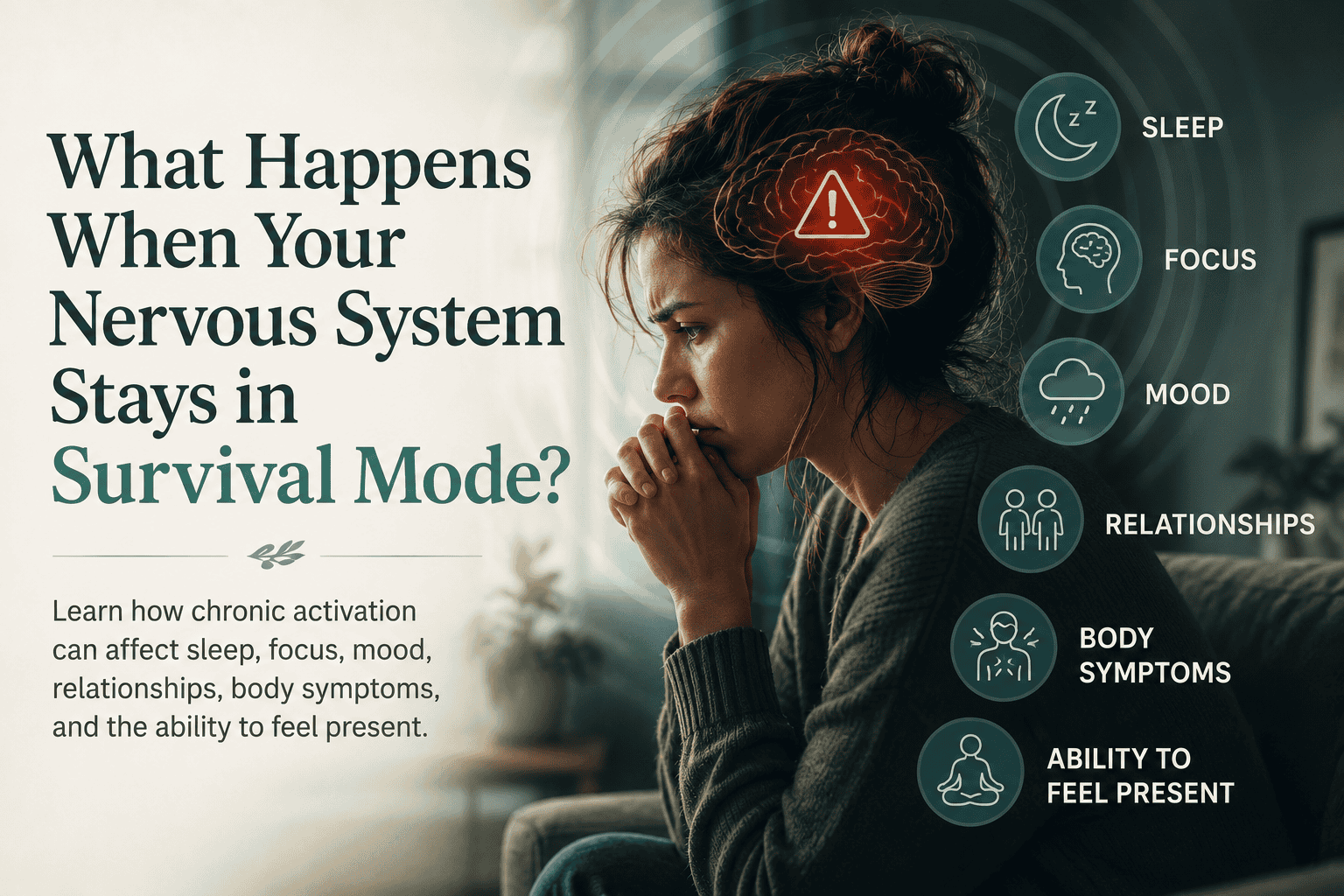
What Happens When Your Nervous System Stays in Survival Mode?

Stress, Trauma & Nervous System Resources

What Happens When Your Nervous System Stays in Survival Mode?

When the body remains prepared for danger long after the immediate stress has passed, chronic activation may affect sleep, concentration, mood, relationships, physical comfort, and the ability to feel fully present in everyday life.

Start Here

Survival Responses Are Designed to Protect You—But They Can Become Exhausting

The nervous system is constantly evaluating what is happening inside and around the body. When something feels threatening, urgent, unpredictable, or overwhelming, the body can shift resources toward protection. Heart rate may increase, muscles may tighten, attention may narrow, digestion may change, and the mind may become more focused on detecting problems.

These responses are useful during an actual emergency. The difficulty begins when the body rarely receives a convincing signal that the danger has ended. A person may continue functioning, working, parenting, caregiving, or managing responsibilities while remaining internally braced for the next problem.

What Does “Survival Mode” Mean?

“Survival mode” is a common, non-diagnostic phrase used to describe a prolonged state of physical and emotional protection. It may involve persistent fight, flight, freeze, shutdown, appeasing, or hypervigilant responses. It does not automatically mean that someone has a trauma disorder, and similar symptoms can also be influenced by anxiety, depression, burnout, grief, sleep loss, health conditions, medication effects, substance use, or ongoing life stress.

Protective Patterns

Survival Mode Does Not Look the Same for Everyone

People often imagine survival mode as visible panic, but chronic activation can appear through agitation, overworking, withdrawal, emotional numbness, people-pleasing, or a mixture of several responses.

Fight

Irritability, anger, defensiveness, arguing, controlling behavior, impatience, or feeling ready to confront a problem immediately.

Flight

Restlessness, overworking, staying constantly busy, excessive planning, leaving situations, or feeling unable to slow down.

Freeze

Difficulty speaking, deciding, moving forward, or taking action even when the person understands what needs to be done.

Shutdown

Emotional numbness, exhaustion, disconnection, sleeping excessively, withdrawing, or feeling as though the body has run out of energy.

Appeasing

Quickly agreeing, apologizing, minimizing personal needs, monitoring other people’s moods, or trying to prevent conflict at any cost.

Hypervigilance

Watching for changes in tone, facial expression, messages, noises, physical sensations, or other signs that something may be wrong.

These patterns are not personality flaws. They are attempts to create safety, predictability, distance, control, or connection. A person may shift between responses depending on the situation and how much internal capacity remains available.

Sleep and Restoration

The Body May Struggle to Fully Power Down

Sleep requires the nervous system to reduce vigilance. When the body remains prepared for danger, falling asleep may feel difficult even when a person is exhausted. Others fall asleep quickly but wake repeatedly, awaken too early, experience vivid dreams, clench their jaw, or remain physically tense throughout the night.

Poor sleep then reduces emotional regulation, concentration, pain tolerance, and frustration tolerance the next day. This can create a cycle in which stress disrupts sleep and sleep loss makes ordinary stressors feel more threatening.

Common Sleep Effects

Chronic Activation May Show Up at Night

  • Difficulty falling asleep despite feeling tired
  • Waking in the middle of the night with a racing mind
  • Light or restless sleep and feeling unrefreshed
  • Nightmares, stress dreams, or waking in a panic
  • Jaw clenching, muscle tension, or morning headaches
  • Needing constant sound, scrolling, television, or distraction to settle

Focus, Memory and Decision-Making

Attention May Become Organized Around Threat Instead of Everyday Tasks

A chronically activated nervous system may prioritize information that seems urgent, uncertain, or potentially dangerous. This can make it harder to sustain attention on routine work, read carefully, remember details, follow conversations, organize several steps, or make decisions without becoming mentally overloaded.

Some people describe “brain fog,” but the experience may also feel like racing thoughts, constant mental scanning, blanking out under pressure, or repeatedly checking work because the mind does not feel settled enough to trust itself.

Focus-related changes may include:

  • Forgetting why you entered a room or what you were about to say
  • Reading the same paragraph several times without absorbing it
  • Difficulty prioritizing when several tasks feel equally urgent
  • Becoming overwhelmed by emails, messages, paperwork, or decisions
  • Making avoidable mistakes when hurried or emotionally activated
  • Mentally rehearsing possible problems instead of attending to the present task

Concentration problems are not specific to nervous system activation. They may also be associated with sleep disorders, depression, ADHD, medication effects, substance use, hormonal changes, neurological conditions, and other medical concerns. Persistent or worsening cognitive changes should be discussed with an appropriate healthcare provider.

Mood and Emotional Regulation

Emotions May Feel More Intense—or Harder to Access

When internal resources are being used to stay alert and keep functioning, the nervous system may have less flexibility for frustration, disappointment, uncertainty, or conflict. Some people feel everything intensely. Others become emotionally flat or disconnected.

Irritability

Noise, interruptions, delays, repeated questions, clutter, or small mistakes may feel unusually difficult to tolerate.

Tearfulness

Tears may appear quickly because the current moment is landing on top of accumulated stress, exhaustion, grief, or fear.

Anxiety

The mind may anticipate problems, rehearse conversations, seek reassurance, or struggle to tolerate not knowing what will happen.

Numbness

Feelings may become distant or muted when emotional intensity has exceeded what the system can comfortably process.

Rapid Shifts

A person may move quickly from capable to overwhelmed, calm to angry, or connected to shut down when capacity is low.

Reduced Enjoyment

Rest, play, intimacy, hobbies, or positive experiences may feel inaccessible because the body remains oriented toward responsibility or danger.

Relationships and Communication

Connection Can Feel Both Necessary and Difficult

Supportive relationships can help the nervous system feel safer, yet chronic activation may make closeness harder to tolerate. A person may want reassurance but also feel crowded, misunderstood, criticized, or responsible for managing everyone else’s emotions.

Neutral comments may sound sharper than intended. Delayed replies may feel like rejection. Ordinary disagreements may trigger urgency, defensiveness, withdrawal, or a need to resolve the issue immediately.

Possible Relationship Effects

Protection Can Be Misread as Disinterest or Control

  • Becoming defensive before fully hearing the other person
  • Withdrawing because conversation feels like too much input
  • People-pleasing to prevent anger, disappointment, or abandonment
  • Monitoring tone, facial expression, or response time for signs of trouble
  • Difficulty asking directly for comfort, space, or practical help
  • Feeling guilty for having needs or limits

Understanding the protective pattern does not excuse hurtful behavior. It can, however, make it easier to take responsibility, communicate more clearly, repair conflict, and develop alternatives to reacting automatically.

Physical Effects

Chronic Stress Can Be Experienced Throughout the Body

Nervous system activation involves the whole body, not only thoughts and emotions. Physical symptoms are real and deserve attention, even when stress appears to be contributing.

Cardiovascular Sensations

A racing or pounding heart, chest tightness, flushing, trembling, or feeling suddenly keyed up.

Breathing Changes

Shallow breathing, frequent sighing, breath-holding, throat tightness, or feeling unable to take a satisfying breath.

Muscle Tension

Tight shoulders, jaw clenching, headaches, back pain, pelvic tension, or waking with sore muscles.

Digestive Changes

Nausea, stomach discomfort, appetite changes, reflux, diarrhea, constipation, or symptoms that worsen under stress.

Fatigue

Feeling tired but wired, crashing after periods of intense functioning, or needing more recovery after ordinary demands.

Sensory Sensitivity

Increased sensitivity to noise, light, touch, crowds, temperature, or multiple conversations occurring at once.

New, severe, persistent, or unexplained physical symptoms should not automatically be attributed to anxiety or trauma. A medical evaluation is important when symptoms could reflect a physical health condition, especially with chest pain, fainting, severe shortness of breath, neurological changes, or other urgent concerns.

Presence and Connection to the Moment

It May Become Difficult to Feel Safe Enough to Be Fully Present

Presence requires enough internal safety to notice what is actually happening rather than constantly preparing for what might happen next. In survival mode, attention may remain pulled toward memories, possible threats, unfinished responsibilities, bodily sensations, or other people’s reactions.

Some people feel detached from themselves, as though they are watching life from a distance or moving through the day automatically. Others remain highly alert but cannot absorb positive experiences. They may recognize that something is enjoyable without being able to feel the enjoyment in their body.

Difficulty feeling present may sound like:

  • “I am here, but I do not feel completely here.”
  • “I cannot relax because I am waiting for the next problem.”
  • “I finish the day and barely remember it.”
  • “Even during good moments, part of me is scanning for what could go wrong.”
  • “I feel disconnected from my body or emotions.”
  • “Rest makes me uncomfortable because I feel as though I should be doing something.”

Experiences of detachment or unreality can occur for several reasons. A qualified mental health professional can help assess whether the experience is related to stress, panic, trauma, depression, dissociation, medication, substance use, sleep deprivation, or another concern.

Why the Pattern May Continue

The Nervous System May Still Be Responding to Current or Learned Danger

Chronic activation is rarely maintained by one factor. Effective support considers both what happened in the past and what remains stressful, unsafe, unpredictable, or unsustainable now.

Ongoing Demands

Caregiving, financial strain, work pressure, legal concerns, discrimination, illness, conflict, or unstable living conditions may keep the body activated.

Unresolved Experiences

Past trauma, loss, betrayal, neglect, or chronic unpredictability may shape how present-day cues are interpreted.

Depleted Capacity

Sleep loss, pain, illness, poor nutrition, excessive responsibility, or lack of recovery time can lower the threshold for activation.

Avoidance Cycles

Avoiding reminders may bring short-term relief while preventing the nervous system from learning that some situations can now be tolerated safely.

Overfunctioning

Staying useful, productive, prepared, or indispensable may protect against vulnerability while making genuine rest difficult.

Misreading Body Signals

Normal sensations may be interpreted as evidence of danger, which can increase fear and intensify the sensations further.

When Activation Is Happening

Begin by Helping the Body Notice the Present Situation

The goal during activation is not to force the body to become completely calm. Trying to eliminate the response immediately can create more pressure. A more realistic goal is to reduce intensity enough to regain choice, orientation, and the ability to decide what is needed next.

Try a brief sequence:

  • Pause: Delay sending the message, making the decision, or continuing the argument when possible.
  • Orient: Look around slowly and identify where you are, what day it is, and what is actually happening now.
  • Support the body: Place both feet on the floor, lean against a chair, unclench the jaw, or hold something with a clear texture.
  • Lengthen the exhale gently: Avoid forcing deep breaths if that increases discomfort. Let the out-breath become slightly slower than the in-breath.
  • Reduce input: Step away from noise, screens, conversation, or multitasking when practical.
  • Name the next need: Decide whether you need information, space, food, water, movement, reassurance, a boundary, or professional support.

Grounding is not a test of whether you can calm down correctly. Some techniques help one person and irritate another. It is appropriate to stop a strategy that increases panic, dizziness, dissociation, pain, or frustration and try a different form of support.

Longer-Term Recovery

Recovery Usually Involves More Than Learning to Calm Down

Regulation skills can be helpful, but lasting change may also require reducing current stress, processing unresolved experiences, strengthening boundaries, improving sleep, receiving medical care, and developing relationships in which safety and support are more consistent.

Recognize the Pattern

Notice triggers, early body signals, thoughts, protective urges, and what helps the system return toward balance.

Increase Actual Safety

Address ongoing danger, coercion, overwork, instability, conflict, or demands that cannot be regulated away through coping skills alone.

Restore Capacity

Support sleep, nutrition, movement, medical care, sensory breaks, recovery time, and realistic limits on responsibilities.

Practice Co-Regulation

Spend time with trustworthy people who can remain steady, respectful, and responsive without demanding immediate emotional change.

Build Flexible Responses

Practice pausing, setting boundaries, tolerating uncertainty, asking for help, and choosing actions rather than reacting automatically.

Process Root Experiences

When clinically appropriate, therapy can address unresolved trauma, grief, shame, fear, relationship injuries, or beliefs that continue signaling danger.

Progress may first appear as noticing activation sooner, recovering more quickly, tolerating rest for a little longer, communicating a need more directly, or staying connected during a manageable disagreement. The goal is greater flexibility—not remaining calm at all times.

Therapy Support

Counseling Can Help Connect Symptoms With Their Context

A therapist can help assess when activation occurs, what the person is protecting against, how symptoms affect functioning, and whether trauma, anxiety, depression, grief, burnout, relationship stress, or another concern may be involved.

Treatment may include education about stress responses, grounding and regulation skills, cognitive and behavioral strategies, boundary work, emotional processing, relationship repair, and trauma-focused treatment when appropriate.

Medical and Psychiatric Support

Similar Symptoms Can Have More Than One Cause

A physician or other qualified healthcare professional may need to evaluate symptoms involving sleep, heart rate, breathing, pain, digestion, hormones, medication effects, substance use, neurological changes, or significant fatigue.

  • Seek urgent care for symptoms that may represent a medical emergency.
  • Discuss persistent sleep or physical symptoms with a medical provider.
  • Consider psychiatric consultation when symptoms are severe or medication may be helpful.
  • Coordinate care when mental and physical health concerns overlap.

Counseling at Motivations Counseling

Trauma-Informed Counseling Can Support Nervous System Recovery

Motivations Counseling provides therapy for adults experiencing chronic stress, anxiety, trauma-related symptoms, emotional overwhelm, irritability, shutdown, sleep disruption, relationship strain, burnout, and difficulty feeling calm or present.

Our counseling team serves clients in Sugar Land, Katy, Richmond, Fort Bend County, West Houston, and through telehealth across Texas when clinically appropriate.

Counseling Support

Counseling in Sugar Land, Katy, and Online Across Texas

Therapy can help you understand what keeps your system activated, strengthen practical regulation skills, address the stressors that continue affecting you, and gradually increase your ability to rest, connect, focus, and feel present.

  • Individual counseling for anxiety, chronic stress, burnout, and emotional overwhelm
  • Trauma-informed therapy focused on safety, stabilization, and increased flexibility
  • EMDR therapy when clinically appropriate
  • Support for shutdown, hypervigilance, irritability, people-pleasing, and relationship strain
  • In-person options in Sugar Land and Katy when available
  • Telehealth counseling across Texas when clinically appropriate
Call or Text: (281) 858-3001

Therapy Learning Center

Continue Learning About Stress, Emotional Overwhelm, and Mental Health

These related resources can help you understand emotional overload, depression, exhaustion, numbness, trauma-informed counseling, and practical support options.

Frequently Asked Questions

Common Questions About Nervous System Survival Mode

What does it mean for the nervous system to be in survival mode?

Survival mode is a common phrase for a prolonged protective state in which the body and mind remain prepared for danger, urgency, conflict, or overwhelm. It may involve fight, flight, freeze, shutdown, appeasing, or hypervigilance. It is not a formal diagnosis by itself.

How do I know whether my nervous system is chronically activated?

Possible signs include difficulty relaxing, disrupted sleep, irritability, racing thoughts, muscle tension, digestive symptoms, feeling constantly responsible, scanning for problems, emotional numbness, or becoming overwhelmed by ordinary demands. A professional evaluation can help determine what else may be contributing.

Can survival mode make me feel exhausted?

Yes. Remaining physically or mentally prepared for threat requires energy. A person may feel tired but unable to rest, function intensely for a period and then crash, or experience persistent fatigue. Medical causes of fatigue should also be considered.

Why can I not sleep when I am exhausted?

Sleep requires the body to reduce vigilance. Chronic stress may keep thoughts, muscles, breathing, and attention activated even when energy is low. Sleep difficulties can also have medical, psychiatric, medication-related, or behavioral causes that may require assessment.

Can survival mode affect memory and concentration?

Chronic stress can make it harder to sustain attention, organize tasks, remember details, and make decisions because attention is repeatedly pulled toward urgency or possible danger. Persistent cognitive changes should be discussed with a qualified provider.

Why do I become irritated by noise, interruptions, or small problems?

When capacity is already low, additional input may feel more intense. Irritability can be a sign that the system has limited room for more stimulation, uncertainty, or demand. It can also occur with sleep loss, depression, anxiety, pain, medication effects, and other concerns.

Can trauma keep the nervous system in survival mode?

Trauma may contribute when current cues resemble earlier danger or when the body has not yet learned that the situation has changed. However, chronic activation can also occur without a trauma disorder and may be related to current stress, burnout, anxiety, grief, illness, or other factors.

How do I get my nervous system out of survival mode?

There is rarely one technique that changes a chronic pattern. Helpful steps may include increasing actual safety, reducing unsustainable demands, improving sleep and physical care, practicing grounding and regulation, strengthening boundaries and support, receiving medical care, and addressing unresolved experiences in therapy when appropriate.

Can therapy help with chronic nervous system activation?

Therapy may help identify triggers and protective patterns, build regulation skills, improve communication and boundaries, address anxiety or depression, and process trauma or loss when clinically appropriate. Treatment should be individualized to the person’s symptoms, history, needs, and current safety.

When should I seek immediate help?

Seek immediate help when there may be a life-threatening medical emergency, a person cannot remain safe, or there are thoughts of suicide or serious self-harm. In the United States, call 911 for an emergency, call or text 988 for the Suicide & Crisis Lifeline, or go to the nearest emergency room.

Susan Baker, M.Ed., NCC, LPC-S, Licensed Professional Counselor Supervisor in Texas

Article Author

Written by a Licensed Texas Mental Health Professional

This article was written for Motivations Counseling by Susan Baker, M.Ed., NCC, LPC-S, a Texas Licensed Professional Counselor Supervisor and clinical leader at Motivations Counseling.

Susan Baker, M.Ed., NCC, LPC-S
Texas Licensed Professional Counselor Supervisor
EMDR Therapist & EMDRIA Member
Texas LPC License #73957

Susan Baker is the Clinical Director of Motivations Counseling and provides trauma-informed counseling, EMDR therapy, anxiety treatment, depression counseling, couples counseling, immigration psychological evaluations, and mental health assessment services. Motivations Counseling serves clients from offices in Sugar Land and Katy, Texas, with telehealth services available statewide for Texas residents.

Take the Next Step

Trauma-Informed Counseling in Sugar Land, Katy, and Online Across Texas

If chronic stress is affecting your sleep, focus, emotions, relationships, physical well-being, or ability to feel present, counseling can help you understand the pattern and begin building a more flexible sense of safety.

×

Stress, Trauma & Nervous System Resources

What Happens When Your Nervous System Stays in Survival Mode?

When the body remains prepared for danger long after the immediate stress has passed, chronic activation may affect sleep, concentration, mood, relationships, physical comfort, and the ability to feel fully present in everyday life.

Start Here

Survival Responses Are Designed to Protect You—But They Can Become Exhausting

The nervous system is constantly evaluating what is happening inside and around the body. When something feels threatening, urgent, unpredictable, or overwhelming, the body can shift resources toward protection. Heart rate may increase, muscles may tighten, attention may narrow, digestion may change, and the mind may become more focused on detecting problems.

These responses are useful during an actual emergency. The difficulty begins when the body rarely receives a convincing signal that the danger has ended. A person may continue functioning, working, parenting, caregiving, or managing responsibilities while remaining internally braced for the next problem.

What Does “Survival Mode” Mean?

“Survival mode” is a common, non-diagnostic phrase used to describe a prolonged state of physical and emotional protection. It may involve persistent fight, flight, freeze, shutdown, appeasing, or hypervigilant responses. It does not automatically mean that someone has a trauma disorder, and similar symptoms can also be influenced by anxiety, depression, burnout, grief, sleep loss, health conditions, medication effects, substance use, or ongoing life stress.

Protective Patterns

Survival Mode Does Not Look the Same for Everyone

People often imagine survival mode as visible panic, but chronic activation can appear through agitation, overworking, withdrawal, emotional numbness, people-pleasing, or a mixture of several responses.

Fight

Irritability, anger, defensiveness, arguing, controlling behavior, impatience, or feeling ready to confront a problem immediately.

Flight

Restlessness, overworking, staying constantly busy, excessive planning, leaving situations, or feeling unable to slow down.

Freeze

Difficulty speaking, deciding, moving forward, or taking action even when the person understands what needs to be done.

Shutdown

Emotional numbness, exhaustion, disconnection, sleeping excessively, withdrawing, or feeling as though the body has run out of energy.

Appeasing

Quickly agreeing, apologizing, minimizing personal needs, monitoring other people’s moods, or trying to prevent conflict at any cost.

Hypervigilance

Watching for changes in tone, facial expression, messages, noises, physical sensations, or other signs that something may be wrong.

These patterns are not personality flaws. They are attempts to create safety, predictability, distance, control, or connection. A person may shift between responses depending on the situation and how much internal capacity remains available.

Sleep and Restoration

The Body May Struggle to Fully Power Down

Sleep requires the nervous system to reduce vigilance. When the body remains prepared for danger, falling asleep may feel difficult even when a person is exhausted. Others fall asleep quickly but wake repeatedly, awaken too early, experience vivid dreams, clench their jaw, or remain physically tense throughout the night.

Poor sleep then reduces emotional regulation, concentration, pain tolerance, and frustration tolerance the next day. This can create a cycle in which stress disrupts sleep and sleep loss makes ordinary stressors feel more threatening.

Common Sleep Effects

Chronic Activation May Show Up at Night

  • Difficulty falling asleep despite feeling tired
  • Waking in the middle of the night with a racing mind
  • Light or restless sleep and feeling unrefreshed
  • Nightmares, stress dreams, or waking in a panic
  • Jaw clenching, muscle tension, or morning headaches
  • Needing constant sound, scrolling, television, or distraction to settle

Focus, Memory and Decision-Making

Attention May Become Organized Around Threat Instead of Everyday Tasks

A chronically activated nervous system may prioritize information that seems urgent, uncertain, or potentially dangerous. This can make it harder to sustain attention on routine work, read carefully, remember details, follow conversations, organize several steps, or make decisions without becoming mentally overloaded.

Some people describe “brain fog,” but the experience may also feel like racing thoughts, constant mental scanning, blanking out under pressure, or repeatedly checking work because the mind does not feel settled enough to trust itself.

Focus-related changes may include:

  • Forgetting why you entered a room or what you were about to say
  • Reading the same paragraph several times without absorbing it
  • Difficulty prioritizing when several tasks feel equally urgent
  • Becoming overwhelmed by emails, messages, paperwork, or decisions
  • Making avoidable mistakes when hurried or emotionally activated
  • Mentally rehearsing possible problems instead of attending to the present task

Concentration problems are not specific to nervous system activation. They may also be associated with sleep disorders, depression, ADHD, medication effects, substance use, hormonal changes, neurological conditions, and other medical concerns. Persistent or worsening cognitive changes should be discussed with an appropriate healthcare provider.

Mood and Emotional Regulation

Emotions May Feel More Intense—or Harder to Access

When internal resources are being used to stay alert and keep functioning, the nervous system may have less flexibility for frustration, disappointment, uncertainty, or conflict. Some people feel everything intensely. Others become emotionally flat or disconnected.

Irritability

Noise, interruptions, delays, repeated questions, clutter, or small mistakes may feel unusually difficult to tolerate.

Tearfulness

Tears may appear quickly because the current moment is landing on top of accumulated stress, exhaustion, grief, or fear.

Anxiety

The mind may anticipate problems, rehearse conversations, seek reassurance, or struggle to tolerate not knowing what will happen.

Numbness

Feelings may become distant or muted when emotional intensity has exceeded what the system can comfortably process.

Rapid Shifts

A person may move quickly from capable to overwhelmed, calm to angry, or connected to shut down when capacity is low.

Reduced Enjoyment

Rest, play, intimacy, hobbies, or positive experiences may feel inaccessible because the body remains oriented toward responsibility or danger.

Relationships and Communication

Connection Can Feel Both Necessary and Difficult

Supportive relationships can help the nervous system feel safer, yet chronic activation may make closeness harder to tolerate. A person may want reassurance but also feel crowded, misunderstood, criticized, or responsible for managing everyone else’s emotions.

Neutral comments may sound sharper than intended. Delayed replies may feel like rejection. Ordinary disagreements may trigger urgency, defensiveness, withdrawal, or a need to resolve the issue immediately.

Possible Relationship Effects

Protection Can Be Misread as Disinterest or Control

  • Becoming defensive before fully hearing the other person
  • Withdrawing because conversation feels like too much input
  • People-pleasing to prevent anger, disappointment, or abandonment
  • Monitoring tone, facial expression, or response time for signs of trouble
  • Difficulty asking directly for comfort, space, or practical help
  • Feeling guilty for having needs or limits

Understanding the protective pattern does not excuse hurtful behavior. It can, however, make it easier to take responsibility, communicate more clearly, repair conflict, and develop alternatives to reacting automatically.

Physical Effects

Chronic Stress Can Be Experienced Throughout the Body

Nervous system activation involves the whole body, not only thoughts and emotions. Physical symptoms are real and deserve attention, even when stress appears to be contributing.

Cardiovascular Sensations

A racing or pounding heart, chest tightness, flushing, trembling, or feeling suddenly keyed up.

Breathing Changes

Shallow breathing, frequent sighing, breath-holding, throat tightness, or feeling unable to take a satisfying breath.

Muscle Tension

Tight shoulders, jaw clenching, headaches, back pain, pelvic tension, or waking with sore muscles.

Digestive Changes

Nausea, stomach discomfort, appetite changes, reflux, diarrhea, constipation, or symptoms that worsen under stress.

Fatigue

Feeling tired but wired, crashing after periods of intense functioning, or needing more recovery after ordinary demands.

Sensory Sensitivity

Increased sensitivity to noise, light, touch, crowds, temperature, or multiple conversations occurring at once.

New, severe, persistent, or unexplained physical symptoms should not automatically be attributed to anxiety or trauma. A medical evaluation is important when symptoms could reflect a physical health condition, especially with chest pain, fainting, severe shortness of breath, neurological changes, or other urgent concerns.

Presence and Connection to the Moment

It May Become Difficult to Feel Safe Enough to Be Fully Present

Presence requires enough internal safety to notice what is actually happening rather than constantly preparing for what might happen next. In survival mode, attention may remain pulled toward memories, possible threats, unfinished responsibilities, bodily sensations, or other people’s reactions.

Some people feel detached from themselves, as though they are watching life from a distance or moving through the day automatically. Others remain highly alert but cannot absorb positive experiences. They may recognize that something is enjoyable without being able to feel the enjoyment in their body.

Difficulty feeling present may sound like:

  • “I am here, but I do not feel completely here.”
  • “I cannot relax because I am waiting for the next problem.”
  • “I finish the day and barely remember it.”
  • “Even during good moments, part of me is scanning for what could go wrong.”
  • “I feel disconnected from my body or emotions.”
  • “Rest makes me uncomfortable because I feel as though I should be doing something.”

Experiences of detachment or unreality can occur for several reasons. A qualified mental health professional can help assess whether the experience is related to stress, panic, trauma, depression, dissociation, medication, substance use, sleep deprivation, or another concern.

Why the Pattern May Continue

The Nervous System May Still Be Responding to Current or Learned Danger

Chronic activation is rarely maintained by one factor. Effective support considers both what happened in the past and what remains stressful, unsafe, unpredictable, or unsustainable now.

Ongoing Demands

Caregiving, financial strain, work pressure, legal concerns, discrimination, illness, conflict, or unstable living conditions may keep the body activated.

Unresolved Experiences

Past trauma, loss, betrayal, neglect, or chronic unpredictability may shape how present-day cues are interpreted.

Depleted Capacity

Sleep loss, pain, illness, poor nutrition, excessive responsibility, or lack of recovery time can lower the threshold for activation.

Avoidance Cycles

Avoiding reminders may bring short-term relief while preventing the nervous system from learning that some situations can now be tolerated safely.

Overfunctioning

Staying useful, productive, prepared, or indispensable may protect against vulnerability while making genuine rest difficult.

Misreading Body Signals

Normal sensations may be interpreted as evidence of danger, which can increase fear and intensify the sensations further.

When Activation Is Happening

Begin by Helping the Body Notice the Present Situation

The goal during activation is not to force the body to become completely calm. Trying to eliminate the response immediately can create more pressure. A more realistic goal is to reduce intensity enough to regain choice, orientation, and the ability to decide what is needed next.

Try a brief sequence:

  • Pause: Delay sending the message, making the decision, or continuing the argument when possible.
  • Orient: Look around slowly and identify where you are, what day it is, and what is actually happening now.
  • Support the body: Place both feet on the floor, lean against a chair, unclench the jaw, or hold something with a clear texture.
  • Lengthen the exhale gently: Avoid forcing deep breaths if that increases discomfort. Let the out-breath become slightly slower than the in-breath.
  • Reduce input: Step away from noise, screens, conversation, or multitasking when practical.
  • Name the next need: Decide whether you need information, space, food, water, movement, reassurance, a boundary, or professional support.

Grounding is not a test of whether you can calm down correctly. Some techniques help one person and irritate another. It is appropriate to stop a strategy that increases panic, dizziness, dissociation, pain, or frustration and try a different form of support.

Longer-Term Recovery

Recovery Usually Involves More Than Learning to Calm Down

Regulation skills can be helpful, but lasting change may also require reducing current stress, processing unresolved experiences, strengthening boundaries, improving sleep, receiving medical care, and developing relationships in which safety and support are more consistent.

Recognize the Pattern

Notice triggers, early body signals, thoughts, protective urges, and what helps the system return toward balance.

Increase Actual Safety

Address ongoing danger, coercion, overwork, instability, conflict, or demands that cannot be regulated away through coping skills alone.

Restore Capacity

Support sleep, nutrition, movement, medical care, sensory breaks, recovery time, and realistic limits on responsibilities.

Practice Co-Regulation

Spend time with trustworthy people who can remain steady, respectful, and responsive without demanding immediate emotional change.

Build Flexible Responses

Practice pausing, setting boundaries, tolerating uncertainty, asking for help, and choosing actions rather than reacting automatically.

Process Root Experiences

When clinically appropriate, therapy can address unresolved trauma, grief, shame, fear, relationship injuries, or beliefs that continue signaling danger.

Progress may first appear as noticing activation sooner, recovering more quickly, tolerating rest for a little longer, communicating a need more directly, or staying connected during a manageable disagreement. The goal is greater flexibility—not remaining calm at all times.

Therapy Support

Counseling Can Help Connect Symptoms With Their Context

A therapist can help assess when activation occurs, what the person is protecting against, how symptoms affect functioning, and whether trauma, anxiety, depression, grief, burnout, relationship stress, or another concern may be involved.

Treatment may include education about stress responses, grounding and regulation skills, cognitive and behavioral strategies, boundary work, emotional processing, relationship repair, and trauma-focused treatment when appropriate.

Medical and Psychiatric Support

Similar Symptoms Can Have More Than One Cause

A physician or other qualified healthcare professional may need to evaluate symptoms involving sleep, heart rate, breathing, pain, digestion, hormones, medication effects, substance use, neurological changes, or significant fatigue.

  • Seek urgent care for symptoms that may represent a medical emergency.
  • Discuss persistent sleep or physical symptoms with a medical provider.
  • Consider psychiatric consultation when symptoms are severe or medication may be helpful.
  • Coordinate care when mental and physical health concerns overlap.

Counseling at Motivations Counseling

Trauma-Informed Counseling Can Support Nervous System Recovery

Motivations Counseling provides therapy for adults experiencing chronic stress, anxiety, trauma-related symptoms, emotional overwhelm, irritability, shutdown, sleep disruption, relationship strain, burnout, and difficulty feeling calm or present.

Our counseling team serves clients in Sugar Land, Katy, Richmond, Fort Bend County, West Houston, and through telehealth across Texas when clinically appropriate.

Counseling Support

Counseling in Sugar Land, Katy, and Online Across Texas

Therapy can help you understand what keeps your system activated, strengthen practical regulation skills, address the stressors that continue affecting you, and gradually increase your ability to rest, connect, focus, and feel present.

  • Individual counseling for anxiety, chronic stress, burnout, and emotional overwhelm
  • Trauma-informed therapy focused on safety, stabilization, and increased flexibility
  • EMDR therapy when clinically appropriate
  • Support for shutdown, hypervigilance, irritability, people-pleasing, and relationship strain
  • In-person options in Sugar Land and Katy when available
  • Telehealth counseling across Texas when clinically appropriate
Call or Text: (281) 858-3001

Therapy Learning Center

Continue Learning About Stress, Emotional Overwhelm, and Mental Health

These related resources can help you understand emotional overload, depression, exhaustion, numbness, trauma-informed counseling, and practical support options.

Frequently Asked Questions

Common Questions About Nervous System Survival Mode

What does it mean for the nervous system to be in survival mode?

Survival mode is a common phrase for a prolonged protective state in which the body and mind remain prepared for danger, urgency, conflict, or overwhelm. It may involve fight, flight, freeze, shutdown, appeasing, or hypervigilance. It is not a formal diagnosis by itself.

How do I know whether my nervous system is chronically activated?

Possible signs include difficulty relaxing, disrupted sleep, irritability, racing thoughts, muscle tension, digestive symptoms, feeling constantly responsible, scanning for problems, emotional numbness, or becoming overwhelmed by ordinary demands. A professional evaluation can help determine what else may be contributing.

Can survival mode make me feel exhausted?

Yes. Remaining physically or mentally prepared for threat requires energy. A person may feel tired but unable to rest, function intensely for a period and then crash, or experience persistent fatigue. Medical causes of fatigue should also be considered.

Why can I not sleep when I am exhausted?

Sleep requires the body to reduce vigilance. Chronic stress may keep thoughts, muscles, breathing, and attention activated even when energy is low. Sleep difficulties can also have medical, psychiatric, medication-related, or behavioral causes that may require assessment.

Can survival mode affect memory and concentration?

Chronic stress can make it harder to sustain attention, organize tasks, remember details, and make decisions because attention is repeatedly pulled toward urgency or possible danger. Persistent cognitive changes should be discussed with a qualified provider.

Why do I become irritated by noise, interruptions, or small problems?

When capacity is already low, additional input may feel more intense. Irritability can be a sign that the system has limited room for more stimulation, uncertainty, or demand. It can also occur with sleep loss, depression, anxiety, pain, medication effects, and other concerns.

Can trauma keep the nervous system in survival mode?

Trauma may contribute when current cues resemble earlier danger or when the body has not yet learned that the situation has changed. However, chronic activation can also occur without a trauma disorder and may be related to current stress, burnout, anxiety, grief, illness, or other factors.

How do I get my nervous system out of survival mode?

There is rarely one technique that changes a chronic pattern. Helpful steps may include increasing actual safety, reducing unsustainable demands, improving sleep and physical care, practicing grounding and regulation, strengthening boundaries and support, receiving medical care, and addressing unresolved experiences in therapy when appropriate.

Can therapy help with chronic nervous system activation?

Therapy may help identify triggers and protective patterns, build regulation skills, improve communication and boundaries, address anxiety or depression, and process trauma or loss when clinically appropriate. Treatment should be individualized to the person’s symptoms, history, needs, and current safety.

When should I seek immediate help?

Seek immediate help when there may be a life-threatening medical emergency, a person cannot remain safe, or there are thoughts of suicide or serious self-harm. In the United States, call 911 for an emergency, call or text 988 for the Suicide & Crisis Lifeline, or go to the nearest emergency room.

Susan Baker, M.Ed., NCC, LPC-S, Licensed Professional Counselor Supervisor in Texas

Article Author

Written by a Licensed Texas Mental Health Professional

This article was written for Motivations Counseling by Susan Baker, M.Ed., NCC, LPC-S, a Texas Licensed Professional Counselor Supervisor and clinical leader at Motivations Counseling.

Susan Baker, M.Ed., NCC, LPC-S
Texas Licensed Professional Counselor Supervisor
EMDR Therapist & EMDRIA Member
Texas LPC License #73957

Susan Baker is the Clinical Director of Motivations Counseling and provides trauma-informed counseling, EMDR therapy, anxiety treatment, depression counseling, couples counseling, immigration psychological evaluations, and mental health assessment services. Motivations Counseling serves clients from offices in Sugar Land and Katy, Texas, with telehealth services available statewide for Texas residents.

Take the Next Step

Trauma-Informed Counseling in Sugar Land, Katy, and Online Across Texas

If chronic stress is affecting your sleep, focus, emotions, relationships, physical well-being, or ability to feel present, counseling can help you understand the pattern and begin building a more flexible sense of safety.

×

Understanding Memory Fragmentation and Nervous System Activation in Immigration Evaluations

Attorney Resource Guide

Understanding Memory Fragmentation and Nervous System Activation in U-Visa and Asylum Evaluations

Trauma-related immigration evaluations often involve painful histories that are difficult for clients to recall, organize, and describe in a linear way. In U-Visa and asylum-related evaluations, memory fragmentation, avoidance, dissociation, hyperarousal, and nervous system activation may affect how a client presents during the clinical interview and how their history is communicated over time.

Why This Matters for Attorneys

Trauma Narratives Are Often Clinically Complex, Not Simply Linear

Attorneys working on U-Visa and asylum-related matters may notice that clients struggle to provide a clear, chronological, emotionally consistent narrative of traumatic events. Some clients provide limited details at first, remember additional information later, become overwhelmed when asked about specific events, or describe experiences in fragments rather than in a complete timeline.

These patterns can raise concerns during immigration preparation because legal settings often require detailed, organized, and consistent testimony. A trauma-informed psychological evaluation does not determine whether a legal claim is true or false. However, it can help explain clinical factors that may affect recall, disclosure, emotional expression, and interview presentation.

Understanding memory fragmentation and nervous system activation can help attorneys better recognize when a client’s difficulty describing events may be related to trauma symptoms, avoidance, dissociation, fear, shame, or physiological overwhelm.

Trauma Memory

How Trauma Can Affect Recall, Sequencing, and Disclosure

Trauma memories are not always stored or retrieved in the same way as ordinary autobiographical memories. Clients may remember certain sensory details vividly while struggling to recall dates, sequence, duration, or peripheral details.

Fragmented Recall

A client may recall pieces of an event without being able to immediately organize the experience into a complete beginning, middle, and end.

Difficulty With Timeline

Dates, sequence, frequency, and duration may be difficult to recall accurately, especially when events occurred during periods of fear, captivity, repeated abuse, or prolonged stress.

Avoidance and Gaps

Trauma survivors may avoid thinking about certain details, minimize the impact, or leave out painful information because the memory feels overwhelming or unsafe to discuss.

Sensory Details

Some clients remember sounds, smells, physical sensations, images, or bodily reactions more clearly than the exact order of events.

Dissociation

During or after trauma, clients may describe feeling detached, numb, unreal, frozen, confused, or disconnected from what happened.

Delayed Disclosure

Clients may disclose additional information later as trust increases, shame decreases, or the nervous system becomes more regulated.

Nervous System Activation

The Body May Respond Before the Client Can Explain the Story

In trauma-related evaluations, the client’s body may respond as if danger is still present. Discussing the traumatic event may activate fear, panic, shutdown, trembling, tearfulness, numbness, rapid speech, difficulty concentrating, or sudden emotional withdrawal.

These reactions may interfere with the client’s ability to answer questions clearly, maintain chronological order, tolerate follow-up questions, or remain emotionally present during the interview.

Hyperarousal The client may appear anxious, restless, vigilant, startled, tearful, tense, or unable to slow down when discussing traumatic material.
Shutdown or freeze responses The client may become quiet, blank, numb, confused, emotionally flat, or unable to continue discussing certain details.
Reduced concentration High distress may affect attention, working memory, word retrieval, organization, and the ability to answer multi-part questions.
Physiological distress Clients may report panic symptoms, nausea, chest tightness, dizziness, shaking, headaches, or sleep disturbance connected to trauma reminders.

U-Visa and Asylum Context

How Memory and Nervous System Issues May Appear in Different Case Types

U-Visa and asylum-related evaluations may involve different facts, but both can include trauma histories that affect recall, disclosure, emotional regulation, and interview presentation.

Clinical Issue How It May Appear in U-Visa Evaluations How It May Appear in Asylum-Related Evaluations
Fragmented narrative The client may recall parts of the crime, aftermath, police involvement, or emotional impact without a smooth sequence. The client may recall persecution, threats, escape, hiding, or fear of return in non-linear fragments.
Avoidance The client may avoid discussing the crime because it activates fear, shame, grief, or self-blame. The client may avoid discussing persecution, political violence, sexual violence, detention, torture, or family threats.
Hypervigilance The client may remain fearful of the perpetrator, retaliation, law enforcement contact, or community exposure. The client may remain fearful of government actors, gangs, political groups, family retaliation, or return to the country of origin.
Delayed disclosure Additional details may emerge after rapport develops or when the client feels safer describing the crime and its effects. Additional details may emerge as the client becomes more able to discuss fear, harm, loss, persecution, or prior threats.
Dissociation or shutdown The client may become numb, detached, tearful, or unable to continue when recalling the traumatic incident. The client may shut down when discussing violence, captivity, assault, death threats, or memories of fleeing danger.

Clinical Signs

What a Trauma-Informed Evaluator May Look For

A psychological evaluation can help identify whether the client’s presentation is clinically consistent with trauma-related symptoms and whether those symptoms affect functioning, communication, and emotional regulation.

Whether symptoms are connected to trauma reminders.

The evaluator may assess whether anxiety, panic, nightmares, intrusive memories, avoidance, numbness, or hypervigilance are triggered by reminders of the traumatic event or fear of future harm.

How the client responds when discussing painful material.

Observed tearfulness, shaking, guardedness, confusion, emotional flatness, dissociation, or difficulty continuing may help document the client’s nervous system response during the interview.

Whether memory problems are global or trauma-specific.

Some clients have broad cognitive problems, while others are generally organized but become fragmented when discussing trauma-related material.

Whether avoidance affects disclosure.

The evaluator may consider whether shame, fear, distrust, cultural stigma, language barriers, or emotional overwhelm contribute to delayed or limited disclosure.

How symptoms affect daily functioning.

Trauma-related symptoms may affect sleep, parenting, work, school, relationships, medical care, concentration, emotional stability, and the ability to participate in legal processes.

Professional Boundaries

Clinical Evaluation Is Not a Legal Credibility Determination

A trauma-informed evaluator can explain clinical patterns without replacing the role of the attorney, immigration officer, judge, or legal fact-finder.

Appropriate Clinical Role Clinical Question What the Evaluator Should Avoid
Assess symptoms Are the client’s symptoms clinically consistent with trauma, anxiety, depression, dissociation, or PTSD-related impairment? Declaring that the legal claim is true or false.
Explain trauma presentation Could trauma-related symptoms affect recall, sequencing, emotional expression, or disclosure? Excusing every inconsistency or making legal credibility conclusions.
Document functional impact How do symptoms affect sleep, work, relationships, parenting, concentration, safety, and daily life? Offering legal opinions about eligibility, relief, admissibility, or case outcome.
Use clinical language What symptoms, diagnostic impressions, and clinical observations are supported by the evaluation? Writing advocacy language that exceeds the evaluator’s clinical role.

Attorney Value

How Attorneys Can Use This Information Responsibly

Attorneys can support the evaluation process by identifying trauma-related concerns, providing relevant records, and helping the client understand the appointment without coaching clinical responses.

Provide Relevant Context

A short attorney summary can identify the traumatic event, case type, major concerns, language needs, deadlines, and records that may help the evaluator understand the referral question.

Prepare Without Coaching

Clients can be told what to expect during the evaluation, but they should not be told what symptoms to report, what diagnosis to seek, or how emotional they should appear.

Allow Time for Rapport

Trauma survivors may need a calm, structured, respectful interview process before they can disclose painful details or tolerate trauma-related questions.

Address Language Needs

Interpretation needs should be identified early. Trauma narratives can become more difficult to communicate when clients are forced to describe painful events in a less comfortable language.

Share Supporting Records

Police reports, declarations, medical records, therapy records, affidavits, victim services records, and prior documentation may help provide clinical context.

Keep Roles Clear

The attorney explains the legal theory. The evaluator assesses clinical symptoms, functioning, trauma impact, and psychologically relevant observations.

Immigration Evaluation Relevance

Why This Matters in Immigration Psychological Evaluations

Trauma-related nervous system activation can affect how a client remembers, organizes, and discloses painful events. For immigration attorneys, this is especially relevant when a client’s history appears incomplete, emotionally guarded, delayed, or difficult to sequence.

Trauma Symptoms Can Affect the Way a Client Presents

In immigration psychological evaluations, nervous system activation may contribute to difficulty recalling events chronologically, delayed disclosure, incomplete initial histories, avoidance of traumatic material, and apparent inconsistencies that are clinically understandable when viewed in the context of trauma, fear, shame, dissociation, or physiological overwhelm.

This does not mean every inconsistency is trauma-related, and it does not replace the attorney’s role or the legal decision-maker’s role. It means a clinical evaluation can help clarify whether the client’s presentation is consistent with trauma-related symptoms, emotional dysregulation, avoidance, or impaired functioning.

Difficulty recalling events chronologically Trauma survivors may remember emotionally intense or sensory details while struggling to place events in a clear sequence.
Delayed disclosure Additional details may emerge after rapport develops, trust increases, shame decreases, or the client becomes more emotionally regulated.
Incomplete initial histories Clients may initially provide limited details because certain memories feel unsafe, overwhelming, embarrassing, or difficult to verbalize.
Apparent inconsistencies Some differences in wording, sequence, or detail may be clinically understandable when trauma symptoms affect attention, memory, and emotional regulation.
Avoidance of traumatic material A client may minimize, skip, or emotionally distance from painful details because discussing them activates distress, fear, or shutdown.

Bottom Line

Fragmented Trauma Narratives Should Be Evaluated Clinically and Carefully

Memory fragmentation, delayed disclosure, emotional shutdown, and nervous system activation do not automatically prove or disprove a legal claim. However, they may be clinically meaningful when they appear alongside trauma-related symptoms, functional impairment, avoidance, fear responses, and consistent patterns of distress.

A well-written immigration psychological evaluation can help attorneys and decision-makers understand how trauma may affect recall, disclosure, emotional expression, and daily functioning — while staying within appropriate clinical boundaries and avoiding legal conclusions.

Continue Learning

Related Immigration Evaluation Resources for Attorneys

These attorney-focused resources explain how immigration psychological evaluations can document trauma symptoms, hardship, clinical findings, memory patterns, and functional impact while staying within appropriate clinical boundaries.

How Trauma Can Affect Memory Consistency

Learn why trauma-related memory patterns may affect disclosure, sequencing, emotional recall, and perceived consistency.

The Role of PTSD Documentation in Immigration Cases

Review how PTSD-related symptoms, avoidance, hypervigilance, sleep disruption, and functional impairment may be documented.

What Makes a Clinically Strong Immigration Psychological Evaluation?

Learn what makes an evaluation clinically useful, trauma-informed, organized, and appropriate for immigration referral questions.

Clinical vs. Legal Opinions in Immigration Evaluations

Understand the difference between clinical documentation and legal conclusions in immigration evaluations.

Understanding Extreme Hardship in Immigration Psychological Evaluations

Explore how evaluations may document emotional, medical, caregiving, family separation, and functional impact concerns.

2026 Immigration Psychological Evaluation Clinical Findings Report

Review clinical trends, common symptoms, diagnoses, trauma histories, and hardship factors observed across evaluations.

U-Visa Psychological Evaluations

Learn how trauma-informed evaluations may document emotional harm, victimization impact, fear, and functional impairment.

Asylum Psychological Evaluations

Learn how asylum-related evaluations may document trauma symptoms, fear of return, and psychological impact.

Immigration Attorney Resource Library

Visit the attorney resource hub for additional articles, referral information, and evaluation guidance.

Susan Baker, M.Ed., NCC, LPC-S

Article Author

Written by a Licensed Texas Mental Health Professional Who Provides Immigration Psychological Evaluations for Attorney-Referred Cases

This article was written for Motivations Counseling by Susan Baker, M.Ed., NCC, LPC-S, a Texas Licensed Professional Counselor Supervisor and clinical leader with experience providing immigration psychological evaluations and trauma-informed mental health assessments.

Susan Baker, M.Ed., NCC, LPC-S
Texas Licensed Professional Counselor Supervisor
Immigration Psychological Evaluation Provider
EMDR Therapist & EMDRIA Member
Texas LPC License #73957

Susan Baker provides trauma-informed immigration psychological evaluations, counseling, EMDR therapy, and mental health assessment services through Motivations Counseling. Immigration-related articles are provided for educational purposes and are not legal advice. Motivations Counseling serves clients from offices in Sugar Land and Katy, Texas, with telehealth services available statewide for Texas residents when clinically appropriate.

Attorney Referrals

Need to Refer a Client for a U-Visa or Asylum Psychological Evaluation?

Motivations Counseling provides trauma-informed, forensic-style immigration psychological evaluations for attorneys and clients throughout Texas. Evaluations may help document trauma symptoms, nervous system activation, memory-related clinical concerns, emotional distress, and functional impact while staying within appropriate clinical boundaries.