
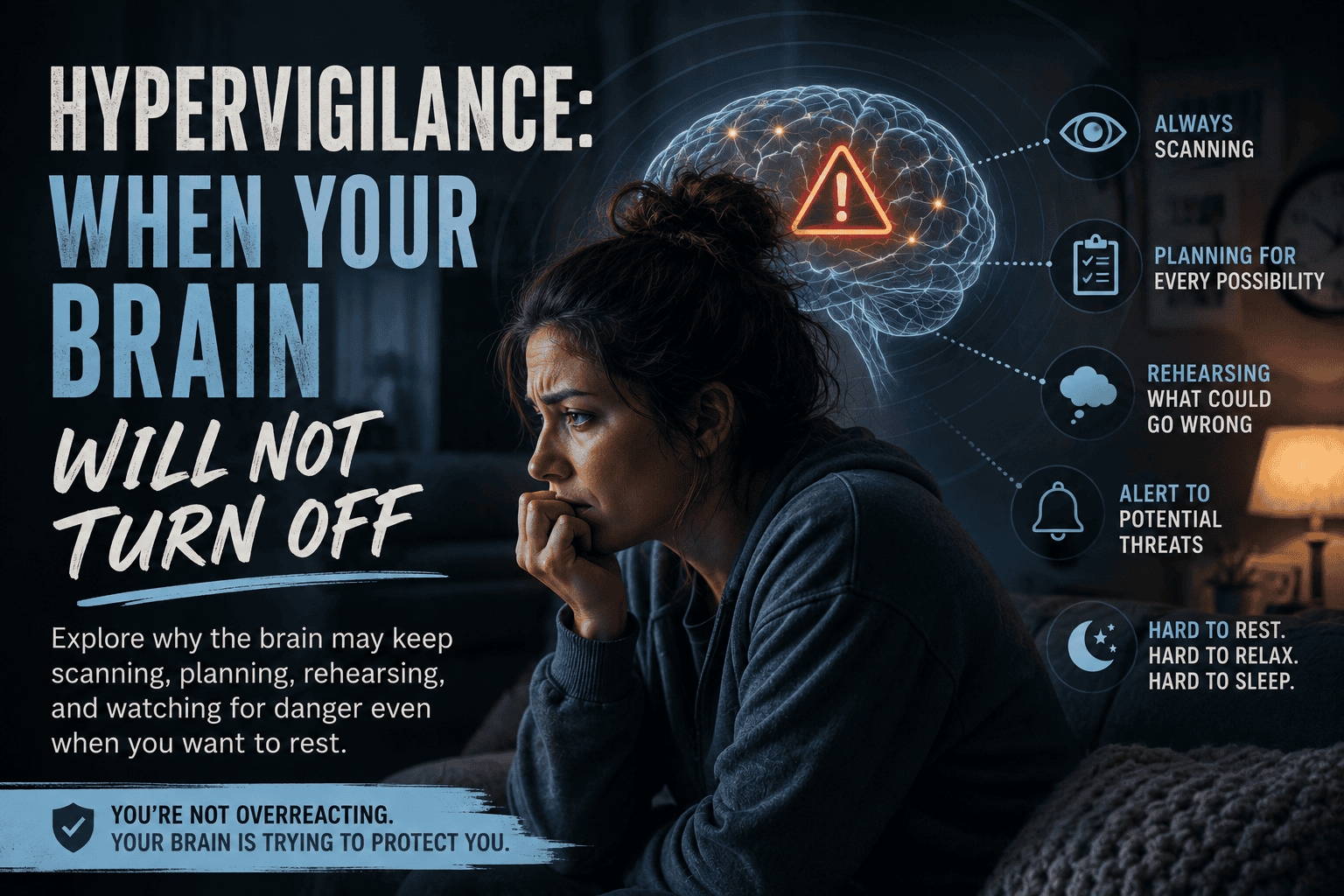
Hypervigilance: When Your Brain Will Not Turn Off
Stress, Anxiety & Nervous System Resources
Hypervigilance: When Your Brain Will Not Turn Off
Hypervigilance can make the mind feel responsible for constantly scanning, planning, rehearsing, checking, and watching for danger—even when you are exhausted and want to rest.
Start Here
Your Brain May Be Trying to Prevent the Next Problem Before It Happens
Hypervigilance can feel like having an internal security system that rarely powers down. The mind may monitor facial expressions, tones of voice, messages, physical sensations, noises, schedules, possible mistakes, unfinished tasks, or changes in the environment. Even during quiet moments, part of the brain may remain focused on what could go wrong next.
This pattern is often exhausting because it requires continuous attention. Rest may feel unsafe, irresponsible, or impossible. The person may recognize that nothing urgent is happening and still feel unable to stop thinking, checking, preparing, or watching.
What Is Hypervigilance?
Hypervigilance is a state of heightened alertness in which attention remains strongly oriented toward possible danger, conflict, error, rejection, loss of control, or physical threat. It is a symptom or protective pattern rather than a diagnosis by itself. It may occur with trauma-related conditions, anxiety, chronic stress, sleep deprivation, burnout, ongoing danger, or other mental and physical health concerns.
A Protective Response
Hypervigilance Usually Develops for a Reason
The brain learns from experience. When anticipating problems has previously reduced harm, prevented conflict, protected someone else, or created a sense of control, constant alertness can begin to feel necessary.
Detect Danger Early
The mind may search for the earliest possible sign of anger, rejection, illness, conflict, failure, or another threat.
Stay Prepared
Planning every detail can create temporary relief by reducing uncertainty and the chance of being caught off guard.
Rehearse Responses
Replaying conversations may feel like a way to prevent mistakes, defend yourself, or prepare for criticism.
Manage Other People
Monitoring moods and needs may have helped reduce conflict or protect relationships in unpredictable environments.
Prevent Errors
Rechecking messages, work, doors, schedules, or decisions may feel necessary when mistakes have carried high consequences.
Maintain Control
Constant awareness may provide a sense of control when life has felt unsafe, unstable, or difficult to predict.
Hypervigilance is not a character flaw or evidence that someone is choosing to worry. It is an attempt to create safety through attention, preparation, certainty, or control. The pattern becomes difficult when it continues after the immediate danger has passed or when it begins interfering with sleep, relationships, concentration, and daily functioning.
Scanning for Danger
Attention May Keep Searching for Evidence That Something Is Wrong
Scanning can occur externally or internally. Externally, a person may watch facial expressions, tone, body language, exits, traffic, noises, messages, workplace changes, or signs of conflict. Internally, the person may monitor heart rate, breathing, pain, dizziness, memory, emotions, or other bodily sensations.
The more attention is directed toward possible danger, the more likely the brain is to notice ambiguous information and interpret it cautiously. A neutral pause, delayed response, ordinary body sensation, or unfamiliar sound may begin to feel significant.
Common Scanning Patterns
Hypervigilance Can Be Quiet and Nearly Constant
- Monitoring another person’s face, tone, or response time
- Checking doors, windows, surroundings, or exits
- Watching the phone for messages or changes
- Tracking physical sensations for signs of illness or panic
- Noticing every sound while trying to sleep
- Looking for mistakes before anyone else can find them
- Feeling responsible for identifying problems before they grow
Not all alertness is excessive. Careful monitoring may be appropriate when there is current danger, abuse, stalking, unsafe work, serious medical risk, or another genuine threat. Support should include increasing actual safety rather than teaching someone to ignore valid warning signs.
Planning, Rehearsing and Mental Checking
Thinking Ahead Can Become an Attempt to Eliminate Uncertainty
Planning is useful when it leads to a decision or practical action. Hypervigilant planning feels different. The mind may continue generating possibilities after enough preparation has already occurred. Each answer creates another question, and certainty remains just out of reach.
Rehearsing conversations can serve a similar function. A person may imagine every possible response, refine wording repeatedly, replay what was said, or prepare defenses for criticism that has not happened. The process may feel productive while actually keeping the nervous system activated.
Hypervigilant thinking may include:
- Planning several backup plans for ordinary situations
- Rehearsing conversations repeatedly before they occur
- Reviewing interactions afterward for signs of mistakes or rejection
- Imagining worst-case outcomes to avoid being surprised
- Checking calendars, messages, directions, or details many times
- Feeling unable to relax until every possible issue has been considered
- Believing that stopping the analysis could allow something bad to happen
The goal is not to stop planning altogether. It is to distinguish productive planning—which ends in a reasonable action—from repetitive mental preparation that increases anxiety without meaningfully improving safety or readiness.
Physical Signs
The Body May Remain Braced Even When the Mind Wants to Rest
Hypervigilance is not only a thought pattern. It can involve muscle tension, breathing changes, sensory sensitivity, fatigue, and a persistent feeling of being keyed up.
Cardiovascular Activation
A racing or pounding heart, flushing, trembling, chest tightness, or feeling suddenly alarmed.
Breathing Changes
Shallow breathing, frequent sighing, breath-holding, throat tightness, or difficulty taking a satisfying breath.
Muscle Tension
Tight shoulders, jaw clenching, headaches, back pain, pelvic tension, or difficulty physically settling.
Sensory Sensitivity
Increased sensitivity to sounds, light, touch, crowds, movement, or multiple conversations at once.
Tired but Wired
Feeling depleted while the mind and body remain too activated to rest or sleep comfortably.
Internal Monitoring
Repeatedly checking bodily sensations and wondering whether they signal panic, illness, or loss of control.
New, severe, persistent, or unexplained physical symptoms should not automatically be attributed to anxiety or hypervigilance. Chest pain, fainting, severe shortness of breath, sudden neurological changes, or other urgent symptoms require appropriate medical evaluation.
Sleep and Nighttime Alertness
Quiet Can Give the Brain More Room to Scan
During the day, responsibilities and distractions can temporarily contain hypervigilant thinking. At night, reduced activity may make worries, memories, sounds, and body sensations more noticeable. The brain may interpret bedtime as the first opportunity to review everything that was missed.
A person may be physically exhausted but mentally active, listening for sounds, checking the phone, replaying conversations, planning the next day, or waking suddenly with a sense that something is wrong.
Possible Sleep Effects
The Brain May Resist Fully Powering Down
- Difficulty falling asleep because the mind keeps reviewing
- Waking repeatedly in response to ordinary sounds
- Checking doors, phones, children, pets, or the environment
- Stress dreams, nightmares, or waking in a panic
- Early-morning waking with immediate planning or worry
- Using television, scrolling, or constant sound to avoid quiet
- Feeling unrefreshed even after spending enough time in bed
Sleep difficulties can intensify hypervigilance the next day by reducing concentration, emotional flexibility, and tolerance for uncertainty. Persistent insomnia may also require medical or behavioral sleep assessment because stress is only one possible contributor.
Focus, Memory and Decision-Making
Attention Used for Threat Detection Is Less Available for Everyday Tasks
Hypervigilance can create the confusing experience of noticing everything and concentrating on nothing. The brain may detect small changes in the environment while struggling to read, organize work, follow a conversation, remember details, or complete multistep tasks.
Decision-making may also become exhausting because every option is evaluated for possible risk. A simple choice can expand into a long analysis involving potential mistakes, reactions, future consequences, and backup plans.
Focus-related changes may include:
- Losing track of a task when a message or sound occurs
- Reading the same information repeatedly without absorbing it
- Remembering threatening details more easily than neutral ones
- Blanking out when questioned, criticized, or placed under pressure
- Difficulty prioritizing because several possibilities feel urgent
- Checking completed work because the mind does not trust that it is finished
- Feeling mentally exhausted after ordinary planning or social interaction
Concentration problems are not specific to hypervigilance. Sleep disorders, depression, ADHD, medication effects, substance use, hormonal changes, neurological conditions, and other medical concerns may produce similar symptoms. Persistent or worsening cognitive changes deserve appropriate evaluation.
Relationships and Communication
Monitoring Other People Can Make Connection Feel Like Work
Hypervigilance often extends into relationships. A person may track changes in tone, response time, facial expression, affection, distance, or routine. This monitoring may be an attempt to prevent rejection, conflict, anger, abandonment, or another painful surprise.
Because the brain is searching for meaningful changes, neutral behavior can be interpreted cautiously. A tired tone may sound critical. A delayed message may feel rejecting. A request for space may feel like evidence that the relationship is in danger.
Relationship Patterns
Protection Can Affect Both Closeness and Boundaries
- Seeking reassurance but having difficulty believing it
- Replaying conversations for signs of rejection or criticism
- Becoming defensive before fully understanding the concern
- People-pleasing to prevent conflict or disappointment
- Trying to resolve disagreements immediately because waiting feels unsafe
- Withdrawing when interaction creates too much stimulation
- Feeling responsible for everyone’s mood and comfort
Understanding hypervigilance does not excuse controlling, intrusive, or hurtful behavior. It can help a person take responsibility more effectively by recognizing the protective urge, slowing the response, communicating needs directly, and learning relationship strategies that do not require constant monitoring.
Possible Contributors
Hypervigilance Can Have More Than One Cause
A careful assessment considers past experiences, current stress, health, sleep, substances, medication, and whether the person is facing actual ongoing danger.
Trauma and Chronic Unpredictability
Abuse, neglect, violence, betrayal, loss, medical trauma, or repeated unpredictability may train the brain to watch closely for early warning signs.
Anxiety and Panic
Anxiety may increase monitoring of thoughts, sensations, mistakes, uncertainty, social reactions, or possible future problems.
Ongoing Stress or Danger
Financial strain, caregiving, legal concerns, illness, discrimination, unsafe relationships, or unstable conditions may keep alertness active.
Sleep Deprivation and Burnout
Limited sleep and prolonged overwork can lower the threshold for alarm, irritability, sensory sensitivity, and repetitive thinking.
Stimulants, Medication or Substances
Caffeine, stimulant medications, withdrawal, recreational substances, and some medication effects may increase restlessness or alertness.
Medical or Hormonal Factors
Thyroid concerns, pain, hormonal changes, breathing problems, neurological conditions, and other health issues may contribute to similar symptoms.
Hypervigilance can occur with post-traumatic stress disorder, but it should not automatically be treated as proof of PTSD. Diagnosis requires a broader clinical assessment of symptoms, duration, exposure history, distress, and functional impairment.
Why the Pattern May Continue
Short-Term Relief Can Teach the Brain to Keep Checking
Hypervigilant behaviors often continue because they provide a brief sense of relief or control. The relief reinforces the belief that checking, planning, or monitoring prevented danger—even when the feared event was unlikely to occur.
Reassurance Cycles
Asking repeatedly may reduce anxiety briefly, but uncertainty quickly returns and creates the need for more reassurance.
Checking Cycles
Rechecking can make the brain less confident in memory and more dependent on another check before feeling safe.
Avoidance
Avoiding uncertainty or reminders may bring short-term relief while preventing new learning about what can be tolerated safely.
Overfunctioning
Staying useful, prepared, or indispensable can protect against vulnerability while making genuine rest feel irresponsible.
Threat Confirmation
Attention naturally finds evidence that matches what it is searching for, making danger appear more common or certain.
Depleted Capacity
Poor sleep, pain, stress, and limited support can make it harder to tolerate uncertainty and disengage from monitoring.
When Your Brain Will Not Turn Off
Aim for Less Urgency, Not Perfect Calm
Trying to command the brain to stop thinking can create another struggle. A more realistic goal is to reduce the sense that every thought requires immediate action. The nervous system may need orientation, physical support, limited planning, and permission to leave some uncertainty unresolved.
Try a brief sequence:
- Name the pattern: “My brain is scanning because it is trying to protect me.”
- Check current reality: Identify what is actually happening now rather than every possible future outcome.
- Orient outward: Look slowly around the room and notice neutral or safe details.
- Support the body: Feel both feet, lean against a chair, unclench the jaw, or lower the shoulders.
- Choose one action: Decide whether one practical step is needed now or whether the issue can be scheduled for later.
- Limit the review: Write the concern down once instead of continuing to mentally rehearse it.
- Reduce input: Step away from news, messages, screens, noise, or repeated checking when practical.
Breathing exercises are not comfortable for everyone. If focusing on breathing increases panic, dizziness, or internal monitoring, use another grounding method such as movement, temperature, visual orientation, pressure, texture, or contact with a supportive person.
Longer-Term Recovery
The Brain Needs Repeated Evidence That It Does Not Have to Monitor Everything
Recovery is usually gradual. The goal is not to eliminate awareness or never feel alert. It is to increase flexibility so the brain can respond when danger is present and disengage when monitoring is no longer useful.
Notice Early Signals
Track situations, body cues, thoughts, and urges that appear before scanning or rehearsing becomes intense.
Increase Actual Safety
Address ongoing danger, coercion, instability, overwork, or unmet practical needs that cannot be regulated away.
Restore Capacity
Support sleep, nutrition, medical care, movement, sensory breaks, recovery time, and realistic limits on demands.
Practice Uncertainty
Gradually leave manageable questions unanswered, reduce unnecessary checking, and observe what happens without immediate action.
Strengthen Direct Communication
Ask for clarification, reassurance, space, or support directly rather than relying only on monitoring and interpretation.
Process Root Experiences
When clinically appropriate, therapy can address trauma, loss, betrayal, fear, shame, or relationship injuries that continue signaling danger.
Progress may first look like noticing the pattern sooner, checking one fewer time, sleeping slightly longer, recovering more quickly after a trigger, tolerating a delayed response, or allowing a manageable uncertainty to remain unresolved. Small changes teach the brain that constant monitoring is not always necessary.
Mental Health Support
Counseling Can Help Identify What the Alertness Is Protecting Against
A therapist can help assess when hypervigilance occurs, which situations or sensations activate it, what the person fears may happen, and how the pattern affects sleep, relationships, work, concentration, and quality of life.
Treatment may include education about stress responses, grounding, cognitive and behavioral strategies, gradual reduction of checking or avoidance, emotional regulation, boundary work, relationship repair, and trauma-focused treatment when appropriate.
Medical and Psychiatric Support
Similar Symptoms Can Require Different Kinds of Care
A physician or other qualified healthcare professional may need to evaluate severe insomnia, heart-rate changes, breathing concerns, pain, thyroid symptoms, medication effects, stimulant use, substance use, hormonal changes, neurological symptoms, or significant fatigue.
- Seek urgent care for symptoms that may represent a medical emergency.
- Discuss persistent sleep or physical symptoms with a medical provider.
- Review caffeine, substances, and medication effects with an appropriate professional.
- Consider psychiatric consultation when symptoms are severe or medication may be helpful.
Counseling at Motivations Counseling
Trauma-Informed Counseling Can Help Reduce Constant Alertness
Motivations Counseling provides therapy for adults experiencing hypervigilance, chronic stress, anxiety, trauma-related symptoms, repetitive mental rehearsal, sleep disruption, emotional overwhelm, irritability, shutdown, relationship strain, and difficulty relaxing or feeling present.
Our counseling team serves clients in Sugar Land, Katy, Richmond, Fort Bend County, West Houston, and through telehealth across Texas when clinically appropriate.
Counseling Support
Counseling in Sugar Land, Katy, and Online Across Texas
Therapy can help you understand why your brain remains on alert, identify what keeps the pattern active, strengthen practical regulation skills, improve sleep and communication, and gradually increase your ability to rest without feeling unprepared.
- Individual counseling for anxiety, chronic stress, burnout, and emotional overwhelm
- Trauma-informed therapy focused on safety, stabilization, and flexibility
- EMDR therapy when clinically appropriate
- Support for checking, scanning, rehearsing, irritability, and relationship strain
- In-person options in Sugar Land and Katy when available
- Telehealth counseling across Texas when clinically appropriate
Therapy Learning Center
Continue Learning About Hypervigilance, Stress, and Emotional Overwhelm
These related resources can help you understand survival mode, emotional flooding, accumulated stress, numbness, and trauma-informed counseling.
What Happens When Your Nervous System Stays in Survival Mode?
Learn how chronic activation can affect sleep, focus, mood, relationships, physical symptoms, and presence.
Read article →Why Do Small Things Feel So Big?
Understand emotional flooding, stress load, trauma reminders, and why reactions can feel larger than the moment.
Read article →Why Do I Get Emotionally Overwhelmed So Easily?
Explore why small stressors may feel intense when the nervous system is overloaded, depleted, or carrying unresolved stress.
Read article →Why Do I Feel Numb Instead of Sad?
Learn why stress, burnout, trauma, or depression may make emotions difficult to access.
Read article →Counseling Services
View counseling options for anxiety, trauma, depression, relationships, teens, and emotional well-being.
View services →Counseling Resource Center
Explore educational resources on anxiety, depression, trauma, relationships, EMDR therapy, and emotional health.
Explore resources →Full Resource Center
Explore the Full Counseling Resource Center
Our Counseling Resource Center includes educational articles on anxiety, trauma, depression, relationships, hypervigilance, emotional overwhelm, nervous system responses, EMDR therapy, teen counseling, and practical ways to understand mental health symptoms.
Frequently Asked Questions
Common Questions About Hypervigilance
What does hypervigilance feel like?
Hypervigilance may feel like constant alertness, scanning the environment, monitoring other people, checking physical sensations, planning for possible problems, or being unable to relax even when nothing urgent is happening. Some people feel visibly anxious, while others appear calm but remain internally watchful.
Why does my brain keep scanning for danger?
The brain may have learned that noticing danger early helps prevent harm, criticism, conflict, rejection, or loss of control. Scanning can continue when there is ongoing stress or after earlier experiences have taught the nervous system that situations can change quickly or unpredictably.
Is hypervigilance the same as anxiety?
Not exactly. Hypervigilance can occur with anxiety, but it may also be related to trauma, chronic stress, ongoing danger, sleep deprivation, burnout, medication effects, stimulant use, or medical conditions. It is a symptom or protective pattern rather than a diagnosis by itself.
Does hypervigilance mean I have PTSD?
No. Hypervigilance is one possible PTSD symptom, but PTSD diagnosis requires a broader pattern involving trauma exposure, additional symptoms, duration, distress, and functional impairment. Hypervigilance can occur for many reasons without PTSD.
Why is hypervigilance worse at night?
Nighttime reduces distractions and may make worries, memories, sounds, and body sensations more noticeable. The brain may use the quiet to review the day, plan for tomorrow, or listen for danger. Sleep loss can then intensify alertness the following day.
Can hypervigilance cause exhaustion and brain fog?
Yes. Constant monitoring uses attention and energy. It can interfere with sleep, concentration, memory, decision-making, and emotional regulation. Fatigue and cognitive changes can also have medical or other psychological causes, so persistent symptoms should be appropriately evaluated.
How can I calm hypervigilance in the moment?
Name the protective pattern, identify what is actually happening now, orient to neutral details in the environment, feel physical support beneath the body, reduce unnecessary input, and choose one practical next step. The goal is not instant calm but enough reduction in urgency to regain choice.
How do I stop replaying and rehearsing conversations?
It may help to decide whether the review is leading to one useful action. Write down the concern, identify any necessary follow-up, and practice postponing further analysis. Therapy can help when rehearsal is persistent, connected to trauma or anxiety, or interfering with sleep and relationships.
Can therapy help with hypervigilance?
Therapy may help identify triggers and protective meanings, build regulation skills, reduce checking and avoidance, improve communication and boundaries, address anxiety or sleep disruption, and process trauma or loss when clinically appropriate. Treatment should be individualized to the person’s needs and current safety.
When should I seek immediate help?
Seek immediate help when there may be a life-threatening medical emergency, a person cannot remain safe, or there are thoughts of suicide or serious self-harm. In the United States, call 911 for an emergency, call or text 988 for the Suicide & Crisis Lifeline, or go to the nearest emergency room.

Take the Next Step
Counseling for Hypervigilance in Sugar Land, Katy, and Online Across Texas
If your brain remains on alert through scanning, planning, rehearsing, checking, or watching for danger, counseling can help you understand the protective pattern and gradually build a greater ability to rest, focus, connect, and feel present.

