
Tag: Attorney Resources

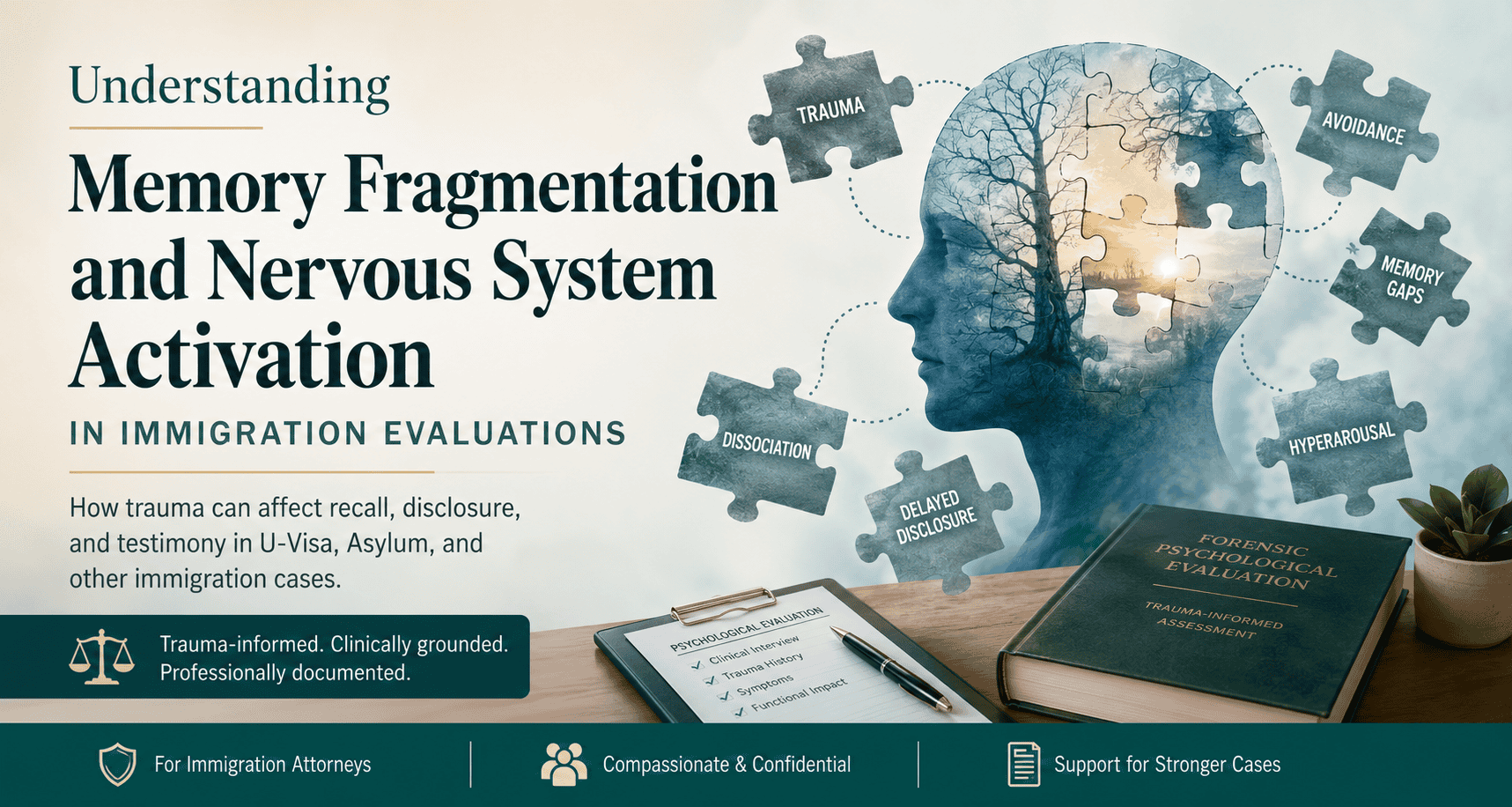
Understanding Memory Fragmentation and Nervous System Activation in Immigration Evaluations

Attorney Resource Guide

Understanding Memory Fragmentation and Nervous System Activation in U-Visa and Asylum Evaluations

Trauma-related immigration evaluations often involve painful histories that are difficult for clients to recall, organize, and describe in a linear way. In U-Visa and asylum-related evaluations, memory fragmentation, avoidance, dissociation, hyperarousal, and nervous system activation may affect how a client presents during the clinical interview and how their history is communicated over time.

Why This Matters for Attorneys

Trauma Narratives Are Often Clinically Complex, Not Simply Linear

Attorneys working on U-Visa and asylum-related matters may notice that clients struggle to provide a clear, chronological, emotionally consistent narrative of traumatic events. Some clients provide limited details at first, remember additional information later, become overwhelmed when asked about specific events, or describe experiences in fragments rather than in a complete timeline.

These patterns can raise concerns during immigration preparation because legal settings often require detailed, organized, and consistent testimony. A trauma-informed psychological evaluation does not determine whether a legal claim is true or false. However, it can help explain clinical factors that may affect recall, disclosure, emotional expression, and interview presentation.

Understanding memory fragmentation and nervous system activation can help attorneys better recognize when a client’s difficulty describing events may be related to trauma symptoms, avoidance, dissociation, fear, shame, or physiological overwhelm.

Trauma Memory

How Trauma Can Affect Recall, Sequencing, and Disclosure

Trauma memories are not always stored or retrieved in the same way as ordinary autobiographical memories. Clients may remember certain sensory details vividly while struggling to recall dates, sequence, duration, or peripheral details.

Fragmented Recall

A client may recall pieces of an event without being able to immediately organize the experience into a complete beginning, middle, and end.

Difficulty With Timeline

Dates, sequence, frequency, and duration may be difficult to recall accurately, especially when events occurred during periods of fear, captivity, repeated abuse, or prolonged stress.

Avoidance and Gaps

Trauma survivors may avoid thinking about certain details, minimize the impact, or leave out painful information because the memory feels overwhelming or unsafe to discuss.

Sensory Details

Some clients remember sounds, smells, physical sensations, images, or bodily reactions more clearly than the exact order of events.

Dissociation

During or after trauma, clients may describe feeling detached, numb, unreal, frozen, confused, or disconnected from what happened.

Delayed Disclosure

Clients may disclose additional information later as trust increases, shame decreases, or the nervous system becomes more regulated.

Nervous System Activation

The Body May Respond Before the Client Can Explain the Story

In trauma-related evaluations, the client’s body may respond as if danger is still present. Discussing the traumatic event may activate fear, panic, shutdown, trembling, tearfulness, numbness, rapid speech, difficulty concentrating, or sudden emotional withdrawal.

These reactions may interfere with the client’s ability to answer questions clearly, maintain chronological order, tolerate follow-up questions, or remain emotionally present during the interview.

Hyperarousal The client may appear anxious, restless, vigilant, startled, tearful, tense, or unable to slow down when discussing traumatic material.
Shutdown or freeze responses The client may become quiet, blank, numb, confused, emotionally flat, or unable to continue discussing certain details.
Reduced concentration High distress may affect attention, working memory, word retrieval, organization, and the ability to answer multi-part questions.
Physiological distress Clients may report panic symptoms, nausea, chest tightness, dizziness, shaking, headaches, or sleep disturbance connected to trauma reminders.

U-Visa and Asylum Context

How Memory and Nervous System Issues May Appear in Different Case Types

U-Visa and asylum-related evaluations may involve different facts, but both can include trauma histories that affect recall, disclosure, emotional regulation, and interview presentation.

Clinical Issue How It May Appear in U-Visa Evaluations How It May Appear in Asylum-Related Evaluations
Fragmented narrative The client may recall parts of the crime, aftermath, police involvement, or emotional impact without a smooth sequence. The client may recall persecution, threats, escape, hiding, or fear of return in non-linear fragments.
Avoidance The client may avoid discussing the crime because it activates fear, shame, grief, or self-blame. The client may avoid discussing persecution, political violence, sexual violence, detention, torture, or family threats.
Hypervigilance The client may remain fearful of the perpetrator, retaliation, law enforcement contact, or community exposure. The client may remain fearful of government actors, gangs, political groups, family retaliation, or return to the country of origin.
Delayed disclosure Additional details may emerge after rapport develops or when the client feels safer describing the crime and its effects. Additional details may emerge as the client becomes more able to discuss fear, harm, loss, persecution, or prior threats.
Dissociation or shutdown The client may become numb, detached, tearful, or unable to continue when recalling the traumatic incident. The client may shut down when discussing violence, captivity, assault, death threats, or memories of fleeing danger.

Clinical Signs

What a Trauma-Informed Evaluator May Look For

A psychological evaluation can help identify whether the client’s presentation is clinically consistent with trauma-related symptoms and whether those symptoms affect functioning, communication, and emotional regulation.

Whether symptoms are connected to trauma reminders.

The evaluator may assess whether anxiety, panic, nightmares, intrusive memories, avoidance, numbness, or hypervigilance are triggered by reminders of the traumatic event or fear of future harm.

How the client responds when discussing painful material.

Observed tearfulness, shaking, guardedness, confusion, emotional flatness, dissociation, or difficulty continuing may help document the client’s nervous system response during the interview.

Whether memory problems are global or trauma-specific.

Some clients have broad cognitive problems, while others are generally organized but become fragmented when discussing trauma-related material.

Whether avoidance affects disclosure.

The evaluator may consider whether shame, fear, distrust, cultural stigma, language barriers, or emotional overwhelm contribute to delayed or limited disclosure.

How symptoms affect daily functioning.

Trauma-related symptoms may affect sleep, parenting, work, school, relationships, medical care, concentration, emotional stability, and the ability to participate in legal processes.

Professional Boundaries

Clinical Evaluation Is Not a Legal Credibility Determination

A trauma-informed evaluator can explain clinical patterns without replacing the role of the attorney, immigration officer, judge, or legal fact-finder.

Appropriate Clinical Role Clinical Question What the Evaluator Should Avoid
Assess symptoms Are the client’s symptoms clinically consistent with trauma, anxiety, depression, dissociation, or PTSD-related impairment? Declaring that the legal claim is true or false.
Explain trauma presentation Could trauma-related symptoms affect recall, sequencing, emotional expression, or disclosure? Excusing every inconsistency or making legal credibility conclusions.
Document functional impact How do symptoms affect sleep, work, relationships, parenting, concentration, safety, and daily life? Offering legal opinions about eligibility, relief, admissibility, or case outcome.
Use clinical language What symptoms, diagnostic impressions, and clinical observations are supported by the evaluation? Writing advocacy language that exceeds the evaluator’s clinical role.

Attorney Value

How Attorneys Can Use This Information Responsibly

Attorneys can support the evaluation process by identifying trauma-related concerns, providing relevant records, and helping the client understand the appointment without coaching clinical responses.

Provide Relevant Context

A short attorney summary can identify the traumatic event, case type, major concerns, language needs, deadlines, and records that may help the evaluator understand the referral question.

Prepare Without Coaching

Clients can be told what to expect during the evaluation, but they should not be told what symptoms to report, what diagnosis to seek, or how emotional they should appear.

Allow Time for Rapport

Trauma survivors may need a calm, structured, respectful interview process before they can disclose painful details or tolerate trauma-related questions.

Address Language Needs

Interpretation needs should be identified early. Trauma narratives can become more difficult to communicate when clients are forced to describe painful events in a less comfortable language.

Share Supporting Records

Police reports, declarations, medical records, therapy records, affidavits, victim services records, and prior documentation may help provide clinical context.

Keep Roles Clear

The attorney explains the legal theory. The evaluator assesses clinical symptoms, functioning, trauma impact, and psychologically relevant observations.

Immigration Evaluation Relevance

Why This Matters in Immigration Psychological Evaluations

Trauma-related nervous system activation can affect how a client remembers, organizes, and discloses painful events. For immigration attorneys, this is especially relevant when a client’s history appears incomplete, emotionally guarded, delayed, or difficult to sequence.

Trauma Symptoms Can Affect the Way a Client Presents

In immigration psychological evaluations, nervous system activation may contribute to difficulty recalling events chronologically, delayed disclosure, incomplete initial histories, avoidance of traumatic material, and apparent inconsistencies that are clinically understandable when viewed in the context of trauma, fear, shame, dissociation, or physiological overwhelm.

This does not mean every inconsistency is trauma-related, and it does not replace the attorney’s role or the legal decision-maker’s role. It means a clinical evaluation can help clarify whether the client’s presentation is consistent with trauma-related symptoms, emotional dysregulation, avoidance, or impaired functioning.

Difficulty recalling events chronologically Trauma survivors may remember emotionally intense or sensory details while struggling to place events in a clear sequence.
Delayed disclosure Additional details may emerge after rapport develops, trust increases, shame decreases, or the client becomes more emotionally regulated.
Incomplete initial histories Clients may initially provide limited details because certain memories feel unsafe, overwhelming, embarrassing, or difficult to verbalize.
Apparent inconsistencies Some differences in wording, sequence, or detail may be clinically understandable when trauma symptoms affect attention, memory, and emotional regulation.
Avoidance of traumatic material A client may minimize, skip, or emotionally distance from painful details because discussing them activates distress, fear, or shutdown.

Bottom Line

Fragmented Trauma Narratives Should Be Evaluated Clinically and Carefully

Memory fragmentation, delayed disclosure, emotional shutdown, and nervous system activation do not automatically prove or disprove a legal claim. However, they may be clinically meaningful when they appear alongside trauma-related symptoms, functional impairment, avoidance, fear responses, and consistent patterns of distress.

A well-written immigration psychological evaluation can help attorneys and decision-makers understand how trauma may affect recall, disclosure, emotional expression, and daily functioning — while staying within appropriate clinical boundaries and avoiding legal conclusions.

Continue Learning

Related Immigration Evaluation Resources for Attorneys

These attorney-focused resources explain how immigration psychological evaluations can document trauma symptoms, hardship, clinical findings, memory patterns, and functional impact while staying within appropriate clinical boundaries.

How Trauma Can Affect Memory Consistency

Learn why trauma-related memory patterns may affect disclosure, sequencing, emotional recall, and perceived consistency.

The Role of PTSD Documentation in Immigration Cases

Review how PTSD-related symptoms, avoidance, hypervigilance, sleep disruption, and functional impairment may be documented.

What Makes a Clinically Strong Immigration Psychological Evaluation?

Learn what makes an evaluation clinically useful, trauma-informed, organized, and appropriate for immigration referral questions.

Clinical vs. Legal Opinions in Immigration Evaluations

Understand the difference between clinical documentation and legal conclusions in immigration evaluations.

Understanding Extreme Hardship in Immigration Psychological Evaluations

Explore how evaluations may document emotional, medical, caregiving, family separation, and functional impact concerns.

2026 Immigration Psychological Evaluation Clinical Findings Report

Review clinical trends, common symptoms, diagnoses, trauma histories, and hardship factors observed across evaluations.

U-Visa Psychological Evaluations

Learn how trauma-informed evaluations may document emotional harm, victimization impact, fear, and functional impairment.

Asylum Psychological Evaluations

Learn how asylum-related evaluations may document trauma symptoms, fear of return, and psychological impact.

Immigration Attorney Resource Library

Visit the attorney resource hub for additional articles, referral information, and evaluation guidance.

Susan Baker, M.Ed., NCC, LPC-S

Article Author

Written by a Licensed Texas Mental Health Professional Who Provides Immigration Psychological Evaluations for Attorney-Referred Cases

This article was written for Motivations Counseling by Susan Baker, M.Ed., NCC, LPC-S, a Texas Licensed Professional Counselor Supervisor and clinical leader with experience providing immigration psychological evaluations and trauma-informed mental health assessments.

Susan Baker, M.Ed., NCC, LPC-S
Texas Licensed Professional Counselor Supervisor
Immigration Psychological Evaluation Provider
EMDR Therapist & EMDRIA Member
Texas LPC License #73957

Susan Baker provides trauma-informed immigration psychological evaluations, counseling, EMDR therapy, and mental health assessment services through Motivations Counseling. Immigration-related articles are provided for educational purposes and are not legal advice. Motivations Counseling serves clients from offices in Sugar Land and Katy, Texas, with telehealth services available statewide for Texas residents when clinically appropriate.

Attorney Referrals

Need to Refer a Client for a U-Visa or Asylum Psychological Evaluation?

Motivations Counseling provides trauma-informed, forensic-style immigration psychological evaluations for attorneys and clients throughout Texas. Evaluations may help document trauma symptoms, nervous system activation, memory-related clinical concerns, emotional distress, and functional impact while staying within appropriate clinical boundaries.


What Attorneys Should Provide Before an Immigration Psychological Evaluation

Attorney Resource Guide

What Attorneys Should Provide Before an Immigration Psychological Evaluation

Immigration psychological evaluations are strongest when the evaluator has enough context to understand the referral question, relevant immigration matter, client history, hardship factors, trauma concerns, and available supporting records. A focused referral packet can help the evaluation remain efficient, clinically grounded, and useful to the attorney — without compromising the evaluator’s independent clinical role.

Why This Matters for Attorneys

A Strong Referral Packet Helps the Evaluation Focus on the Right Clinical Questions

Immigration psychological evaluations may involve hardship waivers, VAWA, cancellation of removal, asylum-related concerns, U Visa matters, T Visa matters, N-648 disability documentation, and other immigration-related issues. Each type of case may involve different clinical questions and different supporting records.

Attorneys can often improve the usefulness of the evaluation by providing a concise case summary, the referral question, relevant deadlines, key family relationships, available records, and any specific issues the evaluator should understand before the clinical interview.

The goal is not to script the evaluation or tell the clinician what to conclude. The goal is to give the evaluator enough context to conduct a focused, trauma-informed, clinically independent assessment.

Important Clarification

Helpful Records Are Useful, But Not Every Case Requires Every Document

Attorneys do not need to delay an evaluation until every possible record is collected. The most useful documents depend on the case type, referral question, deadline, and client circumstances.

Issue Helpful Attorney Support What to Avoid
Referral context Provide a short case summary, immigration matter type, key relatives, deadline, and clinical question. Sending a large file dump with no explanation of what matters most.
Records Send records that directly relate to hardship, trauma, medical vulnerability, mental health, caregiving, or disability. Assuming the evaluator needs every legal document or every filing in the case.
Client preparation Help the client understand the appointment format, confidentiality, payment, language needs, and timeline. Coaching the client on what to say or encouraging exaggerated responses.
Clinical independence Clarify the legal context while allowing the evaluator to independently assess symptoms and functioning. Requesting a predetermined diagnosis, conclusion, or legal finding.

Referral Packet

Core Items Attorneys May Provide Before the Evaluation

A focused referral packet helps the evaluator understand the case context without overwhelming the clinical process.

Attorney Case Summary

A concise summary can identify the case type, referral question, timeline, key family members, major hardship themes, trauma concerns, and documents being provided.

Referral Question

Clarify whether the evaluation should focus on hardship, trauma impact, abuse-related symptoms, fear of return, disability-related functioning, caregiving strain, or another clinical issue.

Deadline and Urgency

If the report is time-sensitive, identify the requested completion date early. This helps clarify whether expedited scheduling or report preparation may be realistic.

Client Declaration

A declaration may help the evaluator understand the client’s personal history, family relationships, trauma exposure, hardship concerns, relocation fears, and emotional impact.

Prior Mental Health Records

Therapy records, psychiatric records, hospitalizations, medications, diagnoses, or treatment summaries may help document symptom history and clinical progression.

Medical Documentation

Medical records may be important when physical illness, disability, treatment access, caregiving needs, medication management, or medical vulnerability contributes to hardship.

Case-Specific Documents

Helpful Records by Immigration Evaluation Type

The strongest referral packets are tailored to the type of evaluation rather than using the same document list for every case.

Evaluation Type Potentially Helpful Records Why They May Matter Clinically
Hardship Waiver Qualifying-relative information, medical records, school records, financial strain summaries, caregiving documentation, mental health history, declarations. Helps assess emotional hardship, separation impact, relocation stress, medical vulnerability, family disruption, and functional impairment.
VAWA Client declaration, protective orders, police reports if available, medical records, therapy records, photographs, affidavits, documentation of abuse impact. Helps contextualize trauma symptoms, coercive control, emotional abuse, fear, PTSD symptoms, depression, and safety-related concerns.
Asylum-Related Evaluation Declaration, medical records, prior mental health records, documentation of threats or persecution, attorney summary of clinically relevant concerns. Helps assess trauma history, fear responses, PTSD symptoms, avoidance, hypervigilance, and fear of return.
U Visa Police report if available, declaration, medical records, therapy records, victim services documentation, affidavits, records of ongoing safety concerns. Helps document trauma-related symptoms, emotional harm, fear, functional impairment, and psychological impact of victimization.
T Visa Declaration, service-provider records, medical or therapy records, safety planning documentation, affidavits, available records related to exploitation or coercion. Helps assess trafficking-related trauma, shame, fear, coercive control, dissociation, distrust, and difficulty disclosing exploitation.

Document Organization

How Attorneys Can Make Records More Useful to the Evaluator

Well-organized records can save time, reduce confusion, and help the evaluator focus on clinically relevant information.

Practical Tip

A Short Summary Is Often More Helpful Than a Large Unlabeled File

Evaluators may receive declarations, medical records, school records, affidavits, legal filings, and prior treatment records. The documents are easier to use when they are labeled, prioritized, and connected to the referral question.

The most helpful packet tells the evaluator what the records are and why they may matter clinically.

Label files clearly Use file names such as “Client Declaration,” “Medical Records,” “School Records,” or “Prior Therapy Summary.”
Prioritize key documents Identify which documents are most important for hardship, trauma, disability, caregiving, or mental health concerns.
Provide relevant dates Helpful dates may include filing deadlines, major traumatic events, medical diagnoses, separations, hospitalizations, or treatment history.
Clarify language needs Note whether the client prefers Spanish, English, or another language, and whether interpretation support may be needed.

Professional Boundaries

Records Support the Evaluation, But They Do Not Replace Clinical Assessment

Supporting documents can help, but the clinical interview and independent evaluation remain central.

Documents provide context.

Records can help the evaluator understand family history, medical needs, trauma exposure, hardship themes, school concerns, treatment history, or prior diagnoses.

The evaluator must still independently assess symptoms.

A strong evaluation includes the client’s self-report, clinical interview, observed presentation, assessment results when appropriate, and the evaluator’s independent clinical impressions.

Attorneys should not coach clinical responses.

It is appropriate to explain the appointment process. It is not appropriate to tell the client what symptoms to report, what diagnosis to seek, or how to present emotionally.

Clinical findings should not be predetermined.

Attorneys may identify the legal context and referral question, but the evaluator must determine symptoms, diagnoses, impairment, and recommendations based on clinical assessment.

Authorization matters.

Communication between the evaluator and attorney requires appropriate client authorization. Confidentiality, informed consent, and report delivery should be handled carefully.

Attorney Value

What Makes a Referral More Efficient and Clinically Useful?

Attorneys can often improve the evaluation process by providing focused information without overwhelming or directing the clinical assessment.

Clear Referral Question

The evaluator can better focus the clinical interview when the attorney clarifies whether the primary concern is hardship, trauma, disability, fear of return, abuse impact, or functional impairment.

Relevant Records

Records are most useful when they directly relate to the client’s psychological symptoms, hardship factors, trauma history, medical vulnerability, or caregiving responsibilities.

Realistic Timeline

Early notice of deadlines helps clarify scheduling, assessment needs, report preparation, and whether expedited options may be available.

Bottom Line

The Best Referral Packets Are Focused, Organized, and Clinically Relevant

Attorneys do not need to provide every record in the case. The most useful information is the information that helps the evaluator understand the clinical referral question, client background, relevant stressors, hardship factors, trauma concerns, disability issues, and available supporting documentation.

A focused packet helps the evaluator prepare for a more efficient and clinically meaningful evaluation while preserving professional independence and appropriate clinical scope.

Continue Learning

Related Immigration Evaluation Resources for Attorneys

These attorney-focused resources explain how immigration psychological evaluations can document hardship, trauma symptoms, clinical findings, and functional impact while staying within appropriate clinical boundaries.

2026 Immigration Psychological Evaluation Clinical Findings Report

Review clinical trends, common symptoms, diagnoses, trauma histories, and hardship factors observed across immigration psychological evaluations.

What Makes a Clinically Strong Immigration Psychological Evaluation?

Learn what makes an evaluation clinically useful, well-organized, trauma-informed, and appropriate for immigration-related referral questions.

Clinical vs. Legal Opinions in Immigration Evaluations

Understand the difference between clinical documentation and legal conclusions, including why evaluators should avoid making legal determinations.

Understanding Extreme Hardship in Immigration Psychological Evaluations

Explore how hardship evaluations may document emotional, medical, caregiving, family separation, and functional impact concerns.

The Role of PTSD Documentation in Immigration Cases

Review how trauma symptoms, PTSD-related impairment, avoidance, hypervigilance, sleep disruption, and functional impact may be documented.

How Trauma Can Affect Memory Consistency

Learn why trauma-related memory patterns may affect disclosure, sequencing, emotional recall, and perceived consistency during evaluations.

The Psychological Impact of Family Separation

Understand how separation fears may affect children, caregivers, attachment, emotional functioning, and family stability.

Immigration Attorney Resource Library

Visit the attorney resource hub for additional articles, referral information, and guidance about immigration psychological evaluations.

Immigration Evaluation Resource Center

Explore the main resource center for clients, families, and attorneys seeking information about immigration psychological evaluations.

Attorney Referrals

Need to Refer a Client for an Immigration Psychological Evaluation?

Motivations Counseling provides trauma-informed, forensic-style immigration psychological evaluations for attorneys and clients throughout Texas. Attorneys may submit referral information, case context, deadlines, and relevant records through the attorney referral process.

What Makes an Immigration Psychological Evaluation Clinically Strong?

Attorney Resource Guide

What Makes an Immigration Psychological Evaluation Clinically Strong?

For immigration attorneys, a psychological evaluation is most useful when it does more than summarize distress. A clinically strong evaluation explains the client’s psychological presentation, connects symptoms to real-world functioning, documents trauma-informed clinical findings, and remains carefully within the evaluator’s professional scope.

Why This Matters

A Strong Evaluation Gives Attorneys Clinically Useful Documentation, Not Just a Diagnosis

Immigration-related psychological evaluations are often requested in matters involving hardship waivers, VAWA, cancellation of removal, asylum-related concerns, U Visa cases, T Visa cases, N-648 matters, and other immigration proceedings. These evaluations may involve trauma, abuse, family separation, fear of return, medical vulnerability, caregiving responsibilities, or serious emotional hardship.

A weak report may simply state that a client is anxious, depressed, traumatized, or afraid. A stronger report explains how those symptoms appear, how they affect daily functioning, how they relate to the client’s history and circumstances, and what clinical recommendations follow.

The evaluator’s role is not to make legal conclusions. The evaluator’s role is to provide organized, clinically grounded mental health documentation that attorneys can consider within the broader legal case.

Important Distinction

Therapy Letter vs. Forensic-Style Immigration Psychological Evaluation

One of the most important distinctions for attorneys is the difference between a supportive treatment letter and a structured immigration psychological evaluation.

Issue Supportive Therapy Letter Clinically Strong Immigration Evaluation
Purpose Often confirms treatment participation, general symptoms, or therapeutic concerns. Provides structured clinical documentation specific to the immigration referral question.
Clinical Depth May be brief and based primarily on treatment relationship. Includes psychosocial history, symptom analysis, functional impairment, assessment findings, and clinical impressions.
Objectivity May sound supportive or advocacy-oriented because it arises from a therapeutic relationship. Maintains a more evaluative tone, documenting findings while avoiding legal conclusions.
Usefulness to Attorneys Can provide helpful background but may not answer the immigration-specific referral question. Organizes clinically relevant facts, symptoms, and impairment in a format attorneys can more easily review and incorporate.

Core Components

Key Elements of a Clinically Strong Immigration Evaluation

A strong report does not depend on dramatic language. It depends on specificity, organization, clinical reasoning, and a clear connection between symptoms and functioning.

Clear Referral Question

The report should identify the immigration-related context and the clinical purpose of the evaluation, such as hardship impact, trauma symptoms, abuse-related distress, fear of return, or functional impairment.

Structured Clinical Interview

The interview should address psychosocial history, immigration stressors, trauma history, family dynamics, medical concerns, educational or occupational history, and current emotional functioning.

Symptom-Specific Documentation

Strong reports describe symptoms with specificity, including panic, depression, sleep disruption, intrusive memories, avoidance, hypervigilance, irritability, grief, shame, or emotional numbing.

Functional Impairment Analysis

Attorneys often need to understand how symptoms affect parenting, work, caregiving, concentration, medical follow-through, daily routines, emotional regulation, and relationships.

Assessment Integration

Screening tools may support clinical findings, but they should be interpreted in context. Scores should not replace clinical judgment, trauma-informed interviewing, or functional analysis.

Clinical Scope Boundaries

The report should document clinical findings without stating that a legal standard has been met or that a person qualifies for immigration relief.

Trauma Memory & Disclosure

Clinically Strong Evaluations Consider More Than Symptoms and Diagnoses

Clinically strong immigration psychological evaluations consider not only symptoms and diagnoses, but also how trauma may affect memory, disclosure, emotional expression, nervous system activation, and daily functioning.

This is especially important in cases involving trauma, abuse, criminal victimization, trafficking, persecution, family separation, or fear of return. Clients may present with fragmented recall, delayed disclosure, avoidance, guardedness, dissociation, emotional numbing, hypervigilance, or difficulty organizing painful events into a clear chronological narrative.

A strong evaluation does not make legal credibility determinations or assume every inconsistency is trauma-related. Instead, it carefully documents whether trauma-related symptoms appear clinically meaningful and whether they affect recall, disclosure, emotional presentation, interview participation, or functional impairment. For a deeper discussion, see Understanding Memory Fragmentation and Nervous System Activation in Immigration Evaluations.

Attorney Usefulness

Weak vs. Strong Immigration Psychological Evaluations

Attorneys can usually tell quickly whether a report is generic or clinically meaningful. The difference is often specificity, reasoning, and organization.

Report Area Weak Evaluation Stronger Evaluation
Symptoms Uses vague statements such as “client is depressed” or “client has anxiety.” Describes symptom patterns, frequency, severity, triggers, duration, and clinical presentation.
Functional Impact Mentions distress without explaining how life is affected. Connects symptoms to parenting, work, sleep, relationships, concentration, caregiving, or daily functioning.
Trauma Lists traumatic events without explaining psychological effects. Documents intrusive symptoms, avoidance, hyperarousal, emotional numbing, shame, dissociation, or fear responses when clinically present.
Assessments Reports scores without interpretation. Explains what assessment results suggest and how they fit with the interview and observed presentation.
Conclusions Uses conclusory or legal-sounding statements. Offers clinical impressions and recommendations while leaving legal analysis to the attorney.

Evaluation Methodology

What Makes the Evaluation Method Clinically Strong?

A strong evaluation is not simply longer. It is better organized, more clinically precise, and more careful in how it connects history, symptoms, impairment, and recommendations.

It begins with the referral question.

The evaluator should understand whether the clinical focus involves hardship, trauma, abuse, disability, fear of return, caregiving strain, psychological impairment, or another immigration-related concern.

It uses trauma-informed interviewing.

Trauma survivors may present with avoidance, shame, guardedness, emotional numbing, dissociation, fragmented recall, delayed disclosure, or physiological distress. A strong evaluation considers these possibilities without assuming that every inconsistency is trauma-related.

It evaluates functioning, not just symptoms.

Attorneys need more than a diagnosis. They need to understand how symptoms affect the client’s life: sleep, parenting, work, caregiving, concentration, relationships, medical care, decision-making, and stress tolerance.

It integrates records and collateral information when available.

Medical records, declarations, school records, affidavits, police reports, prior therapy records, or attorney summaries may help contextualize the client’s presentation. These records support the evaluation but do not replace clinical judgment.

It uses measured clinical language.

Strong reports avoid exaggeration, advocacy tone, legal conclusions, and unsupported certainty. They explain what the evaluator found clinically and why those findings matter from a mental health perspective.

What Attorneys Often Need

Useful Reports Help Attorneys See the Clinical Story Clearly

A clinically strong evaluation should make it easier for an attorney to identify the psychological issues that may be relevant to the case. The report should not require the attorney to guess how symptoms affect functioning or why the client’s presentation matters clinically.

The strongest reports are organized enough to be useful and restrained enough to remain credible.

Specific symptom language Clear descriptions of anxiety, depression, trauma symptoms, sleep disruption, panic, avoidance, or emotional dysregulation.
Functional examples Concrete explanation of how symptoms affect parenting, work, caregiving, relationships, medical care, or daily functioning.
Appropriate scope Clinical findings and treatment recommendations without legal conclusions or eligibility statements.
Organized report sections Referral question, history, symptoms, impairment, assessments, clinical impressions, diagnoses, and recommendations.

Common Problems

What Makes an Evaluation Less Useful?

Many reports fail not because they are short, but because they are vague, conclusory, poorly organized, or outside appropriate clinical scope.

Boilerplate Language

Generic paragraphs that could apply to almost anyone weaken the report and reduce confidence in the evaluator’s case-specific analysis.

Diagnosis Without Explanation

A diagnosis is more meaningful when the report explains the symptoms, history, impairment, and clinical reasoning supporting the impression.

Legal Conclusions

Statements that a client “qualifies,” “meets the legal standard,” or “should be approved” cross into the attorney’s role.

Learning Center

Continue Exploring Immigration Evaluation Resources

Learn more about trauma documentation, PTSD symptoms, hardship evaluations, family separation, attorney referral preparation, and the clinical findings commonly documented in immigration psychological evaluations.

Understanding Memory Fragmentation and Nervous System Activation in Immigration Evaluations

Learn how trauma may affect memory, disclosure, emotional expression, nervous system activation, and clinical presentation during immigration psychological evaluations.

2026 Immigration Psychological Evaluation Clinical Findings Report

Review aggregate clinical findings, common diagnoses, trauma histories, functional impairments, symptom patterns, and treatment recommendations documented across immigration evaluations.

The Role of PTSD Documentation in Immigration Cases

Explore how PTSD symptoms, trauma responses, avoidance, hypervigilance, sleep disruption, and emotional distress may be documented clinically.

How Trauma Can Affect Memory Consistency

Learn how trauma may affect recall, chronology, disclosure patterns, emotional presentation, and perceived consistency during evaluations.

Understanding Extreme Hardship in Immigration Psychological Evaluations

Review how emotional hardship, family separation, caregiving concerns, medical vulnerability, and psychological symptoms may be documented.

Clinical vs. Legal Opinions in Immigration Evaluations

Understand the distinction between clinical findings and legal conclusions, and why maintaining that boundary strengthens evaluation credibility.

What Attorneys Should Provide Before an Immigration Psychological Evaluation

Review what records, declarations, timelines, collateral documents, and referral information can improve evaluation quality.

The Psychological Impact of Family Separation

Examine the emotional, developmental, attachment, and family-system effects of actual or anticipated separation.

Immigration Attorney Resource Library

Browse attorney-focused resources covering immigration psychological evaluations, trauma documentation, hardship evidence, and referral guidance.

Immigration Evaluation Resource Center

Explore the primary hub for immigration evaluation education, attorney resources, and evaluation-related articles.

Attorney Referrals

Need a Clinically Detailed Immigration Psychological Evaluation?

Motivations Counseling provides trauma-informed, forensic-style immigration psychological evaluations for attorneys and clients throughout Texas. Reports are designed to document mental health findings clearly, professionally, and within appropriate clinical scope.

The Importance of Forensic Immigration Evaluations | USCIS-Focused Psychological Assessments

Immigration Psychological Evaluations

The Importance of Forensic Immigration Evaluations

A strong immigration psychological evaluation is more than a summary of symptoms. It is a carefully prepared forensic-style clinical report that helps USCIS officers, immigration attorneys, and immigration judges better understand a person’s psychological functioning, trauma history, hardship, risk factors, and emotional impact in a clear and clinically grounded way.

At Motivations Counseling, immigration evaluations are designed with careful documentation, trauma-informed interviewing, forensic-style organization, and USCIS- and immigration-court-informed reporting in mind.

Forensic-Style Clinical Documentation

What Makes an Immigration Evaluation “Forensic”?

A forensic immigration evaluation is different from a therapy intake, counseling summary, or general mental health letter. In therapy, the clinician’s role is primarily treatment and support. In a forensic-style evaluation, the clinician’s role is to conduct a structured, objective, and clinically defensible assessment for a specific immigration-related purpose.

A forensic-style evaluation is not simply about diagnosing a client. It is about explaining the clinical meaning of the person’s symptoms, history, functioning, trauma responses, and psychological risk factors in a way that is relevant to the immigration matter.

A strong report uses clinical interviewing, psychological screening tools when appropriate, record review, behavioral observations, collateral information when available, and careful clinical reasoning. The goal is to provide useful psychological information while staying within the evaluator’s professional role.

Why Quality Matters

Forensic Quality Helps Turn Personal Distress Into Clear Clinical Documentation

Immigration decisions often involve deeply personal facts: family separation, trauma, abuse, fear of return, medical vulnerability, emotional hardship, or rehabilitation. A well-prepared forensic-style immigration evaluation can help organize these concerns into a clear clinical picture.

Clear Clinical Evidence

A forensic-style report can document symptoms, diagnoses, functional impairment, trauma responses, and emotional hardship in a structured and professional format.

Stronger Case Organization

A detailed evaluation can help connect personal history, psychological symptoms, and immigration-related hardship into one coherent clinical narrative.

Professional Credibility

Reports that are balanced, objective, and clinically grounded are generally more useful than reports that sound generic, overly emotional, or advocacy-driven.

Core Elements

Core Elements of a Strong Forensic Immigration Evaluation

At Motivations Counseling, we focus on the elements that make an immigration evaluation more complete, useful, and defensible.

Clinical and Forensic Preparation

  • Clarifying the immigration referral question
  • Reviewing relevant records when available
  • Understanding the type of immigration relief involved
  • Identifying the psychological issues most relevant to the case
  • Preparing trauma-informed interview questions

Detailed Clinical Assessment

  • Psychosocial and developmental history
  • Trauma and abuse history when relevant
  • Immigration and migration stressors
  • Current symptoms and emotional functioning
  • Functional impairment in daily life, work, parenting, and relationships

Forensic-Style Analysis

  • Behavioral observations during the interview
  • Symptom consistency and clinical plausibility
  • Connections between trauma, hardship, and current functioning
  • Careful diagnostic reasoning
  • Clear discussion of clinical limitations

Readable Reporting

  • Organized sections and clear headings
  • Plain-language explanations for non-clinical readers
  • Clinical conclusions tied to the referral question
  • Avoidance of unsupported legal conclusions
  • Professional recommendations when appropriate

Clinical Value

How a Forensic Evaluation Can Benefit an Immigration Case

A forensic-style immigration evaluation may help an attorney, USCIS officer, or immigration judge better understand the human and psychological dimensions of the case. It can provide clinical context that may not be fully captured in legal forms, personal declarations, or medical records alone.

The value of a forensic-style evaluation is clarity. It helps explain what the client has experienced, how those experiences affected mental health, and how symptoms or hardship show up in real life.

Depending on the case type, a forensic-style evaluation may address trauma-related symptoms, anxiety, depression, panic attacks, sleep disturbance, family hardship, fear of return, domestic violence impact, crime-related trauma, emotional dependency, parenting concerns, or psychiatric stability.

USCIS and Immigration Court

Forensic-Style Evaluations for USCIS and Immigration Court

Motivations Counseling prepares immigration psychological evaluations for matters involving USCIS and immigration court, including cases that may be reviewed by immigration judges. Reports are written to be clinically detailed while remaining organized, professional, and understandable.

Trauma-Informed

We recognize how trauma can affect memory, emotional expression, avoidance, disclosure, and nervous system responses.

Clinically Grounded

We use mental health assessment skills, diagnostic reasoning, and functional analysis to support clinical impressions.

Forensically Focused

We write with the immigration purpose in mind while avoiding unsupported legal opinions or exaggerated claims.

Evaluation Types

Examples of Immigration Matters That May Benefit From a Forensic Evaluation

Immigration psychological evaluations may be helpful across multiple case types when psychological symptoms, trauma, hardship, family disruption, fear, or functional impairment are clinically relevant.

Common USCIS-Related Matters

  • Hardship waivers
  • I-601 and I-601A waiver cases
  • VAWA petitions
  • U Visa and T Visa matters
  • Asylum-related evaluations

Additional Immigration Contexts

  • Cancellation of removal
  • Immigration court evaluations
  • Trauma-related immigration matters
  • Family separation hardship cases
  • INA § 212 mental health-related concerns

Bottom Line

What Makes a Report Stronger?

The strongest immigration evaluations are careful, balanced, and specific. They do not rely on dramatic language or generic conclusions. Instead, they explain the clinical findings in a way that is detailed, credible, and connected to the specific immigration issue.

A strong forensic-style evaluation should answer the question: “What does this person’s psychological history and current functioning mean in the context of this immigration case?”

At Motivations Counseling, we emphasize functional examples, trauma-informed interpretation, symptom consistency, clinical reasoning, and clear conclusions. This allows the report to support the legal team while remaining professionally independent and clinically appropriate.

Learning Center

Continue Exploring Immigration Evaluation Resources

Learn more about clinical findings, trauma documentation, hardship evaluations, attorney referral preparation, family separation, and what makes immigration psychological evaluations clinically useful.

2026 Immigration Psychological Evaluation Clinical Findings Report

Review aggregate clinical findings, common diagnoses, trauma histories, functional impairments, symptom patterns, and treatment recommendations documented across immigration evaluations.

What Makes a Clinically Strong Immigration Psychological Evaluation?

Learn what makes an evaluation organized, trauma-informed, clinically useful, and appropriate for immigration-related referral questions.

Clinical vs. Legal Opinions in Immigration Evaluations

Understand the distinction between clinical findings and legal conclusions, and why maintaining that boundary strengthens evaluation credibility.

What Attorneys Should Provide Before an Immigration Psychological Evaluation

Review what records, declarations, timelines, collateral documents, and referral information can improve evaluation quality.

Understanding Extreme Hardship in Immigration Psychological Evaluations

Review how emotional hardship, family separation, caregiving concerns, medical vulnerability, and psychological symptoms may be documented.

The Role of PTSD Documentation in Immigration Cases

Explore how PTSD symptoms, trauma responses, avoidance, hypervigilance, sleep disruption, and emotional distress may be documented clinically.

How Trauma Can Affect Memory Consistency

Learn how trauma may affect recall, chronology, disclosure patterns, emotional presentation, and perceived consistency during evaluations.

The Psychological Impact of Family Separation

Examine the emotional, developmental, attachment, and family-system effects of actual or anticipated separation.

Immigration Attorney Resource Library

Browse attorney-focused resources covering immigration psychological evaluations, trauma documentation, hardship evidence, and referral guidance.

Schedule an Immigration Evaluation

Need a Forensic-Style Immigration Psychological Evaluation?

Motivations Counseling provides forensic-style immigration psychological evaluations for clients and attorneys throughout Texas. Reports are designed to be trauma-informed, clinically grounded, and carefully structured for USCIS and immigration court use.

×