
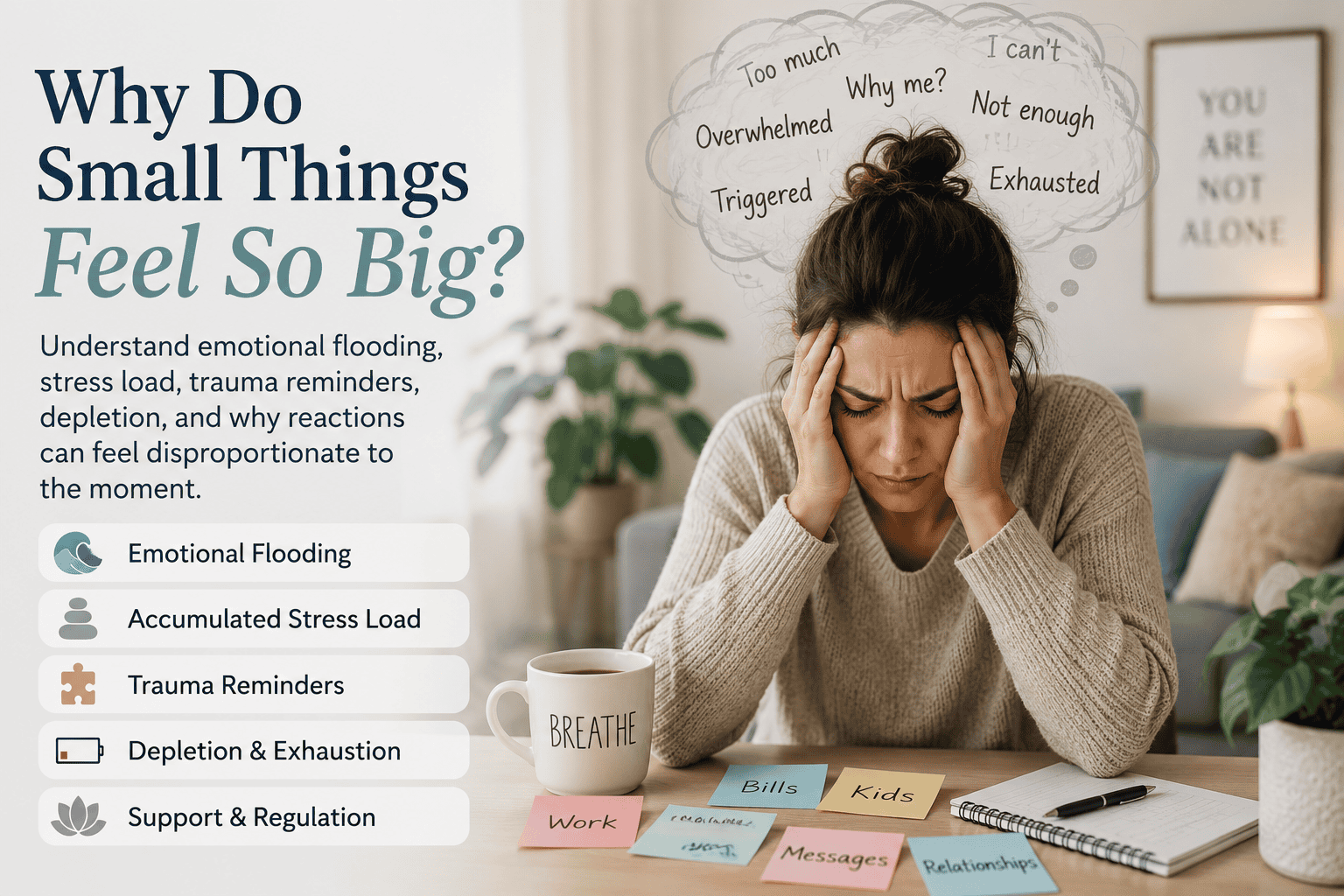
Why Do Small Things Feel So Big?
Emotional Overwhelm & Nervous System Resources
Why Do Small Things Feel So Big?
A reaction can feel much larger than the immediate moment when emotional flooding, accumulated stress, trauma reminders, exhaustion, or other forms of depletion have already reduced the amount of pressure your system can manage.
Start Here
The Final Trigger May Be Small, but the Total Load May Not Be
A spilled drink, a delayed reply, a change in plans, a critical tone, a noisy room, or one more request may appear minor from the outside. Yet the reaction can feel immediate and intense: tears, anger, panic, defensiveness, shutting down, leaving the room, or feeling unable to think clearly.
This does not necessarily mean that you are reacting only to the final event. The moment may be landing on top of hours, days, or years of pressure. The nervous system responds not only to what is happening now, but also to current capacity, expectations, physical state, prior learning, relationship history, and whether the situation resembles something that once felt dangerous, humiliating, unpredictable, or impossible to control.
Why Can a Small Thing Feel So Big?
A reaction may feel disproportionate when the immediate trigger is viewed by itself. It may feel more understandable when the full context is included: accumulated stress, low sleep, pain, anxiety, grief, unresolved conflict, sensory overload, trauma reminders, perfectionism, caregiving demands, hunger, illness, hormonal changes, or the effort required to keep functioning while overwhelmed.
Emotional Flooding
The System Can Become Too Activated to Process the Moment Flexibly
Emotional flooding describes a state in which physiological and emotional activation rises faster than the person can comfortably organize, communicate, or regulate it. The body may prepare to fight, escape, freeze, appease, or shut down before the thinking mind has fully understood what happened.
Rapid Body Activation
Heart rate, breathing, muscle tension, heat, trembling, nausea, or pressure in the chest may increase quickly.
Narrowed Attention
The mind may focus on the most threatening interpretation while losing access to context, nuance, or alternative explanations.
Communication Difficulty
Words may come out sharply, disappear completely, or feel impossible to organize while activation is high.
Urgent Action
There may be a strong urge to fix the issue immediately, defend yourself, leave, send a message, or end the conversation.
Freeze or Shutdown
Some people go blank, numb, tired, detached, unable to decide, or unable to respond even when they want to.
Repetitive Thinking
The mind may replay the event, search for certainty, rehearse arguments, or repeatedly check what happened.
Flooding is not evidence that the feeling is fake or intentionally exaggerated. It means the system is having difficulty staying within a range where emotion, reasoning, language, and choice remain available at the same time.
Accumulated Stress
The “Last Straw” Is Usually Not the Whole Story
Stress accumulates when demands continue faster than the body and mind can recover. Each individual pressure may be manageable, yet the combined load can gradually reduce patience, concentration, emotional flexibility, and the ability to tolerate additional uncertainty.
The final trigger may release a reaction that has been building through work pressure, family needs, financial concerns, caregiving, unresolved conflict, health worries, poor sleep, grief, or the effort required to appear capable when you do not feel okay internally.
Stress-Load Example
One More Request Can Feel Impossible
- You slept poorly and started the day already depleted.
- Several work problems required constant attention.
- You skipped a meal and have been managing a headache.
- A family member needed reassurance or practical help.
- You received a message that created uncertainty.
- Then someone asks a simple question, and you suddenly cry or snap.
The question did not necessarily create the full reaction. It may have exceeded the remaining capacity after many earlier demands had already used most of it.
Trauma Reminders and Learned Threat
The Present Moment May Resemble an Earlier Experience
Trauma reminders are cues that resemble an earlier experience of danger, helplessness, rejection, humiliation, betrayal, loss, or lack of control. The reminder may be obvious, such as a location or anniversary, or subtle, such as a facial expression, tone of voice, silence, smell, body sensation, closed door, abrupt change, or feeling ignored.
The nervous system may respond to the similarity before the person consciously recognizes the connection. A present-day disagreement can therefore feel as though it carries the emotional weight of earlier situations in which disagreement led to punishment, abandonment, intimidation, or emotional withdrawal.
Possible trauma-reminder patterns include:
- A neutral tone feels critical because it resembles past criticism.
- A delayed response feels like abandonment because silence once signaled rejection or danger.
- A change in plans feels intolerable because unpredictability was once associated with chaos.
- Being misunderstood feels unbearable because your reality was repeatedly dismissed.
- A minor mistake triggers panic because mistakes once led to shame, punishment, or loss of safety.
- Someone standing too close, raising their voice, or blocking an exit creates immediate physical alarm.
A strong reaction does not prove that trauma is the cause. Similar reactions can also occur with anxiety, depression, burnout, sensory sensitivity, relationship strain, sleep deprivation, ADHD, autism, medical conditions, medication effects, or other factors. A qualified professional can help assess the broader pattern without assuming a diagnosis.
Physical and Emotional Depletion
Capacity Changes From Day to Day
The same event may feel manageable one day and overwhelming another because regulation depends partly on available physical, cognitive, emotional, and social resources.
Sleep Loss
Poor or interrupted sleep can reduce concentration, frustration tolerance, impulse control, and emotional recovery.
Burnout and Overwork
Long periods of responsibility without meaningful recovery can make even ordinary demands feel excessive.
Pain or Illness
Pain, inflammation, illness, medication effects, hormonal changes, and physical discomfort can reduce available coping capacity.
Hunger and Blood-Sugar Changes
Skipped meals or inadequate nutrition may contribute to shakiness, irritability, weakness, anxiety-like sensations, or difficulty thinking clearly.
Sensory Overload
Noise, light, touch, clutter, crowds, heat, interruptions, or competing conversations can consume additional processing capacity.
Lack of Support
Carrying responsibilities alone, feeling unseen, or believing that no one can help may make every additional task feel heavier.
Emotional regulation is not separate from the body. Rest, nourishment, medical care, medication review, pain treatment, movement, and reduced sensory input may be important parts of understanding why reactions intensify.
The Meaning Attached to the Moment
We React to What an Event Seems to Mean—not Only to the Event Itself
Two people can experience the same event and respond differently because the event carries different meanings. A forgotten task may mean “a normal mistake” to one person and “I am failing everyone” to another. A delayed text may mean “they are busy” or “I am being rejected.”
Meanings are shaped by beliefs, expectations, relationship patterns, earlier experiences, culture, current mood, and what the person fears may happen next.
Common High-Impact Meanings
The Trigger May Touch a Larger Fear
- “I am not safe.”
- “I am going to be abandoned.”
- “I have disappointed everyone.”
- “I am losing control.”
- “No one listens unless I become visibly upset.”
- “I am responsible for keeping everyone okay.”
- “One mistake will prove that I am incompetent.”
Understanding the meaning does not require agreeing that the feared outcome is certain. It helps explain why the nervous system responded as though the moment carried more danger, loss, or consequence than an outside observer might see.
What Happens During an Intense Reaction
The Body and Mind May Shift Into Protection at the Same Time
Emotional reactions are whole-body experiences. Physical activation, attention, memory, interpretation, and behavior can influence one another in a rapid feedback loop.
Breathing Changes
Breath-holding, shallow breathing, rapid breathing, frequent sighing, or throat tightness may increase alarm sensations.
Threat Scanning
Attention may search for evidence that something is wrong and overlook information that suggests safety or misunderstanding.
Memory Activation
Earlier experiences with a similar emotional theme may become more accessible than calm or reassuring memories.
Reduced Flexibility
It can become harder to hold two perspectives, tolerate uncertainty, delay action, or consider that the event may have several explanations.
Emotional Release
Crying, anger, panic, or numbness may reflect both the immediate event and emotion that has been contained until that moment.
Protective Behavior
Arguing, apologizing, withdrawing, overexplaining, fixing, checking, controlling, or leaving may be attempts to restore safety.
Relationships and Misunderstanding
Other People May See the Trigger but Miss the Buildup
Relationship conflict often intensifies when one person sees a “small issue” and the other experiences a much larger emotional impact. The overwhelmed person may feel dismissed, while the other person may feel confused, blamed, or afraid that any minor mistake will create a crisis.
Both experiences can be real. The reaction deserves understanding, and behavior during the reaction still matters. Emotional flooding can explain yelling, withdrawal, repeated reassurance-seeking, or defensiveness without making harmful behavior acceptable.
Communication may improve when people can say:
- “This is landing on top of a lot, and I need a pause before we continue.”
- “I know the immediate issue is small, but it is touching a bigger fear for me.”
- “I want to discuss this, but I cannot do it productively while I am flooded.”
- “I need reassurance, information, space, or practical help—not an argument about whether I should feel this way.”
- “My reaction was intense, and I am responsible for repairing how I spoke to you.”
- “Let us return to the actual problem after both of us have had time to settle.”
Validation means recognizing that the reaction has an understandable context. It does not require agreeing with every interpretation, accepting mistreatment, or abandoning appropriate boundaries.
When a Small Thing Feels Huge
Reduce Intensity Before Trying to Solve Everything
During flooding, the immediate goal is not to prove that the situation is small or force yourself to stop feeling. The first goal is to restore enough orientation and capacity to choose what happens next.
- Pause: Delay messages, decisions, or continued arguing when possible.
- Orient: Look around and identify where you are and what is happening now.
- Support the body: Feel your feet, lean against a chair, release the jaw, or hold a textured object.
- Reduce input: Step away from noise, screens, crowds, or multiple conversations.
- Use a gentler exhale: Let the out-breath become slightly longer without forcing a deep breath.
- Name the need: Ask whether you need space, information, food, water, reassurance, rest, movement, or a boundary.
What Often Makes Flooding Worse
Pressure and Shame Can Add a Second Layer of Distress
- Arguing with yourself that you “should not” feel this way
- Demanding an immediate explanation while the mind is overloaded
- Sending repeated messages to obtain certainty
- Continuing a conflict after speech and reasoning have become difficult
- Using alcohol or substances to force the feeling away
- Treating one intense reaction as proof that you are broken or immature
Grounding strategies are individual. Stop or modify any technique that increases panic, dizziness, pain, dissociation, or frustration. Some people respond better to movement, temperature, sensory reduction, or connection than to breath-focused exercises.
After the Intensity Decreases
Curiosity Is More Useful Than Shame
After an intense reaction, many people become embarrassed and focus only on stopping it from happening again. A more useful review considers what the system was responding to, what capacity was available, and what support was missing.
Questions that may help:
- What had already happened earlier that day or week?
- How had I slept, eaten, rested, and cared for physical needs?
- What did the event seem to mean about me, the relationship, or what might happen next?
- Did anything about the moment resemble an earlier experience?
- What body signals appeared before I became fully flooded?
- What did I need but have difficulty asking for?
- Did my behavior affect someone else in a way that requires repair?
- What could reduce the likelihood or intensity of the same pattern next time?
Responsibility and self-compassion can exist together. You can acknowledge that a reaction had understandable causes while also apologizing, repairing harm, changing behavior, or seeking additional support.
Long-Term Capacity Building
The Goal Is Greater Flexibility, Not Never Reacting Strongly
Long-term improvement often involves reducing the total load, increasing recovery, understanding triggers, strengthening relationships, and developing more choices between the first wave of activation and the eventual response.
Notice Earlier Signals
Learn the first signs of tension, urgency, sensory overload, racing thoughts, withdrawal, or reduced patience.
Plan Recovery Time
Treat rest, meals, sleep, medical care, movement, and sensory breaks as part of regulation rather than as rewards.
Address Actual Stressors
Coping skills cannot replace safety, boundaries, financial support, workload changes, or help with unsustainable responsibilities.
Practice Direct Communication
Ask for reassurance, clarification, space, practical help, or time before the need becomes a crisis.
Challenge High-Stakes Meanings
Examine beliefs that every mistake, delay, disagreement, or disappointment signals failure, rejection, or danger.
Process Root Experiences
When appropriate, therapy can address trauma, grief, shame, relationship injuries, or chronic stress that continues shaping present reactions.
Progress may look like noticing the buildup sooner, recovering faster, using fewer hurtful words, asking for a pause, tolerating uncertainty for longer, or returning to a conversation with more clarity.
Mental Health Support
Counseling Can Help Identify What the Reaction Is Protecting Against
A therapist can help assess triggers, emotional flooding, stress load, trauma reminders, relationship dynamics, avoidance, perfectionism, anxiety, depression, grief, burnout, and the physical or environmental factors that reduce capacity.
Treatment may include grounding and regulation skills, cognitive and behavioral strategies, communication and boundary work, self-compassion, relationship repair, and trauma-focused therapy or EMDR when clinically appropriate.
Medical and Psychiatric Considerations
Intense Reactions Can Have More Than One Contributor
A medical or psychiatric evaluation may be appropriate when emotional changes are sudden, severe, worsening, or accompanied by significant sleep disruption, pain, hormonal symptoms, medication changes, substance use, neurological changes, fainting, chest pain, severe shortness of breath, or other physical concerns.
- Do not assume every physical symptom is caused by stress.
- Discuss new or persistent symptoms with an appropriate healthcare provider.
- Seek urgent medical care for possible emergencies.
- Coordinate mental and physical healthcare when concerns overlap.
Counseling at Motivations Counseling
Therapy Can Help Make Intense Reactions More Understandable and Manageable
Motivations Counseling provides therapy for adults experiencing emotional flooding, chronic stress, anxiety, trauma-related symptoms, irritability, shutdown, people-pleasing, perfectionism, relationship strain, burnout, sleep disruption, and difficulty recovering after emotionally intense moments.
Our counseling team serves clients in Sugar Land, Katy, Richmond, Fort Bend County, West Houston, and through telehealth across Texas when clinically appropriate.
Counseling Support
Counseling in Sugar Land, Katy, and Online Across Texas
Therapy can help you understand why certain moments feel so intense, recognize the buildup earlier, communicate needs more clearly, reduce avoidable stress, and develop more flexible responses without dismissing the experiences that shaped the pattern.
- Individual counseling for emotional overwhelm, anxiety, chronic stress, and burnout
- Trauma-informed therapy focused on safety, stabilization, and increased flexibility
- EMDR therapy when clinically appropriate
- Support for perfectionism, people-pleasing, shutdown, irritability, and relationship strain
- In-person options in Sugar Land and Katy when available
- Telehealth counseling across Texas when clinically appropriate
Therapy Learning Center
Continue Learning About Emotional Overwhelm, Stress, and Nervous System Responses
These related resources explore emotional overload, chronic activation, numbness, depression, trauma-informed counseling, and practical support options.
Why Do I Get Emotionally Overwhelmed So Easily?
Explore why small stressors may feel intense when the nervous system is overloaded, depleted, or carrying unresolved stress.
Read article →What Happens in Survival Mode?
Learn how chronic activation may affect sleep, focus, mood, relationships, body symptoms, and the ability to feel present.
Read article →Counseling Services
View counseling options for anxiety, trauma, depression, relationships, teens, and emotional well-being.
View services →Why Do I Feel Numb Instead of Sad?
Learn why stress, burnout, trauma, or depression may make emotions difficult to access.
Read article →How Therapy Helps Depression
Learn how counseling may support coping, emotional connection, daily functioning, self-understanding, and realistic next steps.
Read article →Counseling Resource Center
Explore educational resources on anxiety, depression, trauma, relationships, EMDR therapy, and emotional health.
Explore resources →Full Resource Center
Explore the Full Counseling Resource Center
Our Counseling Resource Center includes educational articles on anxiety, trauma, depression, relationships, emotional overwhelm, nervous system responses, EMDR therapy, teen counseling, and practical ways to understand mental health symptoms.
Frequently Asked Questions
Common Questions About Why Small Things Feel So Big
Why do I overreact to small things?
What looks like an overreaction may reflect more than the immediate event. Accumulated stress, low sleep, anxiety, grief, trauma reminders, sensory overload, pain, hunger, burnout, relationship history, or beliefs about what the event means can increase the intensity of the response. Understanding the context does not remove responsibility for behavior, but it can make the pattern easier to address.
What is emotional flooding?
Emotional flooding is a state of intense physiological and emotional activation in which it becomes difficult to think flexibly, communicate clearly, tolerate uncertainty, or choose a measured response. A person may become angry, tearful, panicked, defensive, frozen, numb, or unable to speak.
Why does one small problem make me cry?
The problem may be the final pressure placed on an already overloaded system. Tears can release emotion connected to exhaustion, frustration, grief, anxiety, feeling unsupported, or the effort of holding everything together. The immediate event may be small while the total emotional load is not.
Can trauma make minor situations feel dangerous?
Yes. A present situation may contain cues that resemble earlier danger, rejection, humiliation, helplessness, or loss of control. The nervous system can respond rapidly to the similarity even when the current situation is safer. Trauma is one possible contributor and should not be assumed without appropriate assessment.
Why am I more reactive when I am tired?
Sleep loss reduces attention, emotional regulation, frustration tolerance, and the ability to recover from stress. When capacity is lower, noise, uncertainty, mistakes, interruptions, or conflict may feel more difficult to manage. Persistent fatigue or sleep disruption may also require medical evaluation.
Can hunger or physical illness affect emotional reactions?
Yes. Hunger, pain, illness, hormonal changes, medication effects, inflammation, and other physical factors can affect energy, concentration, anxiety sensations, and frustration tolerance. New or persistent physical symptoms should be discussed with an appropriate healthcare provider rather than automatically attributed to stress.
How do I calm down when a small thing feels overwhelming?
Pause the conversation or decision when possible, reduce stimulation, orient to your surroundings, feel the support beneath your body, gently lengthen the exhale, and identify the next immediate need. The goal is not instant calm but enough reduction in intensity to regain choice and perspective.
Does reacting strongly mean I am emotionally immature?
Not necessarily. Intense reactions can reflect overload, depletion, learned protective responses, anxiety, trauma reminders, health concerns, or insufficient support. Emotional maturity is shown through recognizing the pattern, taking responsibility for behavior, repairing harm, communicating needs, and seeking appropriate support.
Can therapy help me stop reacting so strongly?
Therapy may help identify triggers and meanings, recognize earlier body signals, build regulation and communication skills, improve boundaries, reduce perfectionism or avoidance, address anxiety or depression, and process unresolved trauma or loss when clinically appropriate.
When should I seek immediate help?
Seek immediate help when there may be a life-threatening medical emergency, a person cannot remain safe, or there are thoughts of suicide or serious self-harm. In the United States, call 911 for an emergency, call or text 988 for the Suicide & Crisis Lifeline, or go to the nearest emergency room.

Take the Next Step
Counseling for Emotional Overwhelm in Sugar Land, Katy, and Online Across Texas
If small moments regularly trigger intense emotions, conflict, panic, shutdown, or difficulty recovering, counseling can help you understand the larger pattern and build responses that fit both the present moment and your actual needs.

