
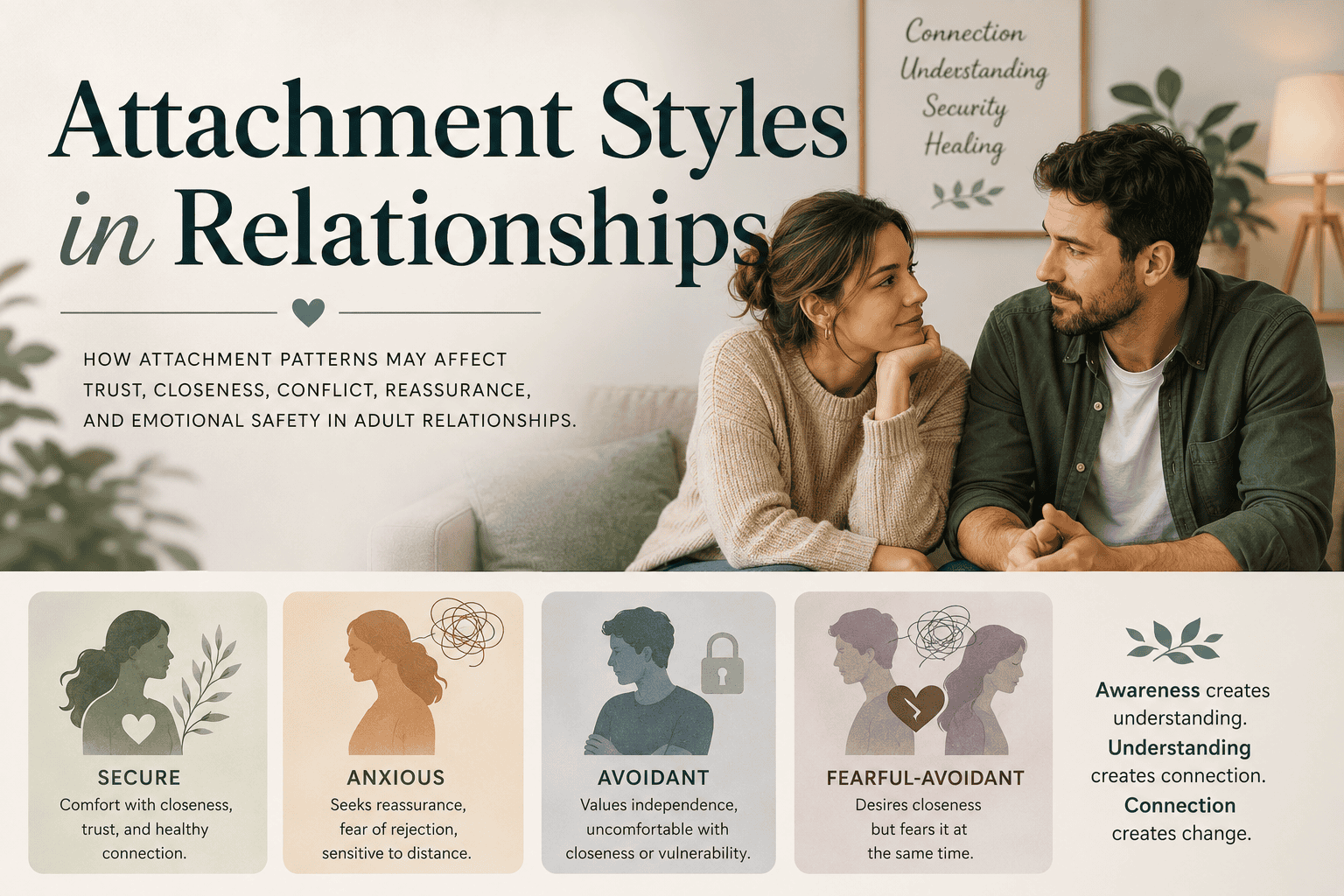
Attachment Styles in Relationships: How Attachment Patterns Affect Trust, Conflict, and Emotional Safety
Couples Counseling Resource Center
Attachment Styles in Relationships
Attachment patterns can shape how adults experience trust, closeness, conflict, reassurance, vulnerability, and emotional safety in romantic relationships. Understanding attachment styles can help partners move beyond blame and begin recognizing the deeper needs and fears underneath repeated relationship patterns.
Start Here
Attachment Patterns Influence How We Reach for Connection
In adult relationships, attachment patterns often show up in the moments when people feel vulnerable, rejected, criticized, misunderstood, ignored, or afraid of losing connection. One person may reach for reassurance, while another may pull away to feel safe. One partner may want to talk immediately, while the other may need space before they can respond.
Attachment styles are not meant to label people as good or bad partners. They are a way of understanding how a person learned to protect themselves emotionally and how those protective patterns may affect present-day relationships.
Attachment Styles
What Are Attachment Styles?
Attachment styles describe common patterns in how people relate to closeness, emotional needs, trust, dependence, independence, conflict, and reassurance. These patterns often develop from early experiences, but they can also be shaped by later relationships, trauma, loss, betrayal, and repeated emotional experiences.
Secure Attachment
Secure attachment often involves comfort with closeness, healthy independence, repair after conflict, and the ability to ask for support.
Anxious Attachment
Anxious attachment may involve fear of rejection, strong needs for reassurance, sensitivity to distance, and worry about abandonment.
Avoidant Attachment
Avoidant attachment may involve discomfort with vulnerability, a strong need for independence, emotional withdrawal, or shutting down.
Fearful-Avoidant Patterns
Fearful-avoidant patterns may include wanting closeness while also fearing it, leading to push-pull dynamics in relationships.
Relationship Cycles
Attachment patterns often become most visible during conflict, disconnection, stress, or moments of emotional vulnerability.
Healing Is Possible
Attachment patterns can change through awareness, emotional safety, therapy, repair, and repeated experiences of secure connection.
Free Attachment Style Quiz
Want to Identify Your Relationship Attachment Style?
If you are curious about how attachment patterns may show up in your relationship, you can take our free Relationship Attachment Style Quiz. The quiz is designed to help individuals and couples reflect on patterns related to reassurance, closeness, independence, emotional safety, and conflict.
This quiz can be especially helpful for couples because each partner may have a different attachment pattern. Understanding those patterns can make it easier to see why one person may pursue reassurance while the other may withdraw, shut down, or need space during conflict.
No personal information is required. The quiz does not ask for your name, email address, phone number, or other identifying information. It is offered for informational and self-reflection purposes only and is not a diagnosis or formal psychological assessment.
After completing the quiz, you will receive a general attachment-style result, such as secure, anxious, avoidant, mixed/fearful-avoidant, or blended. The result is meant to support awareness and conversation, not label either partner as the problem.
Secure Attachment
Secure Attachment Supports Trust, Repair, and Emotional Safety
Secure attachment does not mean a person never feels insecure, anxious, hurt, or frustrated. It means the person generally has an internal sense that relationships can be safe, needs can be expressed, conflict can be repaired, and closeness does not have to erase independence.
In secure relationship patterns, partners are usually better able to ask for support, listen during conflict, take responsibility, tolerate emotional vulnerability, and repair when something goes wrong. Secure attachment is not perfection; it is a pattern of responsiveness and repair.
Secure attachment may look like:
- Being able to ask for comfort or reassurance directly
- Feeling close without feeling trapped
- Taking space without emotionally disappearing
- Repairing after conflict
- Trusting that disagreement does not mean abandonment
- Balancing independence and connection
Anxious Attachment
Anxious Attachment Often Intensifies the Need for Reassurance
Anxious attachment patterns may show up when a person becomes highly sensitive to distance, changes in tone, delayed responses, emotional withdrawal, or signs that a partner may be upset. The person may deeply want connection but feel afraid that connection is fragile or could disappear.
This can lead to reassurance seeking, repeated questioning, intense worry, protest behaviors, or difficulty calming down until the relationship feels secure again.
Anxious attachment may sound like:
- “Are you mad at me?”
- “Do you still care?”
- “Why are you being distant?”
- “I feel like I matter less to you.”
- “I need to talk about this right now.”
- “If you loved me, you would understand why this hurts.”
The goal is not to shame the need for reassurance. The goal is to help the person express needs more clearly and build a stronger sense of internal and relational security.
Avoidant Attachment
Avoidant Attachment Often Protects Through Distance
Avoidant attachment patterns may show up when a person feels overwhelmed by emotional intensity, vulnerability, pressure, criticism, or dependence. The person may care deeply but struggle to stay emotionally present when conflict or closeness feels too much.
Avoidant patterns can look like withdrawal, shutting down, minimizing feelings, needing space, focusing on logic, or becoming uncomfortable when a partner asks for emotional reassurance. From the outside, this may look uncaring. From the inside, it may feel like trying to stay regulated or avoid making things worse.
Avoidant attachment may sound like:
- “I do not want to talk about this right now.”
- “You are making this too big.”
- “I need space.”
- “I do not know what you want me to say.”
- “I feel like nothing I say is right.”
- “Can we just move on?”
Avoidance is often a protective strategy. Therapy can help partners understand the fear or overwhelm underneath distance while also building healthier ways to stay connected during difficult moments.
Fearful-Avoidant Patterns
Some People Want Closeness and Fear It at the Same Time
Fearful-avoidant attachment patterns can involve a painful push-pull experience. A person may deeply want closeness but feel unsafe when closeness becomes real. They may reach for connection and then pull away, test the relationship, become suspicious of care, or feel overwhelmed by vulnerability.
These patterns may be connected to inconsistent, painful, frightening, or confusing relationship experiences. Healing often involves building emotional safety slowly, learning to recognize triggers, and developing more stable ways to communicate needs and boundaries.
Fearful-avoidant patterns may include:
- Wanting reassurance but struggling to trust it
- Feeling drawn to closeness and then needing distance
- Expecting rejection even when a partner is trying to connect
- Becoming overwhelmed by vulnerability
- Testing whether a partner will stay
- Feeling unsure whether relationships are safe
Conflict Patterns
Attachment Styles Often Become Most Visible During Conflict
Attachment patterns may not be obvious when a relationship feels calm. They often become more visible when one or both partners feel rejected, criticized, ignored, controlled, pressured, misunderstood, or emotionally unsafe. Under stress, partners may move into familiar protective strategies.
One partner may pursue connection by asking questions, pushing for a conversation, or seeking reassurance. Another partner may protect themselves by withdrawing, becoming quiet, focusing on logic, or trying to end the conversation. The interaction can become a cycle where both partners feel hurt and neither feels understood.
How Counseling Helps
Therapy Can Help Partners Build More Secure Relationship Patterns
Relationship counseling can help partners understand how attachment patterns show up in conflict, closeness, emotional needs, reassurance, and repair. Rather than blaming one partner for being “too needy” or the other for being “too distant,” therapy helps the couple understand the emotional cycle and the protective strategies each person uses.
Attachment-focused therapy, including Emotionally Focused Therapy for couples, can help partners communicate softer emotions, ask for needs more clearly, respond with greater emotional safety, and create new experiences of trust and connection.
Counseling may help couples:
- Identify attachment patterns without blame
- Understand the pursue-withdraw cycle
- Recognize emotional triggers
- Communicate needs more directly
- Reduce defensiveness, criticism, and shutdown
- Build emotional safety and trust
- Repair after conflict more effectively
- Create more secure patterns of connection
Learning Center
Continue Learning About Relationships, Attachment, and Emotional Safety
These related resources can help couples understand conflict cycles, emotional needs, attachment-based therapy, trauma responses, and relationship counseling options.
Emotional Disconnection in Relationships
Learn why couples can feel emotionally distant, lonely, or disconnected even when they still care about each other, and how counseling may help rebuild emotional safety, communication, and repair.
Read article →Why Couples Get Stuck in the Same Arguments
Understand the conflict cycle beneath repeated arguments, defensiveness, withdrawal, and emotional flooding.
Read article →Couples Counseling
Learn how couples counseling can help partners improve communication, reduce conflict, and rebuild connection.
View service page →Emotionally Focused Therapy for Couples
Learn how EFT helps couples identify negative cycles and strengthen emotional safety and connection.
Read article →Individual Counseling
Individual therapy can help clients understand emotional triggers, anxiety, trauma responses, and relationship patterns.
View service page →Anxiety Counseling
Anxiety can affect reassurance seeking, fear of rejection, avoidance, communication, and emotional closeness.
View service page →Trauma-Informed Therapy
Past experiences can shape how people respond to closeness, conflict, trust, rejection, and emotional safety.
View service page →Emotional Safety in Relationships
A future resource on how couples can create safer conversations, deeper trust, and healthier repair.
Read article →High-Functioning Anxiety?
Learn how anxiety can hide behind achievement, perfectionism, overthinking, people-pleasing, and constant productivity.
Read article →How to Ask for Reassurance
A future guide on expressing needs without criticism, panic, pressure, or emotional shutdown.
Coming soon →Repair After Conflict
A future article about apologies, accountability, emotional repair, and reconnecting after arguments.
Coming soon →Start Counseling
Support for Attachment Patterns in Relationships
If attachment patterns are affecting trust, closeness, communication, reassurance, or emotional safety in your relationship, counseling can help you understand the cycle and begin building healthier patterns of connection.

