
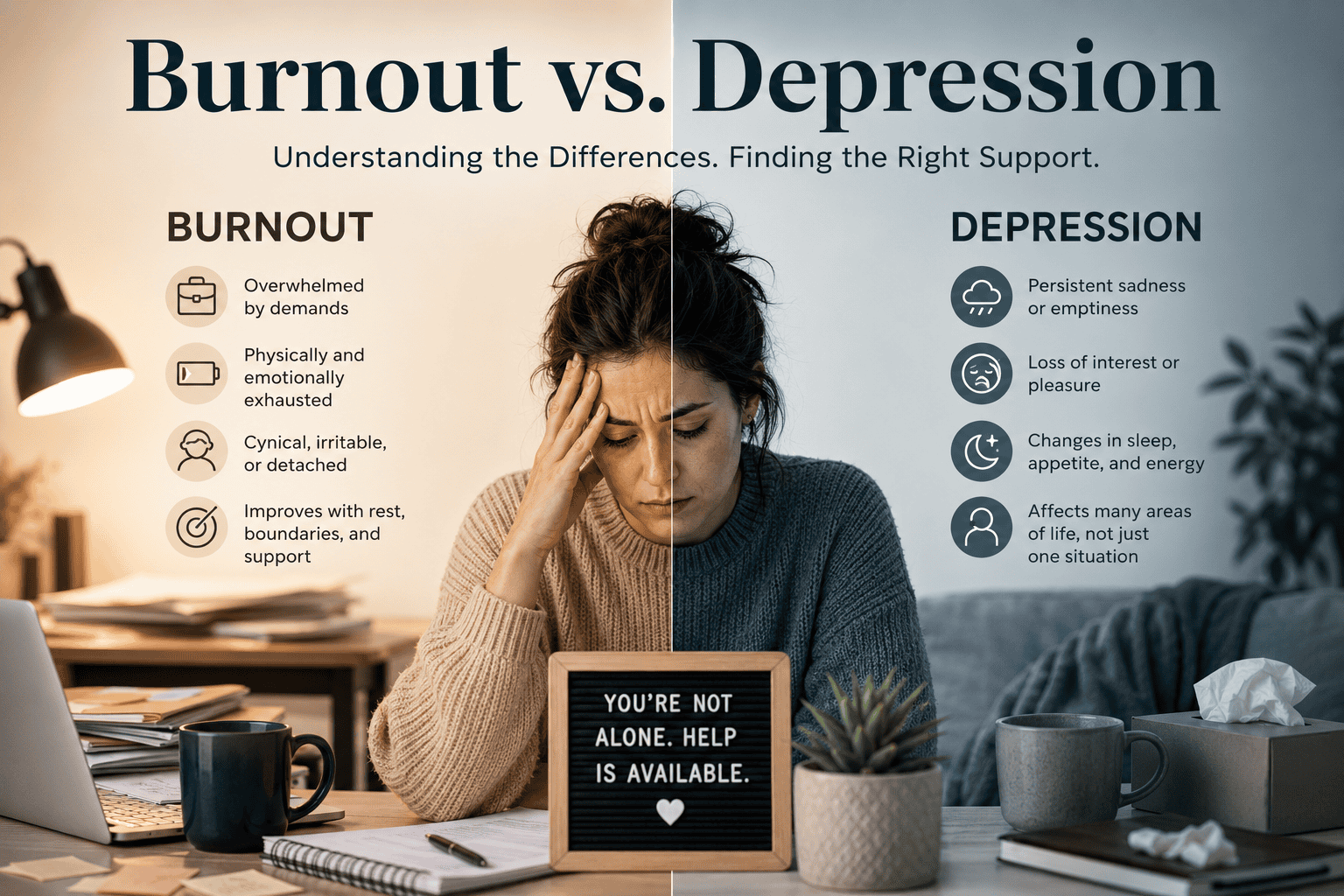
Burnout vs. Depression: How to Tell the Difference | Motivations Counseling
Depression & Stress Resources
Burnout vs. Depression: How to Tell the Difference
Burnout and depression can both involve exhaustion, low motivation, irritability, mental fog, and feeling emotionally drained. But they may have different patterns, causes, and treatment needs. This guide explains how burnout and depression can overlap, how they may differ, and when counseling may help.
Start Here
Burnout and Depression Can Look Similar, but They Are Not Always the Same
Burnout and depression can both make someone feel exhausted, unmotivated, overwhelmed, emotionally drained, irritable, or disconnected. Because the symptoms can overlap, many people wonder whether they are burned out, depressed, or experiencing both.
Burnout is often connected to prolonged stress, overload, caregiving, workplace pressure, emotional labor, or feeling trapped in responsibilities without enough recovery. Depression may involve a broader pattern of low mood, loss of interest, hopelessness, guilt, sleep changes, appetite changes, low energy, concentration problems, and difficulty feeling pleasure across multiple areas of life.
What Is the Difference Between Burnout and Depression?
Burnout is often a stress-related state of emotional, mental, and physical exhaustion connected to prolonged demands or insufficient recovery. Depression is a mental health condition that may affect mood, motivation, energy, sleep, appetite, concentration, self-worth, and the ability to feel interest or pleasure. Burnout and depression can overlap, and burnout may sometimes contribute to depression if support and recovery do not happen.
Side-by-Side Comparison
Burnout vs. Depression at a Glance
This comparison can help clarify the pattern, but it is not a diagnosis. A therapist or medical provider can help determine what may be happening in your specific situation.
Burnout
Burnout is often tied to prolonged stress, overload, responsibility, or lack of recovery.
- Often connected to work, caregiving, school, parenting, or chronic stress
- May improve with rest, boundaries, support, or reduced demands
- Often includes emotional exhaustion and resentment
- May feel better when away from the stressor
- Can include cynicism, irritability, and feeling ineffective
- May become depression if the pattern continues without relief
Depression
Depression may affect mood, motivation, pleasure, self-worth, sleep, energy, and functioning across life areas.
- May not be limited to one stressor or role
- Often includes loss of interest or pleasure
- May involve hopelessness, guilt, worthlessness, or emotional numbness
- May persist even during rest or time away
- Can affect sleep, appetite, concentration, and daily functioning
- May require counseling, medical support, lifestyle changes, or combined care
Many people experience both. Chronic burnout can increase vulnerability to depression, and depression can make ordinary responsibilities feel like burnout.
Shared Symptoms
How Burnout and Depression Can Feel Similar
Burnout and depression can both reduce energy, motivation, patience, focus, and emotional capacity. This is why it can be hard to tell them apart without looking at the broader pattern.
Exhaustion
Both burnout and depression can make everyday responsibilities feel heavier and harder to sustain.
Mental Fog
Concentration, memory, decision-making, and processing speed may become more difficult.
Irritability
Emotional bandwidth may feel low, making small frustrations feel harder to handle.
Withdrawal
You may pull away from people, activities, or responsibilities because everything feels draining.
Low Motivation
Starting tasks may feel difficult, even when you know what needs to be done.
Sleep Problems
Stress, worry, low mood, or nervous system activation can interfere with restful sleep.
Key Differences
Key Differences Between Burnout and Depression
One important difference is where the symptoms appear and what seems to improve them. Burnout is often more closely tied to a specific context, such as work, school, caregiving, parenting overload, or chronic stress. Depression may feel more global, affecting the person’s mood, identity, relationships, sleep, appetite, concentration, and sense of hope across many settings.
Burnout may improve when the person gets meaningful rest, support, boundaries, a change in workload, or distance from the stressor. Depression may not lift as easily with rest alone, especially when symptoms include hopelessness, loss of pleasure, emotional numbness, guilt, or thoughts of death.
Questions that may help clarify the pattern:
- Do I feel better when I am away from the stressful role or environment?
- Do I still feel empty, hopeless, or disconnected even during rest?
- Is the exhaustion mainly tied to work, caregiving, school, or chronic demands?
- Have I lost interest or pleasure in most areas of life?
- Do I feel resentful and depleted, or deeply sad and hopeless?
- Are sleep, appetite, concentration, and self-worth significantly affected?
These questions are not a substitute for professional assessment. They can, however, help you notice whether the pattern seems stress-based, depression-based, or both.
Burnout Patterns
Burnout Often Centers Around Prolonged Stress and Overload
Burnout often develops when demands remain high for too long without enough recovery, support, control, or meaning. It can happen in demanding jobs, caregiving roles, parenting, school, ministry, helping professions, leadership roles, or emotionally intense family situations.
- Feeling drained by a specific role or responsibility
- Feeling trapped, resentful, or emotionally depleted
- Reduced sense of effectiveness
- Needing distance from the stressor
- Difficulty recovering even after short breaks
Important Reframe
Burnout Is Not Just Needing a Vacation
Burnout is often a sign that a person’s system has been under too much demand for too long. A short break may help temporarily, but deeper recovery often requires changes in boundaries, workload, support, expectations, or emotional patterns.
- Rest matters, but so does reducing overload.
- Boundaries may be part of recovery.
- Support is often necessary.
- Burnout can worsen when ignored.
Depression Patterns
Depression Often Affects More Than One Area of Life
Depression may feel less tied to one specific stressor and more like a change in the person’s overall emotional state, energy, thinking, motivation, and ability to experience pleasure. Someone may feel sad, numb, empty, guilty, disconnected, hopeless, or unable to enjoy things even when they are away from work or responsibilities.
Depression can also affect the body and mind. Sleep may increase or decrease. Appetite may change. Concentration may become harder. Tasks may feel overwhelming. The person may withdraw, feel like a burden, or lose hope that things can improve.
Depression may include:
- Persistent sadness, emptiness, or emotional numbness
- Loss of interest or pleasure
- Hopelessness, guilt, or worthlessness
- Sleep or appetite changes
- Low energy and low motivation
- Difficulty concentrating or making decisions
- Social withdrawal or isolation
- Thoughts of death, self-harm, or suicide
If depression includes thoughts of death, self-harm, or suicide, seek immediate support. In the United States, call or text 988 for the Suicide & Crisis Lifeline, call 911, or go to the nearest emergency room.
When Both Are Present
Can Burnout Become Depression?
Burnout and depression can overlap. A person who has been emotionally depleted for months or years may begin to feel hopeless, numb, disconnected, or unable to recover. When stress becomes chronic and there is little relief, depression symptoms may become more likely.
Depression can also make burnout worse. When someone is depressed, ordinary responsibilities may require more effort, recovery may take longer, and stress may feel harder to manage. In this way, burnout and depression can reinforce one another.
Burnout and depression may overlap when:
- Rest no longer feels restorative
- Exhaustion spreads beyond one role or setting
- There is loss of interest in things that used to matter
- The person feels hopeless, numb, or emotionally flat
- Work stress begins affecting relationships, sleep, and identity
- The person cannot imagine things improving
If you are unsure whether you are burned out, depressed, or both, counseling can help clarify the pattern and identify next steps.
An Educational Framework
The Stress-Burnout-Depression Cycle
Burnout and depression can become connected when chronic stress keeps draining emotional and physical resources.
1. Demands Stay High
Work, caregiving, parenting, school, or family responsibilities continue requiring more energy than is available.
2. Recovery Shrinks
Rest, support, sleep, connection, and personal time become limited or ineffective.
3. Burnout Builds
Exhaustion, resentment, irritability, cynicism, and reduced motivation become more noticeable.
4. Mood Drops
Emotional numbness, sadness, disconnection, hopelessness, or loss of interest may begin to increase.
5. Isolation Grows
The person may withdraw, avoid support, or feel too depleted to explain what is happening.
6. The Pattern Repeats
Stress continues, symptoms deepen, and it becomes harder to know where burnout ends and depression begins.
Breaking the cycle usually requires more than pushing harder. It often requires support, rest, boundaries, emotional care, and realistic changes to the demands being carried.
What Helps
What Helps Burnout and Depression
The right support depends on the pattern. Burnout often requires recovery, boundaries, workload changes, and support. Depression may require counseling, medical consultation, emotional processing, behavioral support, and treatment for underlying symptoms.
Clarify the Pattern
Identify whether symptoms are tied to one stressor, multiple areas of life, depression symptoms, or a combination.
Reduce Overload
Burnout often improves when demands become more realistic and recovery becomes possible.
Address Depression Symptoms
Depression may need direct care for mood, motivation, self-worth, hopelessness, sleep, and emotional numbness.
Let Support In
Therapy, trusted relationships, medical care, and practical support can reduce isolation and emotional load.
Support Rest and Sleep
Restorative sleep and actual recovery time are important for both burnout and depression.
Reconnect With Meaning
Counseling can help clients reconnect with values, identity, boundaries, relationships, and a more sustainable life rhythm.
When to Seek Help
When It May Be More Than Burnout
It may be time to seek counseling when exhaustion, low motivation, emotional numbness, sadness, irritability, or hopelessness are lasting longer than expected, affecting multiple areas of life, or not improving with rest. Support can help you understand whether burnout, depression, anxiety, trauma, grief, or chronic stress may be involved.
Consider counseling if you notice:
- Rest does not seem to restore your energy
- You feel emotionally numb, empty, or hopeless
- You have lost interest in things that used to matter
- You are withdrawing from people or avoiding responsibilities
- You feel trapped, resentful, or unable to recover
- You are experiencing sleep, appetite, or concentration changes
- Your self-worth has dropped or guilt has increased
- You wonder whether you are burned out, depressed, or both
If symptoms include thoughts of death, self-harm, or suicide, seek immediate support. In the United States, call or text 988 for the Suicide & Crisis Lifeline, call 911, or go to the nearest emergency room.
Counseling at Motivations Counseling
Therapy Can Help Clarify Whether You Are Burned Out, Depressed, or Both
Motivations Counseling provides therapy for adults experiencing burnout, depression, anxiety, chronic stress, emotional exhaustion, low motivation, mental fog, relationship stress, trauma-related symptoms, and difficulty functioning. Counseling can help clients better understand the pattern and begin building more realistic support.
Our counseling team serves clients in Sugar Land, Katy, Richmond, Fort Bend County, West Houston, and through telehealth across Texas when clinically appropriate.
Counseling Support
Depression and Burnout Counseling in Sugar Land, Katy, and Online Across Texas
If you feel exhausted, unmotivated, emotionally numb, resentful, or unable to recover, counseling can help you understand what is happening and identify healthier next steps.
- Individual counseling for burnout, depression, and emotional exhaustion
- Support for low motivation, mental fog, irritability, and overwhelm
- Help with boundaries, stress patterns, perfectionism, and self-criticism
- Trauma-informed counseling when burnout or depression connects to painful experiences
- In-person options in Sugar Land and Katy when available
- Telehealth counseling across Texas when clinically appropriate
Therapy Learning Center
Continue Learning About Depression, Burnout, Anxiety, and Emotional Exhaustion
These related resources can help adults better understand depression symptoms, exhaustion, mental fog, anxiety, sleep problems, and hidden emotional distress.
High-Functioning Depression
Learn how someone can keep performing outwardly while privately feeling empty, tired, or overwhelmed.
Read article →Can Depression Feel Like Exhaustion?
Understand why depression can feel like deep fatigue, heaviness, and reduced capacity.
Read article →Why Depression Causes Mental Fog
Learn how depression can affect concentration, memory, decision-making, and mental clarity.
Read article →Anxiety and Sleep Problems
Learn how anxious thoughts and nervous system activation can affect sleep and rest.
Read article →Racing Thoughts and Overthinking
Explore how repetitive thinking can affect focus, calm, sleep, and emotional regulation.
Read article →Counseling Resource Center
Explore resources on anxiety, depression, trauma, EMDR, relationships, teen counseling, and emotional health.
Explore Resource Center →Frequently Asked Questions
Common Questions About Burnout vs. Depression
What is the difference between burnout and depression?
Burnout is often connected to prolonged stress, overload, or lack of recovery in a specific role or environment. Depression may affect mood, motivation, sleep, appetite, self-worth, concentration, and the ability to feel pleasure across multiple areas of life.
Can burnout turn into depression?
Burnout can contribute to depression when stress continues without enough recovery, support, or change. Chronic exhaustion, hopelessness, isolation, and loss of interest may signal that depression is also present.
How do I know if I am burned out or depressed?
It may help to notice whether symptoms improve when you are away from the stressor. Burnout may feel more tied to a role or responsibility, while depression may persist across settings and include sadness, numbness, hopelessness, loss of pleasure, or changes in self-worth.
Can burnout and depression happen at the same time?
Yes. Burnout and depression can overlap. Chronic stress can increase vulnerability to depression, and depression can make everyday responsibilities feel more overwhelming and exhausting.
Does rest fix burnout?
Rest can help, but burnout often requires more than a short break. Recovery may involve boundaries, reduced demands, support, workload changes, emotional care, and a more sustainable rhythm.
Does rest fix depression?
Rest may support depression recovery, but depression often needs direct care. Counseling, medical consultation, behavioral support, emotional processing, and social connection may all be important depending on the person’s symptoms.
When should I seek counseling?
Consider counseling when exhaustion, numbness, low motivation, sadness, irritability, hopelessness, or mental fog persists, spreads across life areas, affects relationships or functioning, or does not improve with rest.
Should I see a medical provider?
If fatigue, sleep changes, appetite changes, concentration problems, or mood symptoms are significant, sudden, severe, or worsening, it may be helpful to consult a medical provider to rule out medical causes and discuss treatment options.

Take the Next Step
Burnout and Depression Counseling in Sugar Land, Katy, and Online Across Texas
If you are exhausted, unmotivated, emotionally numb, or unsure whether you are burned out, depressed, or both, counseling can help you understand the pattern and begin building support.

