
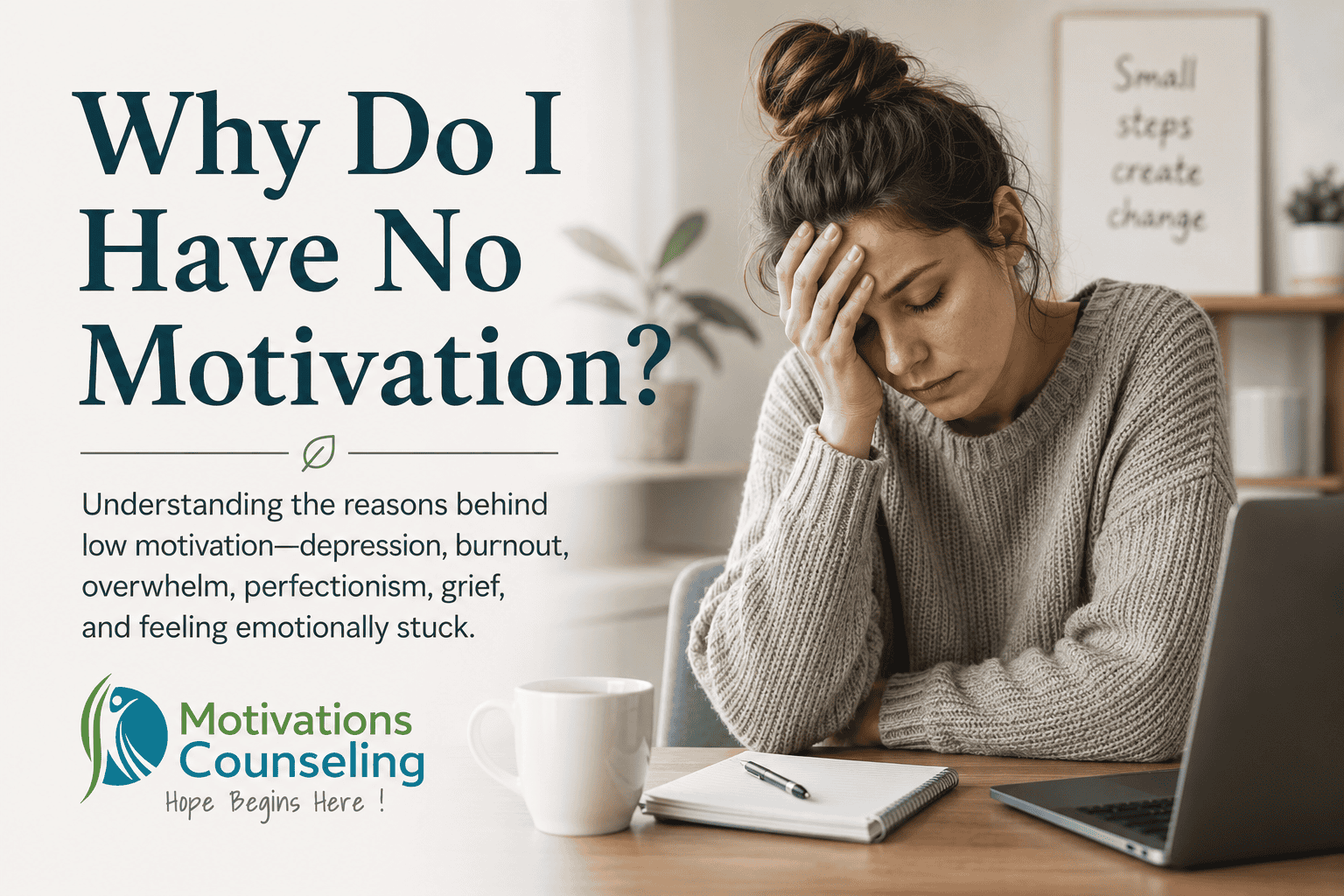
Why Do I Have No Motivation? | Depression, Burnout & Overwhelm
Depression & Stress Resources
Why Do I Have No Motivation?
Low motivation is often misunderstood as laziness, but it can be connected to depression, emotional shutdown, overwhelm, burnout, perfectionism, grief, anxiety, trauma responses, or feeling emotionally stuck.
Start Here
Low Motivation Is Often a Signal, Not a Personal Failure
When motivation disappears, many people immediately blame themselves. They may think they are lazy, undisciplined, irresponsible, or not trying hard enough. But low motivation is often a signal that something deeper is happening emotionally, physically, relationally, or neurologically.
Motivation can drop when the mind and body are overwhelmed, depressed, burned out, grieving, anxious, shut down, or exhausted from trying to function under too much pressure for too long. Sometimes motivation fades because a person is emotionally stuck, afraid of failing, unsure where to begin, or carrying more than they realize.
What Is Low Motivation?
Low motivation refers to difficulty starting, continuing, or completing tasks even when a person intellectually understands that the task matters. It may involve procrastination, avoidance, low energy, emotional numbness, overwhelm, loss of interest, fear of failure, or feeling stuck and unable to move forward.
What It Feels Like
What Low Motivation Can Feel Like
Low motivation does not always mean you do not care. Often, the caring is still there, but your emotional energy, mental bandwidth, or nervous system capacity is too low to act on it.
Difficulty Starting
Even simple tasks may feel too heavy, unclear, or emotionally draining to begin.
Procrastination
You may delay tasks even when you know avoiding them will create more stress later.
Brain Fog
Planning, deciding, organizing, prioritizing, or following through may feel unusually difficult.
Feeling Shut Down
You may know what needs to happen but feel emotionally disconnected or unable to act.
Feeling Overwhelmed
When everything feels like too much, the mind may freeze rather than move forward.
Shame or Self-Criticism
Low motivation can lead to guilt, frustration, and harsh inner dialogue that makes action even harder.
Depression
Depression Can Make Motivation Feel Out of Reach
Depression often affects energy, pleasure, focus, hope, and the ability to feel emotionally connected to life. When depression is present, motivation may not respond to ordinary encouragement, positive thinking, or pressure to “just do it.”
A person may want to function, care about responsibilities, and understand what needs to be done, while still feeling unable to begin. Depression can make tasks feel heavier, rewards feel less rewarding, and the future feel less reachable.
Depression-related low motivation may come with:
- Low mood, sadness, emptiness, or emotional numbness
- Loss of interest in activities that used to feel meaningful
- Fatigue, heaviness, or low physical energy
- Difficulty concentrating or making decisions
- Sleeping too much or having trouble sleeping
- Feeling hopeless, guilty, worthless, or stuck
- Withdrawing from people, hobbies, or responsibilities
Depression-related low motivation is not laziness. It may be a sign that mood, energy, reward, hope, and emotional access have been affected.
Burnout
Burnout Can Drain Motivation After Too Much Output
Burnout often develops after prolonged stress, over-responsibility, caregiving, work pressure, emotional labor, or constant demands without enough recovery. Motivation may disappear because your system has been operating beyond capacity for too long.
- Tasks that once felt manageable may feel impossible.
- You may dread responsibilities before they begin.
- You may feel detached, resentful, cynical, or numb.
- You may need recovery, not more pressure.
Important Reframe
Motivation May Not Return Until Capacity Returns
When burnout is involved, trying to force motivation can deepen exhaustion. Recovery may require rest, boundaries, support, reduced overload, and a more realistic relationship with responsibility.
- Burnout can make effort feel threatening.
- Rest may need to be deeper than a short break.
- Boundaries may be part of mental health care.
- Support can help reduce the load.
Burnout and depression can overlap. Burnout may begin around responsibilities, while depression may affect mood, sleep, energy, interest, hope, and overall functioning.
Emotional Shutdown
Shutdown Can Make Action Feel Impossible
Emotional shutdown can happen when the nervous system becomes overwhelmed and begins to conserve energy. Instead of feeling activated, focused, or engaged, a person may feel numb, frozen, detached, or disconnected from themselves and their goals.
Shutdown can be connected to trauma, chronic stress, depression, grief, anxiety, relationship distress, or repeated emotional overwhelm. It is often a protective response rather than a conscious choice.
Shutdown-related low motivation may feel like:
- Knowing what needs to happen but feeling unable to move
- Feeling emotionally numb, distant, or disconnected
- Going through the motions without feeling present
- Avoiding stimulation, decisions, or conflict
- Feeling frozen when tasks feel too emotionally loaded
- Needing safety and regulation before action feels possible
When shutdown is involved, motivation often improves through safety, pacing, grounding, support, and reducing overwhelm rather than through criticism or force.
Overwhelm
Overwhelm Can Look Like a Lack of Motivation
When there are too many tasks, too many decisions, too many emotions, or too many consequences attached to a choice, the mind may freeze. From the outside, this can look like procrastination or laziness. Internally, it may feel like too much information, pressure, or emotional intensity.
Overwhelm can make it hard to prioritize, decide where to begin, or believe that any single step will matter. The larger the task feels, the harder it can be to start.
Overwhelm-related low motivation may include:
- Avoiding tasks because you do not know where to start
- Feeling paralyzed by decisions
- Starting several things but finishing none
- Feeling mentally cluttered or emotionally flooded
- Feeling defeated before beginning
- Needing tasks broken into smaller, clearer steps
Sometimes the problem is not that you need more motivation. It is that the task needs to become smaller, safer, clearer, and less emotionally overwhelming.
Perfectionism
Perfectionism Can Quietly Block Motivation
Perfectionism can make starting feel risky. If something must be done perfectly, quickly, impressively, or without mistakes, the pressure can become so high that avoiding the task feels safer than trying.
Many people who struggle with motivation are not careless. They may actually care deeply, but the fear of failing, disappointing others, being judged, or not meeting their own standards makes action feel emotionally unsafe.
Perfectionism-related avoidance may look like:
- Waiting until you feel ready before beginning
- Avoiding tasks unless you can do them perfectly
- Feeling overwhelmed by high standards
- Procrastinating because the outcome feels too important
- Being harsh with yourself for small mistakes
- Feeling like effort is only worthwhile if the result is excellent
A helpful goal is often not “try harder.” It may be learning how to begin imperfectly, tolerate uncertainty, and separate your worth from your performance.
Grief
Grief Can Change What Feels Worth Doing
Grief can affect motivation because life may feel different after loss. Goals, routines, relationships, work, school, hobbies, or future plans may not feel the same. Motivation can drop as the mind and body try to adjust to what has changed.
Grief can follow the death of a loved one, divorce, relationship loss, illness, infertility, job loss, relocation, family changes, identity shifts, or any major transition that carries emotional loss.
Grief-related low motivation may include:
- Feeling like ordinary tasks no longer matter
- Having less energy for socializing or hobbies
- Feeling guilty when trying to move forward
- Avoiding reminders of what has changed
- Feeling disconnected from old goals
- Needing time to rediscover meaning
Low motivation during grief does not always mean something is wrong with you. Sometimes it reflects the emotional work of adapting to a changed life.
Anxiety
Anxiety Can Drain Motivation by Keeping the Mind on Alert
Anxiety can consume energy before a task even begins. The mind may run through possible mistakes, outcomes, conflicts, judgments, or consequences. This can make starting feel threatening instead of simple.
For some people, anxiety leads to over-preparing. For others, it leads to avoidance. Both patterns can be exhausting, and both can interfere with motivation.
Anxiety-related low motivation may look like:
- Avoiding tasks because they trigger worry
- Overthinking decisions until you feel stuck
- Feeling tense, restless, or mentally exhausted
- Needing reassurance before taking action
- Procrastinating to avoid discomfort
- Feeling tired from constant mental scanning
When anxiety is involved, motivation may improve as the nervous system becomes calmer and tasks feel less emotionally threatening.
An Educational Framework
The Low Motivation Cycle
Low motivation can become self-reinforcing when overwhelm, avoidance, shame, and emotional exhaustion begin feeding into each other.
1. Pressure Builds
Stress, depression, grief, burnout, anxiety, perfectionism, or overwhelm increases emotional strain.
2. Tasks Feel Too Big
Responsibilities begin to feel unclear, emotionally loaded, or impossible to start.
3. Shutdown or Avoidance
You may freeze, withdraw, distract yourself, or delay action to reduce discomfort.
4. Shame Increases
Self-criticism grows when tasks remain unfinished or responsibilities pile up.
5. Energy Drops
Shame, stress, and avoidance consume energy, making the next step feel even harder.
6. The Pattern Repeats
The longer the cycle continues, the easier it is to believe motivation will never return.
Breaking the cycle often starts with reducing shame, making the next step smaller, and addressing the depression, burnout, grief, anxiety, or overwhelm underneath the avoidance.
What Helps
What Can Help When You Have No Motivation
Motivation often returns gradually after the underlying cause is addressed. The goal is not to shame yourself into action, but to understand what is blocking movement and support the system that feels stuck.
Identify the Cause
Counseling can help clarify whether depression, burnout, anxiety, grief, perfectionism, trauma, or overwhelm is involved.
Reduce Shame
Motivation usually improves more through compassion and clarity than through harsh self-criticism.
Make Steps Smaller
Tiny, specific steps can be more effective than waiting for a large wave of motivation.
Regulate the Nervous System
Grounding, pacing, safety, and emotional regulation may help when shutdown or anxiety is involved.
Reconnect With Support
Safe support can reduce isolation and help you stop carrying everything alone.
Let Action Come Before Motivation
Motivation often returns after small manageable actions begin rebuilding confidence and momentum.
Motivation is usually the last thing to return.
Many people wait until they feel motivated before taking action, but motivation often follows safety, clarity, support, rest, and small steps. You do not have to feel fully motivated to begin healing.
When to Seek Help
When to Seek Counseling for Low Motivation
It may be time to seek counseling when low motivation persists, affects daily functioning, disrupts relationships, interferes with work or school, or comes with depression, anxiety, burnout, grief, emotional shutdown, hopelessness, or feeling unlike yourself.
Consider counseling if you notice:
- You want to do things but feel unable to start
- You are avoiding tasks, people, or responsibilities
- You feel stuck, numb, overwhelmed, or emotionally shut down
- You feel exhausted, burned out, or chronically stressed
- You are losing interest in things that used to matter
- You feel hopeless, guilty, worthless, or ashamed
- Perfectionism or fear of failure keeps you from beginning
- Grief, anxiety, trauma, or depression may be affecting your functioning
If low motivation occurs with thoughts of death, self-harm, or suicide, seek immediate support. In the United States, call or text 988 for the Suicide & Crisis Lifeline, call 911, or go to the nearest emergency room.
Counseling at Motivations Counseling
Therapy Can Help You Understand Why You Feel Stuck
Motivations Counseling provides therapy for adults experiencing low motivation, depression, burnout, anxiety, chronic stress, emotional shutdown, grief, perfectionism, trauma-related symptoms, relationship stress, overwhelm, exhaustion, and difficulty feeling connected to life.
Our counseling team serves clients in Sugar Land, Katy, Richmond, Fort Bend County, West Houston, and through telehealth across Texas when clinically appropriate.
Counseling Support
Depression, Burnout, Anxiety, and Stress Counseling in Sugar Land, Katy, and Online Across Texas
If you have no motivation and feel stuck, counseling can help you understand what may be contributing to the pattern and begin rebuilding movement, confidence, and emotional capacity at a manageable pace.
- Individual counseling for depression, low motivation, and emotional exhaustion
- Support for burnout, overwhelm, grief, anxiety, and chronic stress
- Trauma-informed counseling when shutdown connects to painful experiences
- Help with perfectionism, avoidance, emotional numbness, and feeling stuck
- In-person options in Sugar Land and Katy when available
- Telehealth counseling across Texas when clinically appropriate
Therapy Learning Center
Continue Learning About Motivation, Depression, Burnout, and Emotional Shutdown
These related resources can help adults better understand depression symptoms, burnout, anxiety, chronic stress, trauma responses, emotional shutdown, exhaustion, and loss of interest.
Signs of Depression in Adults
Learn how depression may show up emotionally, physically, cognitively, and relationally.
Read article →Can Depression Feel Like Exhaustion?
Explore why depression can feel like physical heaviness, low energy, brain fog, and depletion.
Read article →Why Am I Losing Interest?
Learn why enjoyable activities may start to feel flat, distant, or emotionally unreachable.
Read article →Burnout vs. Depression
Understand the difference between burnout, depression, emotional exhaustion, and chronic stress.
Read article →Why Do I Feel Anxious All the Time?
Learn why chronic worry, stress, and nervous system activation can make it hard to relax.
Read article →Emotional Disconnection
Learn why numbness, shutdown, and emotional distance can happen during stress or depression.
Read article →Full Resource Center
Explore the Full Counseling Resource Center
Our Counseling Resource Center includes educational articles on anxiety, depression, trauma, EMDR therapy, relationships, teen counseling, emotional overwhelm, nervous system responses, and practical ways to understand mental health symptoms.
Frequently Asked Questions
Common Questions About Having No Motivation
Why do I have no motivation?
Low motivation may be connected to depression, burnout, emotional shutdown, overwhelm, perfectionism, grief, anxiety, trauma responses, chronic stress, exhaustion, or feeling emotionally stuck.
Is having no motivation a sign of depression?
It can be. Depression may reduce energy, interest, pleasure, focus, hope, and the ability to start or complete tasks. Low motivation is especially concerning when it comes with sadness, numbness, fatigue, hopelessness, sleep changes, or loss of interest.
Can burnout cause low motivation?
Yes. Burnout can drain motivation when someone has been under too much stress or responsibility for too long without enough recovery, support, or boundaries.
Why do I procrastinate even when I care?
Procrastination does not always mean you do not care. It may happen when a task feels overwhelming, emotionally threatening, unclear, boring, too large, or connected to fear of failure.
Can perfectionism cause a lack of motivation?
Yes. Perfectionism can make starting feel risky because the pressure to do something perfectly can lead to avoidance, procrastination, and fear of making mistakes.
What helps when I feel stuck and unmotivated?
Helpful steps may include identifying the underlying cause, reducing shame, breaking tasks into smaller steps, addressing depression or anxiety, setting boundaries, processing grief, and seeking counseling support.
Should I wait until I feel motivated to start?
Not always. Motivation often returns after small manageable actions begin rebuilding confidence and momentum. Waiting to feel fully motivated can keep the cycle going.
When should I seek counseling?
Consider counseling when low motivation persists, affects relationships, work, school, or daily functioning, or comes with depression, anxiety, burnout, grief, emotional shutdown, hopelessness, or feeling unlike yourself.

Take the Next Step
Counseling for Depression, Burnout, Anxiety, and Low Motivation in Sugar Land, Katy, and Online Across Texas
If you feel unmotivated, stuck, or emotionally shut down, counseling can help you understand what may be contributing to the pattern and begin moving forward in a manageable way.

