
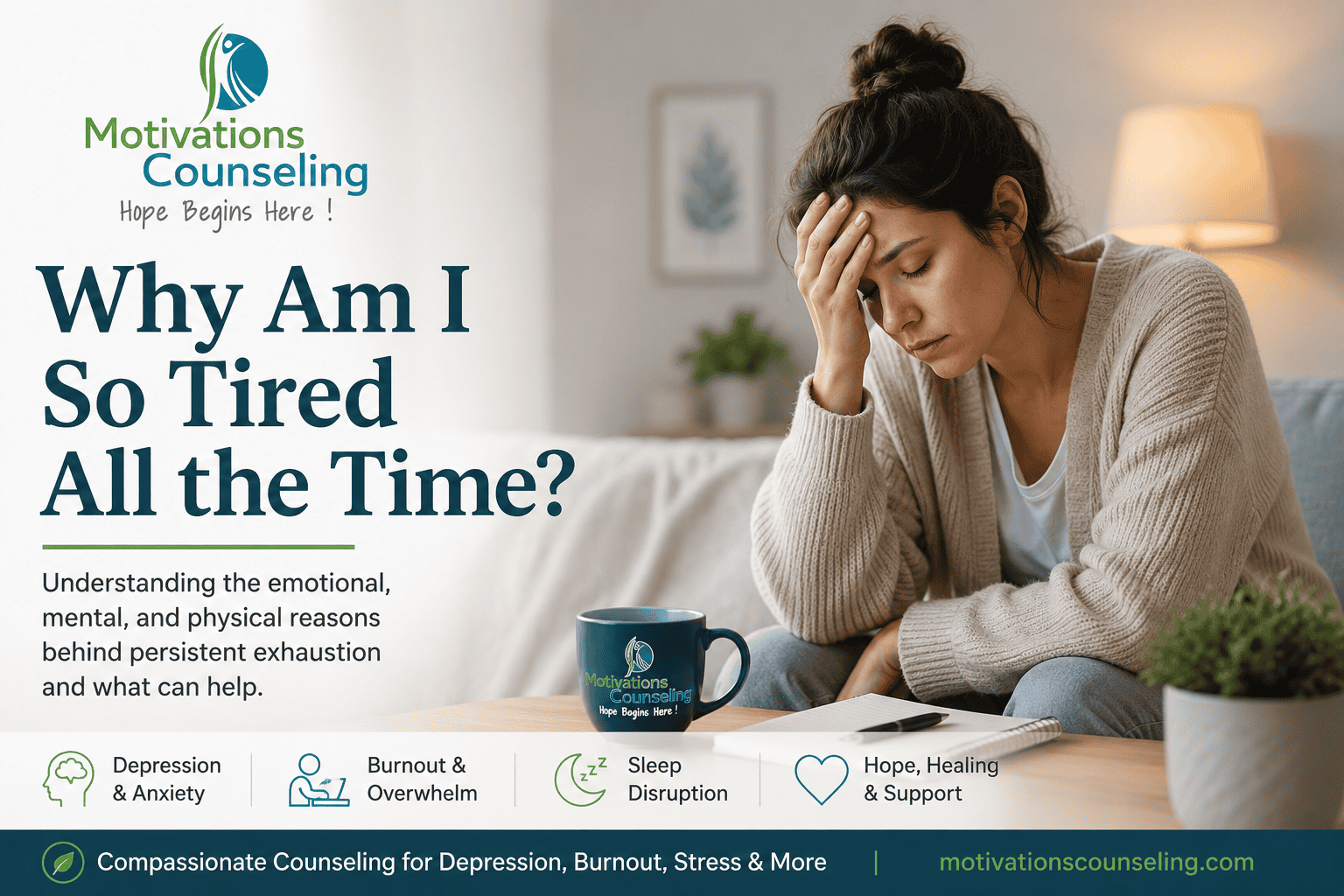
Why Am I So Tired All the Time? | Depression, Burnout & Chronic Stress
Depression & Stress Resources
Why Am I So Tired All the Time?
Persistent exhaustion can come from more than a busy schedule. Depression, burnout, chronic stress, sleep disruption, emotional overload, caregiving, anxiety, trauma responses, and ongoing life demands can all leave the mind and body feeling depleted.
Start Here
Feeling Tired All the Time Can Be a Signal, Not a Character Flaw
Many people blame themselves when they feel tired all the time. They may wonder why they cannot keep up, why rest does not feel restorative, or why normal tasks suddenly feel harder than they should. But ongoing exhaustion is often a signal that the body, brain, emotions, or nervous system have been carrying too much for too long.
Persistent tiredness can be related to depression, burnout, chronic stress, disrupted sleep, anxiety, trauma responses, grief, emotional overload, caregiving demands, health concerns, work pressure, relationship stress, parenting responsibilities, or major life transitions. Sometimes several of these factors overlap.
What Is Persistent Exhaustion?
Persistent exhaustion refers to ongoing physical, emotional, or mental tiredness that does not fully improve with ordinary rest. It may involve low energy, reduced motivation, brain fog, emotional heaviness, sleep disruption, irritability, difficulty concentrating, or feeling overwhelmed by daily responsibilities.
What It Feels Like
What Constant Tiredness Can Feel Like
Exhaustion does not always feel like simply needing a nap. It can affect energy, mood, focus, relationships, motivation, and the ability to feel present in daily life.
Low Physical Energy
Your body may feel heavy, drained, slowed down, or unable to recover even after sleep.
Brain Fog
Thinking, remembering, focusing, planning, or making decisions may feel harder than usual.
Emotional Heaviness
You may feel flat, sad, numb, irritable, tearful, or emotionally overloaded.
Avoiding Plans
Social plans, hobbies, errands, and responsibilities may feel like more than you can handle.
Rest Does Not Restore You
You may sleep, sit down, or take breaks but still wake up or return to tasks feeling depleted.
Feeling Overwhelmed
Ordinary tasks may feel unusually difficult when your emotional and nervous system capacity is low.
Depression
Depression Can Make You Feel Physically and Emotionally Exhausted
Depression is not only sadness. For many people, depression feels like fatigue, heaviness, low motivation, slowed thinking, emotional numbness, sleep changes, and difficulty getting through the day. A person may still be functioning outwardly while privately feeling drained and disconnected.
Depression-related exhaustion may make normal routines feel unusually demanding. Getting out of bed, answering messages, working, parenting, making decisions, or engaging socially may require far more effort than it used to.
Depression-related tiredness may come with:
- Low mood, sadness, emptiness, or emotional numbness
- Loss of interest in things that used to feel enjoyable
- Sleeping too much or having trouble sleeping
- Changes in appetite or weight
- Difficulty concentrating or making decisions
- Feeling guilty, hopeless, worthless, or stuck
- Moving or thinking more slowly than usual
- Withdrawing from people, hobbies, or responsibilities
If exhaustion is paired with loss of interest, hopelessness, emotional numbness, or difficulty functioning, depression may be part of the picture. Counseling can help clarify what is happening and support a path forward.
Burnout
Burnout Can Leave You Depleted Even When You Are Still Functioning
Burnout often develops when prolonged stress, responsibility, pressure, or emotional labor continues without enough recovery. A person may keep performing, caring for others, meeting deadlines, or managing obligations while their internal capacity continues to shrink.
- You may feel tired before the day begins.
- You may dread tasks that once felt manageable.
- You may feel cynical, resentful, detached, or numb.
- You may need more recovery time than you used to.
Important Reframe
Burnout Is Not Fixed by Pushing Harder
When burnout is involved, the answer is usually not more discipline, more productivity, or more self-criticism. The body and nervous system may need reduced overload, stronger boundaries, emotional support, and real recovery.
- Rest may need to be deeper than a short break.
- Boundaries may be necessary for recovery.
- Support can reduce the burden of carrying everything alone.
- Counseling can help identify what needs to change.
Burnout and depression can overlap. Burnout may begin around work, caregiving, school, parenting, or responsibilities, while depression may spread into mood, motivation, identity, sleep, relationships, and overall functioning.
Chronic Stress
Chronic Stress Can Keep the Body on High Alert
Stress can be exhausting because the mind and body are not designed to stay in problem-solving, threat-scanning, or survival mode indefinitely. When stress becomes chronic, the nervous system may remain activated even when there is no immediate crisis.
This can happen with financial pressure, caregiving, relationship conflict, work demands, parenting stress, medical concerns, immigration stress, grief, family responsibilities, or ongoing uncertainty.
Stress-related exhaustion may look like:
- Feeling wired and tired at the same time
- Having trouble relaxing even when you have time
- Feeling tense, restless, irritable, or easily overwhelmed
- Difficulty falling asleep because your mind will not slow down
- Waking up already tired or on edge
- Feeling like there is no room for joy, rest, or connection
Sometimes the first step is not doing more. It is helping the nervous system move out of constant alertness so rest can actually become restorative.
Sleep Disruption
Sleep Problems Can Both Cause and Reflect Emotional Distress
Sleep and mental health are closely connected. Depression, anxiety, trauma responses, grief, stress, and burnout can disrupt sleep. At the same time, poor sleep can intensify mood symptoms, emotional reactivity, brain fog, irritability, and fatigue.
Some people sleep too much and still feel exhausted. Others cannot fall asleep, wake frequently, wake too early, or feel like their sleep is light and restless. In both cases, the issue may be more complex than simply needing better sleep habits.
Sleep-related exhaustion may include:
- Trouble falling asleep because of racing thoughts
- Waking during the night and struggling to return to sleep
- Sleeping more than usual but still feeling tired
- Waking early with dread, anxiety, or heaviness
- Feeling unrested even after a full night in bed
- Using sleep to avoid emotional overwhelm
Ongoing fatigue can also have medical causes. If tiredness is new, severe, worsening, or unexplained, it is important to speak with a medical professional in addition to considering mental health support.
Emotional Overload
Carrying Too Much Emotion Can Be Physically Draining
Emotional overload happens when the amount of stress, grief, fear, pressure, conflict, or responsibility exceeds your current capacity to process it. Even when you are not physically active, emotional labor can consume significant energy.
People who are caregivers, helpers, parents, partners, leaders, therapists, medical professionals, students, or family problem-solvers may become especially used to pushing through emotional overload until their body starts showing signs of depletion.
Emotional overload may feel like:
- Feeling close to tears or irritation much of the time
- Feeling numb because there is too much to feel
- Needing to withdraw after interacting with others
- Feeling mentally full or unable to take in one more thing
- Feeling responsible for everyone else’s needs
- Having little energy left for yourself
Emotional exhaustion is not weakness. It may be a sign that you need support, boundaries, rest, and space to process what you have been carrying.
Life Demands
Sometimes You Are Tired Because Life Has Been Asking Too Much
Not all exhaustion begins with a diagnosis. Sometimes the demands of life have been high for too long. Parenting, caregiving, work stress, financial strain, family conflict, medical concerns, relationship problems, school pressure, grief, or major transitions can slowly wear down emotional and physical capacity.
When responsibilities pile up without enough support or recovery, exhaustion can start to feel normal. You may keep going because you have to, while privately feeling like there is very little left.
Life-demand exhaustion may include:
- Feeling like your day begins with a deficit
- Needing to keep going even when you are depleted
- Feeling resentful, guilty, or trapped
- Having no time that feels truly restorative
- Feeling unsupported or emotionally alone
- Struggling to tell what you need anymore
Counseling can help you sort through what is emotional, relational, practical, and nervous-system related so the exhaustion is not treated as a personal failure.
An Educational Framework
The Persistent Exhaustion Cycle
Fatigue can become self-reinforcing when stress, poor sleep, emotional overload, withdrawal, and self-criticism begin feeding into each other.
1. Stress Builds
Life demands, depression, anxiety, grief, trauma, or burnout place ongoing pressure on the mind and body.
2. Rest Becomes Disrupted
Sleep may become too little, too much, restless, irregular, or emotionally avoidant.
3. Energy Drops
Daily tasks require more effort, and the body may feel heavy, tense, or depleted.
4. Avoidance Increases
You may withdraw from plans, hobbies, responsibilities, or conversations because everything feels like too much.
5. Shame Grows
Self-criticism can increase when you cannot keep up the way you think you should.
6. The Pattern Repeats
More stress, less recovery, and more shame can deepen the exhaustion over time.
Breaking the cycle usually starts with understanding what is driving the exhaustion, reducing shame, supporting rest, and rebuilding capacity in manageable steps.
What Helps
What Can Help When You Are Tired All the Time
The most helpful next step depends on what is contributing to the exhaustion. Depression, burnout, sleep disruption, chronic stress, emotional overload, and medical factors may each require different forms of support.
Identify the Source
Counseling can help clarify whether depression, burnout, anxiety, grief, trauma, stress, or life overload may be involved.
Reduce Shame
Exhaustion is often a signal that something needs support, not proof that you are lazy or failing.
Support the Nervous System
Grounding, pacing, safety, and emotional regulation can help the body move out of constant alertness.
Simplify Where Possible
Reducing overload, setting boundaries, and prioritizing recovery can help rebuild energy gradually.
Reconnect With Support
Safe support can reduce isolation and help you stop carrying everything alone.
Consider Medical Factors
New, severe, or unexplained fatigue should also be discussed with a medical professional.
When to Seek Help
When to Seek Counseling for Persistent Exhaustion
It may be time to seek counseling when tiredness persists, affects your relationships or daily functioning, or comes with depression, anxiety, emotional numbness, burnout, grief, trauma symptoms, sleep disruption, or a sense that you no longer feel like yourself.
Consider counseling if you notice:
- You feel tired most days even after trying to rest
- You are withdrawing from people, responsibilities, or hobbies
- You feel emotionally numb, sad, irritable, or overwhelmed
- You have trouble sleeping or sleep too much
- You feel burned out, trapped, or unable to recover
- You are having trouble concentrating or making decisions
- You feel hopeless, guilty, or unlike yourself
- You suspect depression, anxiety, trauma, or chronic stress may be involved
If exhaustion occurs with thoughts of death, self-harm, or suicide, seek immediate support. In the United States, call or text 988 for the Suicide & Crisis Lifeline, call 911, or go to the nearest emergency room.
Counseling at Motivations Counseling
Therapy Can Help You Understand Why You Feel So Drained
Motivations Counseling provides therapy for adults experiencing persistent exhaustion, depression, burnout, anxiety, chronic stress, emotional overload, grief, trauma-related symptoms, relationship stress, sleep disruption, low motivation, and difficulty feeling connected to life.
Our counseling team serves clients in Sugar Land, Katy, Richmond, Fort Bend County, West Houston, and through telehealth across Texas when clinically appropriate.
Counseling Support
Depression, Stress, and Burnout Counseling in Sugar Land, Katy, and Online Across Texas
If you are tired all the time, counseling can help you understand what may be contributing to the exhaustion and begin rebuilding emotional, physical, and relational capacity at a manageable pace.
- Individual counseling for depression, fatigue, and low motivation
- Support for burnout, chronic stress, emotional overload, and grief
- Trauma-informed counseling when exhaustion connects to painful experiences
- Help with sleep disruption, emotional numbness, and nervous system overwhelm
- In-person options in Sugar Land and Katy when available
- Telehealth counseling across Texas when clinically appropriate
Therapy Learning Center
Continue Learning About Depression, Burnout, Stress, and Emotional Exhaustion
These related resources can help adults better understand depression symptoms, burnout, anxiety, chronic stress, trauma responses, emotional shutdown, and persistent exhaustion.
Signs of Depression in Adults
Learn how depression may show up emotionally, physically, cognitively, and relationally.
Read article →Can Depression Feel Like Exhaustion?
Explore why depression can feel like physical heaviness, low energy, brain fog, and depletion.
Read article →Burnout vs. Depression
Understand the difference between burnout, depression, emotional exhaustion, and chronic stress.
Read article →Why Do I Feel Anxious All the Time?
Learn why chronic worry, stress, and nervous system activation can make it hard to relax.
Read article →Survival Mode
Learn how chronic stress and trauma responses can keep the body stuck in alertness and exhaustion.
Read article →Emotional Disconnection
Learn why numbness, shutdown, and emotional distance can happen during stress or depression.
Read article →Full Resource Center
Explore the Full Counseling Resource Center
Our Counseling Resource Center includes educational articles on anxiety, depression, trauma, EMDR therapy, relationships, teen counseling, emotional overwhelm, nervous system responses, and practical ways to understand mental health symptoms.
Frequently Asked Questions
Common Questions About Feeling Tired All the Time
Why am I so tired all the time?
Ongoing tiredness can be related to depression, burnout, chronic stress, anxiety, sleep disruption, emotional overload, trauma responses, grief, caregiving demands, life stress, or medical factors. Often, more than one factor is involved.
Can depression make you feel exhausted?
Yes. Depression can cause low energy, heaviness, slowed thinking, sleep changes, low motivation, and difficulty completing daily tasks. For some people, exhaustion is one of the most noticeable symptoms.
Can burnout make me tired even when I sleep?
Yes. Burnout can leave the nervous system and body depleted from prolonged stress or responsibility. Sleep may help, but deeper recovery, boundaries, reduced overload, and support may also be needed.
Why do I feel tired but also anxious?
Chronic stress and anxiety can create a wired-and-tired feeling. The body may feel exhausted while the mind continues scanning, worrying, planning, or staying on alert.
Can emotional stress cause physical fatigue?
Yes. Emotional stress can be physically draining, especially when someone is carrying grief, conflict, caregiving responsibilities, trauma reminders, relationship stress, or ongoing uncertainty.
What helps when I feel exhausted all the time?
Helpful steps may include identifying the source of exhaustion, reducing overload, improving sleep support, addressing depression or anxiety, setting boundaries, seeking medical guidance when needed, and getting counseling support.
Should I see a doctor or a therapist for constant tiredness?
It may be helpful to consider both. A medical professional can evaluate physical contributors, while a therapist can help address depression, burnout, anxiety, chronic stress, grief, trauma responses, and emotional overload.
When should I seek counseling?
Consider counseling when tiredness persists, affects relationships or daily functioning, or comes with depression, anxiety, emotional numbness, hopelessness, burnout, grief, trauma symptoms, or feeling unlike yourself.

Take the Next Step
Counseling for Depression, Burnout, and Chronic Stress in Sugar Land, Katy, and Online Across Texas
If you are tired all the time and unsure why, counseling can help you understand what may be contributing to the exhaustion and begin rebuilding capacity in a manageable way.

