
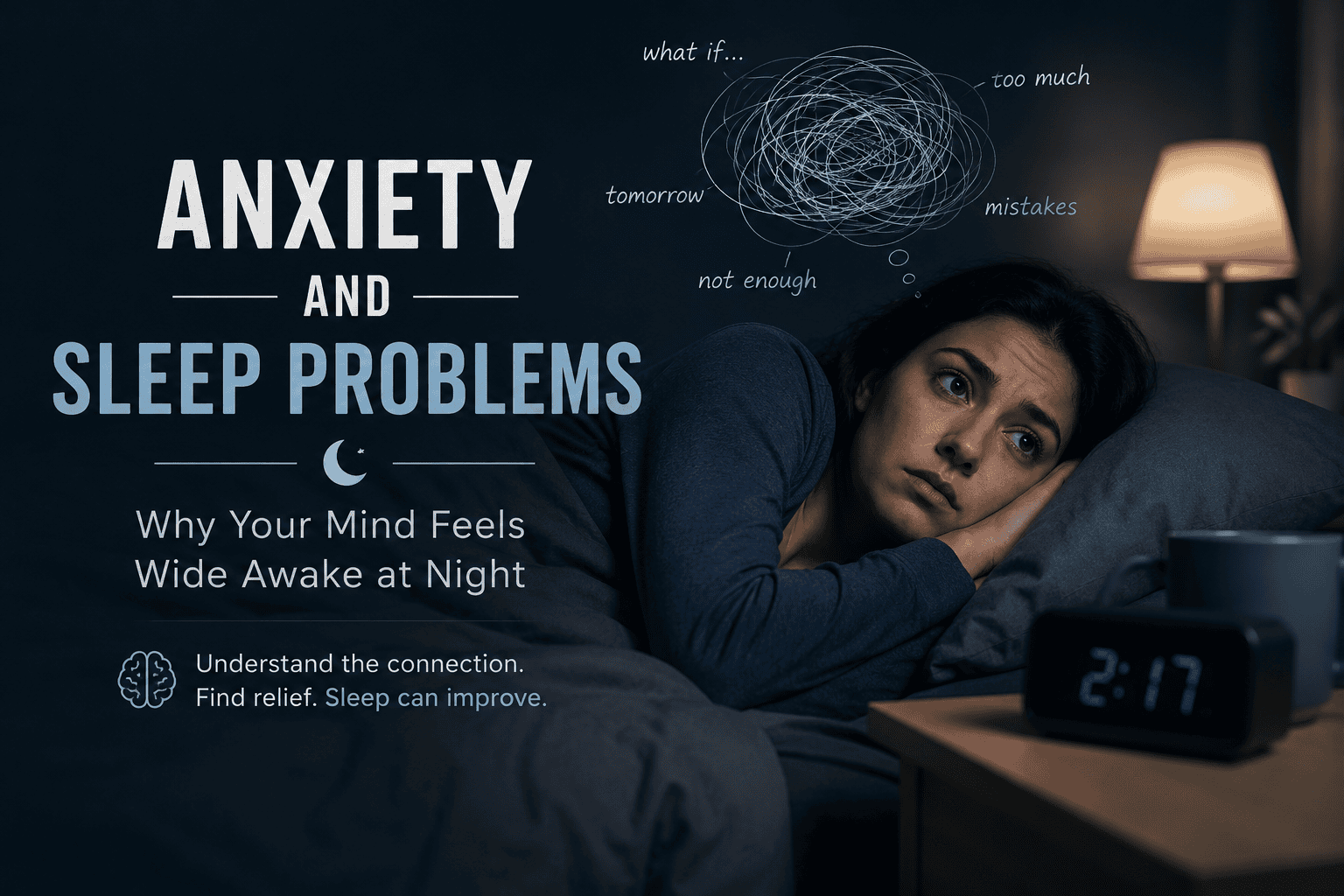
Anxiety and Sleep Problems
Anxiety & Sleep Resources
Anxiety and Sleep Problems: Why Your Mind Feels Wide Awake at Night
Anxiety may make it hard to fall asleep, stay asleep, quiet the mind, or feel rested even after time in bed. This guide explains why anxiety can interfere with sleep, how nighttime worry keeps the nervous system activated, and how counseling can help you begin building calmer patterns around rest.
Start Here
Anxiety-Related Sleep Problems Are Often a Nervous System Pattern, Not a Personal Failure
When anxiety affects sleep, bedtime can become frustrating, tense, or even stressful. You may feel physically exhausted but mentally alert. You may want to rest, but your brain keeps replaying the day, worrying about tomorrow, scanning for problems, or trying to solve things that do not have immediate answers.
Many people blame themselves for not being able to “just relax.” But anxiety-related sleep problems often happen when the mind and body have trouble shifting from alert mode into rest mode. Your nervous system may still be acting as if something needs attention, even when you are safe in bed.
What Are Anxiety-Related Sleep Problems?
Anxiety-related sleep problems happen when worry, racing thoughts, fear, body tension, panic sensations, rumination, or nervous system activation interferes with falling asleep, staying asleep, or waking feeling rested. These problems may include trouble quieting the mind, waking during the night, waking too early, or feeling exhausted despite spending enough time in bed.
What It Feels Like
What Anxiety and Sleep Problems Can Feel Like
Anxiety does not always show up as panic at bedtime. Sometimes it feels like a busy mind, a tense body, a sense of pressure, or a fear that you will not be able to get enough rest.
Trouble Falling Asleep
You may feel tired but unable to settle because your mind keeps replaying, planning, worrying, or scanning for problems.
Restless Sleep
Sleep may feel light, interrupted, or unsatisfying, especially when your body stays tense even after you fall asleep.
Middle-of-the-Night Waking
You may wake at 2 or 3 a.m. with worry, dread, body tension, or a sudden need to think through everything.
Racing Thoughts
Thoughts may feel fast, repetitive, or difficult to interrupt, especially when there are fewer distractions at night.
Physical Anxiety
Anxiety may show up as a racing heart, tight chest, stomach discomfort, jaw tension, shallow breathing, or restlessness.
Waking Up Exhausted
Even after enough hours in bed, you may wake feeling tense, foggy, unrefreshed, or already worried about the day.
Why It Happens
Why Anxiety Keeps the Mind and Body Awake
Anxiety activates the body’s threat-response system. Even when there is no immediate danger, the brain may treat uncertainty, unfinished tasks, emotional conflict, health concerns, relationship stress, financial pressure, or tomorrow’s responsibilities as something that must be solved before you can rest.
This can keep the nervous system in a state of alertness. Instead of moving into a calmer rest state, your body may stay ready to respond. Your mind may continue searching for certainty, reassurance, or a plan.
Anxiety can interfere with sleep by creating:
- Racing thoughts or mental replay
- What-if thinking about the future
- Body tension that makes it hard to relax
- Fear of not sleeping enough
- Pressure to solve problems before bed
- Hypervigilance or feeling “on alert”
- Frustration that turns bedtime into another source of stress
Anxiety-related sleep problems often become self-reinforcing. After several difficult nights, you may begin worrying about sleep itself, which can keep the cycle going.
An Educational Framework
The Sleep-Anxiety Cycle
Anxiety and sleep problems often reinforce each other. Understanding the cycle can help you recognize why sleep becomes harder the more pressure you feel to make it happen.
1. The Day Gets Quiet
As distractions decrease, worries, unfinished tasks, memories, or body sensations become more noticeable.
2. The Brain Starts Scanning
Your mind searches for problems to solve, mistakes to review, or future concerns to prepare for.
3. The Body Activates
Tension, restlessness, shallow breathing, stomach discomfort, or a racing heart may make rest feel farther away.
4. Sleep Becomes Pressured
You may start thinking, “I have to sleep now,” which can increase frustration and make the body even more alert.
5. The Clock Becomes a Threat
Checking the time can create urgency, worry, and mental math about how little sleep you may get.
6. The Pattern Repeats
After several nights, bedtime itself may become associated with stress, pressure, and anticipatory anxiety.
The goal is not to force sleep. The goal is to help your nervous system relearn that bedtime is not a performance test, a problem-solving session, or a danger signal.
Sleep Difficulty
Anxiety Can Make Falling Asleep Feel Like Work
When anxiety is high, the brain may treat bedtime as the moment to review everything. You may lie down and suddenly remember tasks, conversations, fears, or responsibilities that felt manageable earlier in the day.
- You feel tired but wired.
- You cannot stop thinking.
- You feel pressure to fall asleep quickly.
- You become frustrated that your body will not relax.
Anxiety Loop
Fear of Not Sleeping Can Keep the Cycle Going
After repeated difficult nights, you may begin to fear bedtime. The worry may shift from the original stressor to sleep itself.
- “What if I cannot sleep again?”
- “How will I function tomorrow?”
- “Why can everyone else sleep except me?”
- “Something must be wrong with me.”
Sleep anxiety can become its own source of stress. Counseling can help you work with the anxiety pattern rather than fighting your body all night.
Waking During the Night
Why Anxiety Can Wake You Up in the Middle of the Night
Some people fall asleep but wake later with a rush of worry, dread, or body activation. This may happen because the nervous system remains sensitive to stress, even during sleep. When you wake, the mind may quickly attach to a worry and begin problem-solving.
Middle-of-the-night anxiety can feel especially intense because the world is quiet, you may feel alone with your thoughts, and your brain is not fully oriented. Small worries can feel larger at 3 a.m. than they do in daylight.
Night waking may involve:
- Waking with a racing heart or tight chest
- Waking and immediately thinking about work, family, health, or responsibilities
- Feeling dread without knowing why
- Checking the clock repeatedly
- Feeling unable to return to sleep once the mind starts racing
- Waking earlier than planned and feeling anxious before the day begins
Middle-of-the-night anxiety does not always mean something is wrong in that moment. Sometimes it means your nervous system is still carrying stress from the day, the week, or a longer pattern of overwhelm.
Physical Anxiety at Bedtime
Anxiety Can Keep the Body Awake Even When the Mind Wants Rest
Anxiety is not only mental. It can affect the body through muscle tension, breathing changes, digestive discomfort, restlessness, headaches, jaw clenching, and an increased heart rate. When these sensations happen at night, they can make it harder to feel safe enough to sleep.
The body may interpret stress as a signal to stay alert. Even if you logically know you need rest, your nervous system may remain prepared for action.
Physical symptoms may include:
- Chest tightness or racing heart
- Shallow breathing
- Muscle tension or jaw clenching
- Stomach discomfort or nausea
- Restlessness or feeling unable to get comfortable
- Headaches or neck tension
- Feeling tired but physically keyed up
If physical symptoms are new, severe, or concerning, it is important to consult a medical provider to rule out medical causes. Therapy can support anxiety-related patterns, but medical concerns should also be evaluated when needed.
Trauma, Stress, and Hypervigilance
When Trauma or Chronic Stress Affects Sleep
Sleep can feel vulnerable when the nervous system has learned to stay on alert. People who have experienced trauma, chronic stress, unpredictable relationships, loss, emotional neglect, or prolonged pressure may have difficulty fully relaxing even when the environment is safe.
In this pattern, nighttime alertness is not just “overthinking.” It may be the body’s attempt to stay prepared. The mind may scan for danger, replay interactions, monitor sounds, or resist letting go because rest has not always felt safe.
Trauma-related sleep struggles may include:
- Feeling unsafe or vulnerable when trying to sleep
- Staying alert to sounds, messages, or other people’s moods
- Nightmares or distressing dreams
- Waking tense or startled
- Feeling unable to relax when life becomes quiet
- Using distraction or exhaustion to finally fall asleep
If sleep problems are connected to trauma or chronic stress, calming strategies may help, but therapy may also need to address the deeper nervous system patterns underneath the sleep difficulty.
What Helps
Ways to Support Calmer Nights
The goal is not to force your mind to go blank. The goal is to help your brain and body shift gradually toward safety, predictability, and rest.
Create a Worry Transition
Set aside time earlier in the evening to write down worries, unfinished tasks, and realistic next steps so bedtime does not become the planning hour.
Protect the Bed as a Rest Space
When possible, keep intense problem-solving, emails, scrolling, conflict, and work outside of bed so your brain can associate bed with rest.
Use Body-Based Calming
Gentle breathing, grounding, muscle relaxation, stretching, or a body scan may help signal safety to the nervous system.
Name the Thought Pattern
Instead of arguing with every worry, try naming it: “This is a worry thought,” or “My brain is trying to protect me.”
Reduce Clock Checking
Repeatedly checking the time can increase pressure, frustration, and anxiety about how much sleep is left.
Address the Anxiety Pattern
If worry, panic, trauma, or chronic stress keeps returning at night, therapy can help you work with the deeper cycle.
If sleep problems are frequent, severe, worsening, or connected to medical symptoms, it is wise to consult a medical provider. Counseling can be one part of support, especially when anxiety, stress, or trauma are contributing factors.
When to Seek Help
When to Seek Counseling for Anxiety and Sleep Problems
It may be time to reach out when anxiety regularly interferes with sleep, bedtime feels stressful, your mind is difficult to quiet, you wake with panic or dread, or poor sleep is affecting your mood, concentration, relationships, or daily functioning.
Counseling can help you understand the anxiety-sleep cycle, reduce shame, identify triggers, calm nervous system activation, and practice healthier responses to worry, uncertainty, and nighttime alertness.
Consider counseling if you notice:
- You dread bedtime because you expect another difficult night
- Your mind races when you try to fall asleep
- You wake during the night with worry or panic
- You feel tense, restless, or physically activated at night
- You feel exhausted but cannot seem to rest
- You rely on constant distraction to fall asleep
- Anxiety and sleep problems are affecting your daily life
If sleep problems include thoughts of death, self-harm, or suicide, seek immediate support. In the United States, call or text 988 for the Suicide & Crisis Lifeline, call 911, or go to the nearest emergency room.
Anxiety Counseling at Motivations Counseling
Therapy Can Help When Anxiety Is Disrupting Your Sleep
Motivations Counseling provides therapy for adults experiencing anxiety, racing thoughts, sleep-related worry, panic symptoms, trauma-related activation, chronic stress, emotional overwhelm, relationship stress, and major life transitions. Counseling may help you understand why your mind and body feel so activated at night and begin practicing new ways to respond to worry, uncertainty, and restlessness.
Our counseling team serves clients in Sugar Land, Katy, Richmond, Fort Bend County, West Houston, and through telehealth across Texas when clinically appropriate.
Counseling Support
Anxiety Counseling in Sugar Land, Katy, and Online Across Texas
If anxiety is making it hard to fall asleep, stay asleep, or feel rested, counseling can help you better understand the pattern and begin taking manageable next steps.
- Individual counseling for adults
- Support for anxiety, panic, chronic worry, stress, and emotional overwhelm
- Trauma-informed and nervous-system-informed care
- In-person options in Sugar Land and Katy when available
- Telehealth counseling across Texas when clinically appropriate
Therapy Learning Center
Continue Learning About Anxiety, Sleep, Stress, and Nervous System Activation
These related resources can help adults better understand anxiety symptoms, physical anxiety, racing thoughts, high-functioning anxiety, chronic stress, trauma responses, and when counseling may help.
Racing Thoughts and Overthinking
Learn why your mind may keep replaying, predicting, checking, or trying to solve problems that never feel fully resolved.
Read article →Why Do I Feel Anxious All the Time?
Learn why anxiety may feel constant when worry, stress, nervous system activation, and avoidance reinforce each other.
Read article →High-Functioning Anxiety
Understand how anxiety can hide behind productivity, overthinking, perfectionism, and emotional fatigue.
Read article →Why Anxiety Feels Physical
Learn why anxiety can cause body-based symptoms such as tightness, stomach discomfort, racing heart, and tension.
Read article →Survival Mode and Chronic Stress
Learn how long-term stress can affect emotions, sleep, focus, relationships, and the nervous system.
Read article →Counseling Resource Center
Explore resources on anxiety, depression, trauma, EMDR, relationships, teen counseling, and emotional health.
Explore Resource Center →Frequently Asked Questions
Common Questions About Anxiety and Sleep Problems
Can anxiety cause sleep problems?
Yes. Anxiety can make it harder to fall asleep, stay asleep, or wake feeling rested. Racing thoughts, body tension, worry, panic sensations, and nervous system activation can all interfere with sleep.
Why does my anxiety get worse at night?
Anxiety may feel worse at night because the day becomes quieter and there are fewer distractions. Worries, body sensations, unfinished tasks, and emotional stress may become more noticeable when you try to rest.
Why do I wake up anxious in the middle of the night?
Middle-of-the-night anxiety may happen when the nervous system remains activated by stress, worry, or trauma-related alertness. Once you wake, the mind may quickly attach to a concern and begin problem-solving.
Can overthinking cause insomnia?
Overthinking can contribute to insomnia by keeping the mind active and the body alert. The more pressure you feel to fall asleep, the more anxious and frustrated you may become, which can make sleep harder.
What can I do when my mind will not shut off at night?
It may help to create an earlier worry transition, write down unfinished tasks, reduce problem-solving in bed, use body-based calming, and practice naming anxious thoughts rather than arguing with every thought.
Can trauma affect sleep?
Yes. Trauma and chronic stress can keep the nervous system on alert, making sleep feel vulnerable or unsafe. This may lead to difficulty relaxing, nightmares, waking tense, or feeling unable to rest when life becomes quiet.
When should I seek therapy for anxiety and sleep problems?
Consider therapy when anxiety regularly interferes with sleep, bedtime feels stressful, nighttime worry affects your daily functioning, or you feel exhausted from trying to manage your thoughts and body activation.
Can counseling help with anxiety-related sleep problems?
Counseling can help you understand the anxiety-sleep cycle, identify triggers, calm nervous system activation, reduce nighttime rumination, and practice healthier ways to respond to worry and uncertainty.

Take the Next Step
Anxiety Counseling in Sugar Land, Katy, and Online Across Texas
If anxiety is making it difficult to fall asleep, stay asleep, quiet your mind, or feel rested, counseling can help you understand what is happening and begin taking manageable steps toward calmer nights.

