
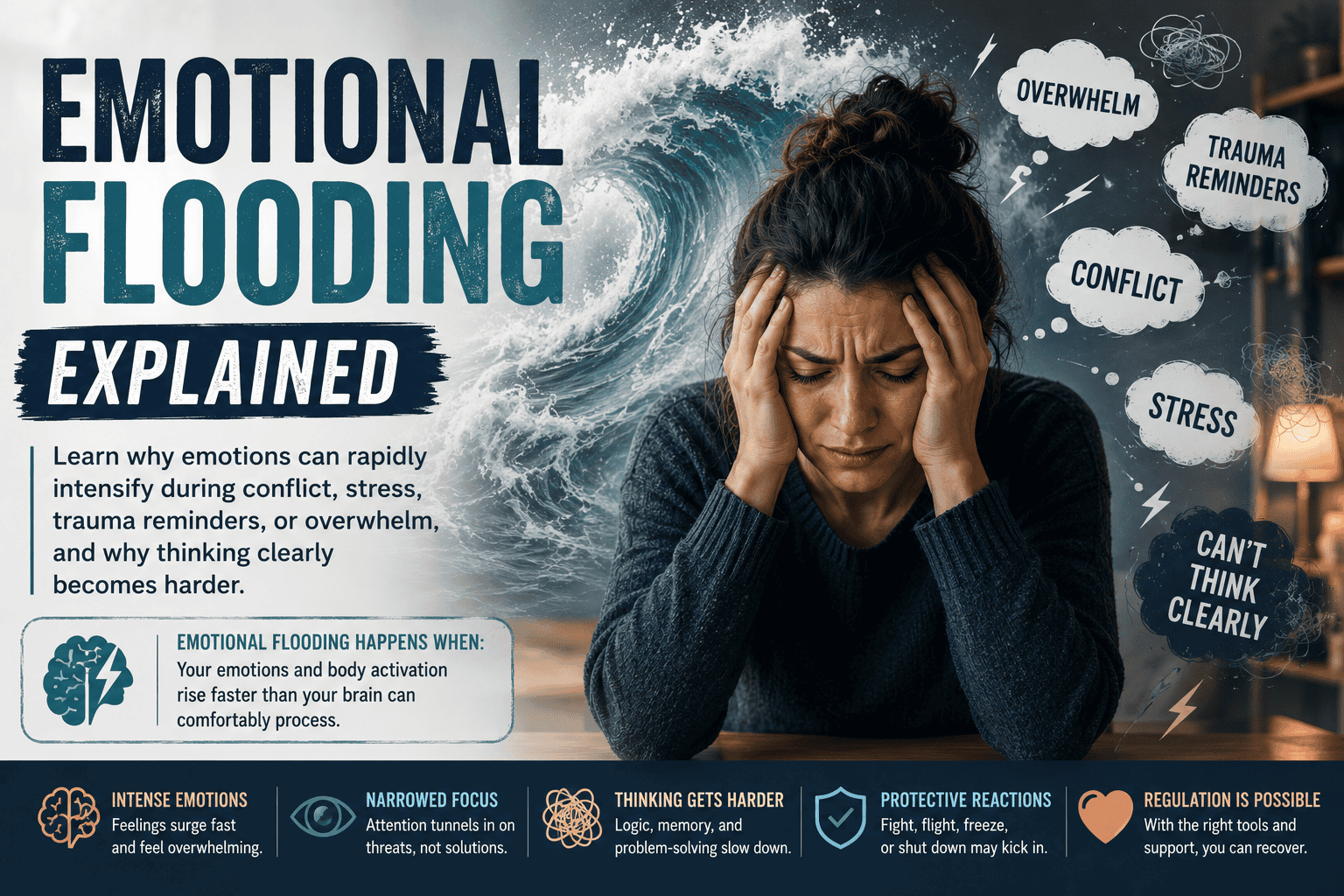
Emotional Flooding Explained: Why Thinking Gets Harder
Emotional Regulation & Nervous System Resources
Emotional Flooding Explained
Emotional flooding can happen when feelings, physical activation, thoughts, and protective urges intensify so quickly that the brain has less access to perspective, language, memory, and flexible problem-solving. It may occur during conflict, accumulated stress, trauma reminders, uncertainty, or overwhelm.
Start Here
Emotional Flooding Is More Than Simply “Getting Too Emotional”
During emotional flooding, the nervous system may shift rapidly into protection. Heart rate can rise, muscles may tighten, attention can narrow, and the mind may become organized around threat, rejection, injustice, helplessness, or the urgent need to make the discomfort stop. The person may still be able to speak and act, but their access to reflection and flexibility may be temporarily reduced.
Flooding can look like anger, panic, crying, shutting down, leaving, arguing, overexplaining, pleading, going blank, or becoming unable to make a decision. The visible reaction is only one part of the experience. Internally, the person may feel as though several emotions and body signals have arrived at once.
What Is Emotional Flooding?
Emotional flooding is a common, non-diagnostic term for a state of intense emotional and physiological activation that temporarily reduces the ability to think clearly, communicate effectively, take in new information, or respond with flexibility. It can occur with anxiety, conflict, trauma reminders, grief, burnout, depression, relationship distress, sensory overload, sleep deprivation, or ongoing stress. It does not automatically indicate a specific mental health diagnosis.
The Flooding Sequence
Intensity Often Builds Through Several Fast-Moving Steps
Flooding may feel instantaneous, but several processes can occur in rapid succession. Understanding the sequence can help reduce shame and make earlier intervention more possible.
1. A Trigger Occurs
A comment, facial expression, delay, mistake, memory, demand, physical sensation, or unexpected change captures attention.
2. Meaning Is Assigned
The moment may be interpreted as criticism, rejection, danger, disrespect, abandonment, failure, helplessness, or loss of control.
3. The Body Activates
Heart rate, breathing, muscle tension, heat, shaking, nausea, pressure, or restless energy may increase.
4. Attention Narrows
The mind may focus on the most threatening interpretation while losing access to nuance, context, or reassuring information.
5. A Protective Urge Appears
The person may want to fight, escape, freeze, shut down, fix the problem immediately, seek reassurance, or prevent disconnection.
6. The Aftermath Begins
Exhaustion, guilt, embarrassment, rumination, confusion, numbness, or renewed conflict may follow once the activation decreases.
The goal is not to prove that the emotion was wrong. The goal is to understand why the system escalated, reduce harmful reactions, and strengthen the ability to notice and respond earlier.
Common Triggers
Flooding Can Be Triggered by the Moment—or by What the Moment Represents
The trigger may appear small from the outside while carrying significant emotional meaning for the person experiencing it.
Conflict or Criticism
A harsh tone, interruption, accusation, disagreement, or feeling misunderstood may quickly increase defensiveness or fear.
Accumulated Stress
The immediate event may land on top of financial pressure, caregiving, deadlines, grief, uncertainty, pain, or too little recovery.
Trauma Reminders
Tone, distance, silence, unpredictability, physical sensations, or power differences may resemble earlier danger or helplessness.
Physical Depletion
Sleep loss, hunger, illness, hormonal changes, pain, overstimulation, medication effects, or substance use can reduce emotional capacity.
Attachment Threats
Delayed responses, emotional distance, perceived rejection, or fear of abandonment may create intense urgency in close relationships.
Loss of Control
Unexpected changes, uncertain outcomes, too many decisions, or dependence on someone else may activate fear or helplessness.
Flooding During Conflict
Disagreement Can Begin to Feel Like an Emergency
During conflict, emotional flooding can make the conversation feel much more dangerous or urgent than it appears to the other person. The brain may prioritize defending, escaping, proving, fixing, or restoring connection over listening and considering multiple perspectives.
Once flooding increases, additional explanations may not help. More words can become more input to process, and attempts to force resolution may intensify the sense of being trapped, dismissed, or abandoned.
Possible conflict responses include:
- Interrupting, raising the voice, or repeating the same point
- Demanding immediate reassurance or resolution
- Leaving abruptly or refusing to continue talking
- Going blank, becoming silent, or losing access to words
- Bringing in many past examples at once
- Interpreting neutral statements as criticism or rejection
Important Distinction
Flooding Explains Reduced Capacity—It Does Not Excuse Harm
Emotional flooding can help explain why someone loses flexibility or reacts quickly. It does not make threats, intimidation, cruelty, coercion, destruction, or violence acceptable. Understanding the nervous system response should support accountability, safety, repair, and different choices.
- Pause when the interaction is becoming unsafe or unproductive.
- Use clear boundaries rather than punishment or humiliation.
- Return to the issue when both people can participate more effectively.
- Seek professional help when conflict repeatedly becomes harmful.
Accumulated Stress Load
The Final Trigger May Be Small, but the Total Load Is Not
Emotional capacity changes from day to day. A person who is rested, supported, and physically comfortable may be able to tolerate frustration that feels impossible after weeks of poor sleep, caregiving, financial pressure, conflict, pain, uncertainty, or constant responsibility.
When stress accumulates without enough recovery, the nervous system may begin reacting from a much higher baseline. The final inconvenience, comment, or request may be the point at which the remaining capacity is exceeded.
Stress load may be increased by:
- Too many responsibilities with too little practical support
- Repeated interruptions, decisions, or emotional demands
- Financial, legal, medical, work, or caregiving uncertainty
- Chronic pain, illness, hormonal changes, or poor sleep
- Unresolved grief, trauma, betrayal, or relationship strain
- Feeling unable to say no, ask for help, or make mistakes
A reaction can look disproportionate when compared only with the final trigger. It may become more understandable when the person’s total stress load and current physical capacity are included.
Trauma and Learned Protection
The Present Moment May Resemble an Earlier Experience
Trauma reminders are not always obvious memories or images. The nervous system may respond to tone, silence, facial expression, physical closeness, authority, unpredictability, feeling trapped, not being believed, or losing control. The present event may be safer, but the body can still react as though an earlier pattern is returning.
This can create intense fear, anger, shame, urgency, numbness, or confusion before the person consciously recognizes the connection.
Do Not Assume Trauma
Emotional Flooding Has Many Possible Contributors
Trauma can contribute, but flooding can also be related to anxiety, depression, grief, burnout, ADHD, sensory overload, relationship stress, sleep deprivation, medication effects, substance use, hormonal changes, pain, or medical conditions. A careful assessment is more useful than assigning a single explanation too quickly.
Body Signals
The Body Often Shows Flooding Before the Mind Can Explain It
Learning early physical signs can make it easier to pause before the activation reaches its highest point.
Heart and Chest
Racing heart, pounding heartbeat, chest pressure, flushing, or a sudden surge of internal urgency.
Breathing
Shallow breathing, breath-holding, frequent sighing, throat tightness, or difficulty taking a satisfying breath.
Muscle Tension
Tight jaw, raised shoulders, clenched hands, shaking, restless legs, headaches, or a strong urge to move.
Digestive Sensations
Nausea, stomach pressure, loss of appetite, urgency, reflux, or a sudden feeling of being physically unwell.
Sensory Intensity
Noise, light, touch, movement, clutter, or multiple voices may become unusually difficult to tolerate.
Freeze or Disconnection
Blurred awareness, numbness, tunnel vision, going blank, feeling unreal, or becoming unable to speak or act.
New, severe, persistent, or unexplained physical symptoms should not automatically be attributed to emotional flooding. Seek appropriate medical evaluation, especially for chest pain, fainting, severe breathing difficulty, neurological changes, or other urgent concerns.
Why Thinking Becomes Harder
Protection Can Temporarily Reduce Access to Perspective and Flexible Reasoning
During flooding, attention may become organized around the perceived threat. The mind searches for evidence, remembers related injuries, predicts consequences, and prepares a response. This can make it harder to absorb reassurance, remember what was just said, consider another interpretation, or generate several possible solutions.
Thinking changes may include:
- All-or-nothing conclusions such as “This always happens” or “Nothing will change”
- Difficulty remembering details or the original point of the conversation
- Repeating the same thought because it feels unresolved or urgent
- Assuming intent without enough information
- Focusing on one threatening detail while missing the larger context
- Feeling unable to choose among options or identify what is needed
- Knowing later what you wanted to say but being unable to access it in the moment
Reduced clarity during flooding is usually temporary. It is often more effective to lower activation first and return to complex problem-solving later rather than forcing insight or resolution at the peak of the response.
Relationship Effects
Flooding Can Make Connection Feel Urgent, Unsafe, or Impossible
In close relationships, the nervous system may be especially sensitive to tone, distance, criticism, delayed responses, or signs of disconnection. One person may pursue conversation urgently while the other becomes flooded and withdraws. Each reaction can intensify the other.
Couples and family members may begin arguing about the reaction rather than the original issue. Over time, both people can become afraid of difficult conversations.
A More Helpful Response
Pause Without Abandoning the Conversation
- Name that the conversation is becoming too activated.
- Agree on a specific time to return rather than disappearing indefinitely.
- Use the pause to regulate, not to build a stronger case.
- Return to one issue at a time.
- Describe needs and impact without humiliation or character attacks.
- Seek couples or family support when the pattern is difficult to interrupt.
After the Flooding Passes
The Nervous System May Need Time to Recover
Once activation decreases, a person may feel physically tired, emotionally raw, embarrassed, confused, numb, or ashamed. They may replay the event, search for signs of damage, or become afraid that the same reaction will happen again.
Common aftereffects include:
- Fatigue, headache, muscle soreness, or difficulty settling
- Guilt about words, tone, withdrawal, or impulsive behavior
- Rumination and mentally rewriting the conversation
- Difficulty remembering the sequence clearly
- Needing reassurance while also wanting distance
- Emotional numbness or a temporary “crash” after intense activation
Repair is most effective when it includes both compassion and responsibility: acknowledge the nervous system response, address any harm, clarify what was needed, and identify a different plan for the next escalation.
When Flooding Is Happening
Reduce Urgency Before Trying to Solve the Whole Problem
The goal is not to suppress emotion or become perfectly calm. The immediate goal is to lower intensity enough to regain orientation, choice, and the ability to communicate safely.
Try a brief sequence:
- Pause the action: Delay sending the message, making the decision, driving away impulsively, or continuing the argument when possible.
- Name the state: “I am flooded,” “My body is in alarm,” or “I cannot think clearly yet.”
- Orient to the present: Look around slowly and identify where you are, what day it is, and what is actually occurring now.
- Use physical support: Feel both feet on the floor, lean against a chair, unclench the jaw, or hold an object with a clear texture.
- Reduce input: Step away from noise, screens, multitasking, or repeated explanations when practical.
- Lengthen the exhale gently: Let the out-breath become slightly slower without forcing large breaths.
- Choose one next step: Ask for time, water, food, space, reassurance, information, a boundary, or professional support.
Grounding strategies are individual. Stop a technique that increases panic, dizziness, pain, dissociation, or frustration and try a different form of support.
Longer-Term Recovery
Greater Regulation Comes From Increasing Capacity and Flexibility
Lasting change usually involves more than learning a single calming technique. It may require reducing current stress, improving physical recovery, changing relationship patterns, and addressing unresolved experiences that continue signaling danger.
Notice Earlier Signals
Identify the first body changes, thoughts, meanings, and protective urges that appear before the response reaches its peak.
Restore Physical Capacity
Support sleep, nutrition, hydration, movement, medical care, sensory breaks, and realistic recovery time.
Reduce Preventable Load
Simplify decisions, adjust unsustainable demands, delegate when possible, and create limits around repeated stressors.
Improve Communication
Practice naming activation, asking for a pause, expressing needs directly, and returning to conversations after regulation.
Increase Actual Safety
Address coercion, abuse, instability, harassment, overwork, or other real conditions that cannot be regulated away through coping skills.
Process Root Experiences
When clinically appropriate, therapy may address trauma, grief, shame, attachment injuries, fear, or beliefs that intensify present-day reactions.
Progress may first look like noticing flooding sooner, pausing before acting, recovering more quickly, communicating one need clearly, or repairing conflict with less shame. The goal is flexibility, not never becoming activated.
Therapy Support
Counseling Can Help Identify What Drives the Flooding Pattern
A therapist can help assess triggers, meanings, physical activation, relationship patterns, current stressors, trauma history, anxiety, depression, grief, sensory overload, and other factors that may be contributing.
Treatment may include education about stress responses, grounding and regulation skills, cognitive and behavioral strategies, communication and boundary work, relationship repair, and trauma-focused treatment when clinically appropriate.
Medical and Psychiatric Support
Similar Symptoms Can Have More Than One Cause
A physician or other qualified healthcare professional may need to evaluate symptoms involving sleep, heart rate, breathing, faintness, pain, hormones, medication effects, stimulant use, substance use, neurological changes, or significant fatigue.
- Seek urgent care for symptoms that may represent a medical emergency.
- Discuss persistent physical or cognitive changes with a medical provider.
- Consider psychiatric consultation when symptoms are severe or medication may be helpful.
- Coordinate care when mental and physical health concerns overlap.
Counseling at Motivations Counseling
Trauma-Informed Counseling Can Support Emotional Regulation and Recovery
Motivations Counseling provides therapy for adults and teens experiencing emotional flooding, anxiety, chronic stress, trauma-related symptoms, irritability, shutdown, relationship conflict, sleep disruption, burnout, and difficulty thinking clearly when overwhelmed.
Our counseling team serves clients in Sugar Land, Katy, Richmond, Fort Bend County, West Houston, and through telehealth across Texas when clinically appropriate.
Counseling Support
Counseling in Sugar Land, Katy, and Online Across Texas
Therapy can help you understand what triggers flooding, recognize the earliest warning signs, strengthen regulation and communication skills, reduce repeated conflict, and address unresolved stress or trauma when appropriate.
- Individual counseling for anxiety, stress, burnout, and emotional overwhelm
- Trauma-informed therapy focused on safety, stabilization, and increased flexibility
- EMDR therapy when clinically appropriate
- Couples counseling for repeated escalation, withdrawal, and communication breakdown
- In-person options in Sugar Land and Katy when available
- Telehealth counseling across Texas when clinically appropriate
Therapy Learning Center
Continue Learning About Emotional Overwhelm and Nervous System Responses
These related resources can help you understand why reactions intensify, how chronic activation affects daily life, and what may support regulation and recovery.
Why Do Small Things Feel So Big?
Understand stress load, trauma reminders, depletion, and why reactions can feel larger than the immediate moment.
Read article →Why Do I Get Emotionally Overwhelmed?
Explore why small stressors may feel intense when the nervous system is overloaded, depleted, or carrying unresolved stress.
Read article →When the Nervous System Stays in Survival Mode
Learn how chronic activation may affect sleep, focus, mood, relationships, physical symptoms, and presence.
Read article →Hypervigilance: When Your Brain Will Not Turn Off
Explore why the brain may keep scanning, planning, rehearsing, and watching for danger even when you want to rest.
Read article →Counseling Services
View counseling options for anxiety, trauma, depression, relationships, teens, and emotional well-being.
View services →Counseling Resource Center
Explore educational resources on anxiety, depression, trauma, relationships, EMDR therapy, and emotional health.
Explore resources →Full Resource Center
Explore the Full Counseling Resource Center
Our Counseling Resource Center includes educational articles on emotional flooding, anxiety, trauma, depression, relationships, hypervigilance, emotional overwhelm, nervous system responses, EMDR therapy, teen counseling, and practical ways to understand mental health symptoms.
Frequently Asked Questions
Common Questions About Emotional Flooding
What is emotional flooding?
Emotional flooding is a state of intense emotional and physical activation that temporarily makes it harder to think clearly, communicate effectively, take in new information, or respond flexibly. It is a descriptive term rather than a formal diagnosis.
What does emotional flooding feel like?
It may feel like panic, anger, urgency, crying, shaking, chest pressure, racing thoughts, tunnel vision, numbness, going blank, wanting to escape, or needing to resolve the situation immediately. Different people may move toward fight, flight, freeze, shutdown, or reassurance-seeking.
Why can I not think clearly when I am emotionally flooded?
During flooding, attention becomes focused on perceived threat, rejection, helplessness, or urgency. The mind may have less access to perspective, working memory, language, and flexible problem-solving until the activation decreases.
Is emotional flooding the same as anger, anxiety, or a panic attack?
No. Flooding can include anger, anxiety, or panic-like symptoms, but it describes the broader state of being emotionally and physiologically overwhelmed. A panic attack has specific clinical features, and anger is only one possible emotional response.
Why does conflict trigger emotional flooding?
Conflict can activate fears of criticism, rejection, abandonment, disrespect, helplessness, or loss of control. Once the nervous system interprets the interaction as threatening, listening and problem-solving may become harder while defensive or avoidant urges become stronger.
Can trauma reminders cause emotional flooding?
Yes. A current tone, facial expression, silence, power difference, physical sensation, or feeling of being trapped may resemble an earlier dangerous or helpless experience. Trauma is one possible contributor, but flooding can also occur because of anxiety, stress, sleep loss, burnout, grief, sensory overload, or other factors.
How long does emotional flooding last?
The length varies. Some episodes decrease within minutes after the trigger ends and the person receives enough space or support. Others last longer when the stressor continues, the person keeps replaying the event, or the body is already depleted. Repeated or prolonged episodes may benefit from professional assessment.
How can I calm emotional flooding in the moment?
Pause the action, name the state, orient to the present environment, feel physical support beneath the body, reduce unnecessary input, lengthen the exhale gently, and identify one immediate need. The goal is not instant calm but enough reduction in urgency to regain choice.
Can therapy help with emotional flooding?
Therapy may help identify triggers and meanings, recognize early body signals, build regulation and communication skills, improve boundaries, reduce repeated conflict, address anxiety or depression, and process trauma or loss when clinically appropriate.
When should I seek immediate help?
Seek immediate help when there may be a life-threatening medical emergency, a person cannot remain safe, or there are thoughts of suicide or serious self-harm. In the United States, call 911 for an emergency, call or text 988 for the Suicide & Crisis Lifeline, or go to the nearest emergency room.

Take the Next Step
Counseling for Emotional Flooding in Sugar Land, Katy, and Online Across Texas
If emotions rapidly intensify during conflict, stress, trauma reminders, or overwhelm, counseling can help you understand the pattern, recognize it earlier, communicate more effectively, and build a greater ability to stay present and make choices.

