
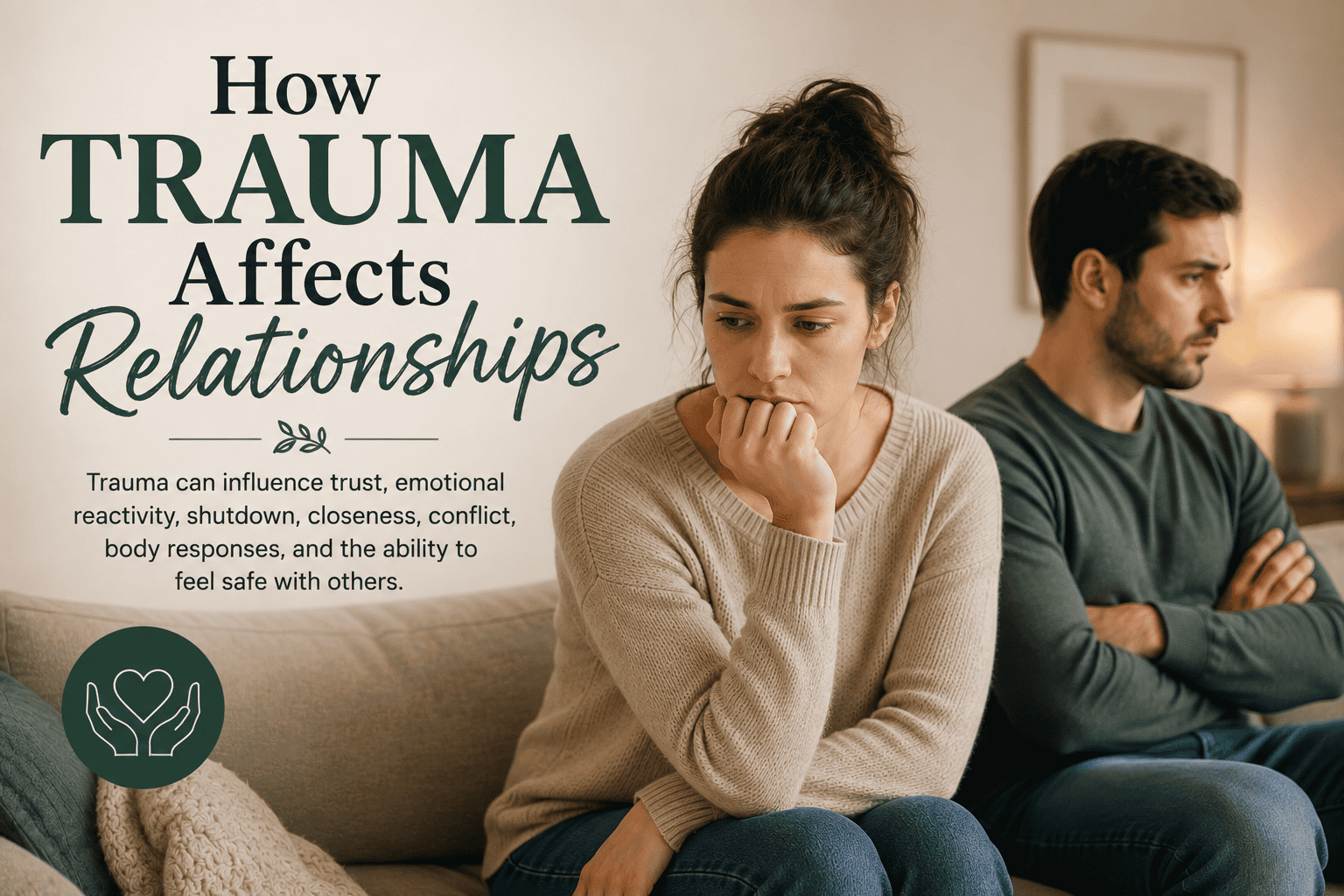
How Trauma Affects Relationships and Emotional Connection
Trauma-Informed Couples Counseling Resource Center
How Trauma Affects Relationships
Trauma can shape the way a person experiences trust, closeness, conflict, touch, emotional vulnerability, and safety. A partner may react intensely, shut down, become watchful, avoid dependence, seek reassurance, or feel disconnected from their body without fully understanding why. These responses are often protective adaptations rather than signs that someone does not care. With awareness, safety, accountability, and trauma-informed support, couples may begin responding to the pattern instead of treating each other as the enemy.
Start Here
Trauma Can Enter the Relationship Even When the Harm Happened Somewhere Else
Trauma is not limited to one type of event. It may develop after abuse, violence, neglect, betrayal, sudden loss, medical emergencies, accidents, military experiences, discrimination, frightening caregiving experiences, childhood instability, or other situations that overwhelmed a person's ability to cope. The nervous system may continue acting as though danger could return even when the present relationship is caring and relatively safe.
This can create confusing moments for both partners. One person may think, “Why am I reacting this strongly?” while the other thinks, “Why does this feel like it is about me?” The present interaction may be real and important, but the intensity, urgency, numbness, or fear may also be shaped by earlier experiences.
Understanding trauma is not about excusing harmful behavior. It is about identifying what the nervous system is trying to protect, increasing choice, and creating safer ways to communicate, set boundaries, repair, and connect.
Trauma and Relationships
Trauma Can Change What the Mind and Body Interpret as Safe
Protective responses that were once necessary may continue after the original danger has passed. In relationships, those responses can affect how a person reads tone, distance, disagreement, dependence, touch, uncertainty, and repair.
Danger Detection
The nervous system may scan facial expressions, silence, changes in tone, or small shifts in behavior for signs that harm is approaching.
Difficulty Trusting
Depending on another person may feel risky when earlier relationships involved betrayal, abandonment, unpredictability, or control.
Strong Reactivity
A present-day disagreement may activate fear, anger, urgency, or panic that feels much larger than the immediate event.
Shutdown or Numbness
The person may go blank, become quiet, lose access to words, feel unreal, or disconnect from emotion when overwhelmed.
Protective Distance
Emotional or physical distance may reduce vulnerability when closeness has previously been associated with danger, pressure, or loss.
Repeating Cycles
One partner's protection may activate the other's fear, creating a cycle of pursuit, withdrawal, escalation, reassurance, or avoidance.
The Nervous System in Relationships
Conflict May Feel Like a Threat Before the Thinking Brain Can Catch Up
Trauma responses are not only thoughts. They involve changes in heart rate, breathing, muscle tension, attention, digestion, energy, memory, and the ability to stay emotionally present.
A tone, expression, silence, touch, question, delay, or disagreement resembles something previously unsafe.
The body detects threat and mobilizes before the person has fully interpreted what is happening.
The person may fight, flee, freeze, appease, shut down, become controlling, or urgently seek reassurance.
The other partner may defend, pursue, withdraw, become frustrated, or interpret the response personally.
Each person's protection becomes evidence of danger to the other, increasing disconnection.
Shame, confusion, exhaustion, resentment, or avoidance may make the next conversation feel even riskier.
A trauma response can be automatic, but behavior still matters. Partners can learn to recognize activation earlier, pause before causing harm, communicate what is happening, and return to the conversation when regulation is more available.
Trust and Emotional Safety
Closeness May Feel Desirable and Dangerous at the Same Time
A person may deeply want connection while remaining alert for rejection, betrayal, criticism, abandonment, control, or humiliation. They may test the relationship, seek repeated reassurance, hide needs, avoid dependence, or leave emotionally before they can be left.
Trust may be harder when someone expects:
- Promises to be broken or affection to disappear
- Private information to be used against them
- Needs to be mocked, minimized, or treated as burdens
- Conflict to end in punishment, abandonment, or danger
- Control to increase as the relationship becomes more serious
- Vulnerability to create shame rather than connection
Safety Is Built Through Experience
Reassurance Helps, but Predictability Makes It Believable
Statements such as “You are safe with me” may be meaningful, but the nervous system often learns through repeated evidence. Trust grows when boundaries are respected, apologies lead to change, pauses are honored, promises are kept, and difficult emotions do not lead to retaliation or disappearance.
A partner cannot force another person's nervous system to feel safe. They can contribute to safety through consistency, empathy, transparency, and respect while also maintaining healthy boundaries.
Emotional Reactivity
Small Present-Day Moments Can Carry the Weight of Earlier Experiences
Trauma may make the nervous system more sensitive to cues associated with danger. A partner arriving late, becoming quiet, touching unexpectedly, raising their voice, disagreeing, appearing distracted, or asking for space may activate fear that is connected to both the present and the past.
Trauma-related activation may look like:
- Rapid anger, panic, crying, or urgency
- Assuming the worst before enough information is available
- Difficulty hearing reassurance once activated
- Repeated questioning or checking for certainty
- Feeling trapped, cornered, abandoned, or powerless
- Needing to leave immediately or demanding immediate resolution
- Remembering earlier pain as though it is happening again
- Feeling ashamed afterward because the reaction seemed disproportionate
The emotion is real even when the interpretation is incomplete. A helpful goal is not to debate whether the person “should” feel activated, but to slow the interaction enough to identify what is happening and what would support safety.
Shutdown, Freeze, and Dissociation
Not Every Trauma Response Looks Emotional or Dramatic
Some people become quieter, flatter, slower, or less emotionally available under stress. What appears to be indifference may be an overwhelmed nervous system reducing sensation, speech, movement, or connection.
Losing Words
The person may know they are upset but be unable to explain what they feel, remember the question, or organize a response.
Feeling Unreal or Far Away
They may feel detached from their body, surroundings, emotions, or the conversation itself.
Sudden Exhaustion
Energy may drop sharply, creating heaviness, sleepiness, collapse, or difficulty staying engaged.
Needing Distance
Space may be necessary for regulation, but it is safer when paired with a clear plan to return rather than indefinite disappearance.
Appearing Fine
A person may smile, agree, or minimize distress while internally feeling frightened, numb, or disconnected.
Delayed Emotion
Feelings may return hours or days later, after the body believes the immediate threat has passed.
Shutdown should not be used to avoid every difficult conversation. A regulated pause includes communication, a reasonable timeframe, and a commitment to return. Silent punishment, intimidation, or indefinite withdrawal is different from nervous-system regulation.
Emotional Closeness
Vulnerability May Activate Longing, Shame, and Fear
Emotional intimacy asks a person to be seen, need another person, and tolerate uncertainty about how they will respond. For someone whose needs were ignored, punished, controlled, or inconsistently met, that experience can feel dangerous.
They may share only practical information, change the subject, joke, become critical, overexplain, or wait until distress becomes overwhelming before revealing what they need.
Physical and Sexual Closeness
The Body May Respond Before the Person Has Chosen What They Want
Trauma can affect touch, desire, arousal, pain, body awareness, consent, and the ability to stay present. A person may want closeness emotionally while their body becomes tense, numb, fearful, or disconnected.
Physical and sexual connection should be guided by ongoing consent, choice, pacing, and respect. Pressure to prove love, forgiveness, or recovery through touch or sex can deepen disconnection and fear.
Trauma and Conflict
Partners May Be Arguing About the Present While Protecting Against the Past
Conflict can activate fears about power, abandonment, humiliation, control, rejection, or helplessness. Each partner may respond to that fear in a way that unintentionally increases the other's distress.
Criticism
Fear or unmet need may emerge as accusation, harshness, or global statements about the partner's character.
Defensiveness
Even gentle feedback may feel like danger when mistakes were previously met with punishment, shame, or rejection.
Leaving or Avoiding
Distance may reduce overwhelm, but repeated avoidance can leave concerns unresolved and intensify the other partner's pursuit.
Urgent Pursuit
A partner may demand immediate answers or reassurance because uncertainty feels intolerable or abandonment seems imminent.
Appeasing
Agreeing quickly, taking all the blame, or hiding preferences may be an attempt to prevent anger, rejection, or escalation.
Reenactment
The relationship may repeatedly recreate familiar roles of pursuer, withdrawer, rescuer, critic, controller, or powerless partner.
Body Responses and Somatic Memory
The Body May Remember What the Mind Cannot Easily Explain
A person may experience tension, nausea, trembling, numbness, pressure in the chest, headaches, rapid heartbeat, shallow breathing, dizziness, pain, or a sudden urge to escape during relationship moments that resemble earlier danger. These sensations may appear before a clear memory or thought.
Body-based signs of activation can include:
- Holding the breath or breathing rapidly
- Jaw, shoulder, stomach, or pelvic tension
- Feeling hot, cold, shaky, dizzy, or nauseated
- Difficulty making eye contact or tolerating touch
- Feeling trapped when a partner stands too close or blocks an exit
- Going numb or losing awareness of physical needs
- Needing repetitive movement, pressure, or distance to regulate
- Difficulty sleeping after conflict even when the conversation has ended
Trauma-informed relationship work respects the body. Slowing down, changing physical position, creating space, orienting to the room, grounding through the senses, and obtaining consent before touch can support greater present-moment safety.
Attachment and Trauma
Earlier Relationships Can Shape How People Seek and Protect Connection
Attachment patterns are not fixed labels. They are strategies that may develop around closeness, dependence, reassurance, conflict, and emotional need—especially when caregiving or earlier relationships were inconsistent, frightening, intrusive, or unavailable.
Anxious Protection
May involve reassurance seeking, heightened sensitivity to distance, fear of abandonment, or urgency to resolve conflict immediately.
Avoidant Protection
May involve minimizing needs, relying heavily on oneself, distancing under pressure, or feeling trapped by emotional dependence.
Fearful or Mixed Protection
A person may strongly desire closeness and then withdraw, become suspicious, or feel unsafe when connection becomes available.
Secure Functioning
Includes direct communication, respect for boundaries, reliable return after conflict, responsiveness, and the ability to repair.
Patterns Can Shift
New experiences of safety, accountability, choice, and consistent care can support greater attachment security over time.
Both Partners Matter
One person's trauma response can activate the other's history, creating a shared cycle that neither partner intended.
Understanding Triggers
A Trigger Is a Cue That Activates a Protective Response
Triggers may be obvious, such as yelling or unwanted touch, or subtle, such as a facial expression, closed door, particular phrase, smell, anniversary, financial conversation, delayed text, or feeling ignored. The cue does not need to be identical to the original trauma to activate the same survival response.
Helpful trigger questions include:
- What happened immediately before the reaction?
- What did the body notice first?
- What danger did the moment seem to predict?
- What did the person feel compelled to do?
- What response from the partner would have increased safety?
- What boundary, pause, or repair is needed now?
Triggers and Responsibility
Being Triggered Does Not Give Either Partner Permission to Cause Harm
A trigger can explain why a reaction occurred without making threats, insults, coercion, property destruction, stalking, violence, or controlling behavior acceptable. Trauma-informed care combines compassion with accountability.
The goal is to identify activation earlier, use safer regulation strategies, communicate needs directly, and repair any harm that occurred rather than asking the other partner to absorb repeated injury.
Supporting a Partner With Trauma
Support Works Best When It Includes Warmth, Choice, and Boundaries
A caring partner can contribute to healing, but they cannot become the therapist, sole regulator, or proof that danger will never occur. Sustainable support protects both partners' dignity and wellbeing.
Listen Before Explaining
Understanding the emotional experience can be more regulating than immediately debating facts, intent, or whether the response is logical.
Offer Choices
Ask whether the person wants space, quiet company, grounding, practical help, reassurance, or a later time to talk.
Respect Consent
Ask before touching, entering personal space, sharing private information, or continuing a conversation during overwhelm.
Be Predictable
Follow through, communicate changes, return when promised, and avoid using silence or affection as punishment.
Maintain Boundaries
Compassion does not require accepting yelling, threats, manipulation, repeated invasions of privacy, or emotional exhaustion without limits.
Encourage Broader Support
Individual therapy, medical care, trusted community, sleep, movement, and practical resources can reduce pressure on the relationship.
Healing Within the Relationship
New Relationship Experiences Can Help the Nervous System Learn Something Different
Healing does not mean never being triggered, never needing space, or never feeling afraid. It often means recognizing activation sooner, having more choices, recovering more quickly, communicating needs more clearly, and experiencing repair that was not available in earlier relationships.
Couples may practice:
- Naming activation without blaming: “My body is reacting strongly, and I need to slow down.”
- Using agreed-upon pauses with a specific return time
- Lowering voices, increasing physical space, and avoiding blocked exits
- Asking before touching or offering physical comfort
- Separating current facts from feared predictions
- Validating emotion while checking interpretations
- Making one clear request instead of escalating through accusation
- Repairing impact even when harm was not intended
- Building ordinary experiences of reliability, play, rest, and affection
- Respecting that individual trauma treatment may be needed alongside couples work
Instead of: “You are overreacting. I did not do anything.”
Try: “I can see that something about this feels threatening. I want to understand what happened, and I also want us to speak respectfully.”
Instead of: “Fine. I will leave you alone forever.”
Try: “I need 30 minutes to settle my body. I am not abandoning the conversation. I will come back at 7:30.”
Instead of: “If you loved me, you would know what I need.”
Try: “I need reassurance that we are okay before we solve the problem. Can you tell me what you are committed to?”
How Trauma-Informed Therapy Can Help
Therapy Can Help Partners Understand Protection Without Letting Protection Control the Relationship
Trauma-informed individual and couples therapy can help people recognize nervous-system activation, understand how earlier experiences shape current patterns, strengthen regulation, communicate vulnerable emotions more safely, and build boundaries that support both connection and choice.
Therapy may help with:
- Identifying triggers, survival responses, and relationship cycles
- Building grounding, stabilization, and emotional regulation skills
- Understanding attachment fears beneath criticism, pursuit, withdrawal, or shutdown
- Improving communication during and after activation
- Strengthening consent, boundaries, predictability, and emotional safety
- Processing traumatic memories through appropriate individual treatment
- Repairing trust injuries and repeated moments of misattunement
- Helping partners determine what type and pace of treatment are clinically appropriate
Emotionally Focused Therapy may help couples understand the attachment cycle that forms around trauma responses. EMDR and other trauma-focused approaches may support individual processing when a person has adequate stability and the treatment is appropriate.
Trauma Is Not the Whole Person
People Are More Than Their Protective Responses
Trauma may influence a relationship without defining every feeling, disagreement, preference, or difficulty. Not every conflict is a trauma response, and not every relationship problem can be solved through trauma processing alone.
Practical stress, incompatibility, untreated medical concerns, substance use, grief, financial strain, unequal labor, discrimination, parenting demands, and current relationship injuries may also need direct attention.
When Safety Must Come First
Trauma History Does Not Make Abuse Acceptable
Active violence, coercive control, credible threats, stalking, sexual coercion, intimidation, weapon access used to frighten, or fear of retaliation require specialized safety assessment. Standard conjoint couples therapy may be unsafe when one partner cannot speak freely or disclosures could lead to punishment.
A qualified clinician may recommend individual support, specialized domestic violence resources, safety planning, substance-use treatment, medical care, or psychiatric stabilization before or instead of joint relationship work.
Therapist Spotlight
Work With Carolina Román for Attachment-Focused Couples Counseling
At Motivations Counseling, Carolina Román, LMFT works with couples using an attachment-focused approach that helps partners understand emotional reactivity, shutdown, distance, negative interaction cycles, and difficulty feeling safe enough to connect.
Her work emphasizes slowing the cycle, identifying the vulnerable emotions beneath protective reactions, and helping each partner communicate in ways that increase emotional accessibility, responsiveness, engagement, and repair.
Carolina serves clients through Motivations Counseling's Houston-area couples counseling services and through telehealth across Texas when clinically appropriate.
Free Relationship Resource
Take the Free Relationship Attachment Style Quiz
Trauma and attachment experiences may influence how partners seek closeness, respond to distance, ask for reassurance, tolerate vulnerability, and protect themselves during conflict. The free Relationship Attachment Style Quiz can help individuals and couples reflect on patterns associated with secure, anxious, avoidant, mixed, or fearful-avoidant attachment.
- No name, email address, phone number, or other identifying information is required
- Immediate educational feedback is provided
- The quiz can be completed by one or both partners
- Results are for self-reflection and are not a diagnosis or formal psychological assessment
Attachment language should be used with flexibility. A person's responses may vary across relationships, situations, and stages of healing.
Trauma and Relationship Learning Center
Continue Learning About the Nervous System, Safety, Attachment, and Connection
These companion articles explore survival responses, hypervigilance, emotional safety, shutdown, attachment, communication, and the relationship cycles that can form around trauma.
When Your Nervous System Stays in Survival Mode
Learn how ongoing activation may affect emotions, attention, sleep, relationships, and the ability to feel settled.
Read article →Hypervigilance: When Your Brain Will Not Turn Off
Explore why the brain may keep scanning for danger even when a person wants to relax or connect.
Read article →Why Do Small Things Feel So Big?
Understand how stress, trauma, and nervous-system overload can intensify reactions to seemingly minor events.
Read article →Emotional Safety in Relationships
Explore how boundaries, consistency, responsiveness, respect, and repair support safer emotional connection.
Read article →Attachment Styles in Relationships
Learn how attachment patterns may affect reassurance, closeness, independence, conflict, and withdrawal.
Read article →My Partner Shuts Down During Conflict
Learn why shutdown may be protective and how couples can use safer pauses and clearer return plans.
Read article →When Communication Breaks Down
Understand why conversations can turn into criticism, defensiveness, silence, escalation, or misunderstanding.
Read article →Frequently Asked Questions
Common Questions About Trauma and Relationships
How can trauma affect a romantic relationship?
Trauma can affect trust, emotional regulation, conflict, attachment, physical closeness, body responses, communication, and the ability to feel safe depending on another person. Responses may include hypervigilance, reassurance seeking, withdrawal, shutdown, anger, avoidance, numbness, or difficulty tolerating vulnerability.
Why do I react so strongly to small things my partner does?
A present-day cue may resemble an earlier danger and activate the nervous system before the thinking brain has fully assessed the situation. The emotion is real, but the reaction may be shaped by both current circumstances and earlier experiences.
Can trauma make someone push their partner away?
Yes. Emotional or physical distance may function as protection when closeness has previously involved betrayal, control, abandonment, pressure, or harm. A person may want connection and still feel unsafe when vulnerability becomes available.
Why does my partner shut down during conflict?
Shutdown may reflect overwhelm, freeze, collapse, dissociation, shame, or fear of making the conflict worse. A helpful pause includes communication, regulation, and a specific plan to return rather than indefinite silence or punishment.
Can trauma affect physical or sexual intimacy?
Yes. Trauma can affect touch, desire, arousal, pain, body awareness, consent, and the ability to stay present. Physical and sexual connection should be guided by ongoing consent, choice, pacing, and respect.
How can I support a partner who has experienced trauma?
Listen with curiosity, offer choices, respect consent and boundaries, communicate predictably, avoid pressuring disclosure, and encourage broader support. A partner can contribute to safety but should not become the person's therapist or sole regulator.
Does trauma excuse hurtful behavior?
No. Trauma may explain why a protective response developed, but it does not make threats, insults, coercion, violence, stalking, controlling behavior, or repeated boundary violations acceptable. Compassion and accountability are both necessary.
Can a relationship help someone heal from trauma?
Consistent experiences of safety, choice, accountability, respect, and repair may support healing. However, a relationship cannot replace appropriate individual treatment, medical care, community support, or specialized services when they are needed.
How can couples therapy help when trauma affects the relationship?
Trauma-informed couples therapy may help partners identify triggers and negative cycles, improve regulation and communication, strengthen boundaries and consent, and create new experiences of emotional accessibility, responsiveness, and repair.
When might couples therapy not be safe?
Standard conjoint couples therapy may be unsafe when there is active violence, coercive control, credible threats, stalking, sexual coercion, intimidation, or fear of retaliation. A qualified clinician should assess safety and recommend the appropriate level of care.

Trauma-Informed Counseling in Sugar Land, Katy & Online Across Texas
Trauma Responses Can Become More Understandable and More Manageable
If trauma is affecting trust, conflict, closeness, shutdown, emotional reactivity, or the ability to feel safe with a partner, trauma-informed therapy can help you understand the pattern, build regulation and choice, and develop safer ways of connecting.

