
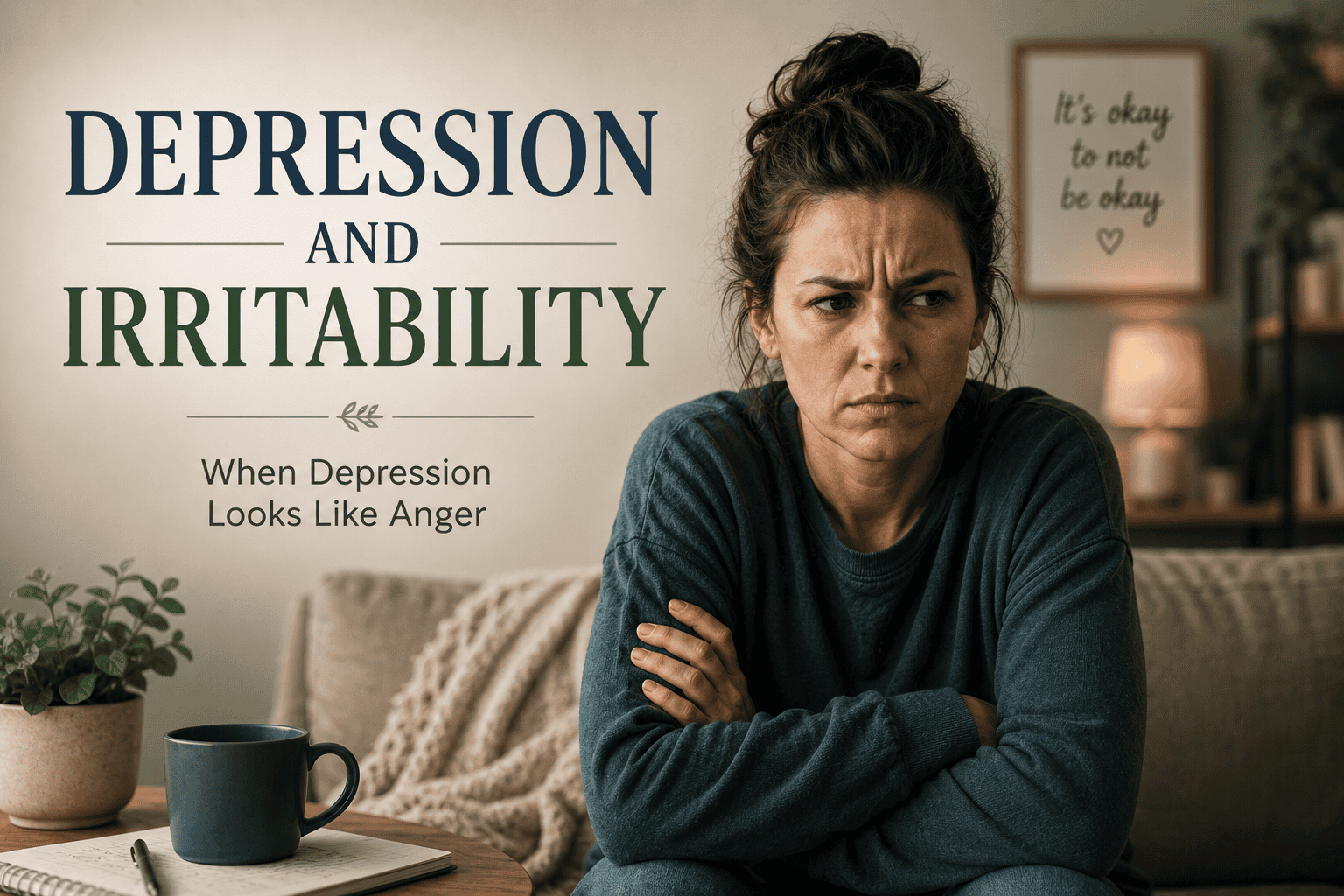
Depression and Irritability: When Depression Looks Like Anger | Motivations Counseling
Depression Resources
Depression and Irritability: When Depression Looks Like Anger
Depression does not always look like sadness. It may also appear as frustration, anger, impatience, emotional reactivity, withdrawal, or feeling constantly on edge. This guide explains why depression can cause irritability and when counseling may help.
Start Here
Depression Can Show Up as Irritability, Not Just Sadness
Many people expect depression to look like crying, sadness, or staying in bed. While depression can look that way, it can also show up as irritability, anger, frustration, impatience, emotional shutdown, or a short fuse. Some people feel less sad than they do tense, reactive, exhausted, or easily overwhelmed.
Depression-related irritability can be confusing because it may look like a personality problem, relationship issue, stress reaction, or anger problem. Underneath the irritability, however, there may be emotional pain, fatigue, hopelessness, shame, anxiety, grief, trauma, burnout, or a nervous system that has very little capacity left.
What Is Depression-Related Irritability?
Depression-related irritability refers to frustration, anger, impatience, emotional reactivity, sensitivity, or a short temper that occurs alongside depression symptoms such as low mood, exhaustion, loss of interest, emotional numbness, sleep changes, hopelessness, or difficulty functioning.
What It Feels Like
What Depression and Irritability Can Feel Like
Irritability can show up emotionally, physically, mentally, and relationally. Some people feel angry on the outside while privately feeling sad, tired, guilty, or disconnected.
Short Fuse
Small frustrations may feel much bigger than usual, and patience may feel harder to access.
Snapping at Others
You may react sharply, then feel guilty, ashamed, or confused about why it happened.
Low Capacity
Depression can reduce emotional bandwidth, making everyday demands feel harder to tolerate.
Emotional Numbness
Irritability may appear when sadness, hurt, grief, or fear feels too hard to access directly.
Withdrawal
You may pull away from people because interaction feels draining or emotionally unsafe.
Guilt After Reactions
You may feel bad about how you responded but still struggle to stop the pattern from repeating.
Why It Happens
Why Depression Can Cause Irritability
Depression can reduce emotional energy, disrupt sleep, increase stress sensitivity, affect concentration, and make ordinary demands feel overwhelming. When a person is already depleted, small problems may feel like too much. Irritability can become the emotion that surfaces first.
For some people, anger is easier to feel than sadness. Anger may feel more protective, more energizing, or less vulnerable than grief, fear, shame, or helplessness. This does not mean the anger is fake. It means anger may be covering deeper emotional pain.
Depression may increase irritability by contributing to:
- Low energy and emotional exhaustion
- Sleep disruption or poor-quality rest
- Loss of interest or pleasure
- Feelings of failure, guilt, or shame
- Hopelessness or feeling trapped
- Reduced frustration tolerance
- Stress overload or burnout
- Difficulty communicating needs clearly
Irritability is often a signal that someone has less emotional capacity available than usual. The goal is not to excuse hurtful behavior, but to understand what is driving the reaction so it can be addressed more effectively.
Anger and Depression
Sometimes Depression Looks Like Anger
Anger may be the most visible part of depression for some people. Instead of saying, “I feel sad,” they may become impatient, critical, defensive, withdrawn, sarcastic, or quick to react. This may be especially true for people who learned to hide vulnerability or who feel uncomfortable expressing sadness.
- Anger may cover sadness, fear, or shame.
- Irritability may increase when energy is depleted.
- Defensiveness may appear when someone feels overwhelmed.
- Withdrawal may be a way to avoid snapping or collapsing.
Important Reframe
Irritability Does Not Mean You Are a Bad Person
Many people feel ashamed when depression comes out as anger or impatience. Shame can make the cycle worse by increasing self-criticism and emotional withdrawal. Understanding the pattern can create room for accountability and compassion.
- You can take responsibility without attacking yourself.
- You can repair relationships after reactive moments.
- You can learn what your irritability is signaling.
- You can build healthier ways to express distress.
If anger ever becomes threatening, physically unsafe, or destructive, immediate support and safety planning are important.
Relationships
Depression-Related Irritability Can Affect Relationships
Irritability can create distance in relationships, even when the person does not want to push others away. Partners, children, friends, coworkers, or family members may experience the irritability as criticism, anger, rejection, or disinterest.
The person experiencing depression may also feel misunderstood. They may think, “I am not trying to be difficult,” or “I do not know why everything bothers me.” This can create a cycle of tension, guilt, withdrawal, and more emotional disconnection.
Relationship patterns may include:
- Snapping during ordinary conversations
- Feeling easily criticized or misunderstood
- Withdrawing to avoid conflict
- Feeling guilty after reacting sharply
- Having less patience with children, partners, or coworkers
- Difficulty asking for help before reaching a breaking point
Repair matters. When depression contributes to irritability, therapy can help clients learn how to communicate distress earlier, take responsibility for reactions, and rebuild connection.
Stress and Capacity
Irritability Often Increases When Capacity Is Low
Depression can make life feel heavier. When someone is also managing work stress, parenting stress, caregiving, grief, trauma, relationship conflict, financial strain, or chronic overwhelm, the nervous system may have very little room left for frustration.
This does not mean every stress reaction is depression. But when irritability occurs alongside low mood, exhaustion, loss of interest, emotional numbness, sleep changes, hopelessness, or difficulty functioning, depression may be part of the picture.
Low emotional capacity may show up as:
- Feeling bothered by noise, interruptions, or small requests
- Wanting to be left alone more often
- Feeling overwhelmed by decisions
- Reacting quickly and regretting it later
- Feeling tense, restless, or emotionally shut down
- Feeling unable to explain what is wrong
When irritability is a capacity issue, the solution is usually not simply “try harder to be patient.” It often requires rest, support, emotional processing, stress reduction, and treatment for the underlying depression pattern.
An Educational Framework
The Depression-Irritability Cycle
Depression-related irritability can become self-reinforcing when reactions create guilt, distance, and more emotional stress.
1. Capacity Drops
Depression, stress, poor sleep, or emotional exhaustion reduce patience and resilience.
2. Irritability Rises
Small frustrations feel larger, and reactions happen more quickly than intended.
3. Conflict or Distance Happens
Others may feel criticized, rejected, or confused by the emotional reaction.
4. Guilt Increases
The person may feel ashamed, disappointed, or frustrated with themselves.
5. Withdrawal Grows
To avoid more conflict, the person may isolate, shut down, or stop asking for support.
6. The Pattern Repeats
Depression deepens, support decreases, and irritability becomes more likely again.
Breaking the cycle usually involves addressing both the outward reactions and the underlying depression, stress, exhaustion, or emotional pain driving them.
What Helps
What Can Help Depression-Related Irritability
Irritability often improves when the underlying depression, stress, exhaustion, and emotional overload are addressed. The goal is not to suppress emotion, but to understand it and respond with more choice.
Name the Pattern
Recognizing irritability as part of depression can reduce shame and help identify what support is needed.
Pause Before Reacting
A brief pause can help create space between the emotional surge and the response.
Communicate Earlier
Saying “I am overwhelmed” sooner may reduce the chance of snapping later.
Support Sleep and Rest
Poor sleep can lower frustration tolerance and make depression symptoms harder to manage.
Reduce Self-Criticism
Shame often worsens depression. Accountability works better when paired with compassion.
Address the Root Cause
Therapy can help explore depression, grief, trauma, burnout, anxiety, relationship stress, or overwhelm.
When to Seek Help
When to Seek Counseling for Depression and Irritability
It may be time to seek counseling when irritability, anger, impatience, emotional reactivity, sadness, numbness, or exhaustion begins affecting relationships, work, parenting, sleep, motivation, or your ability to feel like yourself.
Consider counseling if you notice:
- You feel angry, tense, or irritated much of the time
- You snap at others and later feel guilty
- You feel emotionally numb, sad, empty, or disconnected
- Your patience feels much lower than usual
- You withdraw to avoid conflict or emotional overload
- Your relationships are strained by irritability or defensiveness
- You feel exhausted, hopeless, overwhelmed, or unable to recover
- You wonder whether your anger may be connected to depression
If depression includes thoughts of death, self-harm, or suicide, seek immediate support. In the United States, call or text 988 for the Suicide & Crisis Lifeline, call 911, or go to the nearest emergency room.
Depression Counseling at Motivations Counseling
Therapy Can Help When Depression Comes Out as Irritability
Motivations Counseling provides depression counseling for adults experiencing irritability, anger, emotional numbness, low motivation, exhaustion, stress, anxiety, grief, trauma-related symptoms, relationship strain, and difficulty feeling like themselves.
Our counseling team serves clients in Sugar Land, Katy, Richmond, Fort Bend County, West Houston, and through telehealth across Texas when clinically appropriate.
Counseling Support
Depression Counseling in Sugar Land, Katy, and Online Across Texas
If depression is showing up as anger, impatience, frustration, or emotional reactivity, counseling can help you understand the pattern and build healthier ways to respond.
- Individual counseling for depression and irritability
- Support for anger, frustration, guilt, and emotional reactivity
- Help with stress, burnout, anxiety, grief, and trauma-related patterns
- Relationship-focused support when irritability affects connection
- In-person options in Sugar Land and Katy when available
- Telehealth counseling across Texas when clinically appropriate
Therapy Learning Center
Continue Learning About Depression, Burnout, Anxiety, and Emotional Reactivity
These related resources can help adults better understand depression symptoms, exhaustion, mental fog, hidden depression, burnout, anxiety, and emotional disconnection.
Signs of Depression in Adults
Learn how depression may show up emotionally, physically, cognitively, and relationally.
Read article →High-Functioning Depression
Learn how someone can keep functioning outwardly while privately feeling empty or overwhelmed.
Read article →Burnout vs. Depression
Understand the difference between burnout, depression, emotional exhaustion, and chronic stress.
Read article →Why Depression Causes Mental Fog
Learn how depression can affect concentration, memory, decision-making, and mental clarity.
Read article →Emotional Disconnection
Learn why numbness, shutdown, and emotional distance can happen during stress or depression.
Read article →Counseling Resource Center
Explore resources on anxiety, depression, trauma, EMDR, relationships, teen counseling, and emotional health.
Explore Resource Center →Frequently Asked Questions
Common Questions About Depression and Irritability
Can depression cause irritability?
Yes. Depression can cause irritability, anger, impatience, frustration, emotional reactivity, or a short temper, even when sadness is not the most obvious symptom.
Why does depression make me angry?
Depression can reduce emotional capacity, disrupt sleep, increase stress sensitivity, and create feelings of hopelessness, shame, or overwhelm. Anger may also cover deeper feelings such as sadness, fear, grief, or helplessness.
Is irritability a sign of depression?
Irritability can be a sign of depression, especially when it occurs with low mood, loss of interest, fatigue, sleep changes, emotional numbness, hopelessness, or difficulty functioning.
Can depression look like anger instead of sadness?
Yes. For some people, depression is more visible as anger, defensiveness, impatience, withdrawal, or frustration than sadness or crying.
How does depression-related irritability affect relationships?
Irritability can lead to snapping, conflict, withdrawal, guilt, and emotional distance. Therapy can help clients understand the pattern, communicate distress earlier, and repair relationships.
What helps depression-related irritability?
Helpful steps may include identifying the pattern, improving sleep and rest, reducing stress overload, communicating needs earlier, practicing pauses before reacting, and addressing depression through counseling or other appropriate care.
When should I seek counseling?
Consider counseling when irritability, anger, emotional numbness, sadness, exhaustion, or low motivation persists, affects relationships or daily functioning, or makes you feel unlike yourself.
Should I see a medical provider?
If irritability, mood changes, fatigue, sleep problems, or emotional changes are sudden, severe, worsening, or medically concerning, it may be helpful to consult a medical provider to rule out medical causes and discuss treatment options.

Take the Next Step
Depression Counseling in Sugar Land, Katy, and Online Across Texas
If depression is showing up as anger, impatience, frustration, or emotional reactivity, counseling can help you understand what is happening and begin building healthier ways to respond.

