
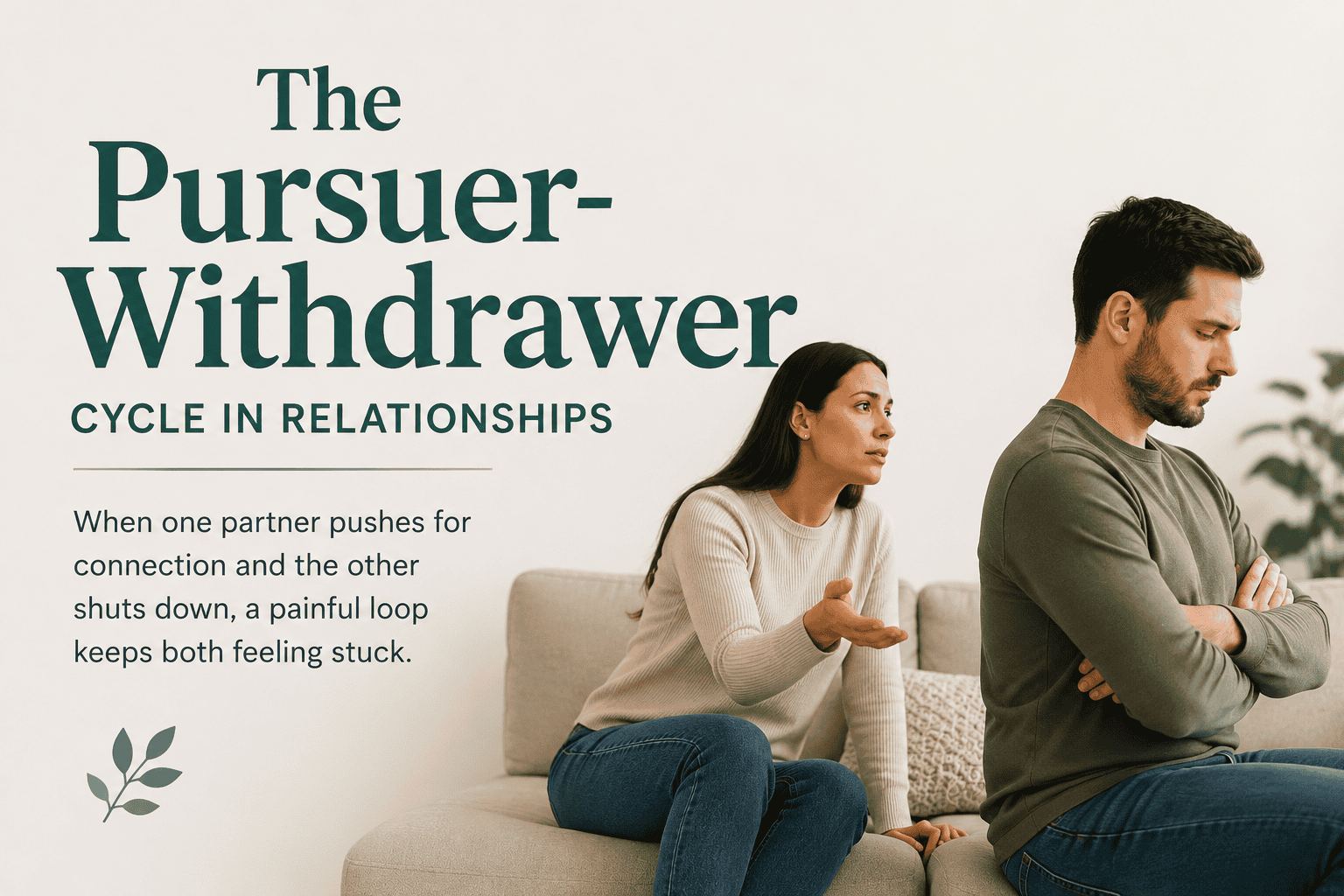
The Pursuer-Withdrawer Cycle in Relationships
Couples Counseling & EFT Resource Center
The Pursuer-Withdrawer Cycle in Relationships
In the pursuer-withdrawer cycle, one partner reacts to disconnection by pushing for conversation, reassurance, or resolution while the other reacts to emotional intensity by becoming quiet, defensive, distant, or shut down. The harder one partner pursues, the more the other withdraws—and both leave the interaction feeling unseen, unsafe, or alone. Emotionally Focused Therapy often helps couples understand this painful loop without treating either partner as the problem.
Start Here
The Conflict Is Often a Cycle, Not a Bad Partner
Couples caught in this pattern frequently believe they are arguing about the topic in front of them: chores, parenting, intimacy, money, phones, in-laws, lateness, tone of voice, or how much time they spend together. Those issues matter, but the emotional process beneath them may determine whether the conversation becomes productive or painful.
The pursuing partner often experiences distance as a threat to connection and moves toward the relationship with more intensity. The withdrawing partner often experiences that intensity as criticism, pressure, failure, or danger and moves away to reduce overwhelm. Each protective response unintentionally confirms the other partner’s fear.
“Pursuer” and “withdrawer” describe positions in a relationship pattern—not fixed personalities, diagnoses, or genders. Both partners may be loving, committed, and distressed by the cycle.
Understanding the Pattern
What Is the Pursuer-Withdrawer Cycle?
It is a repeating interaction pattern in which one partner increases contact or pressure when connection feels uncertain, while the other reduces contact or emotional engagement when the interaction feels overwhelming.
The Pursuer Moves Toward
They may ask repeated questions, seek reassurance, insist on talking now, criticize, protest, follow, text, or intensify emotion to regain connection.
The Withdrawer Moves Away
They may become quiet, leave, focus on facts, minimize, change the subject, go numb, avoid eye contact, or postpone the conversation.
The Pattern Reinforces Itself
Pursuit increases withdrawal; withdrawal increases pursuit. Each partner reacts to the other while trying to manage their own alarm.
Both Partners Feel Hurt
The pursuer may feel abandoned or unimportant. The withdrawer may feel criticized, inadequate, controlled, or unable to succeed.
Both Responses Are Protective
The pursuer protects connection by reaching harder. The withdrawer protects stability by reducing emotional exposure or intensity.
The Bond Becomes Less Accessible
Over time, partners may discuss fewer vulnerable topics, anticipate failure, and feel increasingly lonely or emotionally unsafe.
How the Cycle Develops
A Small Trigger Can Activate a Much Larger Relationship Meaning
The cycle rarely begins with a conscious decision to pressure or shut down. It usually develops quickly as each partner interprets the moment, experiences emotion and body activation, and moves into a familiar protective response.
A delayed reply, critical tone, unfinished task, sexual rejection, distracted attention, or emotional distance.
“I do not matter,” “I am failing again,” “You do not care,” or “Nothing I say will be right.”
Fear, hurt, shame, loneliness, helplessness, frustration, grief, or dread.
Pressure, criticism, repeated questions, defense, silence, leaving, minimizing, or shutting down.
The response is read as abandonment, attack, control, rejection, or proof that connection is unavailable.
Both partners leave with their fears confirmed and become more prepared to protect themselves next time.
The topic can change while the pattern remains the same. A couple may have the same emotional argument about dishes, sex, parenting, spending, family boundaries, or a missed text because the deeper meanings are similar.
The Pursuing Position
Pursuit Is Often an Attempt to Restore Connection
The pursuing partner may notice distance quickly and feel unable to settle until the relationship feels secure again. They may push for a conversation because waiting feels like abandonment, indifference, or evidence that the problem will never be addressed.
Pursuit may look like:
- Wanting to talk immediately
- Asking the same question repeatedly
- Seeking reassurance that the relationship is okay
- Following the partner from room to room
- Sending multiple texts or calling repeatedly
- Criticizing, protesting, or escalating to get a response
- Interpreting requests for space as rejection
What May Be Underneath
The Pursuer May Feel More Vulnerable Than They Sound
Anger or pressure may cover fear, loneliness, sadness, helplessness, or longing. The internal message may be: “Please show me that I matter,” “Please do not leave me alone with this,” or “I need to know that you will come back.”
Understanding the vulnerability underneath pursuit does not make harmful pressure acceptable. The pursuing partner still needs to respect boundaries, physical space, and the other person’s need for a safe, structured pause.
The Withdrawing Position
Withdrawal Is Often an Attempt to Reduce Overwhelm or Prevent Failure
The withdrawing partner may care deeply but lose access to words, emotional clarity, or flexible thinking when conflict becomes intense. They may move away because remaining engaged feels likely to worsen the argument or expose them to more criticism, shame, or helplessness.
Withdrawal may look like:
- Becoming quiet or giving short answers
- Leaving the room or going to sleep
- Focusing only on facts or details
- Minimizing the issue or changing the subject
- Saying “I do not know” or “Nothing is wrong”
- Avoiding eye contact or going emotionally numb
- Delaying difficult conversations indefinitely
What May Be Underneath
The Withdrawer May Feel More Distressed Than They Appear
Silence may cover shame, fear, inadequacy, dread, confusion, or emotional flooding. The internal message may be: “I cannot get this right,” “I am going to make it worse,” “I need the intensity to stop,” or “There is no safe answer.”
Understanding withdrawal as protection does not make emotional disappearance harmless. The withdrawing partner needs to communicate the need for space, provide reassurance when possible, and return to the conversation at an agreed time.
Roles Are Not Fixed
Partners Can Switch Positions Depending on the Topic
A person may pursue conversations about emotional closeness but withdraw from discussions about money. Another may withdraw during conflict but pursue sexual reassurance or repeated confirmation about the relationship. Roles can also reverse over time when one partner becomes exhausted and gives up while the previously distant partner senses the disconnection and begins pursuing.
Common reasons positions change include:
- The topic activates different fears or vulnerabilities
- One partner reaches emotional exhaustion
- A betrayal, illness, loss, or major life transition changes the bond
- The usual pursuer stops reaching and the withdrawer experiences the distance
- Different attachment and coping strategies appear in different situations
The goal is not to decide who is “the pursuer” forever. The goal is to recognize the position each partner takes in a specific cycle and understand what happens between them.
Attachment and Relationship Security
Attachment Patterns May Influence How Partners Respond to Distance and Intensity
Attachment styles do not mechanically determine behavior, but they can help explain why one partner becomes highly alert to disconnection while another relies on distance, independence, or emotional control.
Anxious Attachment Patterns
May increase sensitivity to changes in tone, delayed responses, emotional distance, or uncertainty about the bond.
Avoidant Attachment Patterns
May increase reliance on self-sufficiency, emotional distance, minimizing needs, or shutting down during intensity.
Fearful-Avoidant Patterns
May involve both pursuing and withdrawing—wanting connection while also fearing vulnerability, dependence, or harm.
Secure Functioning
Includes asking directly, taking space without disappearing, returning as promised, listening, and repairing after conflict.
Later Experiences Matter
Betrayal, grief, trauma, repeated invalidation, or previous relationships can alter how safe closeness feels.
Patterns Can Change
Awareness, therapy, boundaries, accountability, and repeated experiences of responsiveness can support greater security.
Emotional Flooding
The Nervous System Can Make the Cycle Harder to Interrupt
During conflict, attention may narrow and the body may move into fight, flight, freeze, shutdown, or appeasing. The pursuer may experience urgent energy that demands action. The withdrawer may lose access to words, go numb, feel trapped, or need distance to think.
When either partner is flooded, problem-solving, listening, memory, empathy, and flexible language may become less available. Continuing to push for resolution can deepen the cycle even when the original goal was connection.
A Productive Pause
Space Works Better When It Includes a Return
- Name the activation without blaming
- Ask for a pause before words or behavior become harmful
- Give a specific return time rather than disappearing
- Offer brief reassurance that the relationship still matters
- Use the break to regulate rather than rehearse the argument
- Return to one manageable issue instead of reopening every grievance
A pause is not effective when it is used to punish, frighten, control, or indefinitely avoid the conversation.
What the Cycle Can Sound Like
The Words on the Surface Often Hide the Deeper Conversation
Pursuer: “Why do you always shut me out? You clearly do not care enough to talk about this.”
Withdrawer: “Because nothing I say is ever good enough. I am done with this conversation.”
Pursuer’s deeper experience: “When you go quiet, I feel alone and afraid that I do not matter.”
Withdrawer’s deeper experience: “When the intensity rises, I feel like a failure and believe I will only make things worse.”
Pursuer: “You never initiate affection. I have to beg you to notice me.”
Withdrawer: “Every touch feels like a test I am going to fail, so I avoid it.”
Pursuer’s deeper experience: “I miss feeling wanted and am scared the relationship no longer matters to you.”
Withdrawer’s deeper experience: “I feel pressured and ashamed, and distance feels safer than disappointing you again.”
Softer language is not about making the issue smaller. It helps each partner communicate the emotional meaning of the problem in a form the other person is more likely to hear.
Common Escalators
Some Attempts to Fix the Cycle Accidentally Strengthen It
Both partners may be trying to solve the problem, protect themselves, or restore connection while using strategies that make the other person less able to engage.
Increasing Volume or Pressure
More intensity may make the withdrawing partner less able to think, speak, or remain emotionally present.
Demanding Immediate Resolution
Urgency can turn a need for connection into an interaction the other partner experiences as coercive or impossible.
Leaving Without Explanation
Unannounced withdrawal can intensify abandonment fears and make future pursuit more urgent.
Invalidating the Emotion
“You are too sensitive” or “This is ridiculous” increases shame and makes vulnerable communication less likely.
Arguing Every Detail
Fact-checking can become a defense against the emotional meaning that needs attention before practical problem-solving.
Recruiting Allies
Using family, friends, or children to prove one partner is wrong can deepen mistrust and triangulation.
Beginning to Change the Pattern
Interrupting the Cycle Requires Different Work From Each Position
The pursuing partner can practice:
- Naming the softer feeling before escalating the complaint
- Making one clear request rather than asking repeated questions
- Allowing a structured pause when the partner is emotionally flooded
- Respecting physical space and avoiding following, blocking, or repeated contact
- Separating the need for reassurance from the demand for instant resolution
- Using support and grounding while waiting for the agreed return time
The withdrawing partner can practice:
- Naming overwhelm before going silent
- Offering brief reassurance without promising an immediate solution
- Requesting a specific amount of time rather than disappearing indefinitely
- Returning when promised or communicating if more time is genuinely needed
- Sharing one piece of the internal experience instead of only facts or defense
- Remaining engaged long enough to show the concern matters
Both partners can practice:
- Calling the cycle by a neutral shared name
- Noticing early body signs before escalation or shutdown
- Discussing one issue at a time
- Using repair statements after hurtful interactions
- Recognizing the intention behind a protective response while still addressing its impact
- Seeking couples counseling when the cycle feels too fast or entrenched to change alone
These steps are not a substitute for safety planning. No partner is required to stay in a conversation involving threats, intimidation, violence, coercion, or fear of retaliation.
How Emotionally Focused Therapy Helps
EFT Helps Couples Move From Protection to Connection
Emotionally Focused Therapy does not simply tell the pursuer to stop talking or the withdrawer to communicate more. The therapist helps the couple slow down the cycle, identify what each position protects, and understand the attachment needs and vulnerable emotions beneath the visible reaction.
EFT may help couples:
- Map the pursue-withdraw sequence without assigning one partner all the blame
- Recognize triggers, meanings, primary emotions, and protective responses
- Help the pursuer communicate fear, hurt, and longing more directly
- Help the withdrawer remain accessible and express overwhelm, shame, or fear
- Create new experiences of reaching and responding
- Build emotional safety, responsiveness, accountability, and repair
- Apply the new pattern to intimacy, parenting, trust, money, and other recurring topics
Relationship Pattern Versus Harm
Not Every Pursuit or Withdrawal Is Equivalent
A cycle framework should not erase differences in behavior or responsibility. Persistent harassment, blocking a doorway, preventing someone from leaving, destroying property, threats, surveillance, intimidation, or repeated boundary violations are not simply “pursuit.” Prolonged silent treatment used to punish or control is not merely a need for regulation.
Each person remains responsible for behavior that harms, frightens, coerces, or controls the other.
When Couples Therapy May Not Be the First Step
Safety Must Come Before Vulnerable Bonding Work
Active violence, coercive control, credible threats, stalking, serious intimidation, or fear of retaliation require careful safety assessment. Standard conjoint couples therapy may be unsafe when one partner cannot speak freely or when disclosures could lead to punishment.
A qualified clinician may recommend individual support, specialized services, safety planning, substance-use treatment, or psychiatric stabilization before or alongside relationship work.
Therapist Spotlight
Work With Carolina Román for EFT-Focused Couples Counseling
At Motivations Counseling, Carolina Román, LMFT works with couples using an attachment-focused approach that helps partners understand negative interaction cycles, reduce defensiveness and withdrawal, and strengthen emotional connection.
Her work can be especially relevant for couples caught in a pursuer-withdrawer pattern because EFT helps both partners slow the cycle, understand what happens beneath pressure and shutdown, and practice safer ways of reaching and responding.
Carolina’s couples work emphasizes emotional safety, responsiveness, and the relationship pattern rather than treating one partner as the sole problem. She serves clients through Motivations Counseling’s couples counseling services in the Houston-area practice and through telehealth across Texas when clinically appropriate.
Free Relationship Resource
Take the Free Relationship Attachment Style Quiz
Attachment patterns may influence how partners respond to distance, reassurance, vulnerability, emotional intensity, and conflict. The free Relationship Attachment Style Quiz can help individuals and couples reflect on patterns associated with secure, anxious, avoidant, mixed, or fearful-avoidant attachment.
- No name, email address, phone number, or other identifying information is required
- Immediate educational feedback is provided
- The quiz can be completed by one or both partners
- Results are for self-reflection and are not a diagnosis or formal psychological assessment
Partners may receive different results. The goal is not to label either person as the problem, but to create language for discussing closeness, independence, reassurance, emotional safety, and the pursue-withdraw cycle.
EFT and Couples Counseling Learning Center
Continue Learning About Conflict, Attachment, and Emotional Connection
These related articles explore the emotional patterns that often accompany pursuit, withdrawal, repeated arguments, disconnection, and difficulty repairing after conflict.
Emotionally Focused Therapy for Couples
Learn how EFT helps couples understand negative cycles, attachment needs, and vulnerable emotions beneath conflict.
Read article →Why Couples Get Stuck in the Same Arguments
Understand why recurring topics often activate the same fear, defensiveness, withdrawal, or emotional flooding.
Read article →Emotional Disconnection in Relationships
Explore how stress, hurt, shutdown, and repeated misattunement can make the emotional bond harder to reach.
Read article →Emotional Safety in Relationships
Learn how respect, responsiveness, boundaries, trust, and repair support safer relationship conversations.
Read article →Attachment Styles in Relationships
Understand how attachment patterns may affect reassurance, closeness, independence, conflict, and withdrawal.
Read article →Couples Counseling
Review counseling services for repeated conflict, emotional distance, communication, trust, and relationship repair.
View service page →Frequently Asked Questions
Common Questions About the Pursuer-Withdrawer Cycle
What is the pursuer-withdrawer cycle?
The pursuer-withdrawer cycle is a repeating relationship pattern in which one partner increases contact, questions, pressure, or reassurance seeking while the other reduces engagement, becomes quiet, distances, or shuts down. Each reaction intensifies the other partner’s protective response.
Does the pursuer care more about the relationship?
Not necessarily. Pursuit is more visible, but withdrawal can also reflect deep concern, fear of failure, emotional flooding, or an attempt to prevent further conflict. The two partners may care equally while protecting the relationship in opposite ways.
Why does the withdrawer shut down?
Withdrawal may occur when a person feels criticized, overwhelmed, ashamed, trapped, emotionally flooded, or convinced that nothing they say will help. Silence can be a protective response, although the person is still responsible for communicating and returning to important conversations.
Why does the pursuer keep pushing?
The pursuing partner may experience distance as abandonment, rejection, indifference, or proof that the issue will never be addressed. Increasing pressure may be an attempt to restore connection or obtain reassurance, even though it often makes the other partner withdraw more.
Can partners switch pursuer and withdrawer roles?
Yes. Partners may take different positions depending on the topic, and the roles may reverse over time. A partner who pursues emotional conversation may withdraw around money, intimacy, family boundaries, or another vulnerable subject.
Is the pursuer-withdrawer cycle related to attachment styles?
It can be. Anxious attachment patterns may increase sensitivity to distance and the need for reassurance, while avoidant patterns may increase reliance on emotional distance or self-sufficiency. Attachment style does not determine behavior, and people may show blended or changing patterns.
Should the withdrawer be allowed to take a break?
A structured break can be helpful when either partner is emotionally flooded. The pause works best when the partner names the need for space, offers brief reassurance, gives a realistic return time, and comes back as agreed rather than disappearing indefinitely.
How can the pursuer communicate without escalating?
The pursuer can name the softer feeling, make one clear request, avoid repeated contact, respect physical space, and agree to a structured return time. Expressing “I feel alone and need reassurance that we will return to this” is often easier to hear than criticism or accusation.
How does Emotionally Focused Therapy help this cycle?
EFT helps couples map the cycle, identify the emotions and attachment needs beneath pursuit and withdrawal, and practice new interactions. The goal is to help the pursuer reach more directly and the withdrawer remain more emotionally accessible and responsive.
When is couples therapy not the right first step?
Standard conjoint couples therapy may be unsafe when there is active violence, coercive control, credible threats, stalking, intimidation, or fear of retaliation. A qualified clinician should assess safety and determine whether individual support, specialized services, or safety planning should come first.

Couples Counseling in Sugar Land, Katy & Online Across Texas
You Do Not Have to Keep Repeating the Same Painful Loop
When one partner keeps pushing and the other keeps shutting down, both may begin to feel hopeless or misunderstood. Couples counseling can provide a structured space to slow the pattern, understand what each partner is protecting, and practice safer ways of reaching, responding, and repairing.
Couples Counseling & EFT Resource Center
The Pursuer-Withdrawer Cycle in Relationships
In the pursuer-withdrawer cycle, one partner reacts to disconnection by pushing for conversation, reassurance, or resolution while the other reacts to emotional intensity by becoming quiet, defensive, distant, or shut down. The harder one partner pursues, the more the other withdraws—and both leave the interaction feeling unseen, unsafe, or alone. Emotionally Focused Therapy often helps couples understand this painful loop without treating either partner as the problem.
Start Here
The Conflict Is Often a Cycle, Not a Bad Partner
Couples caught in this pattern frequently believe they are arguing about the topic in front of them: chores, parenting, intimacy, money, phones, in-laws, lateness, tone of voice, or how much time they spend together. Those issues matter, but the emotional process beneath them may determine whether the conversation becomes productive or painful.
The pursuing partner often experiences distance as a threat to connection and moves toward the relationship with more intensity. The withdrawing partner often experiences that intensity as criticism, pressure, failure, or danger and moves away to reduce overwhelm. Each protective response unintentionally confirms the other partner’s fear.
“Pursuer” and “withdrawer” describe positions in a relationship pattern—not fixed personalities, diagnoses, or genders. Both partners may be loving, committed, and distressed by the cycle.
Understanding the Pattern
What Is the Pursuer-Withdrawer Cycle?
It is a repeating interaction pattern in which one partner increases contact or pressure when connection feels uncertain, while the other reduces contact or emotional engagement when the interaction feels overwhelming.
The Pursuer Moves Toward
They may ask repeated questions, seek reassurance, insist on talking now, criticize, protest, follow, text, or intensify emotion to regain connection.
The Withdrawer Moves Away
They may become quiet, leave, focus on facts, minimize, change the subject, go numb, avoid eye contact, or postpone the conversation.
The Pattern Reinforces Itself
Pursuit increases withdrawal; withdrawal increases pursuit. Each partner reacts to the other while trying to manage their own alarm.
Both Partners Feel Hurt
The pursuer may feel abandoned or unimportant. The withdrawer may feel criticized, inadequate, controlled, or unable to succeed.
Both Responses Are Protective
The pursuer protects connection by reaching harder. The withdrawer protects stability by reducing emotional exposure or intensity.
The Bond Becomes Less Accessible
Over time, partners may discuss fewer vulnerable topics, anticipate failure, and feel increasingly lonely or emotionally unsafe.
How the Cycle Develops
A Small Trigger Can Activate a Much Larger Relationship Meaning
The cycle rarely begins with a conscious decision to pressure or shut down. It usually develops quickly as each partner interprets the moment, experiences emotion and body activation, and moves into a familiar protective response.
A delayed reply, critical tone, unfinished task, sexual rejection, distracted attention, or emotional distance.
“I do not matter,” “I am failing again,” “You do not care,” or “Nothing I say will be right.”
Fear, hurt, shame, loneliness, helplessness, frustration, grief, or dread.
Pressure, criticism, repeated questions, defense, silence, leaving, minimizing, or shutting down.
The response is read as abandonment, attack, control, rejection, or proof that connection is unavailable.
Both partners leave with their fears confirmed and become more prepared to protect themselves next time.
The topic can change while the pattern remains the same. A couple may have the same emotional argument about dishes, sex, parenting, spending, family boundaries, or a missed text because the deeper meanings are similar.
The Pursuing Position
Pursuit Is Often an Attempt to Restore Connection
The pursuing partner may notice distance quickly and feel unable to settle until the relationship feels secure again. They may push for a conversation because waiting feels like abandonment, indifference, or evidence that the problem will never be addressed.
Pursuit may look like:
- Wanting to talk immediately
- Asking the same question repeatedly
- Seeking reassurance that the relationship is okay
- Following the partner from room to room
- Sending multiple texts or calling repeatedly
- Criticizing, protesting, or escalating to get a response
- Interpreting requests for space as rejection
What May Be Underneath
The Pursuer May Feel More Vulnerable Than They Sound
Anger or pressure may cover fear, loneliness, sadness, helplessness, or longing. The internal message may be: “Please show me that I matter,” “Please do not leave me alone with this,” or “I need to know that you will come back.”
Understanding the vulnerability underneath pursuit does not make harmful pressure acceptable. The pursuing partner still needs to respect boundaries, physical space, and the other person’s need for a safe, structured pause.
The Withdrawing Position
Withdrawal Is Often an Attempt to Reduce Overwhelm or Prevent Failure
The withdrawing partner may care deeply but lose access to words, emotional clarity, or flexible thinking when conflict becomes intense. They may move away because remaining engaged feels likely to worsen the argument or expose them to more criticism, shame, or helplessness.
Withdrawal may look like:
- Becoming quiet or giving short answers
- Leaving the room or going to sleep
- Focusing only on facts or details
- Minimizing the issue or changing the subject
- Saying “I do not know” or “Nothing is wrong”
- Avoiding eye contact or going emotionally numb
- Delaying difficult conversations indefinitely
What May Be Underneath
The Withdrawer May Feel More Distressed Than They Appear
Silence may cover shame, fear, inadequacy, dread, confusion, or emotional flooding. The internal message may be: “I cannot get this right,” “I am going to make it worse,” “I need the intensity to stop,” or “There is no safe answer.”
Understanding withdrawal as protection does not make emotional disappearance harmless. The withdrawing partner needs to communicate the need for space, provide reassurance when possible, and return to the conversation at an agreed time.
Roles Are Not Fixed
Partners Can Switch Positions Depending on the Topic
A person may pursue conversations about emotional closeness but withdraw from discussions about money. Another may withdraw during conflict but pursue sexual reassurance or repeated confirmation about the relationship. Roles can also reverse over time when one partner becomes exhausted and gives up while the previously distant partner senses the disconnection and begins pursuing.
Common reasons positions change include:
- The topic activates different fears or vulnerabilities
- One partner reaches emotional exhaustion
- A betrayal, illness, loss, or major life transition changes the bond
- The usual pursuer stops reaching and the withdrawer experiences the distance
- Different attachment and coping strategies appear in different situations
The goal is not to decide who is “the pursuer” forever. The goal is to recognize the position each partner takes in a specific cycle and understand what happens between them.
Attachment and Relationship Security
Attachment Patterns May Influence How Partners Respond to Distance and Intensity
Attachment styles do not mechanically determine behavior, but they can help explain why one partner becomes highly alert to disconnection while another relies on distance, independence, or emotional control.
Anxious Attachment Patterns
May increase sensitivity to changes in tone, delayed responses, emotional distance, or uncertainty about the bond.
Avoidant Attachment Patterns
May increase reliance on self-sufficiency, emotional distance, minimizing needs, or shutting down during intensity.
Fearful-Avoidant Patterns
May involve both pursuing and withdrawing—wanting connection while also fearing vulnerability, dependence, or harm.
Secure Functioning
Includes asking directly, taking space without disappearing, returning as promised, listening, and repairing after conflict.
Later Experiences Matter
Betrayal, grief, trauma, repeated invalidation, or previous relationships can alter how safe closeness feels.
Patterns Can Change
Awareness, therapy, boundaries, accountability, and repeated experiences of responsiveness can support greater security.
Emotional Flooding
The Nervous System Can Make the Cycle Harder to Interrupt
During conflict, attention may narrow and the body may move into fight, flight, freeze, shutdown, or appeasing. The pursuer may experience urgent energy that demands action. The withdrawer may lose access to words, go numb, feel trapped, or need distance to think.
When either partner is flooded, problem-solving, listening, memory, empathy, and flexible language may become less available. Continuing to push for resolution can deepen the cycle even when the original goal was connection.
A Productive Pause
Space Works Better When It Includes a Return
- Name the activation without blaming
- Ask for a pause before words or behavior become harmful
- Give a specific return time rather than disappearing
- Offer brief reassurance that the relationship still matters
- Use the break to regulate rather than rehearse the argument
- Return to one manageable issue instead of reopening every grievance
A pause is not effective when it is used to punish, frighten, control, or indefinitely avoid the conversation.
What the Cycle Can Sound Like
The Words on the Surface Often Hide the Deeper Conversation
Pursuer: “Why do you always shut me out? You clearly do not care enough to talk about this.”
Withdrawer: “Because nothing I say is ever good enough. I am done with this conversation.”
Pursuer’s deeper experience: “When you go quiet, I feel alone and afraid that I do not matter.”
Withdrawer’s deeper experience: “When the intensity rises, I feel like a failure and believe I will only make things worse.”
Pursuer: “You never initiate affection. I have to beg you to notice me.”
Withdrawer: “Every touch feels like a test I am going to fail, so I avoid it.”
Pursuer’s deeper experience: “I miss feeling wanted and am scared the relationship no longer matters to you.”
Withdrawer’s deeper experience: “I feel pressured and ashamed, and distance feels safer than disappointing you again.”
Softer language is not about making the issue smaller. It helps each partner communicate the emotional meaning of the problem in a form the other person is more likely to hear.
Common Escalators
Some Attempts to Fix the Cycle Accidentally Strengthen It
Both partners may be trying to solve the problem, protect themselves, or restore connection while using strategies that make the other person less able to engage.
Increasing Volume or Pressure
More intensity may make the withdrawing partner less able to think, speak, or remain emotionally present.
Demanding Immediate Resolution
Urgency can turn a need for connection into an interaction the other partner experiences as coercive or impossible.
Leaving Without Explanation
Unannounced withdrawal can intensify abandonment fears and make future pursuit more urgent.
Invalidating the Emotion
“You are too sensitive” or “This is ridiculous” increases shame and makes vulnerable communication less likely.
Arguing Every Detail
Fact-checking can become a defense against the emotional meaning that needs attention before practical problem-solving.
Recruiting Allies
Using family, friends, or children to prove one partner is wrong can deepen mistrust and triangulation.
Beginning to Change the Pattern
Interrupting the Cycle Requires Different Work From Each Position
The pursuing partner can practice:
- Naming the softer feeling before escalating the complaint
- Making one clear request rather than asking repeated questions
- Allowing a structured pause when the partner is emotionally flooded
- Respecting physical space and avoiding following, blocking, or repeated contact
- Separating the need for reassurance from the demand for instant resolution
- Using support and grounding while waiting for the agreed return time
The withdrawing partner can practice:
- Naming overwhelm before going silent
- Offering brief reassurance without promising an immediate solution
- Requesting a specific amount of time rather than disappearing indefinitely
- Returning when promised or communicating if more time is genuinely needed
- Sharing one piece of the internal experience instead of only facts or defense
- Remaining engaged long enough to show the concern matters
Both partners can practice:
- Calling the cycle by a neutral shared name
- Noticing early body signs before escalation or shutdown
- Discussing one issue at a time
- Using repair statements after hurtful interactions
- Recognizing the intention behind a protective response while still addressing its impact
- Seeking couples counseling when the cycle feels too fast or entrenched to change alone
These steps are not a substitute for safety planning. No partner is required to stay in a conversation involving threats, intimidation, violence, coercion, or fear of retaliation.
How Emotionally Focused Therapy Helps
EFT Helps Couples Move From Protection to Connection
Emotionally Focused Therapy does not simply tell the pursuer to stop talking or the withdrawer to communicate more. The therapist helps the couple slow down the cycle, identify what each position protects, and understand the attachment needs and vulnerable emotions beneath the visible reaction.
EFT may help couples:
- Map the pursue-withdraw sequence without assigning one partner all the blame
- Recognize triggers, meanings, primary emotions, and protective responses
- Help the pursuer communicate fear, hurt, and longing more directly
- Help the withdrawer remain accessible and express overwhelm, shame, or fear
- Create new experiences of reaching and responding
- Build emotional safety, responsiveness, accountability, and repair
- Apply the new pattern to intimacy, parenting, trust, money, and other recurring topics
Relationship Pattern Versus Harm
Not Every Pursuit or Withdrawal Is Equivalent
A cycle framework should not erase differences in behavior or responsibility. Persistent harassment, blocking a doorway, preventing someone from leaving, destroying property, threats, surveillance, intimidation, or repeated boundary violations are not simply “pursuit.” Prolonged silent treatment used to punish or control is not merely a need for regulation.
Each person remains responsible for behavior that harms, frightens, coerces, or controls the other.
When Couples Therapy May Not Be the First Step
Safety Must Come Before Vulnerable Bonding Work
Active violence, coercive control, credible threats, stalking, serious intimidation, or fear of retaliation require careful safety assessment. Standard conjoint couples therapy may be unsafe when one partner cannot speak freely or when disclosures could lead to punishment.
A qualified clinician may recommend individual support, specialized services, safety planning, substance-use treatment, or psychiatric stabilization before or alongside relationship work.
Therapist Spotlight
Work With Carolina Román for EFT-Focused Couples Counseling
At Motivations Counseling, Carolina Román, LMFT works with couples using an attachment-focused approach that helps partners understand negative interaction cycles, reduce defensiveness and withdrawal, and strengthen emotional connection.
Her work can be especially relevant for couples caught in a pursuer-withdrawer pattern because EFT helps both partners slow the cycle, understand what happens beneath pressure and shutdown, and practice safer ways of reaching and responding.
Carolina’s couples work emphasizes emotional safety, responsiveness, and the relationship pattern rather than treating one partner as the sole problem. She serves clients through Motivations Counseling’s couples counseling services in the Houston-area practice and through telehealth across Texas when clinically appropriate.
Free Relationship Resource
Take the Free Relationship Attachment Style Quiz
Attachment patterns may influence how partners respond to distance, reassurance, vulnerability, emotional intensity, and conflict. The free Relationship Attachment Style Quiz can help individuals and couples reflect on patterns associated with secure, anxious, avoidant, mixed, or fearful-avoidant attachment.
- No name, email address, phone number, or other identifying information is required
- Immediate educational feedback is provided
- The quiz can be completed by one or both partners
- Results are for self-reflection and are not a diagnosis or formal psychological assessment
Partners may receive different results. The goal is not to label either person as the problem, but to create language for discussing closeness, independence, reassurance, emotional safety, and the pursue-withdraw cycle.
EFT and Couples Counseling Learning Center
Continue Learning About Conflict, Attachment, and Emotional Connection
These related articles explore the emotional patterns that often accompany pursuit, withdrawal, repeated arguments, disconnection, and difficulty repairing after conflict.
Emotionally Focused Therapy for Couples
Learn how EFT helps couples understand negative cycles, attachment needs, and vulnerable emotions beneath conflict.
Read article →Why Couples Get Stuck in the Same Arguments
Understand why recurring topics often activate the same fear, defensiveness, withdrawal, or emotional flooding.
Read article →Emotional Disconnection in Relationships
Explore how stress, hurt, shutdown, and repeated misattunement can make the emotional bond harder to reach.
Read article →Emotional Safety in Relationships
Learn how respect, responsiveness, boundaries, trust, and repair support safer relationship conversations.
Read article →Attachment Styles in Relationships
Understand how attachment patterns may affect reassurance, closeness, independence, conflict, and withdrawal.
Read article →Couples Counseling
Review counseling services for repeated conflict, emotional distance, communication, trust, and relationship repair.
View service page →Frequently Asked Questions
Common Questions About the Pursuer-Withdrawer Cycle
What is the pursuer-withdrawer cycle?
The pursuer-withdrawer cycle is a repeating relationship pattern in which one partner increases contact, questions, pressure, or reassurance seeking while the other reduces engagement, becomes quiet, distances, or shuts down. Each reaction intensifies the other partner’s protective response.
Does the pursuer care more about the relationship?
Not necessarily. Pursuit is more visible, but withdrawal can also reflect deep concern, fear of failure, emotional flooding, or an attempt to prevent further conflict. The two partners may care equally while protecting the relationship in opposite ways.
Why does the withdrawer shut down?
Withdrawal may occur when a person feels criticized, overwhelmed, ashamed, trapped, emotionally flooded, or convinced that nothing they say will help. Silence can be a protective response, although the person is still responsible for communicating and returning to important conversations.
Why does the pursuer keep pushing?
The pursuing partner may experience distance as abandonment, rejection, indifference, or proof that the issue will never be addressed. Increasing pressure may be an attempt to restore connection or obtain reassurance, even though it often makes the other partner withdraw more.
Can partners switch pursuer and withdrawer roles?
Yes. Partners may take different positions depending on the topic, and the roles may reverse over time. A partner who pursues emotional conversation may withdraw around money, intimacy, family boundaries, or another vulnerable subject.
Is the pursuer-withdrawer cycle related to attachment styles?
It can be. Anxious attachment patterns may increase sensitivity to distance and the need for reassurance, while avoidant patterns may increase reliance on emotional distance or self-sufficiency. Attachment style does not determine behavior, and people may show blended or changing patterns.
Should the withdrawer be allowed to take a break?
A structured break can be helpful when either partner is emotionally flooded. The pause works best when the partner names the need for space, offers brief reassurance, gives a realistic return time, and comes back as agreed rather than disappearing indefinitely.
How can the pursuer communicate without escalating?
The pursuer can name the softer feeling, make one clear request, avoid repeated contact, respect physical space, and agree to a structured return time. Expressing “I feel alone and need reassurance that we will return to this” is often easier to hear than criticism or accusation.
How does Emotionally Focused Therapy help this cycle?
EFT helps couples map the cycle, identify the emotions and attachment needs beneath pursuit and withdrawal, and practice new interactions. The goal is to help the pursuer reach more directly and the withdrawer remain more emotionally accessible and responsive.
When is couples therapy not the right first step?
Standard conjoint couples therapy may be unsafe when there is active violence, coercive control, credible threats, stalking, intimidation, or fear of retaliation. A qualified clinician should assess safety and determine whether individual support, specialized services, or safety planning should come first.
Couples Counseling in Sugar Land, Katy & Online Across Texas
You Do Not Have to Keep Repeating the Same Painful Loop
When one partner keeps pushing and the other keeps shutting down, both may begin to feel hopeless or misunderstood. Couples counseling can provide a structured space to slow the pattern, understand what each partner is protecting, and practice safer ways of reaching, responding, and repairing.

