
When Communication Breaks Down in a Relationship
Couples Counseling & EFT Resource Center
When Communication Breaks Down in a Relationship
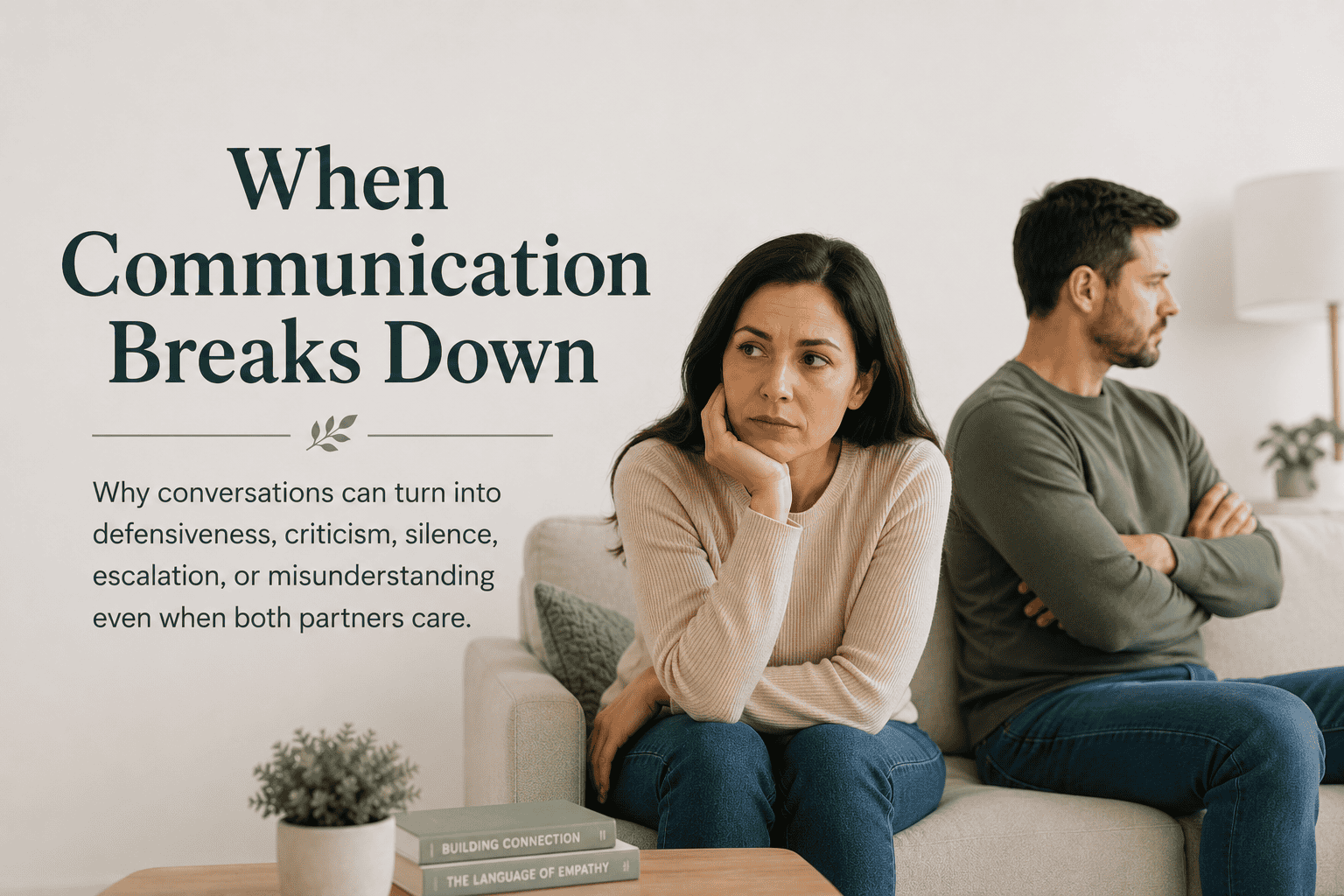
Communication can break down even when both partners care deeply and genuinely want the relationship to work. A practical conversation may quickly turn into criticism, defensiveness, silence, escalation, or misunderstanding when either person feels blamed, dismissed, controlled, rejected, or emotionally unsafe. The problem is often not a lack of communication. It is the protective pattern that takes over when the conversation begins to feel threatening.
Start Here
Caring About Each Other Does Not Automatically Make Difficult Conversations Feel Safe
Partners may enter a conversation with good intentions and still leave feeling criticized, ignored, controlled, or misunderstood. One person may be trying to solve the problem while the other needs emotional acknowledgment first. One may want to talk immediately while the other needs time to organize thoughts. One may hear a request while the other hears an accusation.
Once the nervous system becomes activated, each partner may respond to the emotional meaning of the conversation rather than only to the words. The discussion can shift from “How do we solve this?” to “Do I matter?” “Am I safe with you?” “Am I failing?” or “Will you listen to me?”
Communication problems are often relationship-pattern problems. Better wording can help, but lasting change may also require understanding the fear, hurt, shame, loneliness, and attachment needs beneath the words.
Why Conversations Go Off Track
Communication Breaks Down When Protection Becomes More Urgent Than Connection
A partner may defend, criticize, withdraw, explain, correct, attack, appease, or shut down because the conversation feels emotionally risky—not because the relationship is unimportant.
Perceived Threat
Tone, timing, facial expression, or wording may be interpreted as rejection, criticism, abandonment, control, or disrespect.
Different Meanings
The same words can carry different meanings based on history, attachment, culture, expectations, and prior conflict.
Emotional Flooding
High activation can reduce listening, memory, empathy, flexible thinking, and access to calm language.
Unresolved History
Old hurts, betrayals, repeated disappointments, or failed repairs can make the current issue feel much larger.
Stress and Depletion
Fatigue, work, parenting, illness, grief, financial pressure, and lack of privacy reduce communication capacity.
Negative Cycles
Repeated patterns teach each partner to anticipate the other’s reaction before the conversation has fully begun.
The Breakdown Sequence
The Conversation Usually Changes Before Either Partner Realizes It
A communication breakdown often begins with a small trigger that becomes connected to a larger relationship meaning. That meaning activates emotion and a protective response. The other partner reacts to the protection, and the original concern is replaced by a conflict about tone, intention, fairness, or whether the conversation should continue.
A common sequence includes:
- Trigger: A question, correction, delayed reply, distracted response, missed task, or sensitive topic
- Interpretation: “You do not care,” “I am being blamed,” “I am failing,” or “You are trying to control me”
- Emotion: Hurt, fear, shame, loneliness, anger, helplessness, frustration, or dread
- Protection: Criticism, defense, explaining, silence, withdrawal, escalation, sarcasm, or appeasing
- Partner reaction: The protection is experienced as rejection, attack, indifference, or proof that talking is unsafe
- Breakdown: Both partners leave feeling less understood and more prepared to protect themselves next time
The same sequence can repeat across different topics. A couple may believe they have many separate communication problems when one emotional pattern is appearing in many situations.
Criticism
A Complaint Can Become a Statement About the Partner’s Character
A complaint identifies a specific concern. Criticism often communicates that the partner is selfish, lazy, uncaring, irresponsible, controlling, or fundamentally flawed. Even when the concern is valid, character-based language makes it harder for the other person to remain open.
- “You never think about anyone but yourself.”
- “You always ruin everything.”
- “I cannot depend on you for anything.”
- “You clearly do not care.”
What May Be Underneath
Criticism Is Often a Protest Against Disconnection
The criticizing partner may feel ignored, unsupported, lonely, overburdened, unimportant, or afraid that the issue will never change. The deeper message may be: “Please notice me,” “Please take this seriously,” or “I need to know we are a team.”
Understanding the need underneath criticism does not make contempt, humiliation, or verbal abuse acceptable. Concerns still need to be expressed with specificity, respect, and responsibility.
Defensiveness
Self-Protection Can Make the Other Partner Feel Unheard
Defensiveness may include explaining intent, correcting details, denying impact, counterattacking, shifting blame, or listing the other partner’s mistakes. The defensive partner may be trying to avoid shame, unfair blame, or the feeling that they are a bad partner.
- “That is not what happened.”
- “You do the same thing.”
- “I only reacted because you started it.”
- “Nothing I do is ever good enough for you.”
Impact Before Intent
Intent Matters, but It Does Not Erase the Partner’s Experience
A more productive response may begin with acknowledging impact before explaining intention: “I understand why that felt dismissive. I did not intend to ignore you, but I can see that I did not respond.”
Accountability does not require agreeing with every detail or accepting unfair accusations. It means identifying the part that is accurate without immediately turning the conversation into self-defense.
Silence, Withdrawal, and Shutdown
Quiet Does Not Always Mean Calm or Indifference
A partner may become silent because they are emotionally flooded, ashamed, confused, afraid of escalation, or unable to organize thoughts. The other partner may experience the silence as abandonment, punishment, or lack of care.
Loss of Words
Activation may make it difficult to identify feelings, remember details, or form a clear response.
Fear of Making It Worse
The partner may believe that any answer will be wrong or will lead to a larger argument.
Need for Distance
Leaving may be an attempt to regulate, but disappearing without explanation can intensify the other partner’s alarm.
A Structured Pause
Space is more reassuring when the partner names the need, gives a return time, and comes back as promised.
Avoidance
Some partners repeatedly postpone topics because vulnerability, conflict, or accountability feels unsafe.
Emotional Numbing
Shutdown can feel like going blank, detached, exhausted, or unable to remain emotionally engaged.
Escalation and Emotional Flooding
The More Urgent the Conversation Feels, the Less Productive It May Become
Escalation can involve louder voices, faster speech, interruptions, repeated accusations, following the partner, bringing in old conflicts, threatening the relationship, or demanding immediate resolution. The person escalating may be trying to make the seriousness of the issue understood.
Intensity can make the other partner more defensive, frightened, confused, or shut down. Both people may lose access to empathy, context, and the ability to distinguish the current concern from older pain.
Signs that a pause may be needed include:
- Repeating the same statements without new understanding
- Difficulty remembering what the partner just said
- Shaking, racing heart, numbness, dizziness, or feeling trapped
- Personal attacks, contempt, threats, or escalating volume
- An urge to send harmful messages or make major decisions immediately
- Either partner becoming unable to speak or remain oriented
A pause should protect the relationship from further harm, not punish the other partner. It works best with reassurance, a clear time frame, and an agreement to return to one manageable issue.
Assumptions and Misinterpretation
Partners Often Respond to the Meaning They Heard, Not the Words That Were Said
A request for help may be heard as criticism. A request for space may be heard as abandonment. A question may be heard as interrogation. A practical suggestion may be heard as control. A neutral facial expression may be read as contempt or indifference.
Interpretations may be shaped by the current relationship, earlier experiences, attachment patterns, trauma, culture, family communication, and unresolved conflicts.
Check the Meaning
Curiosity Can Slow Down Automatic Conclusions
- “What did you hear me saying?”
- “What did that mean to you?”
- “I noticed your expression changed. What happened inside?”
- “Are you asking for reassurance, a solution, or help understanding?”
- “I may be making an assumption. Can I check it with you?”
- “What is the main thing you need me to understand?”
Attachment and Communication
Attachment Patterns May Shape What Partners Need During Difficult Conversations
Attachment style does not determine behavior, but it can influence sensitivity to distance, criticism, dependence, emotional intensity, and uncertainty about the bond.
Anxious Patterns
May increase reassurance seeking, urgency, sensitivity to tone, and fear that distance means rejection.
Avoidant Patterns
May increase self-reliance, discomfort with intensity, minimizing needs, or withdrawal under pressure.
Mixed Patterns
A partner may want closeness and fear it at the same time, moving between pursuit, shutdown, and guardedness.
Secure Communication
Includes asking directly, tolerating difference, taking accountable pauses, returning, listening, and repairing.
Relationship History
Trust injuries, repeated invalidation, abandonment, or betrayal can change how safe communication feels.
Patterns Can Change
Responsiveness, boundaries, accountability, and repair can build greater security over time.
Stress Load
Communication Capacity Changes With Sleep, Health, Work, Parenting, and Grief
A couple may communicate relatively well under ordinary conditions and struggle during chronic stress. Exhaustion, pain, caregiving, financial strain, pregnancy, infertility, work pressure, illness, and lack of privacy can reduce patience and make neutral events feel more threatening.
Improving communication may require more than better wording. The couple may also need rest, practical support, clearer responsibilities, medical care, boundaries, or reduced demands.
Trauma Responses
Current Conversations Can Activate Earlier Experiences
A raised voice, silence, sudden movement, criticism, emotional distance, or feeling trapped may trigger trauma-related fear, hypervigilance, shutdown, appeasing, or strong protective reactions. The partner may respond to both the current interaction and the earlier experience it resembles.
Trauma-informed couples work should build safety and stabilization rather than pressuring immediate disclosure or vulnerability. Individual trauma treatment may also be appropriate.
Texting, Email, and Digital Conflict
Written Communication Removes Tone, Timing, and Immediate Repair
Texting can help with logistics or brief reassurance, but emotionally charged topics are easy to misread. Partners may send long messages, respond defensively to one sentence, interpret delayed replies as rejection, or continue arguing when both are too activated to think clearly.
Digital communication may become unhelpful when:
- Messages become increasingly long, rapid, or accusatory
- One partner repeatedly demands an immediate response
- Each sentence is analyzed for hidden meaning
- Screenshots are shared to recruit support against the partner
- Threats, insults, monitoring, or repeated contact violate boundaries
- The conflict continues late at night or during work, driving, or childcare
A useful message may be: “This matters to me, and I do not think texting is helping us understand each other. Can we talk at 7:00 tonight after we have both had time to settle?”
Repair Attempts
Healthy Communication Is Not the Absence of Conflict—It Is the Ability to Repair
Repair attempts are words or actions that reduce harm, clarify intention, restore respect, and help the couple return to connection or problem-solving.
Pause the Pattern
“We are getting pulled into the same cycle. I want to slow down before we hurt each other.”
Reassure the Bond
“I am upset, but I care about you and want us to understand each other.”
Reflect the Message
“What I hear is that you felt alone when I did not respond. Is that right?”
Take Responsibility
“My tone was harsh, and I understand why you became defensive. I am sorry.”
Set a Return Time
“I need thirty minutes to settle. I will come back at 8:00 so we can continue.”
Return to One Issue
“Let us focus on what happened tonight rather than every past argument.”
Practical Communication Shifts
Better Conversations Usually Require More Safety, Clarity, and Regulation
Before the conversation:
- Choose a time when neither partner is exhausted, rushing, intoxicated, or responsible for immediate tasks
- Identify the main concern and the outcome you hope for
- Decide whether you need listening, reassurance, problem-solving, or a specific agreement
- Consider whether the topic is better discussed in person than by text
During the conversation:
- Describe a specific behavior rather than attacking character
- Name the feeling and relationship meaning underneath the concern
- Make one clear request
- Check what the partner heard before repeating the point more forcefully
- Acknowledge impact before explaining intent
- Pause when either partner is too flooded to remain respectful and oriented
After the conversation:
- Confirm what was understood or agreed
- Follow through on specific commitments
- Return to unresolved concerns rather than hoping they disappear
- Repair hurtful tone, withdrawal, defensiveness, or escalation
- Notice what helped the conversation go differently
Communication skills are most effective when both partners are willing to use them. One person cannot create a safe, reciprocal relationship alone.
How Emotionally Focused Therapy Helps
EFT Looks Beneath the Words to the Emotional Pattern
Emotionally Focused Therapy does not focus only on teaching partners better phrases. The therapist helps the couple slow difficult moments, identify the emotional meaning each person experienced, understand protective responses, and recognize how the interaction became a cycle.
- Identify the negative communication pattern without assigning one partner all the blame
- Understand the fear, hurt, shame, loneliness, or attachment need beneath criticism and defense
- Help a withdrawing partner remain more emotionally accessible
- Help a pursuing partner communicate needs more directly and less urgently
- Create new experiences of listening, reaching, responding, and repair
- Build emotional safety, responsiveness, accountability, and trust
Communication Problem or Harmful Pattern?
Not Every Relationship Problem Can Be Solved With Better Communication
Communication strategies cannot make coercion, intimidation, stalking, threats, surveillance, physical violence, financial control, or repeated boundary violations safe. A person should not be pressured to communicate more openly when openness may lead to retaliation.
Each partner remains responsible for harmful behavior. A relationship-cycle explanation should never erase differences in power, safety, or accountability.
When Couples Therapy May Not Be the First Step
Safety Assessment May Need to Come Before Conjoint Work
Standard couples therapy may be unsafe when there is active violence, coercive control, credible threats, stalking, serious intimidation, or fear of retaliation. Severe substance use, unmanaged psychiatric instability, or ongoing deception may also require different priorities.
A qualified clinician may recommend individual support, specialized services, safety planning, substance-use treatment, or psychiatric care before or alongside relationship work.
Therapist Spotlight
Work With Carolina Román for EFT-Focused Couples Counseling
At Motivations Counseling, Carolina Román, LMFT works with couples using an attachment-focused approach that helps partners understand the emotional process beneath criticism, defensiveness, silence, escalation, and repeated misunderstandings.
Her couples work emphasizes emotional safety, responsiveness, and the relationship pattern rather than treating one partner as the sole problem. She helps couples slow difficult conversations, recognize negative interaction cycles, and practice more direct and emotionally accessible ways of reaching and responding.
Carolina serves clients through Motivations Counseling’s Houston-area couples counseling services and through telehealth across Texas when clinically appropriate.
Free Relationship Resource
Take the Free Relationship Attachment Style Quiz
Attachment patterns may influence how partners hear criticism, respond to emotional distance, ask for reassurance, tolerate vulnerability, and manage conflict. The free Relationship Attachment Style Quiz can help individuals and couples reflect on patterns associated with secure, anxious, avoidant, mixed, or fearful-avoidant attachment.
- No name, email address, phone number, or other identifying information is required
- Immediate educational feedback is provided
- The quiz can be completed by one or both partners
- Results are for self-reflection and are not a diagnosis or formal psychological assessment
Partners may receive different results. The goal is not to label either person, but to create language for discussing closeness, independence, reassurance, emotional safety, and communication needs.
EFT and Couples Counseling Learning Center
Continue Learning About Communication, Conflict, Attachment, and Emotional Safety
These companion articles explore the patterns that often accompany defensiveness, withdrawal, repeated arguments, disconnection, and difficulty repairing after conflict.
Emotionally Focused Therapy for Couples
Learn how EFT helps couples understand negative cycles, attachment needs, and vulnerable emotions beneath conflict.
Read article →The Pursuer-Withdrawer Cycle
Understand why one partner pushes for connection while the other becomes distant or shuts down.
Read article →Why Couples Get Stuck in the Same Arguments
Explore why different topics may activate the same emotional pattern, defensiveness, or flooding.
Read article →Emotional Disconnection in Relationships
Learn how stress, hurt, shutdown, and repeated misattunement can make the emotional bond harder to reach.
Read article →Emotional Safety in Relationships
Understand how respect, responsiveness, boundaries, trust, and repair support safer conversations.
Read article →Attachment Styles in Relationships
Explore how attachment patterns may affect reassurance, closeness, independence, conflict, and withdrawal.
Read article →Frequently Asked Questions
Common Questions About Communication Breakdown in Relationships
Why does communication break down even when both partners care?
Caring does not prevent emotional activation. A conversation may trigger fear, hurt, shame, loneliness, or a sense of rejection. Each partner may then move into criticism, defense, silence, escalation, or another protective response that makes the other person feel less understood.
Why do small conversations turn into big arguments?
The immediate topic may connect to a larger relationship meaning, such as not mattering, being blamed, feeling alone, or fearing that nothing will change. Once those meanings are activated, the couple may argue about the emotional history beneath the issue rather than only the current event.
What is the difference between a complaint and criticism?
A complaint identifies a specific behavior or concern. Criticism makes a broader statement about the partner’s character, intention, or worth. “I felt overwhelmed when the task was not completed” is more specific than “You are selfish and never help.”
Why does my partner become defensive?
Defensiveness may protect against shame, unfair blame, inadequacy, or the fear of being seen as a bad partner. The person may explain intention, correct details, counterattack, or shift blame instead of first acknowledging impact.
Why does my partner go silent during conflict?
Silence may reflect emotional flooding, fear of escalation, shame, confusion, numbness, or difficulty finding words. It may also be avoidance. A constructive pause includes naming the need for space, offering reassurance, setting a return time, and coming back to the discussion.
Should couples stop a conversation when it becomes heated?
A pause can be helpful when either partner is too activated to listen, think clearly, or remain respectful. The pause should not be used to punish or avoid the issue indefinitely. It works best when the couple agrees when and how they will return.
Is texting a good way to resolve relationship conflict?
Texting may help with logistics or a brief reassurance, but emotionally complex topics are easy to misread because tone, facial expression, pacing, and immediate repair are absent. A short message that schedules an in-person or video conversation may be more productive.
How can we communicate without becoming defensive?
Use specific language, name the feeling and meaning underneath the concern, make one clear request, and acknowledge impact before explaining intention. Partners can also check what the other person heard and take a structured pause when activation becomes too high.
How does Emotionally Focused Therapy help communication?
EFT helps couples understand the emotional pattern beneath communication breakdown. It identifies the vulnerable feelings and attachment needs beneath criticism, defensiveness, pursuit, and withdrawal, then helps partners practice new ways of reaching, listening, and responding.
When is couples therapy not the right first step?
Standard conjoint couples therapy may be unsafe when there is active violence, coercive control, credible threats, stalking, intimidation, or fear of retaliation. A qualified clinician should assess safety and determine whether individual support, specialized services, or safety planning should come first.

Couples Counseling in Sugar Land, Katy & Online Across Texas
Communication Can Improve When the Pattern Becomes Safer to Understand
If conversations repeatedly become defensive, critical, silent, escalated, or confusing, couples counseling can provide a structured space to slow the interaction, understand what each partner is protecting, and practice clearer and more responsive ways of communicating.

