

Tag: Depression

High-Functioning Depression: Hidden Symptoms Behind Success | Motivations Counseling

Depression Resources

High-Functioning Depression: When Everything Looks Fine on the Outside

Some people keep performing at work, school, or home while privately feeling empty, tired, disconnected, or overwhelmed. This guide explains what high-functioning depression can look like, why it is often missed, and when counseling may help.

Start Here

High-Functioning Depression Can Be Easy to Miss

High-functioning depression describes people who continue meeting responsibilities while privately struggling with symptoms of depression. From the outside, they may appear capable, dependable, successful, organized, or emotionally steady. Inside, they may feel exhausted, empty, disconnected, sad, overwhelmed, or like they are simply pushing through the day.

This can be especially confusing because life may not look like it is falling apart. Someone may still go to work, attend school, care for children, show up for others, and complete daily tasks. But the emotional cost of continuing to function can become increasingly heavy.

What Is High-Functioning Depression?

High-functioning depression is a common phrase used to describe depression symptoms that are less visible because a person continues to perform daily responsibilities. It is not a formal diagnosis, but it can describe a real pattern of sadness, exhaustion, numbness, low motivation, self-criticism, isolation, or hopelessness that may exist beneath outward functioning.

What It Feels Like

What High-Functioning Depression Can Feel Like

High-functioning depression often feels like living two different realities: one that other people see, and one that happens internally.

Looking Fine Outside

You may appear successful, calm, responsible, or productive even while feeling emotionally depleted inside.

Constant Exhaustion

Daily tasks may get done, but they may require far more effort than others realize.

Emotional Numbness

You may feel flat, disconnected, empty, or unable to fully enjoy things that used to feel meaningful.

Autopilot Functioning

You may keep moving through responsibilities while feeling mentally or emotionally checked out.

Self-Criticism

Even when you accomplish things, your mind may tell you it is not enough or that you should be doing better.

Private Withdrawal

You may show up where you have to, then isolate, collapse, or disconnect when no one is watching.

Why It Is Hidden

Why High-Functioning Depression Can Go Unnoticed

Depression is often associated with visible impairment: not getting out of bed, missing work, crying often, or being unable to manage daily life. While those symptoms can happen, depression does not always look that obvious. Some people continue functioning because they feel they have no choice, have learned to hide distress, or rely on achievement to keep going.

Other people may see a responsible parent, a successful professional, a strong student, a dependable friend, or a calm spouse. They may not see the exhaustion, emptiness, irritability, self-doubt, or hopelessness underneath.

High-functioning depression may be missed because:

  • The person continues working, studying, parenting, or caregiving
  • They may smile, joke, or reassure others that they are fine
  • They may avoid asking for help because they do not want to burden others
  • Productivity may hide emotional distress
  • Perfectionism may make symptoms harder to admit
  • Others may assume success means the person is doing well

Functioning does not mean someone is not struggling. Many people with depression continue meeting expectations while privately feeling emotionally worn down.

Common Signs

Signs of High-Functioning Depression

High-functioning depression may not always look dramatic from the outside. The signs often show up internally, privately, or in the emotional effort required to keep life moving.

  • Feeling tired most of the time
  • Difficulty feeling joy or excitement
  • Feeling emotionally numb or disconnected
  • Private sadness, emptiness, or hopelessness
  • Increased irritability or impatience
  • Difficulty resting without guilt
  • Self-criticism despite outward success
  • Withdrawing after responsibilities are finished

Important Reframe

Outward Success Does Not Cancel Inner Pain

People with high-functioning depression may doubt their own symptoms because they are still accomplishing things. They may think, “I should not feel this way,” or “Other people have it worse.” But the ability to function does not erase emotional distress.

  • You can be productive and depressed.
  • You can be responsible and exhausted.
  • You can be successful and emotionally disconnected.
  • You can be loved and still feel lonely inside.

High-functioning depression often becomes more painful when the person feels they have to keep proving they are okay.

Why People Keep Going

Why Some People Keep Functioning Despite Depression

Some people continue functioning through depression because responsibilities do not stop. Children still need care. Work still expects performance. School still has deadlines. Bills still need to be paid. For many people, pushing through becomes a survival strategy.

Others keep functioning because they have spent years being the dependable one. They may feel uncomfortable needing help, fear disappointing others, or believe they are only valuable when they are productive.

People may keep going because they:

  • Feel responsible for everyone else
  • Fear being seen as weak or needy
  • Use productivity to avoid painful feelings
  • Have perfectionistic expectations for themselves
  • Believe they should be able to handle things alone
  • Do not want to worry their family, partner, coworkers, or friends
  • Have learned to hide emotional pain from earlier life experiences

Pushing through may help someone survive for a while, but it can also delay support and deepen emotional exhaustion.

Hidden Cost

The Hidden Cost of High-Functioning Depression

Maintaining responsibilities can look positive from the outside, but it may come at a cost when someone is privately struggling. The person may have little energy left for connection, rest, joy, creativity, hobbies, emotional presence, or self-care.

Over time, the effort required to keep functioning can become harder to sustain. Some people reach a point where their usual coping strategies stop working, and symptoms begin affecting work, relationships, health, sleep, or daily motivation.

High-functioning depression may contribute to:

  • Burnout and emotional exhaustion
  • Relationship disconnection
  • Sleep problems or restless sleep
  • Increased anxiety or irritability
  • Physical tension, headaches, or fatigue
  • Loss of interest in enjoyable activities
  • Isolation and reduced support
  • Worsening depressive symptoms over time

The goal is not simply to keep functioning. The goal is to feel more connected, supported, emotionally alive, and able to live with less internal strain.

Depression and Anxiety

High-Functioning Depression Can Overlap With Anxiety

High-functioning depression often overlaps with anxiety. A person may keep performing because anxiety pushes them to meet expectations, avoid failure, prevent criticism, or stay in control. This can create a painful cycle where anxiety drives productivity while depression drains emotional energy.

From the outside, the person may look motivated or organized. Internally, they may feel tense, pressured, restless, afraid of disappointing others, or unable to relax.

Anxiety may show up as:

  • Perfectionism
  • Overthinking and second-guessing
  • Fear of failure or disappointing others
  • Difficulty resting without guilt
  • Feeling responsible for everything
  • Racing thoughts at night
  • Constant pressure to keep performing

Counseling can help identify whether productivity is coming from healthy motivation, anxiety-driven pressure, depression-related avoidance, or a combination of patterns.

An Educational Framework

The High-Functioning Depression Cycle

High-functioning depression can become self-reinforcing when outward performance hides inner distress.

1. Responsibilities Continue

Work, school, parenting, caregiving, and daily expectations keep demanding effort.

2. The Struggle Is Hidden

The person appears capable while privately feeling empty, tired, sad, or overwhelmed.

3. Energy Drops

More effort is required to do the same tasks, leaving less energy for rest, joy, and connection.

4. Self-Criticism Increases

The person may think they should be doing better because life still looks functional from the outside.

5. Isolation Grows

Because others do not see the struggle, the person may feel increasingly alone or misunderstood.

6. The Pattern Repeats

Functioning continues, but depression remains hidden and emotional exhaustion deepens.

Breaking the cycle often begins with telling the truth about how hard things feel, even if life still appears manageable from the outside.

What Helps

What Can Help High-Functioning Depression

Support for high-functioning depression often includes reducing shame, identifying hidden patterns, building healthier support systems, and creating more realistic ways to manage responsibilities without emotional collapse.

Reduce Shame

Naming the pattern can help people stop blaming themselves for feeling depressed despite functioning.

Make Responsibilities More Realistic

Simplifying tasks, setting limits, and reducing overload can help conserve emotional energy.

Let Support In

Talking honestly with a trusted person or therapist can reduce isolation and hidden pressure.

Support Sleep and Recovery

Depression often worsens when rest is disrupted or when people never fully recover from stress.

Reconnect With Meaning

Therapy can help clients explore what feels meaningful, nourishing, connected, or emotionally alive again.

Address Deeper Causes

Depression may connect to stress, grief, trauma, anxiety, burnout, relationship pain, or long-standing self-pressure.

When to Seek Help

When to Seek Counseling for High-Functioning Depression

It may be time to seek counseling when you are still functioning but privately feeling emotionally depleted, numb, hopeless, overwhelmed, disconnected, or unable to enjoy your life. You do not have to wait until everything falls apart before reaching out for support.

Consider counseling if you notice:

  • You feel empty, sad, numb, or disconnected much of the time
  • You are exhausted from keeping up appearances
  • You function well publicly but collapse privately
  • You have lost interest in things that used to matter
  • You feel irritable, overwhelmed, or emotionally shut down
  • You rely on productivity to avoid feelings
  • You feel lonely even when surrounded by others
  • You wonder how much longer you can keep pushing through

If depression includes thoughts of death, self-harm, or suicide, seek immediate support. In the United States, call or text 988 for the Suicide & Crisis Lifeline, call 911, or go to the nearest emergency room.

Depression Counseling at Motivations Counseling

Therapy Can Help When You Are Functioning but Not Okay

Motivations Counseling provides depression counseling for adults who may appear functional on the outside while privately experiencing sadness, exhaustion, emotional numbness, low motivation, anxiety, stress, grief, trauma-related symptoms, or difficulty feeling connected to life.

Our counseling team serves clients in Sugar Land, Katy, Richmond, Fort Bend County, West Houston, and through telehealth across Texas when clinically appropriate.

Counseling Support

Depression Counseling in Sugar Land, Katy, and Online Across Texas

If you are still showing up for responsibilities but privately feeling empty, tired, disconnected, or overwhelmed, counseling can help you understand what is happening and begin building healthier support.

  • Individual counseling for depression and emotional exhaustion
  • Support for high-functioning depression and hidden distress
  • Help with perfectionism, self-criticism, avoidance, and burnout
  • Trauma-informed counseling when depression connects to painful experiences
  • In-person options in Sugar Land and Katy when available
  • Telehealth counseling across Texas when clinically appropriate
Call or Text: (281) 858-3001

Frequently Asked Questions

Common Questions About High-Functioning Depression

Is high-functioning depression a real condition?

High-functioning depression is not a formal diagnosis, but it is a commonly used phrase for people who experience depression symptoms while continuing to function at work, school, home, or in relationships.

Can someone be successful and still be depressed?

Yes. Depression does not always prevent someone from achieving goals or meeting responsibilities. Many people continue performing well externally while struggling internally.

What are signs of high-functioning depression?

Signs may include emotional numbness, exhaustion, loss of interest, irritability, self-criticism, private withdrawal, difficulty enjoying success, and feeling like you are simply pushing through the day.

How is high-functioning depression different from burnout?

Burnout is often connected to prolonged stress or overwork, while depression may involve broader symptoms such as sadness, hopelessness, emotional numbness, loss of interest, sleep changes, and changes in motivation or self-worth. The two can also overlap.

Why do people hide depression?

People may hide depression because they fear being judged, do not want to worry others, feel responsible for everyone else, believe they should handle things alone, or have learned to mask emotional pain.

Can therapy help high-functioning depression?

Therapy can help by addressing depression symptoms, self-criticism, perfectionism, avoidance, stress, trauma, grief, relationship concerns, and the hidden emotional cost of continuing to function while struggling.

When should I seek counseling?

Consider counseling when sadness, emptiness, emotional numbness, exhaustion, irritability, hopelessness, or disconnection persists and begins affecting your quality of life, relationships, sleep, motivation, or ability to feel present.

Should I wait until things get worse before getting help?

No. You do not have to wait until life falls apart to seek support. Counseling can be helpful even when you are still functioning but privately struggling.

Susan Baker, M.Ed., NCC, LPC-S, Licensed Professional Counselor Supervisor in Texas

Article Author

Written by a Licensed Texas Mental Health Professional

This article was written for Motivations Counseling by Susan Baker, M.Ed., NCC, LPC-S, a Texas Licensed Professional Counselor Supervisor and clinical leader at Motivations Counseling.

Susan Baker, M.Ed., NCC, LPC-S
Texas Licensed Professional Counselor Supervisor
EMDR Therapist & EMDRIA Member
Texas LPC License #73957

Susan Baker is the Clinical Director of Motivations Counseling and provides trauma-informed counseling, EMDR therapy, anxiety treatment, depression counseling, couples counseling, immigration psychological evaluations, and mental health assessment services. Motivations Counseling serves clients from offices in Sugar Land and Katy, Texas, with telehealth services available statewide for Texas residents.

Take the Next Step

Depression Counseling in Sugar Land, Katy, and Online Across Texas

If everything looks fine on the outside but you privately feel empty, exhausted, disconnected, or overwhelmed, counseling can help you understand what is happening and begin finding support.

×

Why Depression Causes Mental Fog: Concentration, Memory & Clear Thinking | Motivations Counseling

Depression Resources

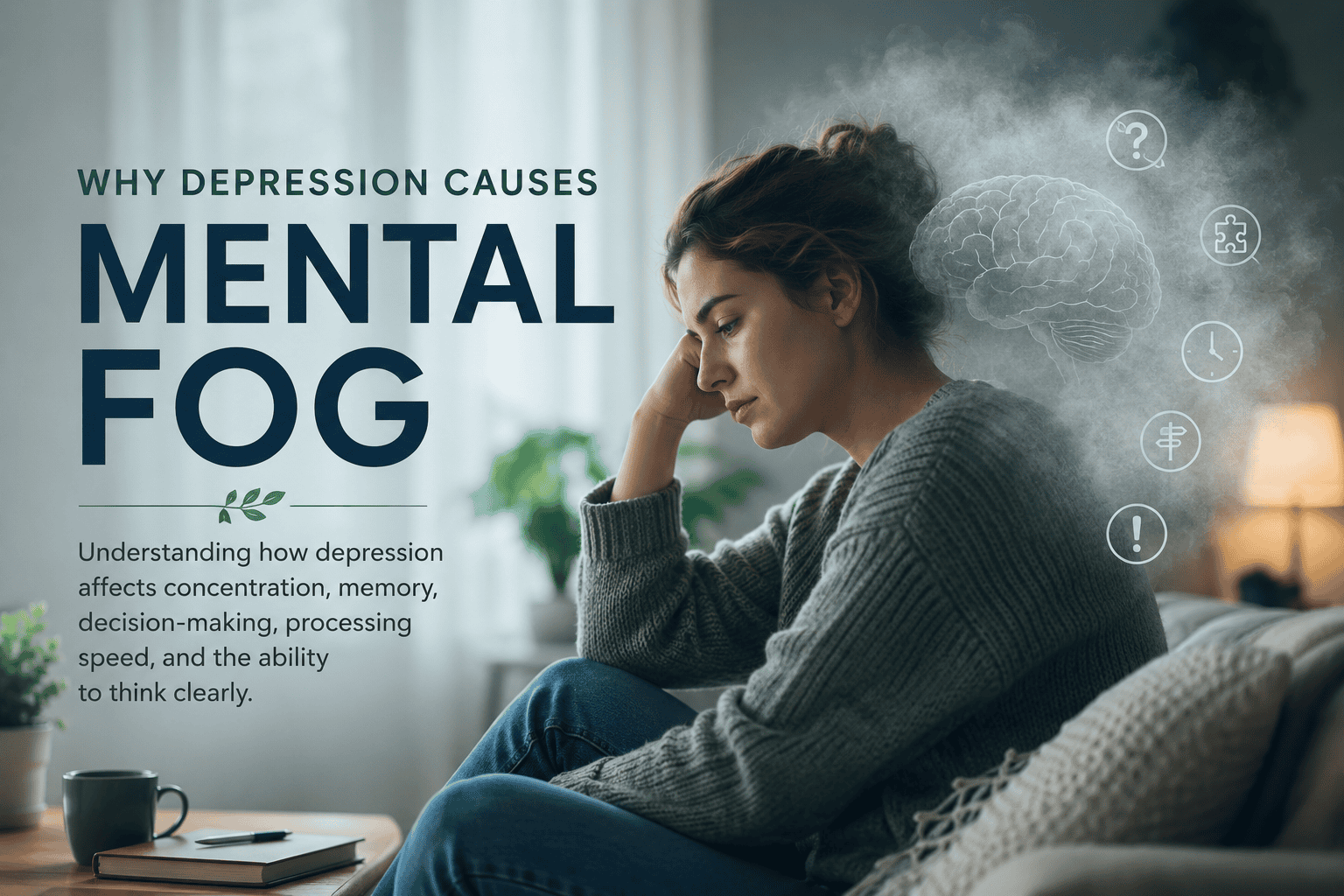
Why Depression Causes Mental Fog

Depression can affect concentration, memory, decision-making, processing speed, motivation, and the ability to think clearly. This guide explains why mental fog can happen with depression, what it may feel like, and how counseling can help people understand and manage the pattern.

Start Here

Mental Fog With Depression Is Real

Depression is often described as sadness, hopelessness, low motivation, or emotional heaviness. But for many people, one of the most frustrating symptoms is mental fog. It may feel harder to focus, remember details, organize thoughts, make decisions, follow conversations, or complete tasks that used to feel manageable.

This does not mean someone is lazy, careless, unintelligent, or not trying hard enough. Depression can affect the way the brain processes information, manages attention, uses energy, responds to stress, and makes decisions. When emotional pain and mental fatigue are high, thinking clearly can become much harder.

What Is Mental Fog in Depression?

Mental fog in depression refers to difficulty thinking clearly, focusing, remembering information, making decisions, processing information quickly, or staying mentally organized. It may feel like the mind is slowed down, cloudy, overloaded, disconnected, or harder to access.

What It Feels Like

What Depression-Related Mental Fog Can Feel Like

Mental fog can affect daily functioning in quiet but significant ways. Some people notice it at work or school, while others notice it in conversations, parenting, household tasks, relationships, or simple everyday decisions.

Cloudy Thinking

Your thoughts may feel slow, unclear, scattered, or harder to organize than usual.

Poor Concentration

Reading, working, listening, or finishing tasks may require more effort and feel easier to lose.

Memory Gaps

You may forget appointments, lose track of details, repeat questions, or struggle to recall information.

Decision Fatigue

Even small choices may feel overwhelming, stressful, or harder than they should.

Slower Processing

It may take longer to understand information, respond to questions, or move from one task to another.

Mental Exhaustion

Thinking itself may feel tiring, especially when depression is also affecting sleep, motivation, and energy.

Why It Happens

Why Depression Can Make Thinking Feel Harder

Depression affects more than mood. It can influence attention, motivation, sleep, energy, stress response, self-talk, and the ability to mentally organize information. When the brain is managing emotional heaviness, fatigue, worry, guilt, shame, or hopelessness, there may be less mental capacity available for focus and problem-solving.

Mental fog can also become worse when depression disrupts sleep, reduces activity, increases isolation, or creates a cycle of self-criticism. The person may notice they are not functioning like themselves, then feel guilty or discouraged, which can make concentration and motivation even harder.

Depression may affect thinking by contributing to:

  • Low mental energy
  • Reduced motivation and initiation
  • Sleep disruption or oversleeping
  • Negative self-talk and rumination
  • Difficulty filtering distractions
  • Slowed information processing
  • Stress, anxiety, or emotional overload
  • Reduced confidence in decisions

Mental fog is often one part of the depression picture. It can improve as depression symptoms are addressed, daily structure increases, sleep becomes steadier, and support systems become stronger.

Concentration

Depression Can Make It Hard to Stay Focused

Concentration requires mental energy, emotional availability, and the ability to filter distractions. Depression can interfere with all three. A person may read the same paragraph repeatedly, start tasks but not finish them, lose track of conversations, or feel unable to stay mentally present.

  • Work tasks may take longer.
  • School assignments may feel harder to start.
  • Conversations may feel difficult to follow.
  • Household responsibilities may feel mentally overwhelming.

Important Reframe

Trouble Focusing Is Not a Character Flaw

When depression affects concentration, people may blame themselves for being unproductive, irresponsible, or unmotivated. In reality, the brain may be operating with less available energy and more emotional load than usual.

  • Difficulty focusing does not mean you are not trying.
  • Low productivity does not mean you are lazy.
  • Needing smaller steps does not mean you are failing.
  • Support can help make tasks feel more manageable.

One helpful goal is to reduce shame around concentration problems. When the symptom is understood clearly, it becomes easier to build realistic strategies instead of relying on self-criticism.

Memory

Why Depression Can Affect Memory

Depression can make memory feel unreliable. Someone may forget what they planned to do, lose track of where they placed things, miss details from conversations, or struggle to recall information when they need it. This can be especially frustrating for people who are usually organized or high functioning.

Memory problems during depression may be connected to attention. If the brain is tired, distracted, emotionally overwhelmed, or focused on negative thoughts, information may not be fully encoded in the first place. Later, the person may feel like their memory is failing when the problem began with reduced attention and mental availability.

Depression-related memory issues may include:

  • Forgetting appointments or tasks
  • Misplacing items more often
  • Difficulty remembering details from conversations
  • Needing repeated reminders
  • Feeling mentally disorganized
  • Struggling to recall words, plans, or next steps

If memory changes are sudden, severe, worsening, or medically concerning, it is important to consult a medical provider. Counseling can support depression-related patterns, but medical causes should be evaluated when appropriate.

Decision-Making

Depression Can Make Decisions Feel Overwhelming

Decision-making requires energy, confidence, flexibility, and the ability to imagine possible outcomes. Depression can make even ordinary choices feel heavy. A person may second-guess themselves, avoid decisions, feel paralyzed, or worry that they will make the wrong choice.

This can happen with major life decisions, but it can also happen with simple choices such as what to eat, what task to start, whether to return a message, or how to organize the day. When depression is present, the brain may experience choices as pressure rather than as manageable steps.

Decision fatigue may look like:

  • Putting off choices because they feel too hard
  • Feeling stuck between options
  • Needing reassurance before deciding
  • Feeling guilty no matter what you choose
  • Overthinking small decisions
  • Avoiding tasks that require planning or prioritizing

Therapy can help clients reduce decision pressure, identify realistic next steps, and separate depression-driven thoughts from values-based choices.

Processing Speed

Depression Can Make the Mind Feel Slowed Down

Some people describe depression-related mental fog as feeling like their mind is moving through mud. It may take longer to respond, understand information, switch tasks, complete work, or find the right words. This can feel embarrassing or discouraging, especially when others do not understand what is happening internally.

Slower processing can be connected to low energy, disrupted sleep, emotional overload, stress, medication effects, grief, anxiety, trauma, or the depressive episode itself. The person may still be capable and intelligent, but their access to mental clarity may feel reduced.

Slowed thinking may include:

  • Taking longer to answer questions
  • Difficulty switching between tasks
  • Feeling mentally delayed or disconnected
  • Struggling to organize information quickly
  • Finding it harder to problem-solve
  • Feeling exhausted after mentally demanding tasks

When processing speed is affected by depression, pacing matters. Smaller steps, fewer competing demands, realistic expectations, and support can help reduce overwhelm.

An Educational Framework

The Depression-Fog Cycle

Mental fog can become self-reinforcing. Understanding the cycle can reduce shame and help identify where support and change can begin.

1. Depression Lowers Mental Energy

Mood, sleep, motivation, and emotional weight reduce the brain’s available capacity.

2. Focus Becomes Harder

Tasks, conversations, planning, reading, and follow-through may require more effort.

3. Responsibilities Pile Up

Unfinished tasks can create more stress, guilt, pressure, and discouragement.

4. Self-Criticism Increases

The person may think, “What is wrong with me?” or “I should be able to do this.”

5. Energy Drops Further

Shame, stress, and overwhelm can make the fog feel even heavier.

6. The Pattern Repeats

Depression, mental fog, avoidance, and guilt can reinforce one another.

Breaking the cycle often begins with compassion, structure, realistic expectations, support, and small steps that reduce overwhelm rather than increase shame.

What Helps

What Can Help Mental Fog From Depression

Depression-related mental fog often improves through a combination of emotional support, symptom treatment, daily structure, realistic pacing, sleep support, self-compassion, and practical strategies for memory, focus, and decision-making.

Use Smaller Steps

Break tasks into very small actions so the brain does not have to hold too much at once.

Create External Structure

Calendars, reminders, lists, routines, and visual cues can reduce the burden on memory.

Lower Decision Pressure

Simplifying choices and planning ahead can reduce decision fatigue.

Support Sleep

Depression and sleep problems often affect each other. Improving sleep rhythm may help mental clarity.

Reduce Shame

Self-criticism can worsen depression. Compassionate accountability is often more effective than blame.

Seek Support

Therapy can help address depression symptoms, thought patterns, stress, grief, trauma, and daily functioning.

When to Seek Help

When to Seek Counseling for Depression and Mental Fog

It may be time to seek counseling when mental fog is interfering with work, school, relationships, parenting, household responsibilities, emotional regulation, sleep, motivation, or daily functioning. Therapy can help you understand what is happening and begin building support around both the emotional and cognitive effects of depression.

Consider counseling if you notice:

  • You feel mentally foggy, slowed down, or disconnected
  • You are forgetting tasks, appointments, or important details
  • Simple decisions feel overwhelming
  • You are struggling to concentrate at work, school, or home
  • You feel guilty, ashamed, or frustrated about productivity
  • You feel emotionally numb, hopeless, tearful, or withdrawn
  • Your sleep, appetite, motivation, or relationships have changed

If depression includes thoughts of death, self-harm, or suicide, seek immediate support. In the United States, call or text 988 for the Suicide & Crisis Lifeline, call 911, or go to the nearest emergency room.

Depression Counseling at Motivations Counseling

Therapy Can Help When Depression Makes Thinking Feel Hard

Motivations Counseling provides depression counseling for adults experiencing low mood, loss of motivation, emotional heaviness, mental fog, concentration problems, low energy, sleep changes, grief, stress, anxiety, trauma-related symptoms, and difficulty functioning.

Our counseling team serves clients in Sugar Land, Katy, Richmond, Fort Bend County, West Houston, and through telehealth across Texas when clinically appropriate.

Counseling Support

Depression Counseling in Sugar Land, Katy, and Online Across Texas

If depression has made your thinking feel foggy, slow, scattered, or harder to trust, counseling can help you understand the pattern and begin taking manageable next steps.

  • Individual counseling for depression and emotional overwhelm
  • Support for low motivation, mental fog, and concentration problems
  • Help with shame, self-criticism, avoidance, and daily functioning
  • Trauma-informed counseling when depression connects to painful experiences
  • In-person options in Sugar Land and Katy when available
  • Telehealth counseling across Texas when clinically appropriate
Call or Text: (281) 858-3001

Frequently Asked Questions

Common Questions About Depression and Mental Fog

Can depression cause mental fog?

Yes. Depression can affect concentration, memory, processing speed, motivation, decision-making, and the ability to think clearly.

Why does depression make it hard to focus?

Depression can reduce mental energy, increase emotional overload, disrupt sleep, and make it harder for the brain to filter distractions or stay engaged with tasks.

Can depression affect memory?

Depression can affect memory, especially when attention, sleep, stress, and emotional energy are also disrupted. Some people forget details because information was not fully absorbed in the first place.

Why do simple decisions feel hard when I am depressed?

Depression can lower energy and confidence, increase self-doubt, and make choices feel heavier. Even small decisions may feel overwhelming when the brain is already overloaded.

Does mental fog mean something is wrong with my intelligence?

No. Mental fog does not mean someone is unintelligent. It often reflects the effect depression has on energy, attention, processing, motivation, and emotional capacity.

Can therapy help with depression-related mental fog?

Therapy can help by addressing depression symptoms, self-criticism, avoidance, stress, grief, trauma, daily structure, and practical coping strategies that support clearer functioning.

Should I see a doctor for mental fog?

If mental fog is sudden, severe, worsening, or accompanied by concerning medical symptoms, it is important to consult a medical provider. Mental fog can have emotional, medical, sleep-related, medication-related, or other causes.

When should I seek counseling for depression?

Consider counseling when depression, low motivation, mental fog, sleep changes, hopelessness, emotional numbness, or difficulty functioning interferes with daily life, work, school, relationships, or your ability to care for yourself.

Susan Baker, M.Ed., NCC, LPC-S, Licensed Professional Counselor Supervisor in Texas

Article Author

Written by a Licensed Texas Mental Health Professional

This article was written for Motivations Counseling by Susan Baker, M.Ed., NCC, LPC-S, a Texas Licensed Professional Counselor Supervisor and clinical leader at Motivations Counseling.

Susan Baker, M.Ed., NCC, LPC-S
Texas Licensed Professional Counselor Supervisor
EMDR Therapist & EMDRIA Member
Texas LPC License #73957

Susan Baker is the Clinical Director of Motivations Counseling and provides trauma-informed counseling, EMDR therapy, anxiety treatment, depression counseling, couples counseling, immigration psychological evaluations, and mental health assessment services. Motivations Counseling serves clients from offices in Sugar Land and Katy, Texas, with telehealth services available statewide for Texas residents.

Take the Next Step

Depression Counseling in Sugar Land, Katy, and Online Across Texas

If depression has made your thinking feel foggy, slow, scattered, or harder to trust, counseling can help you understand what is happening and begin taking manageable next steps.

×

Emotional Support Animal Letters in Texas: What You Need to Know

ESA Learning Center

Emotional Support Animal Letters in Texas: What You Need to Know

Emotional support animal letters can be confusing because there is so much misinformation online about ESA registration, instant letters, housing rights, and what a licensed mental health professional actually evaluates. This guide explains how ESA documentation works in Texas, what an ESA letter can and cannot do, and what to consider before seeking an evaluation.

Start Here

ESA Documentation Is a Clinical Recommendation, Not a Pet Registration

An emotional support animal letter is documentation from a licensed mental health professional stating that an emotional support animal may be clinically appropriate for a person with a mental health condition. It is not the same as registering a pet, buying a certificate, or obtaining a service dog credential.

A legitimate ESA letter should be based on a clinical evaluation. The evaluator considers symptoms, functioning, mental health needs, and whether the animal appears to provide therapeutic benefit related to the individual’s emotional or psychological condition.

View ESA Service Page

What Is an Emotional Support Animal?

An ESA Provides Emotional or Therapeutic Support Through Its Presence

An emotional support animal is an animal that may help reduce symptoms or provide emotional support for someone with a mental health condition. For some people, the presence of an animal may help with anxiety, depression, trauma-related symptoms, panic, emotional regulation, loneliness, or stress-related difficulties.

Emotional support animals are different from service animals. A service animal is trained to perform specific tasks for a person with a disability. An ESA does not need specialized task training in the same way. Instead, the therapeutic benefit usually comes from the animal’s presence, companionship, routine, grounding effect, or emotional support.

Emotional support animals may be clinically meaningful for some individuals, but ESA documentation should be based on an actual mental health evaluation rather than a quick online purchase or generic certificate.

An ESA may provide support by helping with:

  • Reducing feelings of loneliness or emotional isolation
  • Providing routine, comfort, and companionship
  • Helping with grounding during anxiety or trauma-related distress
  • Supporting emotional regulation during periods of stress
  • Encouraging daily structure, care, and responsibility

How ESA Letters Work

A Letter Should Come After a Clinical Evaluation

ESA documentation should reflect a licensed professional’s clinical judgment, not a guaranteed transaction.

Clinical Evaluation

A licensed professional reviews the individual’s mental health history, current symptoms, and treatment-related needs.

Mental Health Assessment

The evaluation considers emotional symptoms, functional limitations, and whether the animal may help alleviate symptoms.

Clinical Determination

Documentation is provided only when the clinician determines that an ESA recommendation is clinically appropriate.

Documentation

If clinically justified, the provider may issue ESA documentation that can be used as part of a housing accommodation request.

Ethical Standards

A legitimate ESA process avoids guarantees, fake registries, and documentation that is issued without clinical review.

Follow-Up Support

When authorized and appropriate, a provider’s office may clarify documentation while protecting client confidentiality.

Who May Qualify?

Qualification Depends on Clinical Factors, Not Just Wanting to Keep a Pet

A person may potentially qualify for ESA documentation when they have a mental health condition and the emotional support animal helps alleviate symptoms or supports functioning in a clinically meaningful way. The decision is not based only on loving an animal or wanting to avoid pet fees.

The clinical question is whether the animal provides emotional or therapeutic support connected to the person’s mental health needs. A clinician may consider diagnosis, symptoms, daily functioning, emotional distress, treatment history, and the role the animal plays in helping the person manage symptoms.

Clinical concerns that may be considered include:

  • Anxiety-related symptoms
  • Depression or mood-related symptoms
  • Trauma-related symptoms or PTSD
  • Panic symptoms
  • Emotional regulation difficulties
  • Other mental health concerns that substantially affect functioning

A diagnosis alone does not automatically mean ESA documentation is appropriate. The evaluator also considers functional limitations and whether the animal helps alleviate symptoms in a clinically relevant way.

Housing Accommodation Requests

ESA Letters Are Often Used for Housing Accommodation Requests

Many people seek ESA documentation because they live in housing with pet restrictions, pet rent, breed limitations, or other animal-related policies. ESA documentation may support a reasonable accommodation request when the individual has a qualifying mental health condition and the animal helps alleviate symptoms.

However, an ESA letter does not force automatic approval. Housing providers may review documentation, request clarification in appropriate situations, and make accommodation decisions based on applicable laws, policies, and facts.

Important Clarification

No Therapist Can Guarantee Housing Approval

ESA documentation is a clinical recommendation. It does not guarantee that a landlord, property manager, university housing office, or other housing provider will approve a request.

  • ESA documentation is not pet registration.
  • There is no official national ESA registry.
  • Housing providers may review documentation.
  • Accommodation decisions are made by the housing provider.
  • Documentation should be issued only when clinically appropriate.

Common Misconceptions

ESA Myths Can Lead People Toward Bad Information

Many websites sell certificates, ID cards, or instant letters that may look official but do not replace a clinical evaluation.

Myth: ESAs Must Be Registered

There is no official national emotional support animal registry. Registration websites do not determine whether an ESA is clinically appropriate.

Myth: ESA Letters Are Guaranteed

A legitimate provider should not guarantee documentation before completing a clinical evaluation.

Myth: ESAs Are Service Dogs

Emotional support animals and service animals are different. Service animals are trained to perform specific disability-related tasks.

Reality: Evaluation Matters

ESA documentation should be based on symptoms, functioning, treatment needs, and the clinical role of the animal.

Reality: Housing Rules Differ

Housing accommodations are different from airline policies, public access rules, and ordinary pet policies.

Reality: Ethics Matter

A careful ESA process protects the client, the clinician, and the credibility of legitimate mental health documentation.

Choosing an Evaluator

Choose a Licensed Professional Who Takes the Evaluation Seriously

Because ESA documentation can affect housing accommodation requests, it is important to work with a licensed mental health professional who understands the difference between ethical clinical documentation and quick online letter sales.

A qualified evaluator should complete an actual assessment, explain that documentation is not guaranteed, and avoid making promises about housing approval. The process should focus on mental health needs rather than simply producing a letter.

Licensed Professional

Look for a licensed mental health professional who is legally and clinically qualified to evaluate mental health concerns.

Real Evaluation Process

The provider should gather clinical information and assess whether an ESA recommendation is appropriate.

Avoid Instant-Letter Claims

Be cautious of websites that promise instant approval, registration, certification, or guaranteed acceptance.

ESA Evaluations at Motivations Counseling

Texas ESA Evaluations Through a Licensed Counseling Practice

Motivations Counseling provides emotional support animal evaluations for Texas residents. Evaluations may be completed through secure telehealth when clinically appropriate, with in-person services available through our Sugar Land and Katy-area counseling practice when scheduling allows.

Our process is designed to be clear, ethical, and clinically grounded. Documentation is provided only when the evaluator determines that an ESA recommendation is clinically appropriate based on the evaluation.

Clinical ESA Evaluation

Schedule an ESA Evaluation in Texas

The ESA evaluation fee is currently $99. If you qualify and ESA documentation is clinically appropriate, there is no additional charge for the letter.

  • Licensed Texas mental health professionals
  • Telehealth available statewide for Texas residents
  • Same-day options may be available when scheduling allows
  • Documentation provided only when clinically appropriate

ESA Learning Center

Continue Learning About ESA Letters, Housing, and Mental Health Support

These related resources can help you better understand emotional support animal documentation, housing accommodation requests, and when an ESA evaluation may be clinically appropriate.

Texas Emotional Support Animal Laws Explained

Learn how ESA documentation may relate to housing accommodation requests and what Texas residents should understand.

Read article →

Can a Landlord Deny an Emotional Support Animal?

Understand common reasons housing providers may review, question, or deny an ESA accommodation request.

Read article →

ESA Letter vs Service Dog

Learn the difference between emotional support animals, service animals, public access, and housing documentation.

Read article →

Can Anxiety Qualify for an Emotional Support Animal?

Explore how anxiety symptoms, functional limitations, and clinical need may be considered during an ESA evaluation.

Read article →

What Documentation Can a Landlord Request?

Review what housing providers may commonly ask for when reviewing an ESA accommodation request.

Read article →

How ESA Evaluations Work

Learn what to expect during an emotional support animal evaluation with a licensed mental health professional.

Coming soon →

How to Choose a Qualified ESA Evaluator

Learn what to look for when choosing a licensed professional for an emotional support animal evaluation.

Coming soon →

Is an Online ESA Letter Legitimate?

Understand the difference between telehealth-based clinical evaluations and websites that sell instant letters.

Coming soon →

Beware of Instant ESA Letter Websites

Learn why instant approvals, fake registries, and guaranteed documentation can create problems for clients.

Coming soon →

Emotional Support Animal Resource Center

Browse our complete library of emotional support animal articles, FAQs, and practical resources covering housing, Texas laws, landlord requests, evaluations, and more.

Explore Resource Center →

Featured Page

The Complete Emotional Support Animal Guide

Looking for the complete picture? Our clinician-written guide explains emotional support animal evaluations, ESA letters, Texas housing accommodations, landlord documentation, eligibility, service animal differences, and answers to the most common questions about Emotional Support Animals.

Who Qualifies? ESA Letters Texas Housing Landlord Questions Clinical Evaluations Common Myths

Frequently Asked Questions

Common Questions About Emotional Support Animal Letters in Texas

Is an ESA the same as a service dog?

No. A service dog is trained to perform specific tasks for a person with a disability. An emotional support animal provides emotional or therapeutic support through its presence and relationship with the individual, but it is not the same as a service animal.

Do emotional support animals need to be registered?

No. There is no official national ESA registry. Websites that sell registrations, certificates, ID cards, or vests do not replace a clinical evaluation from a licensed mental health professional.

Can anxiety qualify for an emotional support animal?

Anxiety may be considered during an ESA evaluation when symptoms substantially affect functioning and the animal helps alleviate symptoms in a clinically meaningful way. Qualification depends on the individual evaluation.

Can a landlord deny an emotional support animal?

Housing providers may review accommodation requests and documentation. An ESA letter may support a request, but it does not guarantee approval. Housing decisions depend on applicable laws, documentation, and the specific circumstances.

Are ESA letters guaranteed?

No. ESA documentation should not be guaranteed before an evaluation. A licensed clinician may provide documentation only when it is clinically appropriate based on the assessment.

How much does an ESA evaluation cost at Motivations Counseling?

Motivations Counseling currently offers ESA clinical evaluations for $99. If the evaluator determines that ESA documentation is clinically appropriate, there is no additional charge for the letter.

Can the evaluation be completed online?

In many cases, ESA evaluations may be completed through secure telehealth for Texas residents when clinically appropriate. Some situations may require additional clinical follow-up before documentation can be issued.

Susan Baker, M.Ed., NCC, LPC-S

Article Author

Written by a Licensed Texas Mental Health Professional

This article was written for Motivations Counseling by Susan Baker, M.Ed., NCC, LPC-S, a Texas Licensed Professional Counselor Supervisor and clinical leader at Motivations Counseling.

Susan Baker, M.Ed., NCC, LPC-S
Texas Licensed Professional Counselor Supervisor
EMDR Therapist & EMDRIA Member
Texas LPC License #73957

Susan Baker is the Clinical Director of Motivations Counseling and provides trauma-informed counseling, EMDR therapy, depression counseling, anxiety treatment, emotional support animal evaluations, and mental health assessment services. Motivations Counseling serves clients from offices in Sugar Land and Katy, Texas, with telehealth services available statewide for Texas residents.

Start Your ESA Evaluation

Schedule an Emotional Support Animal Evaluation in Texas

If you are seeking ESA documentation, Motivations Counseling can help you complete a clinical evaluation and determine whether an emotional support animal recommendation may be appropriate. Evaluations are available for Texas residents through telehealth and through our Sugar Land and Katy-area counseling practice when scheduling allows.

×

Understanding Extreme Hardship in Immigration Psychological Evaluations

Attorney Resource Guide

Understanding Extreme Hardship in Immigration Psychological Evaluations

In hardship-related immigration matters, attorneys often need more than a general statement that a family would suffer. A clinically strong psychological evaluation documents how separation, relocation, medical vulnerability, caregiving responsibilities, psychological symptoms, and family disruption may affect a qualifying relative’s emotional functioning and daily life.

Why This Matters for Attorneys

Hardship Evaluations Are Stronger When They Explain Clinical Impact, Not Just Emotional Pain

Extreme hardship cases often involve deeply personal family circumstances: separation from a spouse or parent, children with emotional or educational needs, medical vulnerability, financial instability, fear of relocation, caregiving burdens, trauma history, depression, anxiety, and uncertainty about the future.

A weak hardship report may simply state that a qualifying relative would be sad, anxious, or overwhelmed. A stronger report explains how the stressor affects psychological functioning: sleep, concentration, parenting, caregiving, medical follow-through, work stability, emotional regulation, relationships, and ability to cope.

Attorneys remain responsible for legal strategy and hardship arguments. The evaluator’s role is to provide clinically grounded documentation of symptoms, impairment, family dynamics, psychological risk factors, and treatment needs.

Clinical Scope

Extreme Hardship Is a Legal Concept; Psychological Impact Is Clinical

A psychological evaluator should not decide whether the legal standard has been met. The evaluator documents mental health findings that attorneys may consider within the larger case.

Issue Attorney Role Evaluator Role
Legal standard Analyzes statutory requirements, legal arguments, and case strategy. Does not determine eligibility or state that the legal hardship standard has been met.
Hardship theory Identifies how facts should be presented within the legal framework. Documents emotional, psychological, relational, medical, and functional impact within clinical scope.
Evidence organization Determines how declarations, records, and reports support the legal case. Reviews relevant information when available and integrates clinically meaningful context.
Recommendations Uses clinical findings as appropriate in the legal submission. Provides mental health treatment recommendations, supports, and risk considerations when clinically appropriate.

Core Hardship Factors

What a Clinically Strong Hardship Evaluation May Address

Strong evaluations look at how multiple hardship factors interact rather than treating each concern as isolated.

Emotional Hardship

The report may document sadness, grief, fear, guilt, emotional overwhelm, irritability, panic, hopelessness, or difficulty coping with possible separation or relocation.

Psychological Symptoms

Evaluations may address anxiety, depression, trauma symptoms, sleep disruption, panic attacks, intrusive worry, concentration problems, emotional dysregulation, or worsening mental health history.

Medical Vulnerability

Medical issues may intensify psychological hardship when the qualifying relative depends on emotional support, transportation, medication management, treatment access, or caregiving stability.

Caregiving Responsibilities

Hardship may involve children, elderly parents, disabled relatives, medically vulnerable family members, or others who rely on the client’s practical, financial, or emotional support.

Children and School Functioning

When children are involved, evaluations may document attachment disruption, academic stress, behavioral changes, special education needs, emotional symptoms, or developmental vulnerability.

Relocation Stress

Possible relocation may involve safety concerns, language barriers, loss of medical care, education disruption, reduced support systems, financial instability, or cultural adjustment stress.

Two Common Scenarios

Separation Hardship vs. Relocation Hardship

Attorneys often need documentation that distinguishes the psychological impact of remaining in the United States without the applicant from the impact of relocating abroad with the applicant.

Scenario Clinical Issues Often Explored Functional Impact to Document
Separation Anxiety, depression, grief, panic, sleep disturbance, attachment disruption, parenting strain, caregiving burden, fear about family stability, and worsening prior mental health symptoms. Reduced work functioning, impaired parenting, difficulty managing children’s needs, reduced medical follow-through, emotional instability, social withdrawal, and impaired concentration.
Relocation Fear about safety, language barriers, loss of treatment access, financial instability, education disruption, medical concerns, isolation, trauma triggers, and loss of established support systems. Disruption in treatment, reduced stability, difficulty accessing care, increased anxiety, loss of employment, educational setbacks, isolation, and impaired ability to cope.

Functional Impairment

Hardship Documentation Should Explain How Daily Life Is Affected

A strong hardship evaluation does not stop at feelings. It explains how symptoms change the person’s ability to function in concrete areas of life.

Clinical Depth

Functional Impact Is Often the Difference Between a Generic Report and a Useful One

Attorneys may already have declarations describing love, fear, and family hardship. The clinical report adds value when it explains how those stressors affect mental health, behavior, caregiving capacity, medical stability, and daily functioning.

This is where a psychological evaluation becomes more than a sympathy statement.

Parenting and caregiving How symptoms may affect patience, consistency, supervision, emotional availability, or ability to manage children’s needs.
Work and concentration How anxiety, depression, poor sleep, or intrusive worry may affect focus, productivity, attendance, or decision-making.
Medical follow-through How emotional instability may affect treatment compliance, transportation, appointments, medication routines, or health management.
Daily emotional regulation How hardship stress may affect irritability, tearfulness, panic, withdrawal, sleep, appetite, motivation, or ability to cope.

Report Documentation

What a Strong Hardship Evaluation Report May Include

The strongest reports are structured, specific, clinically grounded, and careful about the boundary between psychological findings and legal conclusions.

Clear referral context

The report should identify the type of immigration matter, the referral question, the qualifying relative relationship when relevant, and the clinical purpose of the evaluation.

Psychosocial and family history

The evaluation should describe family roles, dependency patterns, caregiving responsibilities, emotional bonds, child-related concerns, medical issues, and support systems.

Clinical symptoms and diagnostic impressions

A strong report documents symptoms such as anxiety, depression, panic, trauma-related distress, sleep disturbance, grief, irritability, and functional impairment, with diagnoses when clinically supported.

Assessment results when appropriate

Screening tools may support findings related to depression, anxiety, trauma symptoms, emotional distress, or functional impairment, but should be interpreted alongside interview findings and clinical observations.

Treatment recommendations

Recommendations may include individual therapy, trauma-informed treatment, EMDR when clinically appropriate, psychiatric consultation, family support, medical follow-up, or stress-management planning.

Attorney Value

What Makes a Hardship Evaluation More Useful to Attorneys?

A strong report gives attorneys clinically specific material rather than general statements of distress.

Specific Examples

The report should include examples of how hardship affects daily functioning, not simply state that the qualifying relative is worried or sad.

Connection Between Facts and Symptoms

Strong reports connect hardship stressors to symptoms, impairment, risk factors, family dynamics, and treatment needs in a clinically coherent way.

Clinical Restraint

The evaluator should avoid stating legal conclusions, predicting legal outcomes, or using advocacy language that exceeds the mental health role.

Important Boundary

A Psychological Evaluation Does Not Replace Attorney Strategy

The evaluator documents clinical findings. The attorney determines legal relevance, prepares the case strategy, and decides how the psychological evaluation fits with declarations, medical records, country conditions, financial records, school records, affidavits, and other evidence.

This boundary strengthens the report. A clinically strong evaluation is persuasive because it is specific, organized, careful, and grounded in psychological assessment — not because it tries to argue the legal case.

Learning Center

Related Immigration Evaluation Resources

Continue learning about hardship evaluations, clinical findings, trauma documentation, family separation, PTSD symptoms, memory consistency, and attorney referral guidance.

2026 Immigration Psychological Evaluation Clinical Findings Report

Review clinical trends, common symptoms, diagnoses, trauma histories, functional impairments, and hardship factors documented across immigration evaluations.

What Makes a Clinically Strong Immigration Psychological Evaluation?

Learn what makes an immigration evaluation organized, trauma-informed, clinically useful, and appropriate for immigration-related referral questions.

Clinical vs. Legal Opinions in Immigration Evaluations

Understand the boundary between clinical documentation and legal conclusions in immigration psychological evaluations.

The Role of PTSD Documentation in Immigration Cases

Explore how PTSD symptoms, trauma responses, sleep disruption, avoidance, hypervigilance, and impairment may be documented clinically.

How Trauma Can Affect Memory Consistency

Learn how trauma may affect recall, chronology, disclosure patterns, emotional presentation, and perceived consistency.

What Attorneys Should Provide Before an Immigration Psychological Evaluation

Review the records, referral information, deadlines, declarations, and case context that can support a focused evaluation.

The Psychological Impact of Family Separation

Examine how separation may affect children, caregivers, attachment, emotional functioning, stability, and family systems.

Extreme Hardship Psychological Evaluations

Learn more about hardship waiver evaluations involving qualifying relatives, family separation, relocation concerns, and emotional impact.

Immigration Attorney Resource Library

Browse attorney-focused articles about immigration psychological evaluations, clinical documentation, hardship evidence, and referrals.

Attorney Referrals

Need a Hardship Waiver Psychological Evaluation?

Motivations Counseling provides trauma-informed, forensic-style immigration psychological evaluations for hardship waiver matters, qualifying-relative hardship, family separation concerns, relocation stress, and related immigration cases throughout Texas.